In my last blog I talked about the use of the top down construction methodology in the construction of high rise towers. It presents a number of considerable structural challenges which have resulted in a quite unusual and, so I’m told, unique construction sequence on our project. A senior design consultant from Sydney, Australia who is now working in the London structural engineers office confirmed that view of Friday morning when he described the 100BG basement as engineering insanity. Therefore, as it’s a Wednesday and because pictures are far more interesting than my boring text, see below some images outlining current progress.
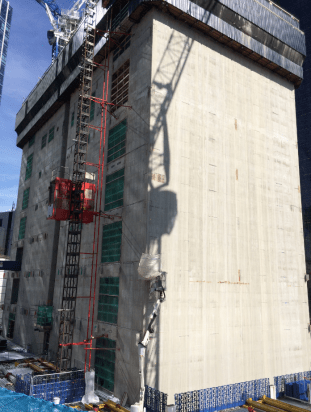
Fig1: The concrete core, allegedly one of the largest currently under construction in Europe, is paused at a temporary hold point on floor 8.
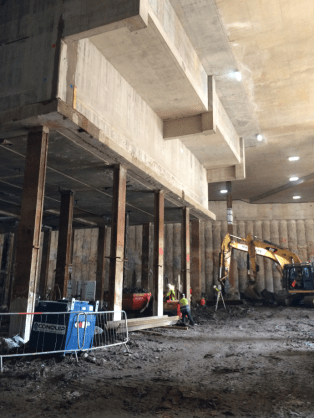
Fig2: The full vertical load of this core is carried through steel plunge columns which are cast 5m into large load bearing concrete piles just below dredge depth. Interestingly we were able to excavate the Tower basement to 2.0m OD from 15.0m OD without use of any temporary internal propping regime.
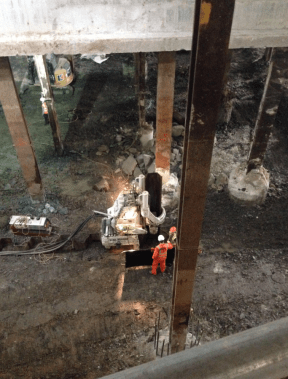
Fig3: Sheet piles have been installed around the edge of the plunge columns to allow further excavation of the core pile cap to a depth of 0.0m OD. The Tosa pushes 6m long steel sheet piles in at a rate of approximately 24 per day. The 4m embedment seems more than sufficient to me considering they are in stiff London clay and are for the temporary condition only.

Fig4: Pile Cap excavated to depth in stiff london clay material. The water table is approximately 6m above dredge depth but ground water has not presented any issue during any stage of this excavation.
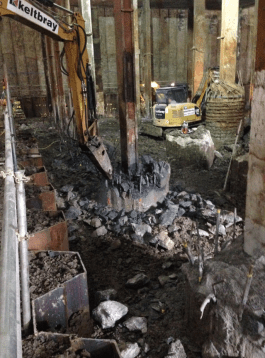
Fig5: Machinery breaking out the top of the core concrete piles in preperation for construction of the core pile cap. In the back right of the image you can see a column where the process of pouring the concrete caused the rebar cage in the column to rise in the pile shaft.
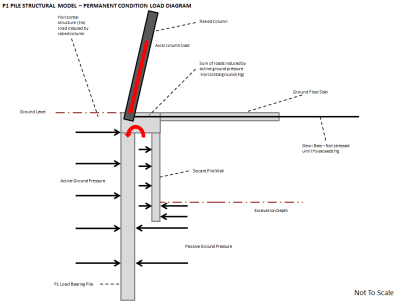
Fig6: Tower secant pile wall restraint
 Holdfast Training Services Trial Blog
Tom,
Nice blog update. You might be in a good position being able to compare Jo’s tower with your tower and their construction methodology: one being top down the other bottom up, seeing as this engineer is in town. I saw a number of completed projects at Arup that were either or. I think as you point out, being able to go 13m without any temporary propping scheme is pretty awesome – I would crudely estimate that is a £200kish saving if not more. Do you think, among a number of factors, there might be a set excavation/basement depth at which point top down becomes economic? Clearly you have the programme advantage of constructing in two directions but with the significant added hassle of de-conflicting activities below and above ground.
What is the Brookfield Multiplex view, (noting a 100 to 40 storey difference between Australia and the UK but essentially towers founded on large piles with a secant wall perimeter) having different construction sequences?
How are you taking into account settlement as the building is constructed? I.e. what is your fixed datum for setting out if the building not does stay still?
Damo,
As you rightly pointed out the Top down approach allows us to construct above and below ground level concurrently. This provides a significant saving on programme duration, initially estimated at around 12 weeks compared to other bids. As the project runs at about 300k per week this adds up to a significant saving, plus it gets the clients tenants into the building and paying rent earlier. I’d suggest the overall financial benefits stretch into the millions when considered over the full project. I would think at least two floors of basement would be required for this to be efficient enough to justify the hassles that accompany top down construction. We did have three major contractors on site all on tight programmes, concrete, steel and excavation. They all want the same crane time, space for storage and priority for deliveries. As a result keeping them all happy on such a constrained site is quite a challenge.
Settlement of the building is a risk that we are mitigating. It turns out that floors at the top of skyscrapers can almost never be flat, who knew! My thesis topic is on the monitoring and mitigation of differential axial shortening in high rise buildings. As a quick response we are surveying the site daily and we will compare the projected results expected in the structure with the actual shortening seen in the steel columns and concrete core as we go up the building.
Wow – I will visit this site if I possibly can. This is the nearest thing to Russian roulette with a big block of concrete I’ve ever seen! The rebar rising up in the pile presumably means that pile no longer has the moment capacity it was designed with thereby pushing this set up nearer to the edge of a toping failure… Fantastic photos – Thanks Tom.
Rich,
I suspect the Structural Engineers would argue that the mitigation of risk through thorough design removes the gambling element of this approach. That said standing under an 8 storey concrete core does seem very odd. The column loads are designed with substantial safety factors applied and we are very wary of overloading them too early. The core hold point at floor 8 ensures the vertical load is all controlled until the pile cap is constructed.
The rising cage does indeed reduce the moment capacity of the pile. When we knew this was an issue an additional design check and non conformance report was completed on the as built state of the pile. Fortunately because the cage was always longer than actually required it passed the scrutiny of the structural engineers.
Tom, excellent article. I have been wondering how you could get the top down method to work. Are the plunge columns only temporary? How do you control the effective length? Do you lock them in as you go down.
You obviously support the wall from the capping beam but do you have ground anchors to keep the wall from snapping or are your piles seriously reinforced. I think the longest span of our wall is 10 m. So would love to know how you got it to work.
Doug,
The plunge columns in the major walls of the core will be cast in concrete as we build up and are therefore permanent. Some of the smaller columns in the centre of the core that are not aligned with structural walls will be cut out once the pile cap is conected to the base of the existing core. The worst case effective length of the column is at its current point, i.e. with the pile cap exposed. Once we have cast the pile cap 3m of this column length is restrained in concrete and therefore Leff reduces. As we built up still further, basement level 1 then restrains these columns, also reducing Leff. It is this staged build process which limits how many stories we can load on top of the core. As a result we cannot go past floor 10 until the pile cap is cast and the column Leff is reduced below. Eventually we will have a complete concrete connection between the base of the current core and pile cap, at this point we will not need to control vertical load through structural hold points.
The secant wall in the tower basement is supported by large load bearing, 60m piles constructed outside the perimeter secant pile wall. John tells me each of these is commonly known as a ‘dead man’. Each large pile supports 9m run of secant pile wall and is connected l by the capping beam. I will load up a free body diagram of a section of wall that I used to analyse this model for TMR1.
Mate, impressive stuff and thank you really clear.
Tom, I think these pictures are brilliant too.
For a simpleton E&Mer, could you very briefly explain the process of completing the pile cap under the core. Will the full weight of the core forever pass through the steel columns or is it to be also supported with some concrete columns to bear some of the load? I’m trying to picture how it would be completed. Thanks, Stu
Stu,
No problem.
1. Currently we have a very big hole (the basement) which is, give or take, 13m deep. In the centre of that hole we have a smaller hole (the pile cap) which is 2m deep. At the base of the pile cap we have exposed the top of the large load bearing concrete piles. The plunge columns protrude out these piles and suspend the concrete core above our heads.
2. Next step is construction of the pile cap. In the pile cap we will construct the reinforcement cage which is 3m deep as it will tie in to the metre deep Basement level 2 (BL2) slab. Due to the volume of concrete required the pile cap will be divided up and cast in four separate pours.
3. Once the pile cap is constructed we will install the BL2 slab. The slab is a metre thick and it ties into the constructed pile cap and secant pile wall through shear keys (steps cut into the secant pile wall). Generally the load path goes through the slab and into the secant pile walls and pile cap. In effect, it hangs between the secant pile wall and pile cap with heave board filling the void between its underside and the clay material. Due to its size the current plan is to cast the BL2 slab in 14 separate pours. Joints will be prepared between the pours to ensure we get a good bond.
4. Once BL2 slab is constructed we build the core walls up to Basement level 1 (BL1) which is at the same level as the underside of our current core . Plunge columns that are aligned with these walls will be cast into this concrete. To ensure we get a reliable bond between the new core walls and the underside of the existing concrete core the last few millimetres of wall will be constructed using very high strength grout rather than concrete. This reduces voids and ensures we get maximum bearing area between the existing core and the new concrete core basement walls. False work decking will be supported off BL2 to allow construction of BL1. Once the decking is in place the re-bar will be fixed and the concrete poured, again in numerous pours over a period of a few weeks.
5. You ask an interesting question reference the load path once the walls are constructed. Currently the load applied has induced elastic strain in the columns, ie they have already shortened elastically. This stress is locked in to the columns indefinitely and will always be carried in those plunge columns cast into the walls. Once we recommence the build above the GF slab the total load will increase further. At this point the steel columns will see additional elastic strain. This additional shortening will cause the core to drop minimally until the point at which the new concrete walls are engaged in bearing. At this point the load is transferred through the concrete walls, which have a much greater surface area than the steel columns, and directly to the pile cap.