Piling by estimation
This slide show lays out the basic process to piling at Paradise.
Piling began in Paradise three weeks ago. The piles are 1200mm bored RC piles working in end bearing. Each pile requires a rock socket length of approximately 6D.
Despite the management issues with the demolition subcontractor being currently 9 weeks behind schedule and still on site, the piling has been going well. The target has been to complete 2.5 piles per day and the pilers are currently hitting around 3 per day.
The estimation that the piling is working on is that of the rock head level (m AOD of the incredibly weak and completely underwhelmingly named “Bromsgrove Sandstone”). The rock head level is required 10 days before the piles are installed and this has been assumed based on previous construction drawings that show the underside of foundation levels. This level effects the overall length of the pile and more importantly the length of the steel reinforcement cages, hence the lead time.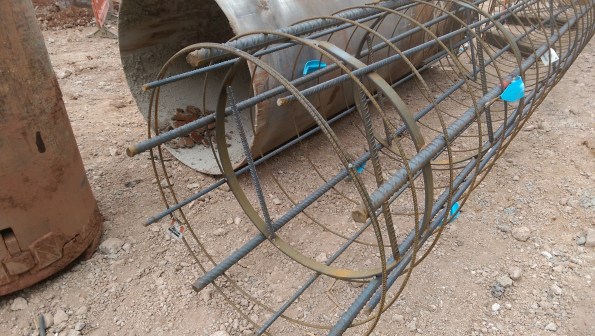
The issue I had yesterday on site was an obstruction encountered below the presumed rock head level. This obstruction appeared to be a concrete slab, possibly blinding, at about 5.5m below piling mat, the rock head should be 4.25m below. A quick inspection of the piling hole identified the sandstone was collapsing above the obstruction and water was trickling in to the base.
The piling designer was contacted and assured everyone that the rock socket length could still be achieved by increasing the depth of the pile, but not the length of the cage, so the bottom 1.25m would have no structural steel. (Revision – due to additional length in the cages the actual length without steel is only 600mm). This pile will be recorded as a non-conformity by the piling sub-contractor and I will advise that further testing be carried out on this pile.
This pile is located in the core of the structure and as such I am now concerned that the surrounding piles will also have a rock head level lower than expected. When we do the surrounding piles (Approx 3 days after that pile in question – Monday) I will be able to get a better idea of what the obstruction is.
 Holdfast Training Services Trial Blog
Thanks Chris.
How many piles do you have gong in? If you’re making progress at an equivalence of 6 days to a five day week is the programme going to move to the left or are there other critical path activities that preclude a gain? Hope today is interesting 🙂
There are 192 piles in total in 5 areas; A, B, C1, C2 and D. Unfortunately we are operating under an AiP process due to the A38 tunnel, anything within a zone of influence requires approvals which are starting to delay works. The demo sub-contractor is also behind schedule (9 weeks) so the pilers are whipping their tails to get them out. This is leading to QC failures and I feel the pilers might actually have nowhere to go after area A. (Nonsensically area B was completed first).
What is the reinforcement cage for ? Unless the piles are tension piles or a heave tension is likely OR the piles have to sustain lateral actions then there is no need for a reinforcement cage
All the piles in this design are either have wind loading causing tension under ULS loading around 1 – 2.5MN or they are subject to eccentricity moments.
There is also lateral loading of vehicle impacts that have been assumed for the piles connected to columns in the car parking areas.
The load cases for each pile were supplied to Cementation Skanska by Carillion’s (our) designer, Ramboll. Cementation then completed the pile design based on assumed rock head levels and the provided forces.