Archive
Arching effect in soils
 Secant wall bending in towards the soil
Those of you that have read my blogs will realise I am having a few issues on site. I have now stopped excavating and have started to build back up. In order to build our stairs we needed to remove an anchor waler. We asked permission from the designers 6 weeks ago, but were ignored. We asked several times more and the designers refused to take our calls. So needing to make progress we sent an ultimatum on Aconex, email and in writing, we would remove the waler on a given date and if they didn’t get back to us then they agreed that it is safe to proceed (for my own sanity I did a free earth model and compared against the wallap analysis for the new case). That date passed and we removed the waler on Friday 19th. The stairs will be built in the next 2 days and will restrain the piles from then.
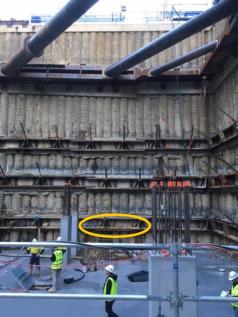
Ground waler removed from wall so stair can be built.
When I inspected the wall after the waler had been removed I expected movement towards the hole. What I found was the wall had actually moved outwards. The wall is buried in low to medium strength phyllite and this is clearly stiffer than the piles so the ground has arched to the remaining ground anchor walers.
I have regularly inspected the wall and there are no signs of cracking or further deformation. The load has moved elsewhere! If you look at the first photo you will see a slight bow inwards of the shotcrete.
Here comes the science:
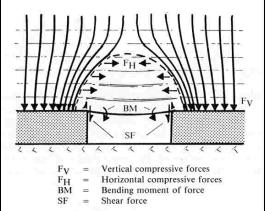
“Arching occurs when there is a difference of the stiffness between the installed structure and the surrounding soil. If the structure is stiffer than the soil then load arches onto the structure. Otherwise, if the structure is less stiff than the soil then load arches away from the structure.
For instance, if part of a rigid support of soil mass yields, the adjoining particles move withrespect to the remainder of the soil mass. This movement is resisted by shearing stresses which reduce the pressure on the yielding portion of the support while increasing the pressure on the adjacent rigid zones. This phenomenon is called the arching effect.”
 Holdfast Training Services Trial Blog