EXCAVATION MADNESS
In my 7.5 months on site I have seen plenty of suspect activities been undertaken by one of the many sub-contractors. In almost every occasion so far the perceived risk to life has been reasonably minimal. In these instances we have had opportunity to discuss the problem with the senior construction team and multiple engineers of varying experience employed by the project.
This morning however, whilst conducting a check of some works on another part of site, I spotted a section of works that concerned me to such a degree that it caused me to cancel everything I was doing in order to have an informed debate (It turned into an argument) with the sub-contractors on-site engineer.
Now I am happy to be wrong, particularly with Geo-technic stuff, but the image below triggered some long archived memories of a JM lecture back in PEW. We effectively have two primary issues that concerned me:
Issue A: Workers operating in a deep unsupported excavation in stiff blue clay. In the worst position the walls were over 2m tall and near vertical. This was compounded by numerous enormous diggers moving around the perimeter providing a particularly unhelpful surcharge.

Issue B: In the background you can see a very, very large stockpile of disturbed excavation material piled up directly adjacent to this work area. This pile must be at least 7m tall and was worryingly close to where the guys were working in the base of the excavation. If that slipped I have no doubt it would end up in the base of the excavation. Given the amount of spoil involved it would take us days to find people under that heap.
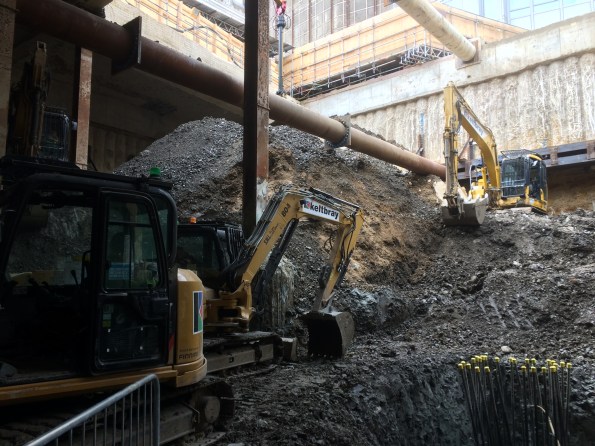
The sub-contractors on site gave me a load of excuses about the stiffness of the clay. I asked them who knew how long it would stand up for, he couldn’t answer. He then told me he was allowed a 1.35m vertical wall (Not sure where that has come from) before it became a problem. I quite quickly pointed out that unless all of his men are unusually short the wall was still well over that limit. I am 185 CMs tall on a good day in my boots (As generously stated on my MOD 90) and it was definitely taller than me.
In the end the answer was simple. It didn’t look right and I knew enough from PEW to have the confidence to stop work until we had some answers. I told them to prove I was wrong and that the excavation was safe in that condition and I would allow them to recommence work. They obviously couldn’t so are now working to make the area safe before anyone else enters the excavation. I also got the temporary works engineer to confirm he agreed with me and funnily enough he did. In summary, when programme comes under pressure expect sub-contractors to cut corners. Alarming but true.
 Holdfast Training Services Trial Blog
Nice work Tom. We often see the “prove it” approach on site but normally I’m on the opposite side to the Temp Works department. I wonder how many people walked by thinking it wasn’t their problem?
Out of interest was there an opportunity for someone to spot this sooner? Did their RAMS mention where and how they would stockpile the excavated material?
Tom, I assume that the sub-contractor didn’t get to this stage overnight? Was the site being checked/ inspected regularly.
Here any exposed face needs a daily check sheet that confirms the a slope or excavation isn’t showing signs of failure. Whether this check is carried out as rigorously as it should be is another matter entirely.
Additionally I thought its worth mentioning, the guys on this site will naturally default all slopes to 40 degrees and automatically call it a ‘safe batter’ whether it is or not. They have learned this over time when most designs state that slopes cant exceed 40 degrees.
So long term or short term…. let’s say this is short term
So fine grained or coarse grained- let’s say this is coarse grained
The theoretical drained (long term ) angle on a slope with no surcharge is 45+ phi/2 to the horizontal
Slap some FoS on that and that’s where Jonny gets ihis 40 degrees (or so)
But is the material in fine grained then it has a long term and short term beahviour
In the short term the slope is unloaded the pwp goes down and the effective stress goes up and it is possible ( with no FoS) to prove that a vertical face of height 2cu/gamma is possible
In a proven fine grained face excavation I specify an 85 degree batter ( may be arrived at using benches) and insist that the batter is covered to :
a) reduce the rate of pwp change
b) to catch head bang blocks which might fall out
But I am always vigilant on how long the excavation is open; I don’t allow surcharge without benching
Now if the material is excavated spoil , we are in dangerous territory . Tricky. The act of excavating remoulds the spoil. In theory the strength can go to a phi of 15 degrees or so – you just don’t know. If there is surcharge AND water can access then you really are taking chances.
It is a perennial problem in top down working
All in all a picture for my ….if Tom can spot this then…..you know the abuse that follows…collection
As the chaps have said…Good job!
Their RAMS does control the method and procedure for stockpiling material on site. Unfortunately the grab that was pulling the material out of the hole to limit it getting beyond this point broke over the weekend. Rather than stop work and delay programme the subbie continued to pile it up hoping the grab would get fixed quickly enough to regain control of the stockpile. It didnt and they didn’t.
I spotted this at approx 0815 on Monday morning so this issue had started over the weekend when on site supervision was reduced. That said, they have five machnies working in a small space and therefore the condition of the excavation can change incredibly quickly once they are going. Turn your back for an hour and chances are the site has changed drastically. Unfortunately the subbie doesn’t appear prepared to slow progress to prevent issues like this occuring. It’s not the first time it has happened with them.
Even the photos don’t really do this justice. The alarming thing about this issue was that it was glaringly obvious to anybody, including the five blokes working away underneath it. You don’t need to know much about Geo to spot this is a problem on site, particularly the spoil mound which really was enormous and at a very high angle. Lectures from PEW certainly helped me call the subbies bluff and bat off the countless excuses that were thrown at me to try to maintain programme. I still can’t quite believe some of the complete rubbish they came out with to try justify this work despite the evident risk involved.