I smell gas is that your ASS again?
Just when I thought that I had heard the last of Acid Sulphate Soils (ASS) they rear their ugly head again.

Almost out of the basement must be time for Phase 3
Those of you that are familiar with my blog posts will be aware of the regular discussions I have with my brother comrades in the CFMEU Union. The latest affront seems to be that our Basement level 6 stinks! There is concern that this is a ruptured gas line. At 22 m below the surface, this would have to be a very deep gas pipe! Personally, I cannot smell gas but I thought it might be have a faint smell of ammonia.
We have checked the area with a gas sniffer and the air quality is fine. The guys are not making it up though and it really does stink down there. We still have water coming through the holes made for the ground anchors and while the quality of the piles is pretty good there is a small amount of water leaking between the secant piles. I suggested that it might be due to mould that is starting to grow on the piles and areas of stagnant water (caused by blockages in the spoon drains). This was pretty quickly shot down because if it is mould we can expect our site to be shut down. Some bright spark has hit on the idea that it is water contaminated in Acid Sulphate Soil.
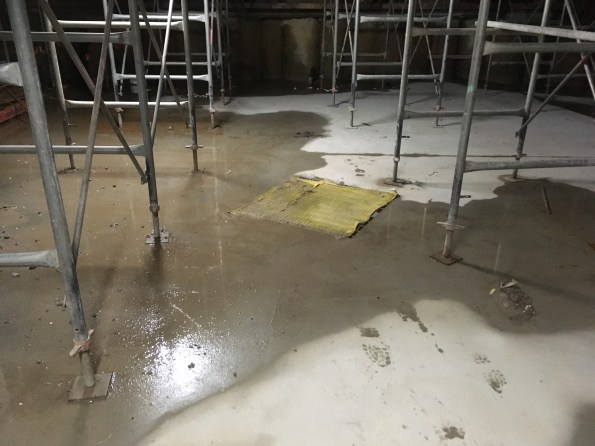
Basement 6 ‘the dungeon’ – It puts the lotion in the basket
Here comes the Science again:
ASS occurs when sulphates in the soil are exposed to air and broken down by bacteria. On our site there is a clay layer that contains a high concentration of sulphates. During excavation we exposed this soil to air so it oxidised and produced Sulphuric Acid. Now we have finished excavation and all of the ASS has been removed. The only ASS around us what is left outside of our site. Now it is possible that the ground water around the site seeps through this soil and flows into our site through the anchors and from under the ground bearing slabs, where it is then collected by the site drainage system.
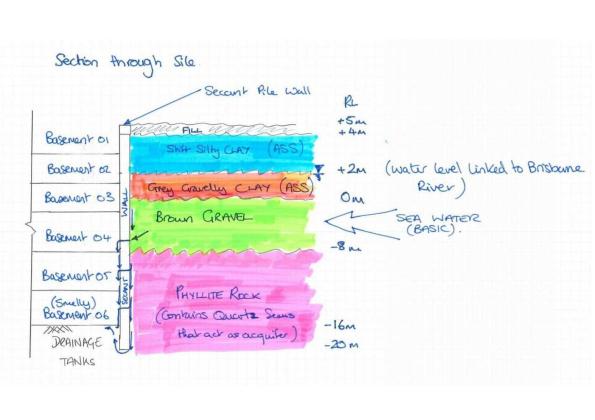
What I think is happening behind the wall (Not a flow net!)
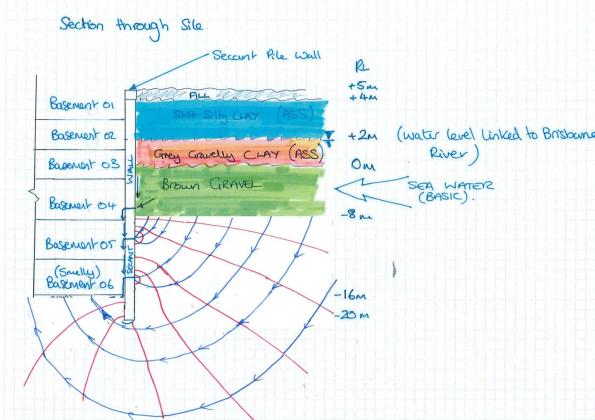
A less than perfect flow net.
However, the soil outside of our site has not been excavated and therefore cannot have been oxidised. The site is approximately 200 m from the Brisbane River to the North and the West. As you can see from my diagram the area is flushed by sea water with the tide . Sea Water is naturally basic and so counteracts any effect of the ASS. When I last had the water tested to get approval for discharge into the stormwater drainage the water was mildly alkaline and similar to the pH of the Brisbane River. SO NO IT’S NOT MY ASS!
What are we doing about it:
I now have to hold a workshop with the blokes to explain that it is not gas or ASS in the meantime the guys are cleaning up the walls to remove any mould (although there is no mould officially there) and remove the stagnant water that is on site. We are installing some temporary fans to move the air around the basement until the permanent fans are installed.
 Holdfast Training Services Trial Blog
Your basement does look quite wet, I assume it is a grade 1 or 2 basement. Could you apply some waterproofing to control the water and therefore the smell/ gas? It seems that dealing with the gas isn’t really a long term solution and that you need a passive solution.
We have recently been smelling gas on our site. Not in the deep hole but up on the piling platform. It’s not constant but it definitely comes and goes.
We have connected one of our gas monitors (usually at the bottom of the box) but all levels are fine so far. Thoughts are that it is either being blown into site or a dislodged gas main under Battersea Park Road. Either way it will be difficult to prove either.
Hi Jonny,
The client has agreed to a wet wall. With regards the waterproofing the wall- I believe this ship has sailed and is prohibitively expensive. Much of the water you see is from the stair penetration and a little is coming from the ground anchors that have not been sealed off yet.
I suspect this is more the mould in the bottom of the hole. Once the walls are cleaned up and it is properly ventilated by the fans and lit, it should be brought back under control. The permanent solution is for the car park to be ventilated by fans. This appears to be a case of wait and see.
Yes I became aware of acid sulphate soils in Australia a few years ago. As I understood it they were associated with the decay of mangrove swamp. Two things
1 They are very aggressive to concrete so I assume the concrete basement elements were always designed against attack;
2 The geological sequence you show implies high permeability material and therefore an equipotential at -8m Making the construction of a flow net for the phyllite more easier to do and show than NOT.
The ASS produces sulphuric acid when organic material decomposes in the sulphate rich soils. It doesn’t necessarily have to be mangrove but, in this case it probably is old mangrove swamp. ASS is found around the world but particularly around the eastern seaboard of Australia.
ASS needs oxygen to feed the decomposition of the organic material to produce the Sulphuric Acid so if we have not disturbed the clay outside it should not produce any acid.
When I get time I will produce a flow net. I am removing the steel props at the moment, installing a piling mattress and then trying to sort out the latest disaster (the piles cannot take the vertical load of the building). Overheard an amusing conversation between the ‘engineers’ and PM- what is dead and live load? – Priceless
Forgot to mention that the piles and pad foundations are design to withstand the highly acidic soil. The foundations could be considered overkill as the ASS are in the higher strata.