Site Update, many activities
No major problems on site but I thought that a more general site update might be due (especially in light of a potential placement for next year).
Recently in the last few weeks the activity has steadily increased as the TBM parts have been delivered on site and the SCL (spray concrete lining) team are setting up. Many robotic tracked vehicles driving around. This has all come as the primary works in the Crossover box come to an end. Construction of the box is as far as it will go until the TBMs have finished tunnelling. So there is a oncoming shift in focus of the main civils team from the Crossover Box to the Station Box. The work force on site has also ballooned 3 times what it has been for the last year.
Crossover Box
Excavation. The excavation has now been completed. All the props strain gauges are showing that they are behaving as they are expected and shape arrays in the d-walls are showing expected deflection. Now that the excavation has finished the monitoring will be reduced and shape arrays and relocated to the Station Box.
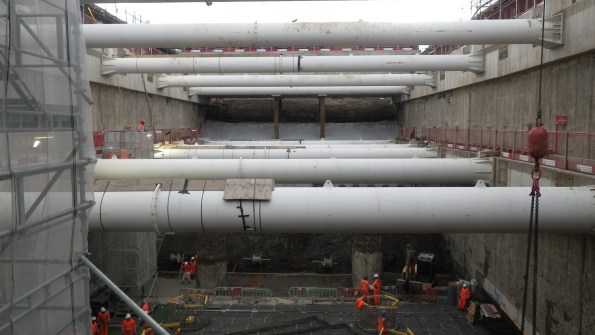
Crossover Box from B-02 level
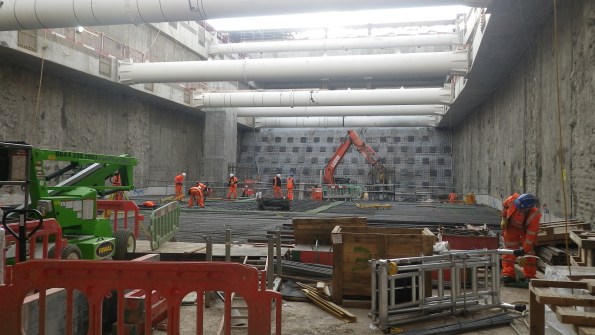
Crossover Box from B-04 level
Soil Nailing. The last of the excavation has been possible due to the soil nailing. Over the last week BAM Nuttal has been sub contracted to install six rows of soil nails to stabilise the clay at a 70° slope. This required 24hr working to excavate 1.2m high benches into the clay at night, so that nailing could take place during the day. This is a semi-temporary condition, for up to a year. The London Clay was holding well, but for how long… no one knows squared.
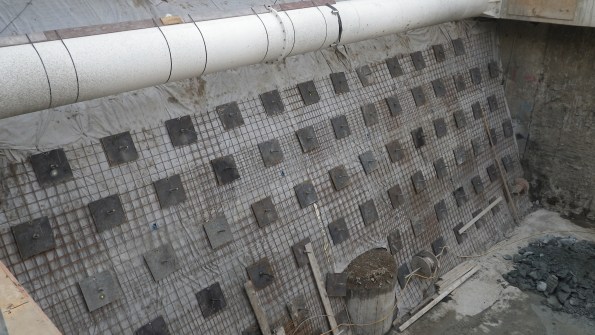
6 rows of soil nails
Base Slab. A third of the base slab (pour 1 & 2) 1.5m deep, has been completed with the middle third pour (pours 3 and 4) planned for Thursday. This has gone largely without incident… surprisingly.
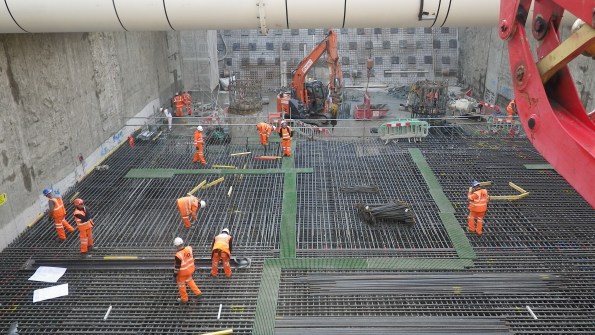
Steel fixing base slab pour 3 and 4.
Headwalls. The stage 1 headwalls are being cast today. They are essentially columns cast against the d-wall. These increase the stiffness of the box and provide additional load capacity to allow two 6m diameter holes to be removed via stitch drilling. The headwalls are 6.7m high and are being poured through guillotines in the formwork under pressure. This has required a lot of planning, much more than usual. It’s the first time such a high pour has been done for most on site, its going smoothly so far.

Temporary Bridge. In addition DAM structures are about to finish the erecting of a steel bridge over part of the primary structure. This will provide access across the site once the excavation has started on the station box side. The steel has just been finished. The RC deck is not being constructed (you can see some of the falsework in place at the far side.
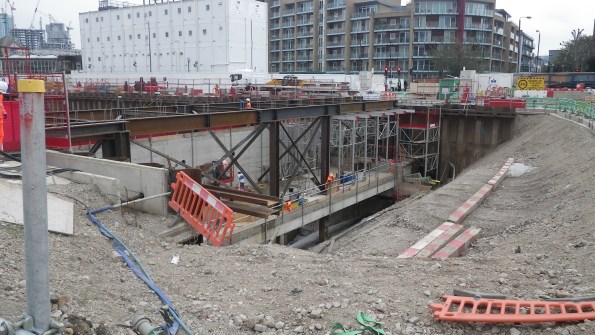
Steel Bridge complete – RC deck under construction
Station Box
Piling and D-walling. Rotary bored piles have 5 weeks left on site which will provide quite a bit of relief as the ancillaries (casings, augers etc) for 4 sizes of piles and the polymer plant are de-mobilised.
D-wall panels are currently 39% complete. This is a delay of 4 weeks so as to reduce the impact to the FLO works, my time has been largely taken up negotiating a phased handover ahead of the completion. As expected this is highly contentious. Lots of commercial discussions but we now have a solution that should keep FLO on their programme to built target and CSL with enough room to actually complete the piles.
Capping Beam Construction. Lastly, following the handover of the first 4 gridlines (24m long) FLO have started to break down the d-walls and have started the construction of the capping beam.
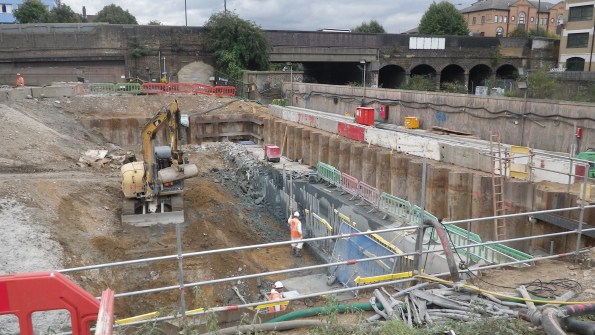
First section of Station Box Capping Beam.
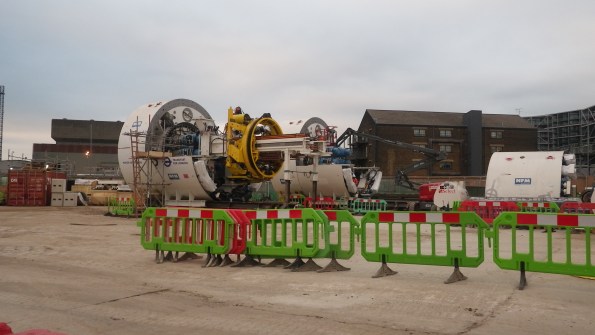
Semi assembled TBMs
 Holdfast Training Services Trial Blog
Jonny,
Is the TBM assembled next to the hole then dropped in complete or is it sent down in pieces? I assume its a large piece of kit and therefore you need to do some clever planning to ensure your propping regime doesnt prevent and obstruct it being dropped/assembled in the hole?
Interestingly a site engineer who sits next to me told us in the office than when they dropped a TBM into the crossrail box a few years ago, they had a significant issue with the TBM teeth. Apparently they are made of a very expensive material (Im assuming an unusual metal alloy). They fixed them all on to the face of the machine at ground level in preperation for the lift into position. One morning they came back to site and they had all dissapeared. It turns out that some dodgy blokes broke into site and nicked them all off the machine. Might be worth checking your site security systems!
Tom, correct. The TBMs are assembled on site (Ive just added a picture of them semi assembled) and then lifted in with a 950t crawler crane. The propping scheme at the eastern end has a ‘mole hole’ which is wider then usual, giving an opening that is 11.5m wide by 23m long.
The props are all the same at each level however at the eastern end there the transverse beams are part of the primary works which include a 6m wide and 1.4m deep slab (which works more like a beam). This ‘slab’ is then cut out for the final structure. This means the eastern end of the box is extremely stiff at the moment. This is be to cater for the hole that is cut into the d-wall for the tunnel.
As for the cutting head, I suspect so however they are currently shrouded in tent for welding and the site has just gone 24 hrs. So security should be a little easier.
Clever stuff. In the area where the props are further apart was the size/stiffness of the secant piles and capping beam increased to accommodate this gap? I ask because we have used different secant piles in different areas of our perimeter wall in order to support an unusual propping regime. I suppose you could use a very stiff wailing beam to transfer this load into larger props but 23m x 11.5m seems like a big gap. Alternatively as your an infrastructure project you could just throw tax payers cash at the problem and design all the secant pile for the worst case condition (ie the bit where you left a mole hole).