Archive
Load Testing with a Difference– 25 NOV 16
So Bridge 1 is complete. This is the temporary structure that cuts across our site and provides access to adjacent phases. Its construction will facilitate our basement excavation in due course. Broadly speaking it is a motorway over bridge. It spans 80m over 9 spans (the largest of which is 18m) has a 7.3m carriageway with a maintenance footpath on either side. It has been delivered on time, on schedule and possibly to budget… Probably not to budget as the client’s scope was so vague that the trade contractor has taken him to town with additional items. I have spent the last month or so compiling Site Instructions to complete the bridge in line with the client’s intent.

Bridge 1 Aerial View – An adjacent phase 40T artic can be seen on the bridge ready to be offloaded
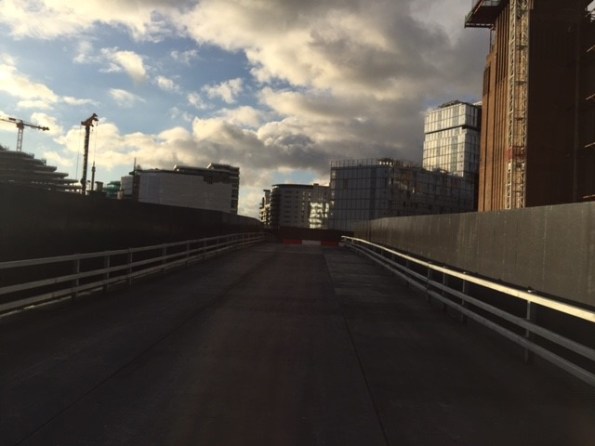
Bridge 1 – Deck View
Most recently, I have hosted a series of visits from various client representatives that have not just moved the goal posts but completely changed the sport… The design brief was cast in stone well over a year ago. The structure of the temporary bridge was to be designed as a private access road and therefore Highway regulations did not apply in their entirety. Clearly, the client and designer cherry picked areas (crash barrier rating and bridge loading for example).
From my perspective, the past month or so has been challenging, the client’s expectations are wholly unrealistic. My “favourite” client check was the load testing dry run conducted last week. Photos below:


Porsche Load Testing
The test to confirm the ground clearance for sports cars was successful as the Porsche did not ground out at any point. However, from my perspective, given that the gradient was dictated by the existing road profile at the entrance to the site and the final road level at the permanent HALO Bridge. How could the bridge deck profile have been altered had the sports car test failed? Answers on a self-addressed postcard please.
 Holdfast Training Services Trial Blog