Archive
Atkins – Epsom

Like the rest of the course, I have moved to a design office just before Christmas leave and had time to settle in. My phase 3 attachment is with Atkins in their Building Services division at Epsom. This short blog will be a brief introduction to Atkins and one of the projects I have been working on.
Atkins Profile
Atkins are a global multi-disciplined design consultancy providing design, engineering and project management. The company was established in 1938 by Sir William Atkins and over the next 75 years it has developed into one of the top 20 global design firms in the world. It has 18,052 staff across 300 offices in 29 different countries and a global company revenue of £1.86 billion.
Hinkley Point C (HPC)

Client: EDF Energy value £1 million
Atkins involvement with the £18bn nuclear power station project is providing a Bill Of Quantities (BOQ), cable routing drawings, load schedule and lighting calculations for the ‘Small Power and Lighting Package’ for the 40 building across the site.
The client required a robust cost model which could be included in the Initiation To Tender to potential contractors. Atkins were extremely keen to impress the Client and decided to deliver the project through 3D modelling software Revit.
Project Process
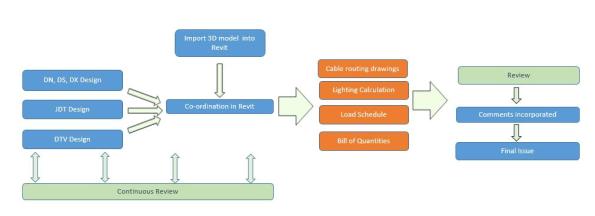
In order to setup the 3D model, the CAD team imported the 3D files for all the Structural, Architectural and Building Services information. The CAD team created families of symbols to represent the different types of cables, containments and fittings which would enable the accurate generation of BOQ.
The engineers used the layout information from the General Arrangement drawings, designed the cable routes and manually added the families of symbols into the 3D revit model for each of the buildings.
3D Cost Model
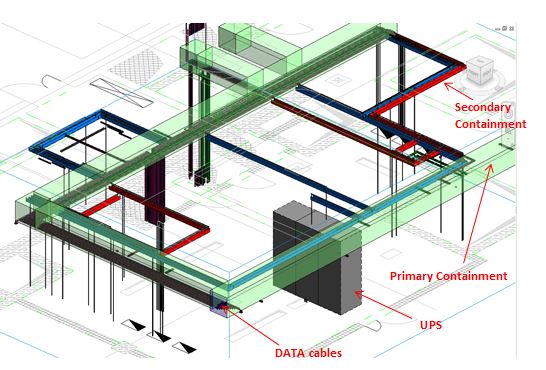
The picture below shows the 3D model for the small power (DX) supplying the Data and Audio system within one room. Cables have been drawn from the electrical devices, above the secondary containment and primary containment to the distribution boards.
Blue – standard trunking various sizes, Red – fire rated trunking various sizes , Light Green – Primary Containment
The output from the 3D cost model: total number of devices, total length of secondary containment and total cable length. The cable lengths are higher than initially estimated by the designer because of the requirement to have separate routes for each device, increasing the redundancy within the systems. The picture below is showing the cable lengths for the same room above.

Conclusion
Revit is quite simple and easy to use. It is much easier than Autocad and similar to the other 3D modelling or CAD software used in Phase 1. The difficult part I have seen is initially setting the project up and resolving issues which have all been managed by the BIM technicians. Revit provides a higher quality product and it currently takes longer to create due to the input into the model which will increase overall cost.
Using Revit has enabled Atkins to outsource parts of the work to its design centre in India, but this has required a more in-depth review of their work.
http://www.atkinsglobal.co.uk/en-GB/media-centre/news-releases/2013/group/2013-02-20
 Holdfast Training Services Trial Blog