Archive
Water, water everywhere…things that I have learnt about hydraulics
Summary of Secondment to Warren Smith and Partners
Introduction
Following last week’s update on all things mechanical, this week covers my secondment to Warren Smith and Partners, the project’s consultants for Hydraulics, Dry and Wet fire system. In addition they also have departments for civil and stormwater drainage design. I benefited from this design secondment in 3 areas:
- Extending technical knowledge of services engineering.
- Reinforcement of theory and knowledge from PET course.
- Practical aspects and implications of theory.
Aim of secondment.
The aim of the secondment to WS&P was to develop a thorough understanding of the processes used for the design of hydraulics, dry and wet fire services and civil and storm water drainage.
Timetable.
- Monday 17 Oct 16 – Civil: Storm water and drains. Inc site visit to domestic development.
- Tuesday 18 Oct 16 – Civil: Storm water and drains. Inc. site visit to Barangaroo development.
- Monday 24 Oct 16 – Hydrant and potable water. Fire (Dry/Wet).
Key documents.
- AS 1670: Fire detection, warning, control and intercom systems – System design, installation and commissioning.
- AS 1851: Routine service of fire protection systems and equipment
- AS 2419.1: Fire hydrant installations.
- AS/NZS 3500: Plumbing and drainage
- Part 1: Water services
- Part 2: Sanitary plumbing and drainage.
- Part 3: Stormwater drainage
- Part 4: Heated water services
- Australian Building Codes Board: National Construction Code 2014 Volume 3.
Overview of secondment.
Storm Water Design. WS&P uses two main programmes for design; DRAINS to model the catchment area and storm water runoff design; and MUSIC (Model for Urban Stormwater Improvement Conceptualisation) for stormwater treatment.
The outputs of DRAINS are used for the modelling within MUSIC. I undertook a short design exercise using MUSIC based on the Barangaroo Reserve Development in Sydney – the area circled in the figure below was an old industrial dockland and was converted to a public space and nature reserve (the hill is entirely man made). The requirement was for a reduction of >80% for total suspended solids, >65% nitrogen and >45% phosphate. Using a combination of onsite detention tanks, swales, filters and bio-retention I achieved this. Following the site visit to the Barangaroo Reserve development I believe I would have been able to further refine my design to remove some of the filters, thereby reducing the council’s ongoing maintenance burden for the stormwater system.
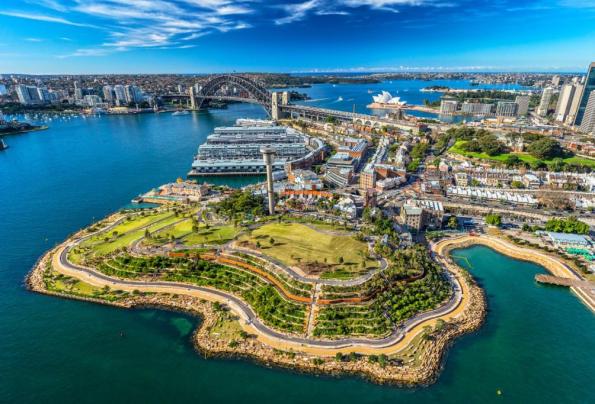
Figure 1: Barangaroo reserve development can be seen in the foreground.
The New South Wales government states that the minimum requirement for post-development flow be no greater than the pre-development flow. However, each local authority can set more onerous requirements. For example, Hornsby Council in Northern Sydney states that the 20 year post-development flow must be less than the 5 year pre-development flow. Understanding the local restrictions is therefore vital.
The site visit was to a small scale residential development where a plot was to be split in two and both plots developed. The purpose of the visit was to ensure that all parties were aware of the implications of the requirement to meet Hornsby council’s post-development flow standard, to ensure that there was sufficient mains pressure and to comply with the water authorities’ requirement for both plots’ waste water infrastructure to be entirely separate. This latter requirement caused issues for the routing of the drainage from the second plot to the sewer system that would require the removal of community trees – this brought in another set of regulations about tree removal. As highlighted in the paragraph about, a thorough understanding of the local restrictions is vital.
Hydrants, hose reels, sprinklers and drenchers. All the requirements for fire equipment are based on the size, construction and use of buildings as well as the available mains water pressure and volume flow rate. The requirements are laid out in the National Construction Code of Australia, the structure of which also acts as a flow chart to assist in the development of the building design.
- Part A: Classification of building.
- Part B: Structural provisions.
- Part C: Fire resistance (classification, number of levels and volume of building)
- Part D: Access and egress.
- Part E: Services and Equipment. During the discussion about sprinklers it was clear that WS&P’s position was that as sprinklers control 90% of fires, they would, where possible, use sprinklers in their designs even if not stated in the code. This position is supported by the fire brigade and their inspection authority that have closed loop holes that allowed for the exclusion of sprinklers under certain circumstances.
In addition to the codes and requirements for fire equipment, the important installation features were discussed:
- Sprinkler heads are to be unobstructed in order to allow the sprinkler envelope to form.
- Flexible sprinkler pipes have a given bend radius. During installation it is usual for other trades to move the flexible hoses and possibly cause damage. This must be checked.
- Within ceiling voids, sprinklers also act as fire detectors, therefore removing the requirement for a separate ceiling void detection system.
The first two of these points have been useful during my quality assurance inspections.
Potable Water. WS&P uses PIPES for modelling all hydraulic designs – potable water, fire and hydrants. As potable water is an open system, unlike a heating system where the water can be treated, the constant flow of water degrades the pipes – oxidation and erosion – therefore the recommended circulation flow drops to <0.6m/s. Delivery flow can be greater and in line with the CIBSE values.
During schematic design the water authority provides details of the flow and pressure within the mains, the final design should consider the following factors:
- Minimum amplification of existing infrastructure.
- Minimum disruption to routine function of mains: from both connection to mains and location of connection.
- Reduction of mains connections as each one occurs routine service costs to the end user.
- Pumps requirements: If mains pressure is under 250kPa then a pump is required.
- Pressure reduction requirements. The max pressure at an outlet is 500kPa therefore pressure reduction may be required. Where there is a large step down, this should be done incrementally with reductions of between 25 and 50%. Best practice for preventing oversizing of RPZs is to install 2 in parallel (each designed for 50% flow) with a small bore (15mm) bypass.
Smoke Control Systems. As detailed from the Fredon secondment, the mechanical consultant produces the Fire Fan Control Matrix. This stipulates which fan has to do what in the event of a fire – the Fire Fan Control Panel and the Mechanical Control Centre are then programmed to enact this. It is important that all stages of the fire design involve both the Mechanical and Fire designers, and as stated earlier it is important to have a clear delineation of roles and responsibilities.
The Emergency Warning Intercom System (EWIS) for a hospital must be set up to minimise distress to patients. Therefore at the St George Hospital there are no speakers in the patient rooms, but to ensure that there is sufficient warning in each ward an additional mimic panel has been added at each Nurse’s Station. Therefore in the event of an evacuation the nurses are aware but immobile patients are not subject to the distress caused by listening to the automated evacuation warning instructions.
AS1670 covers fire rating copper cables, but not optical fibre. This gap is currently being resolved.
Key lessons learnt.
Standards must be fully understood, but also there is a requirement to be cognisant of the other national, regional and local regulations. The consultant’s value is clear in their expert understanding of all the levels of codes etc.
Design conditions for all circumstances must be understood – for example the difference between the potable water circulation flow rates and the acceptable distribution flow rates.
Designs should be optimised to reduce the end user’s maintenance requirements.
Recommendations.
With the wide range of expertise within WS&P, it could be an option for future Phase 3 attachments.
 Holdfast Training Services Trial Blog