Concept Design…
A potential client, wanting a 7 storey building, is keen to discuss the advantages of ‘beneficial occupancy’. Interestingly the most valuable floors are levels 4 to 7 and as such, these are the priority. Having been approached with this request, RBG have offered a concept design which allows the contractor to programme the more valuable, upper levels ahead of the lower.
Step 1: Foundations and raft slab (black)…

Step 2: Jump the core (green)…
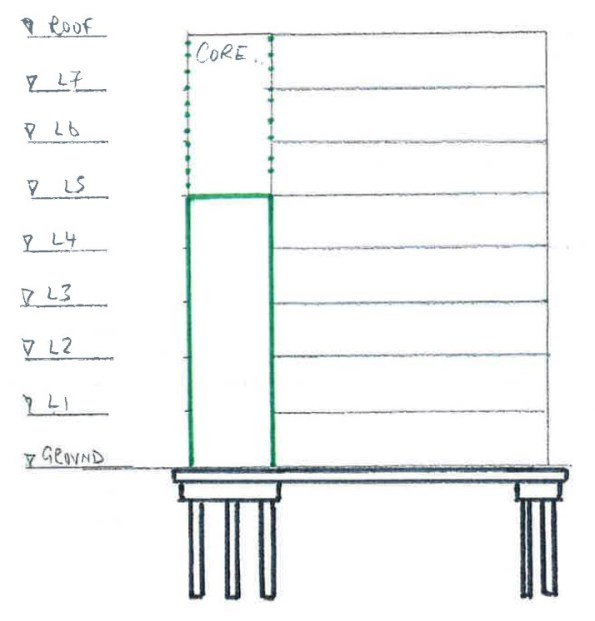
Step 3: Once the core has reached the required height (level 5), secure 15m prefabricated column (blue)…
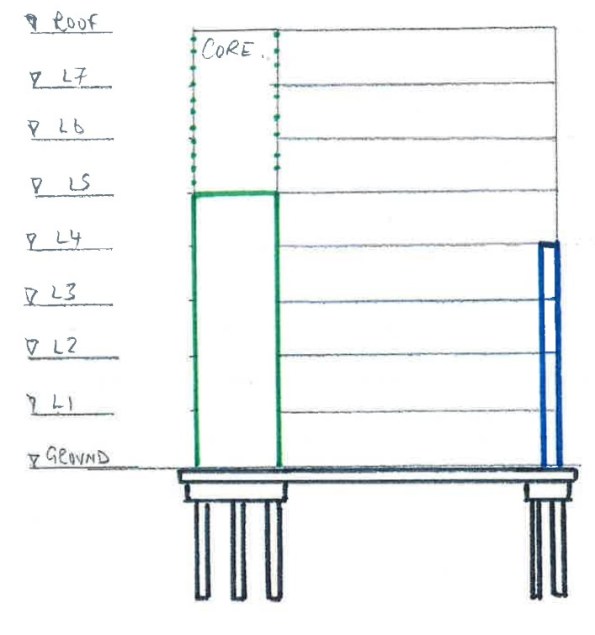
Step 4: Connect column to core at level 4 with prefabricated steel truss (red)…
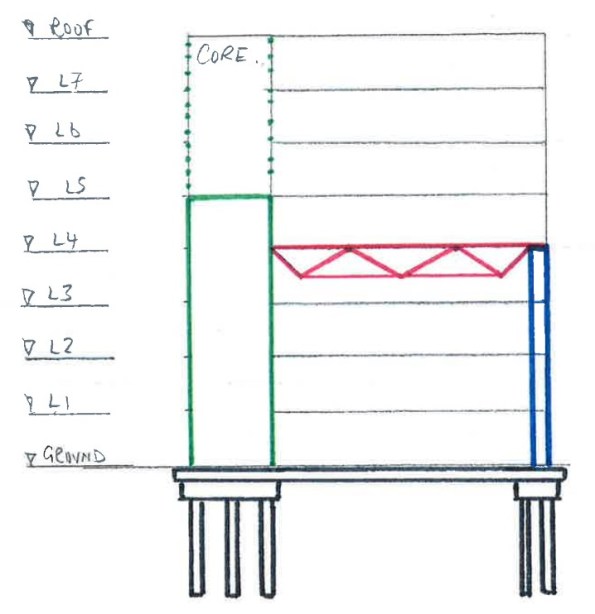
Step 5: Infill level 4 with precast slab and then progress concurrently through levels 5 to 7 and ground to level 3 using conventional falsework.
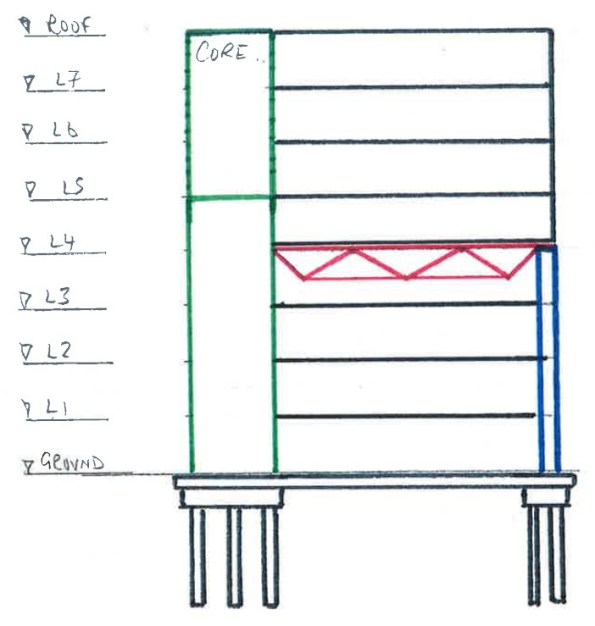
Step 6: Remove truss.
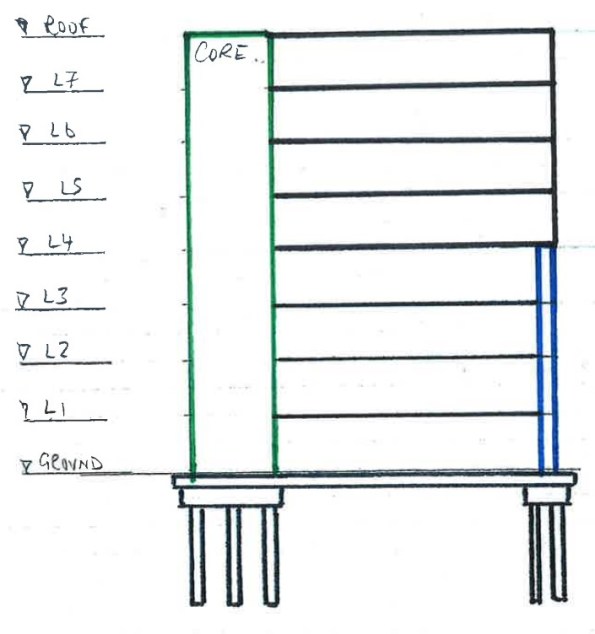
Whilst simple, this approach delivers the most valuable areas of the asset to the client earlier than conventional methods. It also negates the need for a ‘deep beam’ arrangement at level 4, maintaining level 3 headroom.
Unfortunately due to commercial sensitivities, I haven’t been allowed access to the cost benefit analysis of this approach. I have however been informed that whilst this approach costs more in materials, it delivers the most valuable areas of the asset sooner. The earlier delivery of levels 4 to 7 translates to an earlier profit for the client. This advance of profit offsets the inflated cost of materials.
 Holdfast Training Services Trial Blog
I like the general idea. You are putting in a temporary transfer beam at L4 so that the L4 to L7 load paths; are columns coming down onto the transfer beam and then being re-supported as the G to L4 structure is completed ?
I think a part plan would assist the understanding
A108 used beneficial occupancy although at a much larger scale. The first 41 floors of 100 were in the first hand over of 6. The greatest challenge we had was not specifically with the structure but the servicing of the construction – electrics, plumbing, cranes, Alimaks, physical escape routes, providing resident access to upper floors during construction etc – essentially how are you going to move equipment, materials and people? You cannot handover a floor or part there of unless it is clear of all temporary services and finished – obvious solution was to run services through the structure and punch additional penos into the core and slabs as required. This is very much a construction management thing rather than the engineers problem, however, on A108 this did translate to large retrospective changes and additions to the structure because so many things hadn’t been considered early on. With little residual capacity this proved very difficult at times to achieve, especially with the core and slabs. Could be worth a question to the builder (if there is one) to get thoughts on this early and preempt any later changes that might be made.
Andy, really interesting. Did you get involved in the concept design stage or the brainstorming of options to release the high value floors?
Were there other options put to the client?
Is there a comparative risk register between these two options – as you say, the initial costs are likely to be much higher (Prestressed vs RC) but the client will get a payout at an earlier stage. As Jo hints at, access to the floors must be a huge consideration as the end-user will need to move through a construction site.
No, I wasn’t involved, I just overheard and thought it was interesting. It is still early days, no register as of yet but I am sure they will perform a cost benefit analysis once they have short listed their options. I agree with you and Jo with regards to services and access. Even if the client has to wait for services and access, this method would allow concurrent activity above and below level 4. This would result in an earlier completion date, if only to a lesser degree.