Analysis Software
There’s been quite a bit of discussion recently regarding what analysis software is being used in various design offices. There are a wide range of options and the practice I am with have developed some loose guidance on which structural analysis software should be used for different design problems as outlined in the figure below.
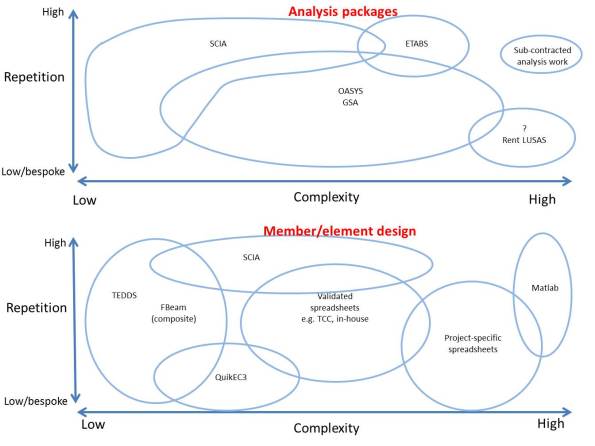
So far I have used SCIA, TEDDS and bespoke excel spreadsheets. It has been a steep learning curve to get to understand some of this software, during which time I’ve been very grateful for YouTube. There are some really great examples to follow. Expedition have also published a useful table on their internal website listing which members of staff you should speak to for advice on different packages – this has proven extremely useful.
I was initially frustrated that we use STAAD at PEW as it now seems very simplistic and doesn’t cover the complexity or design options of some of the other software. However, I think it is useful to demonstrate the process of modelling and analysis, and I suppose no matter which software you choose you can’t cover all the options. I think it may be worth looking at TEDDS if a replacement is ever sought. TEDDS for Word is very powerful and would prove useful during design exercises.
One thing that has really surprised me is the use of simpler software to check software output rather than hand calcs. It seems that there is so much familiarity and confidence in simple software like TEDDS that people are confident they won’t make the input errors. However, I don’t have that intuitive understanding of TEDDS yet so I don’t feel comfortable doing that. CIRIA technical note 133 is a useful guide to checking computer analysis.
My level of confidence with the software remains low, but this is improving as I build up an understanding of the design options that can be applied and how these change the model.
 Holdfast Training Services Trial Blog
Tony, we have Tedds in the STREs. Time spent on that during your attachment will put you in a good place for future PQE roles. I am currently putting a business case together to get funding for Tekla’s online training package. Yep, we spend circa £1500/yr for each licence and no-one has received any formal training to fully realise the benefits of using the software we pay for.
Thanks Daz. That’s useful to know. Might make even more sense to use TEDDS on the PET Course then, even though we’d only be able to scratch the surface in the time available.
Interesting blog. This is an area with which I am very familiar ( from a previous life in which my team and I actually wrote FBEAM, amongst other packages)
The trend (at the high end) is towards analysis and design verification packages attached to full modeling. I have used Bentley RAM and have tried to become familiar with Autodesk’s REVIT . These attach the analysis and design verification functions to the building model , which is assembled from objects.
At the high end in pure analysis are ETABS, LUSAS, ANSYS, Abaqus and the other generic finite element packages
At the high end in design verification/detailing are the material specific pieces like Tekla’s XSTEEL and StruCAD. I don’t really know of equivalents in concrete ( other than CONCEPT for pre-stressed) or timber (other than FINE)
For all the high end work, I have found that the learning curve is steeeEEEEPPP and the operative really has to be using the package in the day job…as it were
Down at the low end is TEDDS. It does a little elemental analysis and code base verification of standard elements. As Daz notes it is a set of visual basic macros bolted onto Word as a delivery engine.
I’d have thought it was fairly ideal for 170 – ( I used to know all the guys at CSC who wrote TEDDS- I hadn’t realised that it had been sold to Tekla. They are a Finnish outfit who made their cash in steel design-verification- CNC software).
It is fairly intuitive and the output is didactic ( that is it explains where each of the code based steps are taken from).
On STAADPro…it’s a strange beast. On the one hand the interface barely hides it’s text-fil-e driven origins. It is a powerful structural analysis engine for 3-D ‘bar’ elements. It can do more but not with ease. It does have steel and concrete design verification segments ; but I doubt whether you were let loose on it… I’ve used and it’s reasonably powerful but you wouldn’t learn much from using it and you have to use it fairly frequently to retain competence
StaadPro is integrated in the Bentley suite in that models exchange with RAM easily. So you can build a stick model in Staad move it into RAM when on top of the structural analysis.
Moreover we get a great deal on the licences here.
I do think we should use something like TEDDS is our teaching ( certainly for the CoW-C’s – or whatever they are going to be called ) – you may remember a piece of software I wrote for retaining wall design. I think it was better than TEDDS ( I would say that wouldn’t I?) but it tried to be similarly didactic
I’d like to hear more thoughts on this
John, do you know what the difference in cost is between these analysis tools are? I am assuming that the cost of the STAAD Pro package would have been a defining factor in the selection by PEW. At the design office i’m in they use TEKLA Structural designer and pay approximately £2000 per licence (this includes the software and technical support but not the training package….these cost vast amounts extra as I’m sure Daz is about to find out!).
Is there any appetite for PEW to adopt TEDDs at PEW in the near future? I think it would be beneficial considering that the STREs use it.
I absolutely agree. TEDDs is quite heavily used as far as my experience goes – and Robot (Autodesk) as a modelling package. Well worth the investment if 170 are looking at TEDDs too. Surely if the STREs use it then using it in the PEW would just be an extension to their licensing?