The Stage
I have started my Phase 2 attachment with Brookfield Multiplex (MPX) as what seems to be a site engineer and construction manager on The Stage project in Shoreditch, London and I want to provide an overview of the project and site to allow future blogs to relate to it.
Location
As can be seen from the picture below, the project is within drinking distance of “The City”. It also sits next to two other MPX sites, Principal Place Residential and Principal Place Commercial. There are also numerous other projects going on within the immediate vicinity making for a very congested area of London. It also means that some of the MPX staff (mainly H&S and QS related) are cross-decking between the projects, splitting their time between the sites.

General
The development is a mixed use scheme comprising of a 37 storey residential tower (building 1 – prestressed concrete), a 14 storey office block (building 3 – steel frame), and a 9 storey commercial and retail block (building 2 – prestressed concrete). In addition to the three largest buildings there will also be a performing arts pavilion, heritage centre, sunken amphitheatre, popup retail units (to hide a dated masonry substation) and the conversion of former Victorian rail viaducts; and all to be done to a BREEAM excellent standard. There is also the preservation of the remains of Shakespeare’s Curtain Theatre which date back to 1577. These remains are of international significance and are being preserved as the focal centrepiece to the development, hence the name.


Contract
The project is currently in week 19 of 20 of a Pre-Contract Service Agreement (PCSA) and conducting early works using a JCT D&B contract between the Client and MPX. I will be spending some time with the contracts team to better understand how this works commercially. The background to this is that Gilliard Homes (the Client) originally started the project themselves and stopped it when things weren’t going to plan, then they appointed MPX as Principal Contractor. They wanted work to happen quickly which is why a final contract for the project hasn’t yet been established. What this means is that there are legacy issues on site caused by the work conducted by Galliard Homes. For example there are some incomplete secant wall capping beams in place of which Keltbray, the main contractor on site, cannot guarantee the structural integrity of and will have to demolish. There are also existing utilities which the Client had previously moved from outside of the hoarding, which now lie in the way of the secant pile wall design. This requires the UK Power Network (UKPN) and BT to be involved to move the utilities before the secant wall is constructed. All elements resulting from the work conducted prior to MPX result in a risk being carried by the Client.
Current state of site
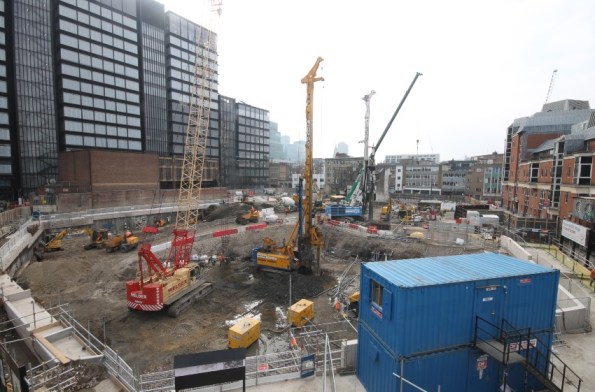
The site is currently in week 11 of 50 of early works, incorporating secant pile walls and bearing piles before excavating about 18m to allow for a bottom up construction. There are 2 x 90T piling rigs on site with respective cranes, working on 1m thick piling mats. The ground is being excavated from +15m AOD to +11m AOD before props are installed to allow further excavation. Another important aspect of the project is the presence of the Museum of London Archaeology (MOLA), who are conducting archaeological digs on site. We were taught that archaeological finds are likely to cause a significant delay to a project. However, it is a key part of the brand of the development and MOLA’s digs are being facilitated by MPX throughout the project and time has been put into the program to allow for archaeological overruns. The only finds being preserved are those of the Curtain Theatre which dates back to 1577. This has been fully excavated and has since been covered using polystyrene, steel plates and some very expensive aggregate. This means that the area under which they lie can be trafficked and used for stores. The presence and exploitation of the archaeological site and its future use as a major tourist destination means that the development does not need to incorporate any “affordable housing”. There are also other archaeological digs being conducted on site but these will all be recoded and removed by MOLA.
Piling methods
Currently there are bearing piles and secant pile walls using guide walls being constructed. However, I noticed that contiguous piles were mentioned in the H&S plan. This will be a subject of another blog. In the meantime the piles here are CFA using polymer (polymer plant in the picture is hidden by the blue ISOs). You can hear the suction from the London clay when the auger is removed from the casing. I will also see the first of the plunge piles being constructed in the next few weeks. I will do a separate blog about the history of the soil in this area of London as it has some good historical background.
Key constraints
Hackney Council have a number of restrictions to the site, the first of which is the working hours. The site is limited to weekdays 0800 – 1800hrs and Saturdays 0800 – 1300hrs. This means that the piling has to be at a practical stage every day to finish at that time. Any over-size loads are only allowed to be delivered overnight or at the weekend. There are no actual sound limitations imposed on the site so the project has a self-imposed noise limit of 78dB, which is the average noise level measured from the city. A full pre-construction survey was conducted of the surrounding buildings and their movement is being monitored. Of interest is the tilt monitors installed on the listed pub at the western edge of site. I note that the monitor recorded 6mm of deflection at 2030hrs last night (everyone had left site by then), correlating with the pub opening times. It has also been noted that it deflects by similar amounts when the beer is delivered to its cellars. Every time a monitor, whether sound or tilt, is triggered it is automatically logged on Information Exchange (software) and a report is to be filled in. That, in conjunction with the pre-construction survey, are used to establish whether the site causes any damage to surrounding buildings.
Another building which forms part of the site boundary is a 1950s masonry UKPN substation which has already been damaged by the back of a bucket when a subcontractor broke from an agreed method statement, an issue of non-conformity which has all been resolved. It is being closely monitored for movement as it apparently supplies electricity to half of the city.
Issues
Live substations. There are currently 2 live substations on the site which require temporary substations for the duration of the project. The installation of the temporary substations and the removal and decommissioning of the old has already involved a lot of interaction between subcontractors and utilities agencies. It has been interesting to see how the interagency interaction is managed by the MPX team and has been the basis of me learning how MPX operate on the site.
Site accommodation. The site accommodation was inherited by the work done by the Client previously and is deemed inadequate for MPX. Its size and location is critical to the project’s progress and the responsibility for its implementation have been given to me. In the short term it needs a temporary expansion in its current location to cope with an increase in the female workforce, to coincide with MOLA increasing their numbers in June. In the medium term a 4 storey 40m x 12.5m modular temporary accommodation block will be built on a concrete slab still to be constructed on the southern edge of site. This will house approximately 1200 personnel and will be complete by November. Following this the existing site accommodation will be refurbished and expanded to facilitate the latter stages of the project when the personnel reduce and move out of the 4 storey block. I have now been given the responsibility of this site accommodation project and have mid tender scope if works meetings with two suppliers to discuss the options next week.
Office politics. The main construction manager has resigned (on my day 3) after being on the project 9 weeks. This means he only has to give 1 week notice and will be leaving next Wednesday. It would appear I am now mid handover/takeover with him, hence the site accommodation project switching to me. I have already seen there is a case of office politics, largely based on personalities. It will be interesting to see how this progresses and how it differs from what we are used to. It may stem from the project office being dislocated from the site office by a few streets; naturally I think this causes a bit of friction between the two.
Summary
This blog covers an overview of the project and an experience of my first week here. It provides a starting block to help orientate future posts about the project and gives a rough idea of what will be involved here at The Stage. Meanwhile I will come up with various ways of getting Shakespeare into future blogs.
 Holdfast Training Services Trial Blog
Hi thanks for the blog. Congratulations on making construction manager, are there no Project Managers or Project Engineers on the job? In MPlx Queensland a Construction manager runs multiple sites but yours looks quite big.
I notice these secant pile wall. How deep is the basement? What methodology are you using to build it?
The BREEAM stuff is great will help you nail the sustainability competency early.
Hi Ed,
Welcome to Phase 2 and the writing about it rather than reading about it side of the blog! No contract in place yet…. Sounds all too familiar – watch that disaster unfold! I’m also intrigued that Keltbray ‘need’ to demolish recently constructed capping beams. They may not have been responsible for their construction but, as any engineer on a cut and carve will tell you, not having drawings or been there at time of construction is where engineers distinguish themselves from builders. It’s a very easy quick win for ‘knowledge and understanding of engineering’, ‘communication’ and ‘practical application of engineering’
I wonder how long the MOLA consent to record and remove will last if there is a significant find. I guess you’ll find that one out when time gets tight and they see something too good to be true emerge from the mud. I suspect we’ll see very brief blog entries for the next few weeks if you’re taking over as site manger (out, out, brief candle!).
Hi Doug, there were two construction managers (CM) working on this project, one senior CM and one piling CM. It was the senior CM who has just left and we are waiting to find out when a new one will be appointed.
The offices here are dislocated by a couple of streets. The site office, with the day to day running of sub contractors, has two CMs, two site engineers (including myself) and a H&S manager. The project office has the project manager and senior engineer (both chartered engineers), as well as the rest of the project team.
The basement will be about 9m deep. In general, the site is split into 5 zones using contiguous piles, allowing bearing piles to be constructed and each zone to be excavated in stages. The contiguous piles will be excavated as the layer of the overall site reduces. Once the site is at its final reduced level, the basement slabs will be cast and the rest of the construction will work back up.
I agree it will be good to see how the BREEAM stuff is being incorporated into the build. I see stuff like the piling matts made out of crushed (and graded) material from other sites, the environmental engineer is trying to get a “living wall” put on one side of the site office, water management from site etc. I will be spending more time with the environmental team in the future to better understand the implementation of it.
Ed, it looks like you have a really good site there with lots of experienced people who can help you get what you need. Glad the new CM is starting so can get what you need.
In my experience living walls are a pain in the arse. So good luck with that.
Hi Ed, good blog. It is interesting to see what the dynamic is on site as these details rarely filter through to the design office. With any luck you won’t get lumped with the construction manager hat for too long as it is a whole different kettle of fish to being a site engineer.
Rich, you are right about the capping beam – there are no immediate plans to demolish it. However the piles that are being capped are the issue. I’m not sure whether the company who did the initial works had had a skin full the night before but the piles look like a set of Witches teeth! I currently have about 20-30 NCRs relating to the piles (most of which are the piles being out of tolerance for verticality) which will need remediation works. The client is (naturally) not happy to have reduced basement space due to some badly placed piles so I am now looking at how to break out and reinstate the worst piles.
Hi Rich and Fred, Yes luckily a new construction manager has been appointed and is just doing the inductions now – I didn’t want that that to detract from my learning. Fred is quite right about the piles. There are observations that some of the existing piles had been pushed into place, therefore deforming the reinforcing cage, and additional reinforcing put in the top to try to hide this. On the eastern side of site the legacy secant wall has been exposed and was found to have numerous piles out of tolerance. These have been surveyed and projections made to see how they will look at the base of the piles. This means that that Keltbray have had to survey the existing works and provide remediation to what had been done, in order to provide the warranty at the end of the project. The pile cap reinforcing is exposed in only a relatively small (8m) area as the concrete had not been pored when the project was paused. It looks deformed and and so I think the easier option of demolishing the relatively small capping beam is going to be taken in order to provide the adequate warranty and move along quickly. There is still more legacy secant wall to be exposed which will prove interesting to survey and find out what lies beneath.