One Nine Elms – How not to design a structure
So, hello everybody. I hope everyone is settling in well and the Australia lot are not too sunburnt. In order to not bore everyone by just regurgitating AER 1, I intend to give you a brief overview of my site and then discuss the main issue with the project.
HEALTH WARNING – it’s a long one, sorry.
One Nine Elms – Multiplex
I am currently a site engineer for Multiplex on the One Nine Elms project. Multiplex have been brought in by Wanda (the client) after a number of contractors had walked away, being unable to agree on price and the project was showing little progress being almost a year behind schedule. The current contractual arrangements are slightly confusing but in essence everyone is currently under contract directly to Wanda. Second London Wall (Employers Agent) are the clients advisors and Multiplex under a Construction Management contract, but with not direct control over the sub contractors. All this makes for a confusing and rather inefficient site however, Multiplex will be moving to a Design and Build contact in June with the client becoming Second London Wall. I suspect this will be a future blog or TMR once it becomes a little clearer.
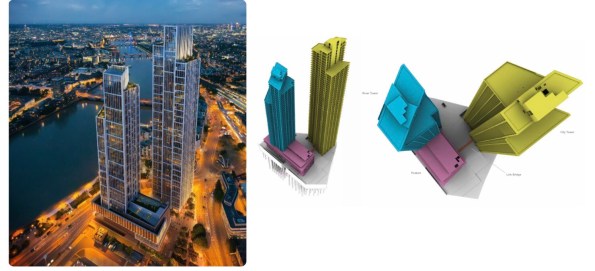
Fig. 1 Architects Impression (Left) and Superstructure 3D (Right) – notice the lack of St George Wharf completed in 2014
The site is the redevelopment of the Market towers, two 23 storey RC towers completed in 1975 and demolished by McGees in April 2015. Piling and groundworks began on site during the demolition and is not likely to be complete until the early 2018 which I will elaborate on below.
Superstructure
The superstructure consists of two high rise buildings referred to as the City Tower (yellow) and the River Tower (blue), the towers are linked at the first floor with a link bridge via a podium (purple). The City Tower is 56 storeys assigned for residential occupation, with the River Tower being 42 storeys with the upper levels being for residential occupation and the lower levels assigned as a hotel along with the podium. The structural concept for both towers is typically post tensioned reinforced concrete solid slabs supported by composite concrete encased steel columns and a centrally located reinforced concrete core. The reinforced concrete core along with its buttresses provide the lateral stability to the building, floor plates act as diaphrams restraining columns and transfer lateral loads to the core.
Substructure
There are two basement levels across the whole site with a third level between the two towers. A 1750mm combined sewer runs through the middle of the site which splits the substructure in two. Groundwater cut off is achieved by two 800mm diaphragm walls boxes either side of the sewer which have a toe depth in the London Clay. The foundations supporting the Superstructure consist of 256 compression and tension bored piles acting in conjunction with the raft at B2 level. These piles vary in diameter ranging between 1800mm and 900mm with the toe in the Thanet Sands. Due to the proposed construction sequence some of the piles contain plunge columns.
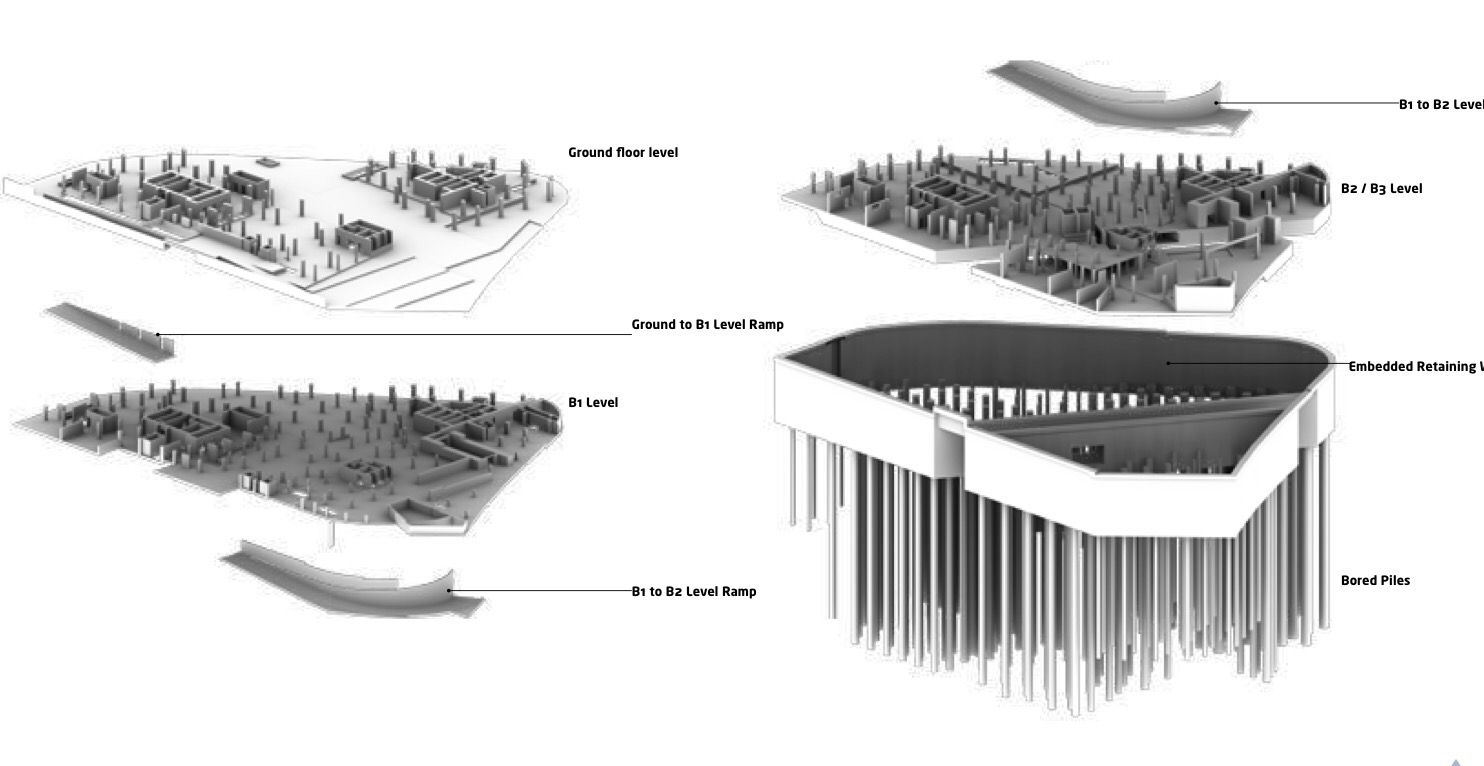
Fig 2 Diagram of substructure
Ground Conditions
The ground below the site is typical of London and consists of Made Ground (depths between 1.1m – 4.90m), Alluvium (depths between 4.5m – 9.5m), Kempton Park Gravel (depths between 7.5m – 23.0m), London Clay (depths between 22.0m – 31.5m), Lambeth Group (depths between 10.5m – 16.2m), Thanet Sand (depth between 9.2m and 13.0m) above the Newhaven Chalk Formation. Groundwater is between 3.7m and 6.4m deep and is known to fluctuate, with the level of the Thames. Fig 3 below shows the Lithology along the route of the sewer, there is a scour Pingo feature in the East of the site and it can be clearly seen on the right below.
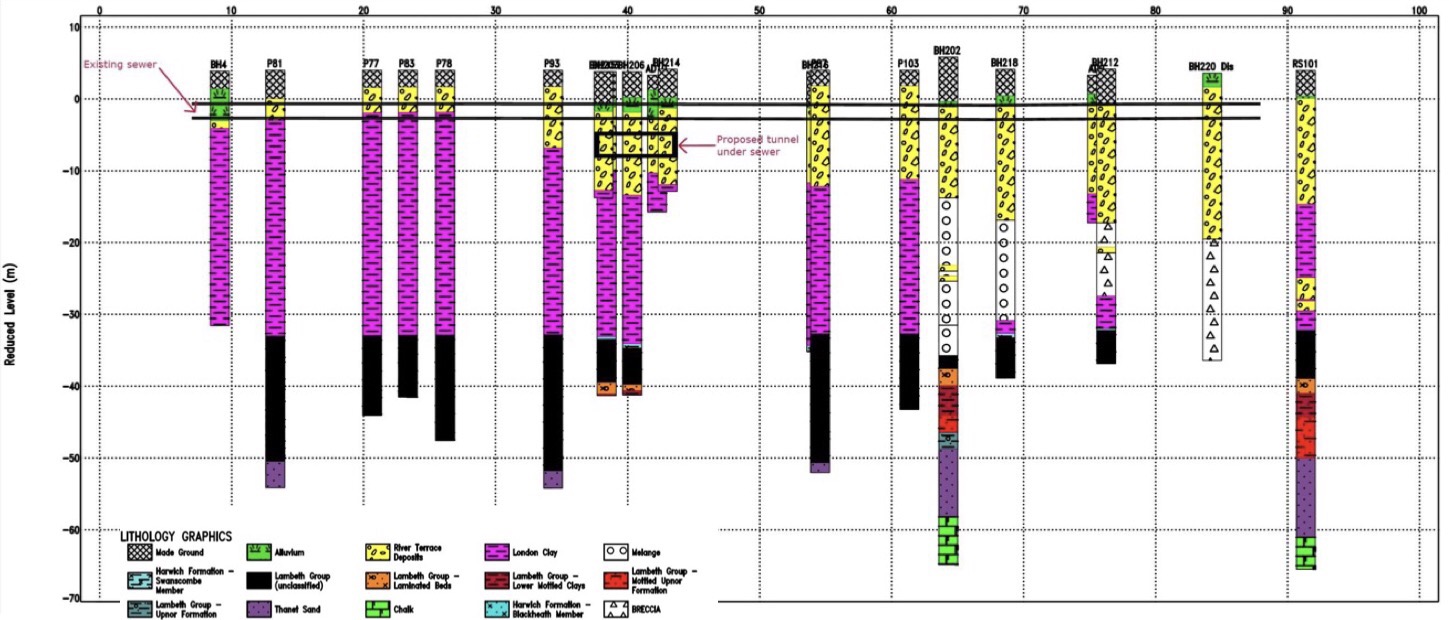
Fig 3. Lithology along the length of the sewer
Construction Sequence
The original squence and design was for top down whilst constructing the two tower cores on a number of plunge columns simultaneously, in theory reducing the project duration. However due to issues with the sewer which I will outline below the sequence has gone to pot and now looks like bottom up around the River Tower and top down around the City Tower.
Sewer Issue
As mentioned above, the site sits directly over an existing Victorian masonry combined sewer. The Market Tower (old building) basement structure spanned over the sewer and was supported on piles either side with a 1.3m to 1.5m exclusion. Where superstructure columns landed within the exclusion zone a 2m deep slab transferred the load to piles either side. The same solution has been proposed for the new building – First error!
The option to construct a new sewer around the perimeter of the site was tabled at a cost of around £2 million, this was rejected by the CEO of Wanda. The reason cannot have been for cost. The 150m of extra diaphragm wall, two 2m deep steel transfer beams, fabricated out of 200mm thick plate which take down a main load path over the sewer and the 1000 tonne crane to lift them in will cost significantly more. Mental!
Having made the decision not to construct a new sewer, the next worst possible decision would be to let the achitects put the taller of the two towers where the scour feature is. Hence requiring a greater number of larger piles to carry the larger loads in more difficult ground, which raises issues of conflicting with existing piles….. You guessed it. The core of the 56 Storey City Tower is smack bang over the sewer and in the worst ground. Not only this but due to load exclusion zone the two huge transfer beams mentioned above are now required. Mental 2!
So you would think with everything mentioned above, a detailed internal monitoring system of the sewer would be wise to compare displacements to expected values….. Nope. Wanda decided it didn’t want to waste money installing a detailed monitoring system during the demolition (against the advice of pretty much everyone involved in the project), instead opting for an Invar rod and tube system on the crown of the sewer. These are cheap but have numerous disadvantages, such as not being very accurate being suceptible to temperature change and being surface laid are easily tracked over and disturbed by plant.
Analysis was conducted to estimate the sewer movement during demolition (heave due to a reduction in effective stress in the clay) and settlement during the construction of the D Wall and permanent structure. This analysis predicted vertical sewer deflections of +27mm during demolition, +63mm during excavation and on completion of the superstructure of +28mm (que a JM rant on accuracies in geotechnics). An interesting point here is that the new structure makes a better job of spreading the load across the footprint of the site, hence the heave remember JMs voids ratio v effective stress.
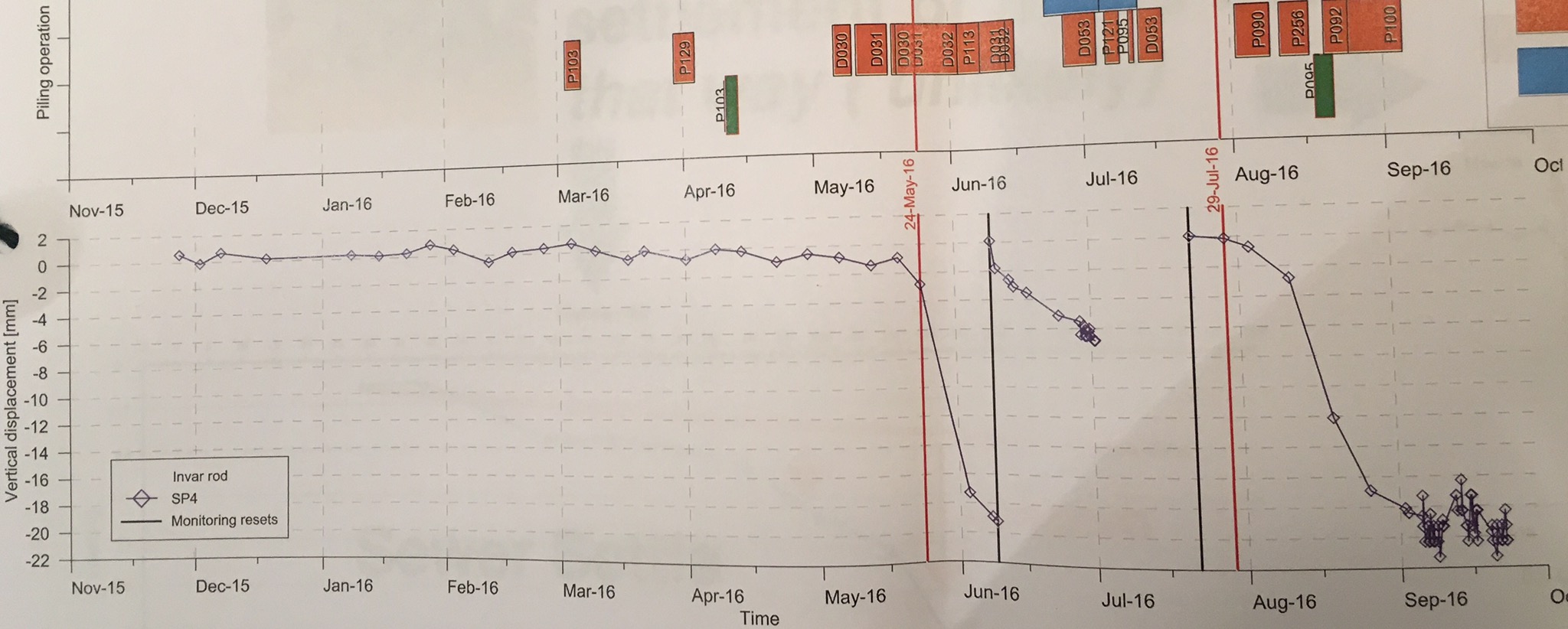
Fig 4 weekly Invar Rod monitoring results overlaid with activity, piling (green), Coring (orange)
As can be seen in Fig 4 above, the coring of existing piles for construction of the D wall seems to suggest about 50mm of settlement, combined with 200mm of settlement known to have occurred before 2013. This puts the sewer way beyond the allowable strain stated by Thames Water (TW). The large jumps and the rod resets (black lines), raise the question of the reliability of the results but if this is all you have then it has to be trusted.
As a result of this settlement TW have imposed a 7.5m load exclusion zone either side of the sewer, until its integrity can be guaranteed . This effectively makes the completion of the piling impossible and blows the programme to bits. The current solution is to line the sewer with a steel liner, this maybe jacked down the sewer or lifted into place by cutting out the crown. These are subject to TW approval of the method. This work will take 30 – 40 weeks which is a direct delay to the project, as the effected areas are on the critical path and at an unknown cost (this will be a subject of a future blog). On top of this the D wall and key piles for transfer beams can not be done until after the sewer remediation. The clamshell rig leaves site for another job next weekend, leaving an incomplete GW cut off and a fairly large bentonite farm in the only area where work can continue. This is a pretty big issue, these rigs normally require a big lead time, booking for 9 months or more and have a significant establishment cost. Due to the depth required and then associate problems on achieving interlock due to tolerances, a secant wall solution may not be possible. The resultant of this is Wanda considering purchasing their own clamshell rig at a cost of £1.2million and MPX under considerable pressure to demonstrate to the client that are worth there margins.
Sorry for the long one, I’ve probably glossed over some vital information so fire away.
 Holdfast Training Services Trial Blog
Brad,
Looks like you’ve got an interesting job already – what is your role in any of the monitoring?
I had a similar issue on my site in Birmingham, replace sewer with highway tunnel. We had considerably better ground but we approached it in a similar way. Invar rods on the crown of the tunnel – but we backed this up wtih Automatic Total Stations, 360 prisms and tilt sensors through the length of the tunnel – this wasn’t cheap. To be honest with you, I don’t know how much use the automatic monitoring was in my situation, I feel it would be more useful in yours though.
Have you done any kind of load or settlement testing to correlate between loading and deflection observed in the sewer? We ended up using sleeved piles that would prevent load being transferred to the tunnel and this seems to have worked.
Have Wanda considered the effects of vibration of the demoltion or construction operations on the tunnel – maybe more detrimental to a masonary tunnel. We also used vibration monitors to access this but due to the form of the tunnel – RC portal – it didn’t pose much of a problem.
Good luck with the piling – try and get involved with that if you can. Who are the pilers?
Chris,
I may have made the job sound more interesting that it actually is. The monitoring is carried out by a sub contractor for McGees as it is in there package. The settlement occurred prior to my arrival onsite and MPXs arrival even. Currently I have no role in the monitoring/sewer but it is only the third week.
The Invar rods although being cheap are not suitable for use during the construction and therefore an internal solution is inevitable. I personally have not done any analysis but I am considering it for a TMR. The designers AKT had estimated settlement during the demolition of the building and a 3D finite element analysis to estimate settlement during the D wall construction. The results suggested the heave from unloading would be the driving factor.
I am still looking at what analysis and limits were in place wrt to vibration but vibration monitoring was taking place. The old structure used sleeved piles, however most of the new piles site inside of the D Wall and atleast 1.5m away (this comes from assuming a 45 degree load path). I have read the report as to why the structural engineers think it has settled and they are unsure. They take the easy option saying it could be from D watering on a nearby site.
It would be interesting if you could dig anything out about the method they used to line the sewer. The current plan is to do it using a 6 hour window when they think the flow will be low but it is a combined sewer and TW are fairly sure there is some unauthorised attenuation tanks connected to it. I have suggested some monitoring combined with precipitation monitoring to get a good understand of the flows but it is currently falling on deaf ears.
Brad
Welcome Brad! The structural system is the same as Millennium Tower, Vienna, which you might recall seeing on a slide. It allows very fast construction (they achieved between two and three storeys a week) so once you’re out of the ground it could be quite quick and momentarily interesting before becoming very dull repetition. I’ll leave JM with all the GEO and simply wonder if the H&S and risk associated with relining a live 1750mm dia sewer and purchasing a £1.2M clam shell really outweigh the time, cost or quality risks associated with building new and abandoning, which is presumably still on the table? If this is about to go from psuedo traditional to D&B I’m wondering how the responsibility and risk associated with ground water cut off and sewer are being handled. Wanda can’t be about to transfer it if they’re investing in rigs but similarly Multiplex could presumably simply opt to resolve via alternative works… This all has liquidated damages liability get out clause, claim and counter claim written all over it! I look forward to following this one.
Richard,
I vaguely remember, seems a fairly standard method for high rise structure. With the current delays I doubt I will see much of the superstructure, maybe some slip forming of the core.
I think abandoning the sewer went out the window when the D wall construction started, at which point the sewer was not a problem and the settlement estimates were inside allowable limits. Wanda/MPX have just committed £100k for a detailed design for a sewer lining and are about to secure the logistic pipeline so it’s happening at some point.
The contract information is currently being kept a closely guard secret. I think the sewer remediation is being dealt with on a provisional sum, how this associated delays are being costed I am unsure. I am trying to sit down with the commercial director for the project to get an understanding of this.
But I think you are right, Multiplex having lost the original tender now have a cash cow on its books.
Brad
Brad
Very interesting. We visited this site as the same piling contractor (and team), BBGE, worked on this site as ours; Battersea Power Station Phase 3.
I thought McGee were the PC at present? Have MPX got a site presence?
I think the commercial side will be very interesting but tricky to get to the bottom of.
Good luck
Hi Dickie,
McGees are doing piling attendance and some capping beam works, they had submitted a tender for the substructure but were unsuccessful. It looks like Carey’s are getting the job and a currently working on a letter of intent, but the price is yet to be agreed.
MPX have a small team on site, monitoring the contractors and setting up for when the project moves to design and build.
I am yet to fully poke my nose into the commercial side , I am currently trying to get the projects commercial director out for a beer and see what I can learn. Possible shape some decent experience opportunities out of it.
Brad
Brad
Good luck.
On BPS Phase 3 Bouygues UK were operating under letters of intent ACTING as Construction Manager.
The site team was left trying to manage the two contractors…
However, both contractors were employed directly by the client who had signed a very naive contract (from the site teams “tactical” level).
This issue manifested itself through the client whose expectation was a little divorced from that written in the signed contract.
Brad
Just realised I forgot to say – the two contractors were BBGE and McGee who were awful…
Just returned – sop sorry for the late comment: I wonder whether the sewer rebuild might have had a fairly high risk cost in trying to place a 5 m deep 2m tunnel around a site in London. I also wonder whether a solution might have been to install a pumping station and a back drop to take the asset up and route the thing at high level around the inside of the diaphragm- I presume there are no significant laterals within the site? I can’t think that a modest size pumping station and a 2m steel pipe would cost more than £1m – even with the amortized cost of pump replacement…I wonder?
Not sure I understand what you mean by ‘coring’ ( the orange patches on Fig 4) and why this implies settlement ( is the negative settlement or heave?)
Jon, sorry for my delayed reply. I am not 100% clear why the various sewer options where discounted, however the risk pot (if there was one)for the sewer has almost certainly been spent. Coring is the removal of existing piles, as the pile is being removed the surrounding soil may relax causing settlement. The settlement is negative, I have a report from a specialist which is inconclusive blaming external de-watering.