How your Great Grandad built a Chimney.
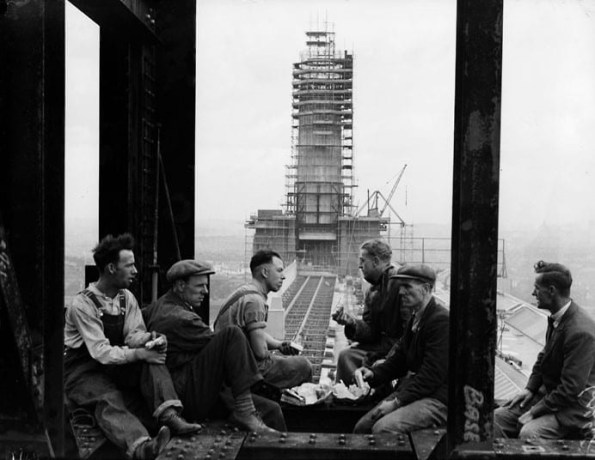
Figure 1: The original construction of Battersea Power Station’s chimneys.
English Heritage had many stipulations before planning permission was granted for the redevelopment of Battersea Power Station, a key one of which was the restoration of the iconic chimneys. These had to be built using the same methods as they were in the 1930s, which has led to some interesting issues during construction.
Jump forming over slip forming.
The original proposal was to slip form the main shaft of the chimney using a smooth form, and then go back and attach the ribs, which are mostly cosmetic and contain no reinforcement, afterwards as well as marking on the day joints (Figure 2.) However, the use of jump forming was enforced as this was used during the original build. This is where the formwork is lifted 1.22m (4 feet as per original design) every other day, building the chimney in a series of rings. This results in the horizontal rings, or day joints, as a by-product. The ribs are cast at the same time during jump forming. Having not been involved in slip forming I do not know if these ribs could be included in a slip form, could someone enlighten me? To ensure that there is an interlock between the pours, the top of the pour is sprayed down at the end of the day to remove the grout and expose the aggregate, allowing the next pour to bind to the previous one.
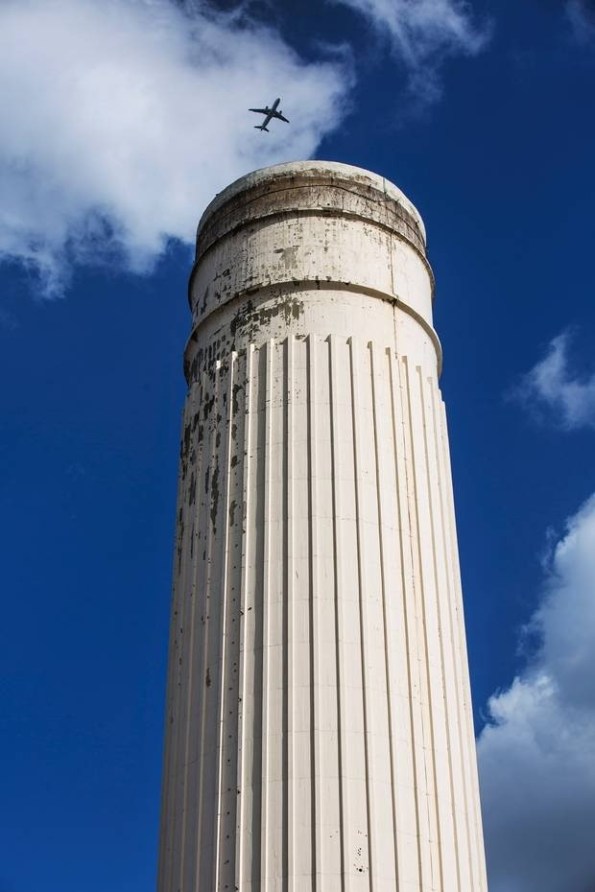
Figure 2: Original chimney, showing taper, day joints and ribs.
The taper.
As can be seen in Figure 2, the chimneys taper as they rise. This is achieved by using removable plywood panels within the outside formwork (Figure 3), which have a slight taper and are trimmed by 1.5mm per side per jump. They are sized to fit between each of the ribs. To make this small cut easier, there are 3 sets of panels, so after each form is used it is trimmed by 4.5mm on each side and introduced back into the cycle. The ribs themselves are a constant size throughout. As there are no ribs on the inside, the formwork is simpler and consists of metal sheets which can slide over each other to reduce in size.
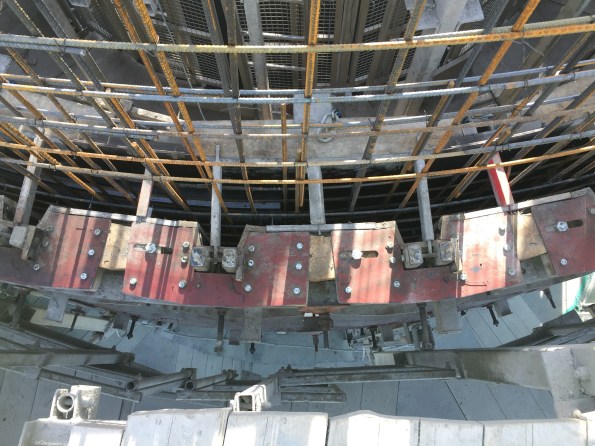
Figure 3: Formwork.
Concreting.
Due to the low quantities of concrete required per jump, a concrete pump was not suitable as more concrete would be required in the hose to achieve the height required than is actually needed in the formwork. Instead, there is a 600L hopper on mini train track installed within the hoist (Figure 4), which is filled from the onsite batching plant (which is purely for the chimneys and can only produce 300L per batch) via another hopper on a set of forks. The hopper is then pushed back into the hoist and ascends. At the top this hopper is used to fill 4 wheelbarrows, which are moved in a one way loop around the top of the chimney, pouring into the formwork via a wooden slide, before continuing around to be filled again. There are two wooden slides (Figure 5) which leap frog each other around the chimney, and despite the system being so low tech, it is remarkably efficient. The workforce of 7 (4 on wheelbarrows, 1 on the hopper / hoist, 1 with a vibrating poker and 1 supervisor / slide mover) quickly pour the 600L into place. Using this system they are now able to achieve 1 jump every 2 days.
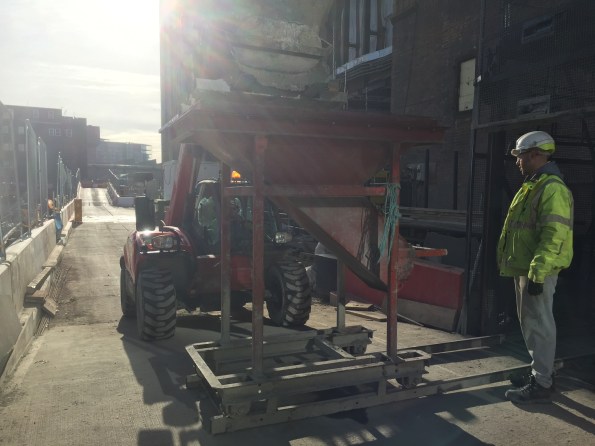
Figure 4: Hopper on tracks.
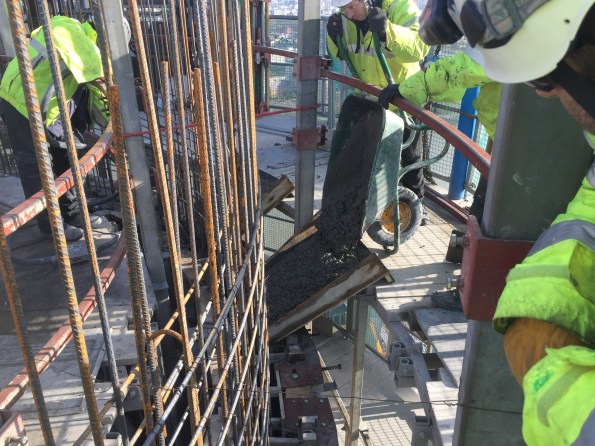
Figure 5: Wooden Slide.
Reinforcement.
This is shown in Figure 3 and Figure 5, and it consists of an inner and outer mesh which is constructed from straight bars every other day, in between pours.
Future use.
There are Halfen channels cast into the inside of the chimneys, as there are various fixtures being installed later on. All will have internal ladders for maintenance, one will have 5 flues for the various plant rooms across the development (so that the chimney will “smoke” once again) and 1 will contain a glass viewing platform in a lift which Willy Wonka himself would be proud of, as shown in Figure 6.
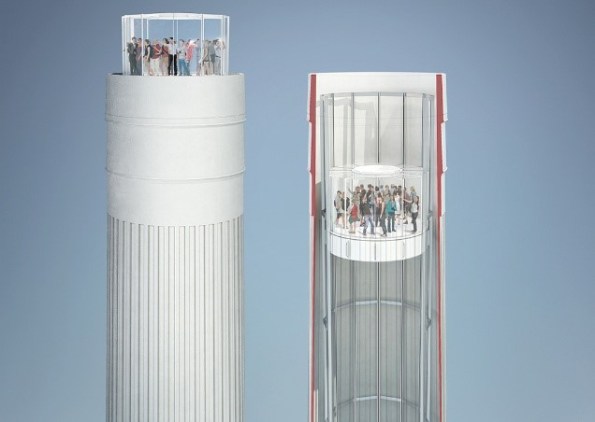
Figure 6. Glass Elevator in the North West Chimney
Summary.
I think that this construction method proves two main theories; keep things simple where possible, and that repetition will improve speed. Firstly, I think that there will always be a place for the simple, low tech solution in construction. Although simpler methods may not be as quick as more modern techniques, the potentially low set up cost and running costs, coupled with the speed at which they can commence, could often offer a more affordable solution. Clearly this may not be the case if the task is on the critical path where time is likely to be the main driver. Secondly, where things can be designed to be repetitive, they should be. There are a total of 4 chimneys to be restored, each requiring over 40 jumps. The overall process is becoming slicker each jump, and although the crew quickly reached the maximum allowed rate of 1 jump every 2 days, the total working hours to achieve this has reduced.
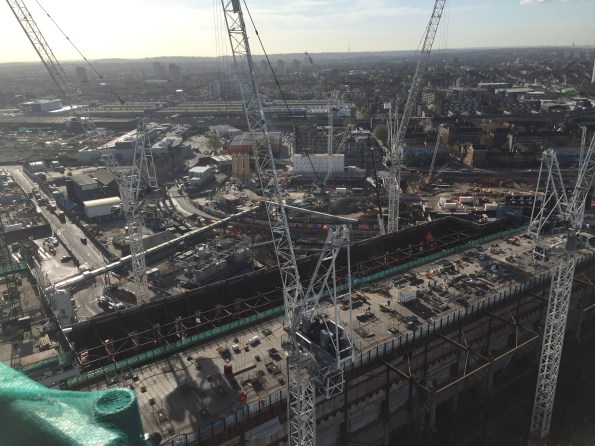
Figure 7: The view from the top (looking at the NLE.)
The chimneys are now finished, and a construction enquirer article has been written.
http://www.constructionenquirer.com/2017/06/05/two-year-rebuild-complete-of-battersea-chimneys/
 Holdfast Training Services Trial Blog
Laurie,
Good intro to an interesting project. The cost benefit analysis between jump form and slip form is a good thing to look. So much so I wrote a TMR on it a few weeks ago so I have a few minor comments on your blog. Obviously this is a brief summary but feel free to argue any points I make if you have a different perspective.
1. I don’t see a reason why that type of structure couldn’t technically be cast using slip form, though for the following reasons I wouldn’t advise it:
2. Slip Form rigs are very expensive to design, procure and install. The rig on the 100BG project for example was circa £2million quid all up. And they take ages to install. As a result they are generally only considered financially beneficial on very tall projects where the programme savings you gain from their use (ie once climbing they are approx. 30% quicker than jump form) outweigh the initial capital cost. In concrete structures taking upwards of 4 months to build, the savings from reducing programme by 30% are significant!
3. Generally, the quality output from a slip form is a lot worse, therefore they are better when you cant see the final concrete structure. In our case the core was always going to be hidden by a steel superstructure so appearance wasn’t that important. Looking at yours clearly the surface finish is important, hence the interest in the groove detail. The ‘smooth’ pans you refer to in slip form still cause significant friction stresses against the relatively low strength concrete when the slip form moves up a level, as such damage is inevitable. I never saw any structural implications but the final finish was often ugly.
4. On the benefits side Slip form rigs are self climbing, self loading systems using hydraulic jacks to transfer load to ground and lift the system. Jump form typically (though not always-see the 22Bishopsgate Automated Jump Form System) require Tower Crane support to jump lift every panel. You have probably spotted already that TCs are often a fiercely contested resource on site between different subbies. Committing multiple crane hours each day to lifting formwork delays other programme driven tasks such as steelwork etc. This alone is a good reason to avoid traditional jump form. That said, I’ve travelled past Battersea and you have an absurd amount of cranes so its probably not an issue, worth considering it as a cause of the decision though.
Looking at this generally I agree using jump form, as you said, is the all round better option in this case.
Hope all is well
TD
Tom,
Thanks for that, I’d not really looked into the various benefits of each as I was under the impression that this decision was made purely for heritage reasons, so slip forming was ruled out. However after reading your response maybe more thought was put into it. With regard to lift, despite the number of cranes (currently 13 tower cranes but rising to 16) none of them are actually as tall as the chimneys, so this jump form rig must work without crane support somehow. I will do some digging.
Tom, Laurie
Is a tapering structure still easily slip formed?
I would think its achievable but probably not easy. Mental Architects strike again, I still don’t understand why they hate flat, straight and square edged design!
Laurie,
Thanks for your blog. I have no experience of jump or slip form to talk of but I do know that from a risk point of view there was limitations on the construction of the chimneys.
Probably a marketing constant to the Malaysian clients identified that the chimneys were a key feature to the power station. There was considerable concern that the contractor would not be able to actually build the new chimneys after demolition that they were worried that they could be left with a power station without chimneys. So high was this on on their risk register that the contractor was initially limited to demolishing and building each chimney one at a time. I believe that after the construction of the first one that they got permission to proceed with the three remaining chimneys concurrently.