Archive
New arrival at Gatwick and a nugget for the Civils
Having received a detailed handover from Stu Douglas, I am now in the chair as an M&E Package Manager and currently involved in a number of interesting projects. The Department for Transport has imposed a directive on all major UK airports which requires Gatwick to install new baggage scanners to ensure they conform to the Explosive Detection System 3 Standard by 1 Sept 2018. The machines are larger in all regards, including size, weight and heat rejection, therefore there are multiple projects running simultaneously in order to install these machines; I will introduce you to these projects over a number of blogs in due course.
The Gatwick Airport estate is vast and is distributed across two terminals, North and South. The South Terminal opened in 1958 and has a footprint of 160,000 m2 and the North terminal opened in 1988 with a footprint of 98,000 m2, with a supporting workforce of 24,000 employees spanning 252 companies. GAL employs 2,800 staff directly which is sufficient to manage a throughput of 43.1m passengers in 2016. GAL is projecting that passenger numbers will increase to 52m by 2032 and the infrastructure must also expand to accommodate such a vast increase.
The airport boasts a colourful past, serving as an aerodrome in the 1930s and later requisitioned for military use for the RAF in 1940. The estate was renovated in 1956 to become a commercial airport paving the way for Gatwick to become the UK’s second largest airport. Figure 1 shows Gatwick in general with the South Terminal at the bottom of the image.
 Figure 1 – Ariel view of Gatwick Airport.
Gatwick is a heavily engineered and congested environment which makes the simplest construction project or electrical/mechanical installation very complex indeed. That said, I have come across a small construction project which may be of interest to the Civils. The principle contractor is MARCO (to be clear, this is not a person but the company name) whose brief was to Design and Build office space and a welfare facility for the Gatwick Handling Agents (GHA) to operate from in the South Terminal.
The project progressed well until the contractor had to excavate a 50m x 1m channel through a concrete base of 600mm to allow for soil pipes to transit waste from the toilets to a new foul drain. Figure 2 is a capture of the design drawing which shows the location of the toilets, pipe runs (brown) to the foul drain and I Beam columns (in the red circles).
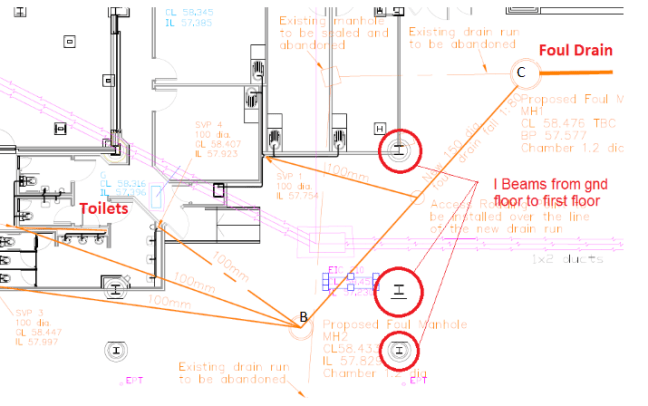
Figure 2 – A capture of the GHA design drawing showing the area of interest.
The foul pipe from B to C has a cross fall of 1:80 and both the grey and black water is gravity fed to the foul drain at C.
Unfortunately the channel is in a confined space with a low ceiling and restricted access, therefore the contractor is unable to use diesel powered excavators and dumpers to remove the rubble. Consequently they employed the use of a portable control BROKK hydraulic breaker and then handball the rubble from site. The BROKK and channel is shown in Figure 3.
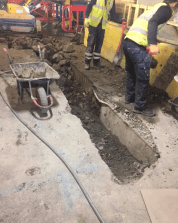
Figure 3 – BROKK and Channel
The BROKK is also shown in Figure 4 below, it requires an 15kW/32A 3 phase supply from a generator which can be remoted away from the confined space. There are larger machines on the market that can be hired, this is at the bottom end of the scale. The machine will produce a noise level well in excess of the HSE standard of 85 dB(A) therefore ear protection is required. The machine also produces a downward pressure on the tip at 25MPa.


Figure 4 – BROKK 100
THE PROBLEM
The vibration energy applied through the tip to the ground is transmitted through the concrete to the vertical I Beam columns circlied in red at Figure 2. The vertical columns connect to horizontal beams supporting the Departures Lounge and a number of retail outlets. The vibrations were having an impact on the outlets above and the Project Manager was summoned to Harrods to explain why their jewellery was dancing around the shop; as a result the excavation was halted with immediate effect. The noise level was measure by the on-site EHS representative at 76dB, to put this in perspective, employers must provide PPE to those exposed to noise above 85dB. Another 9dB increase then the customers in Harrods would be issued with PPE!
THE SOLUTION
At first, the PM suggested that disruptive maintenance is conducted in silent hours which is between 2300hrs and 0400hrs, however if this course of action was adopted, the contractor would fall behind considerably. The contract is an NEC3 Option E (Cost Reimbursable) which translates into delay costs which are imposed onto the client (Gatwick).
The second option was to cut the concrete channel beyond 600mm depth using an orbital cutter down to the compacted earth beneath, doing so detached the channel from the rest of the concrete pad. This simple act prevented the majority of the vibration energy being transmitted through the pad to the vertical columns. The BROKK was re-introduced and the noise assessment was conducted again during silent hours and a notable reduction was observed from 76dB down to between 52-54dB.
Both contractor, client and Harrods are happy once more!
Site Recce and My Last Blog
I was recently involved in submitting a tender for the construction of for a proposed development that had 3 x 30 storey towers and a common 3 level basement in Brisbane.
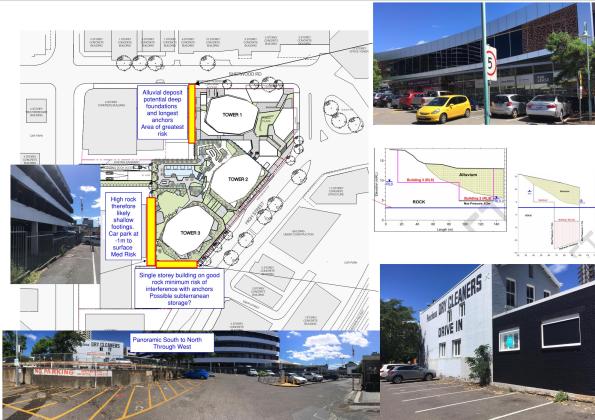
I was asked to look at where there were likely to be clashes of ground anchors and neighbouring structures. The image above is what I prepared to brief the bosses and contains a section through the development to show what the rock horizon is.
After conducting a desk top study I had to recce the site and determine what the likely foundations were and whether they could impact upon the ground anchors that would temporarily retain the basement. From the desk top study I has a good idea the ground profile but no idea of what the foundations of the neighbouring structures were. As the site was only 30 mins away I decided to take a trip out to visit.
As an interesting aside – the dry cleaners photographed above has been leaching chlorinated solvents into the groundwater that has now contaminated the whole site and meant that we have to vapour proof the entire basement because the of these volatile organic chlorinated compounds (VOCCs) into the groundwater.
We had previously looked at a soldier pile and panel solution to retain the basement in areas of good rock and then a water tight wall. This pile and panel solution would now need a bentonite lining and then vapour proof barrier. Attached is a sketch of the design I compiled along with the sub-contractor and environmental consultant. This is not easy to construct and is going to be very expensive as it needs to cover the whole basement. Given the new information the client has withdrawn the tender and is looking at possibly doing away with the basement altogether.
Scan-to-Me from 10 4 31 1 2017-04-04 074557
The end is very much nigh. The attachment to the Multiplex Queensland Head Office has been more beneficial than I initially believed. I have gained significant technical experience from a first class structural engineer but also a vast amount of contractual experience. I have had the opportunity to lead on geotechnical design and hopefully has provided me with some useful case studies for CPR.
In other news the family enjoyed one last holiday in the sun. It was very much needed after the thesis! Mark – bring on the photos of Namibia!
![IMG_6964[1].JPG](https://pewpetblog.com/wp-content/uploads/2017/04/img_69641.jpg?w=595)
Sam and Izzy (with friends) enjoying Fiji
 Holdfast Training Services Trial Blog