How much reinforcement is too much reinforcement?
I draw your attention to the photos below as an illustration of the problem. It shows the quantity of steel being installed both longitudinal and transverse.
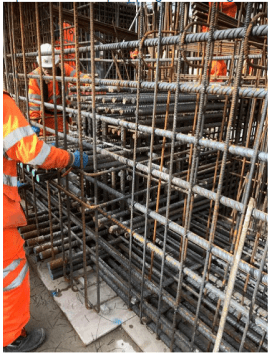
Photo 1 – B40 Longitudinal Bar (The steel coming towards the photo is the bottom longitudinal steel at the end of a beam)
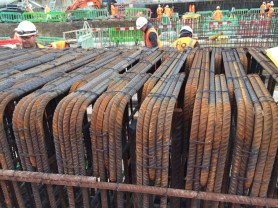
Photo 2 – Transverse Reinforcement

These beams are at the B01 level in the Battersea Station Box, in places 3.8m deep, acting as transfer beams for the over site development. They have been designed for point loads of up to 10MN, transferring the load to plunge columns.
If I now break this into two:
Longitudinal steel – The quantity of longitudinal steel in places is greater than the 0.04Ac. I thought this 4% figure existed to prevent brittle failure and allowed tension cracks to appear in the concrete prior to the beam failing. Therefore, if this is the case then what are the implications of a design such as this?
Transverse steel – Looking in the guidance for the minimum spacing of transverse steel, the distance should be 20mm (10mm aggregate) to form a bond between bars. Clearly this does not, therefore I see three problems potentially arising. Firstly a proper bond will not be able to form between traverse bars; does anyone know what implication this will cause? Does it mean a reduction in shear resistance? Secondly it does not allow for vibrating pokers to be lowered into the concrete at this location during casting and thirdly it acts as a sieve during pouring, causing separation in the concrete. All of which are mentioned in the codes when designing transverse steel.
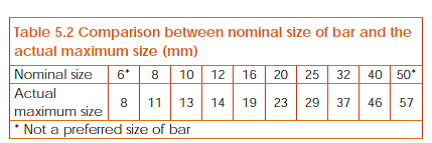
Looking into the detailing a bit further I discovered in the IStrutE detailing guide, the table below shows the difference between size and diameter of bars. Apparently one should not confuse size with diameter, after all a size 40mm bar is 46mm in diameter. Therefore when this transverse steel was detailed, if the size was assumed to be the diameter, all those millimetres add up to the situation in the photos above.
 Holdfast Training Services Trial Blog
Henry,
We have had a few issues with over crowded reinforcement in the main tower core base here (~120t reinforcement). This was mainly in the bottom layers where the lift core starters also tied in. The solution we found was to decrease the mix to 10mm aggregate (which you already have) and then move some of the steel from layer B2 up to layer B4. Not sure if something similar would be possible in your case?
Thanks for the reminder on the bar diameter table – I’m pretty sure the design here has suffered from this (or a miscalculation) in a few areas.
James,
Yes, in some locations, in consultation with the designers, we have moved the steel into a higher layer. To indicate the quantity in places we already have a B5 layer of B40 bars.
I thought the design bar diameter table was interesting as I’m sure we all just assumed the size was the diameter when we were designing RC previously.
H
We did discus difference between specified diameter and actual bar size but to be fair in it is the middle of so much else that is more important in understanding the fundamentals that this is something that is best left for learning on site. Hey presto, you and all other readers will now not forget 🙂
We also discussed bar bundling but again in the fog of war… You will note that EC allows 4 bars to be bundled and your RSME reinforcement guide has detail on layout and how the equivalent bar size is calculated.
Having said all of that, at 3.8m deep these are no ordinary beams but it looks rather like someone has missed that point somewhere along the line. I’d expect there to be design of several virtual beams within the depth to make better use of the concrete, which I suspect will otherwise hit it’s strain limit before a full depth parabolic stress block can be developed.
I know you have several of these super beams on site and that Jonny produced a report on them at one point. I suspect that there is a very reasonable TMR in progressing the assumptions and discoveries he made further if it interests you.
Henry,
I think you’ve got valid concerns. Have your contractors responded to these concerns?
I’ve not seen anything like this but when I had concerns about the constructability of a design my instinct was to check the design risk register to see if it had already been raised and dealt with. Might they already have a solution?
Tony
Tony,
On this project FLO (Laing O’Rourke and Ferrovial Agroman JV), who I am working for, are the Principal Contractor and constructing this area of the works.
This is a D&B contract and the finialised drawings for the detailed design are in some cases only days ahead of us fixing the steel. Far from ideal! However our representatives from the designers on site are fairly quick about processing design changes. For example allowing us to miss out links so that we can fit a concrete pump or vibrating pokers into the steel cage. But this is a ah-hoc solution slowing down the steel fixers.
This does not change the underlying issue that the loads required on the beams are large. The loads from the columns which will sit on these beams are from the Battersea Phase 3 building which previously had a design change. The knock on effect was redesign of these beams, therefore it is our belief that the design includes more steel to future proof more potential change in design from Phase 3. As part of this I believe the designers have forgotten the actual width vs size of the Rebar.
I have now checked the Project Risk Register and it has £100 000 post mitigation against ‘Reinforcement congestion – preventing flow of concrete’. The mitigation states ‘Develop Design’.
Henry
Henry- not really my bag this
For maximum area EC2 gives 0.04Ac generally rising to 0,08Ac at laps but there is a rider that allows higher if it doesn’t hinder construction ( whatever that means).
The links look a bit suspect: are you allowed to have more than four bars in a bundle? If the equivalent bar size is the bar size multiplied by the root of the number in the bundle- this then sets the spacing AND the COVER – looks to me like both might be really struggling.
I was trying to think of anything fundamental in regards bar ( or equivalent bar) spacing. In normal concrete the concrete failure occurs in the paste between the agg. In other words the paste is the weak bit…..it ye cannae get the agg in then ……..In high strength concrete this rule reverses.
Henry,
Out of interest who are the designers? There is of course always a concern about having space to get the concrete in between the steel.
That said, depending on your phase 3 placement I expect your views might adjust slightly should you find yourself in the position of designing something, such as a large transfer beam, which actually gets built in real life rather than as an academic exercise in the head of the PEW tutor marking academic work. In this context, its easy to understand why structural engineers often over design steel in concrete elements. On large projects the cost of this extra steel is normally minimal compared to the potential cost implications of something failing on site. Therefore the Rich McLure concrete approach of design big early, then add a bit more for fun, normally applies.
In our design office, on temporary works systems such as Tower Cranes, I hear the term Utilization a lot. This is essentially how high an element is stressed compared to its design limit. Even after high FoS are applied to design loads, we typically aim to get the utilization to around 75% as a maximum. Therefore if I have an anchor capable of carrying 550kn (40 dia bar) of load we aim to keep the load in it below 385kN. I’m sure the guys at the wing will think this is mad. That said, under utilized systems are quicker to approve through extensive design checking processes and helps us all sleep better at night.
Tom
And PS normally if something cant be built or is not practical the concrete sub contractors raise it as NCRs when they do their steel detailing process. As experts in building concrete their own engineers often have ideas worth considering.
Tom,
I think this is mad. The habit of putting a FoS onto something that is already designed according to a limit state approach displays ignorance of the principles applied in design. You should sleep very soundly at night at 100% utilization. I think it’s perfectly understandable that, where designs are at developed not technical design, a designer might ant to recognize the risk of changes to load paths and actions and mitigate this through an allowance of spare capacity in order to accommodate increased forces. This then allows for either no change at technical design or a saving depending upon myriad time cost quality factors. On which basis, this is not mad.
The other aspect to bear in mind is that utilization also impacts serviceability limits, fatigue, creep, relaxation… so it might not be ultimate limit state that is driving the design decision.
Of course, in the spirit of partnering, NCRs are raised by the subcontractor as soon as an issue is noticed. Anecdotally, however, they are raised as soon as there is risk it will be raised by others and not at the earliest opportunity. This is so that you can claim the float at the latest point possible to relieve pressure on other issues that might have arisen for which no delay would be admissible i.e. recover programme slip by claiming a delay on a design aspect that is admissible. It’s a naughty contract/project management tactic but is commercially useful. Anyone seen this/suspect this?
Slightly straying off Henry’s original post but hopefully a useful discussion anyway.
I think I’d agree with Tom on temporary works. I know JM has said that he thinks FOS in temp works are crazy because you KNOW what your loads will be, but in the back of your mind is the thought that although you’ve been told how it will be used you’re never sure how accurate the brief is. The environment can change quickly on a construction site so even if it’s not your fault that structure X was overloaded, it’s comforting to know that you’ll find out during the weekly inspection rather than when you’re dragging bodies out from under it. Resources aren’t so critical either as you can probably re-deploy them, so why not chuck a little extra capacity in? With a contractor you know and trust then you might be less conservative, though, if that’s not the case, then sleeping at night is quite important.
However with permanent works I think get rid of the term utilization and focus on optimisation. Why design a transfer structure that’s capable of taking 25% extra load, you’re not suddenly going to see an increase of 25% of the design load one morning when a building is being used. Surely it’s just wasted resources, and any fool can overdesign (even me). The guy’s here are working on optimisation software that focuses on optimising each element in turn for the forces it will actually see in use, and deciding their own material safety factors based on quality and the level of assurance. That’s why they get paid the big bucks.
But, I’m probably wrong about that as well. Maybe that’s where the industry was/should have been 20 years ago. Now we’re all about sustainability and the circular economy. Engineers now aren’t talking about utilisation or optimisation as that’s become bread and butter. They’re now talking about designing tight, or designing loose and comparing options between optimising for the loads the current use will see, with a relatively short design life, and hopefully making it deconstructable, or designing for long life which requires an assessment of potential future uses, which could have significantly different loadings. The latter has many barriers but the payoff of a large % structural re-use is a huge benefit to programme, cost and sustainability. Go big early?
Tony I will continue your thread. I think this is situation dependent. Personally my departments mantra has been to walk the line, Pay attention and use the capacity to the max. This is a design and build contract the future use unless specified should be of no concern. They are contracted to build what they have agreed at contract. Why should the contractor pay for extra capacity. Sure it works if you can reduce programme but, every time you increase capacity it cost money in material and labour costs. A balance has to be struck.