Archive
Online CPD – ICE CPR presentations
Whilst searching through the ICE events page looking for CPD events in the Manchester area I was presented with only 2 search results, a Fellowship workshop and a student pub quiz. Acknowledging that I may not be quite ready for the first and questioning the output I would get from the second, I widened my search to see what past lecture recordings were online.
It was then that I found a recording of the James Rennie medal final for 2017 (link here). As detailed on the ICE website, “The James Rennie Medal recognises the best Chartered Professional Review candidate of the year. This year’s final will feature ICE’s top three Chartered Professional Review (CPR) candidates of 2016. They will each present and defend their CPR reports to an audience.”
I found it a useful insight to CPR presentations, even if it is currently a year or so off. Hopefully it’s of use to others out there if you weren’t already aware.
SUPERLATCH – An innovation in piling safety and a time saver
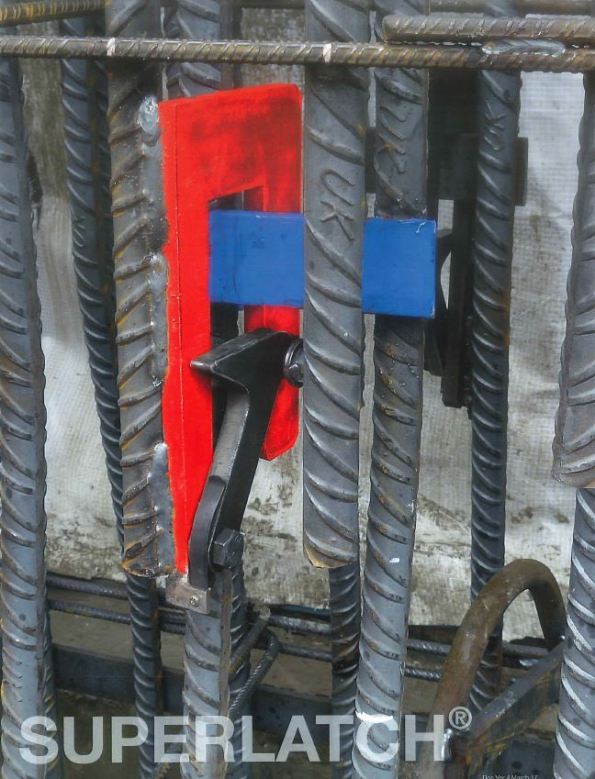
Figure 1: Superlatch connection system.
Today I used SUPERLATCH to splice the pile reinforcement cages for the first time, and I thought that the overall system is interesting and worthy of a blog. The inventor (Steve Render) was here as the system is in its infancy, so I had a good opportunity to ask a few questions and to get a brochure from him as well.
Superlatch is a highly efficient means of connecting spliced reinforcement cages during the construction of rotary bored piles, and I was assured that it can be used in CFA and diaphragm walls too. It has two main aims, to save time, and to increase safety. I will cover these separately below:
Safety
Traditionally the connections between sections of reinforcement cage have consisted of multiple shackles or u-bolts which are secured by the contractor between the piles. This practice requires that the operatives reach through the gaps in the cages with their hands or even whole arms, whilst the lower cages are suspended on the casing with temporary supports, and the top cage is suspended by a crane. Although this process has been used at BPS for all piles so far without incident, if either of these cages were to move, the arm / hand would be at serious risk. Superlatch is welded to the cage off-site during cage construction, and when the cages are lowered onto the preceding cage, the latch mechanism (covered later) automatically secures the connection with no need for any operatives to reach through the cage. If the cage needs to be dismantled for any reason, there is a release tool (Figure 2) which again does not require an operative to reach through the cage.
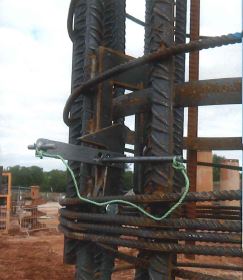
Figure 2: Release Tool
Time
In theory, not having to manually splice the cages clearly saves time, however so far my experience of Superlatch (one pile consisting of 5 cages and 4 splices) is that it is slower, although I am confident that it will soon speed up. The cages which it is being used to splice are formed of 44no 40mm diameter bars, spaced equally in pairs. There pairs are welded together in places, the uppermost of which is approximately 1.2m from the end. This results in some pairs having gaps between them at the end, as shown in Figure 3.
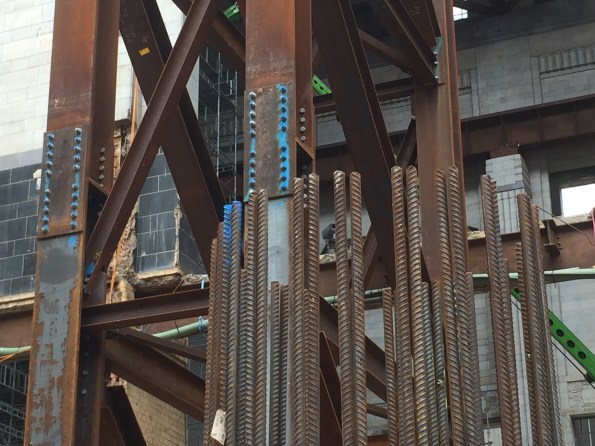
Figure 3: Gaps in paired bars.
When lowered, the Superlatch in the upper cage sticks into the lower cage like a fin, as seen in Figure 4. These fins need to be located between the pairs of bars, but it has proved difficult to achieve this, often resulting in many lowers and raises of the cage before it is in the correct position. I have suggested that the pairs of bars are spot welded at the top to mitigate this problem – but no welding of the cages is allowed on site, and attempts with tie wires proved insufficient. The fabricator will be contacted and asked to do this weld at the top, which should improve the time taken on piles where the cages are yet to be delivered. Clearly this will not be an issue when single bars are used. I expect this system to save approximately 10-15 minutes per splice in the near future, resulting in a considerable saving of 40-60 minutes per pile, as well as increasing safety.

Figure 4: Multiple latches per splice protrude like fins into the inside of the cage.
How does it work?
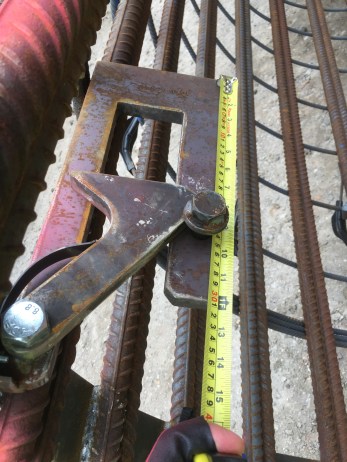
Figure 5: Superlatch Mechanism.
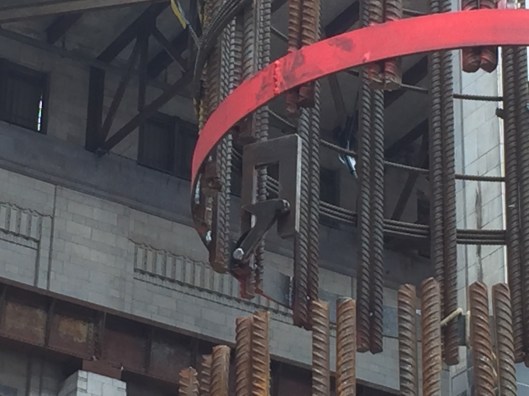
Figure 6: Mechanism in position.
As can be seen in Figure 5 and Figure 6, Superlatch works with a simple spring loaded latch, which is lowered onto a receiving band (shown in yellow on Figure 7) on the cage below. This bands can be substituted with a plate for a diaphragm wall. There must be a minimum of 2 latches per splice, today we had 3 for the lowest splice and 4 for the remainder, due to the load each splice would carry increasing up the length of the cage (the cages are suspended during the pour.) A range of sizes of Superlatch are available, with an individual load range of 1-6 tonne, so it can be suitable and efficient for small to large cages.
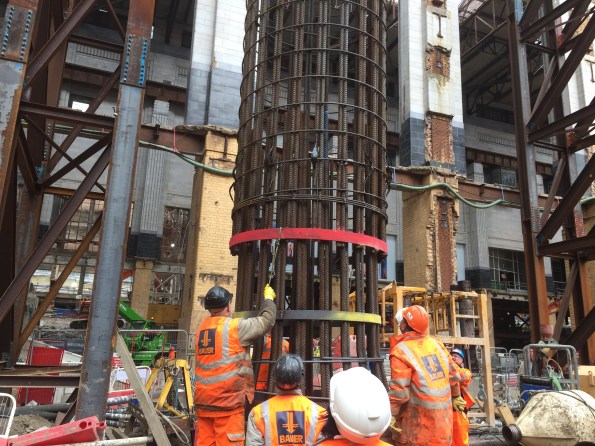
Figure 7: Lowering the cages together.
Conclusion
This system is undoubtedly safer, but in my experience of piling (admittedly limited to just 7 weeks) the risk which it mitigates has a very low likelihood already, and potentially does not need further mitigation. However, as a time saving product, I think that it is a really good option. Bauer and their cage fabricators have not used Superlatch before, and the operatives here and the fabricators at the yard are still learning the initial lessons of how to adapt their techniques and designs to maximise the potential benefits. With a little more experience in splicing cages in this way, coupled with an extra / repositioned weld when bars are in pairs, I think that the product will be a success.
I have added the Superlatch brochure here if anyone is interested, and I will reply in 1 to 2 weeks with an updated opinion of time savings once I have used it more and when the modified cages arrive.
Ground Water and Retaining Wall
This is one for those of you with a keen eye for geotechnics I think.
I am currently looking at getting all the ducks in order and the sequence of the bulk dig on One Nine Elms. Prior to the excavation, a ground water pumping test will check that the basement box is water tight (more likely reduce the risk it leaks like a sieve). This has raised a slight contractural issue which has been missed in the scope of works and allowances the sub contractor has agreed.
The design of the D Wall assumes the ground water level at the level of the soil on the passive side throughout the excavation. However the pumping test contractor has not allowed for recharging the box after the test and the substructure contractor have specifically stated their rates for excavation assume the ground water level is below formation.
During a planning meeting I was quizzed fairly robustly, below I have summed up my response. Are my comments sensible or have I been an idiot?
1. Why would the sub contractor specify the GW level in their rates? If the GW level is at the surface, the excavated soil will be wet. Dry material will need to be imported and mixed with the wet before it can be transported and accepted at the tip, therefore resulting in cost. I also suspect bulking factor is dependant material and water content.
2. Would a lower GW effect the working surface? Yes it would improve it, effective stress goes up which is directly proportional the the shear strength of the soil.
3. Why would the wall be design like that, it’s not how it is constructed? It’s the worst case, the designer may have been unsure of the methodology so will have taken worst case GW and therefore higher pore pressure.
4. What would happen to the D Wall if the GW level was below formation during the dig? Errmmm….. it would effect the wall stability. See scribbles below, in short passive pressure would increase, therefore stability would be better.
 In terms of the strength, the SF & BM capacity of the wall won’t change as the strength of the steel and concrete is unchanged but the loads exerted on the wall will. I suspect the position of the max BM will change but be lower in value. Running it through software would have quickly told me this but there was none to hand and I didn’t fancy getting my pencil out, plus I would need to check at the various excavation stages. So my answer was weak in this regard.
The wall carries a vertical load, this can essentially be modelled at a pile with some of the shaft resistance gone i.e. where it is excavated. The wall will experience the max vertical load in the long term therefore it would be safe to say the construction methodology will not effect the vertical capacity.
Multiplex being a management contractor the would never rely on my advice, even if I put numbers behind it. In the end the design contractor will be paid to alter the GW level in their software and give the thumbs up. A 10 min job charge at a day or two fees.
City Pollution – Old Habits Die Hard
In the sustainability study group this morning we discussed the Construction industry and current lack of regulations regarding control of plant vehicle pollution. The following link takes you to an article that discusses the problems with construction plant pollutants in London and the challenge of regulating them in an industry where enforcing higher standards would generate absurd replacement costs.
It turns out that a lot of plant equipment currently used in London is Red diesel powered and outrageously inefficient. One of the Geo boffins told me they had recently received some environmental data from a site showing that it currently takes one piling rig 1000 litres of diesel to bore every 60m deep pile. There are 74 of them on the project!
The construction industry might grind to a halt if the Government begins to pay as much attention to plant equipment engines as they do VW diesel cars.
 Holdfast Training Services Trial Blog