Home
> Uncategorized > The dangers of storing piling casings upright
The dangers of storing piling casings upright
Just a quick blog to warn about the dangers of storing piling casings upright, something which is done at BPS as space is tight, and I am sure is often the case elsewhere too.
When excavating down to the pile to construct pile caps, the reinforcement cage was clearly damaged on two adjacent piles, as shown in Figure 1 and Figure 2. After a brief investigation, it was concluded that the damage was probably caused by screwing a casing into the ground as indicated in Figure 3.
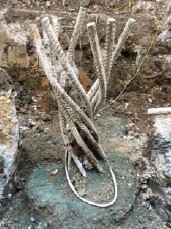
Figure 1. Damaged reinforcement cage 1.

Figure 2. Damaged reinforcement cage 2.
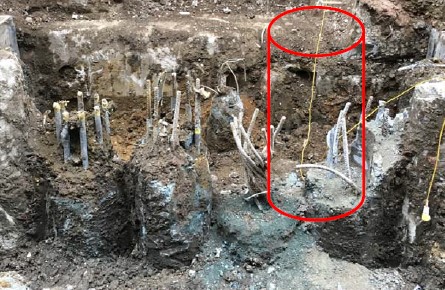
Figure 3. Assessed cause of damage.
What is going to happen now?
- Mitchellsons to break down the pile to sound steel and concrete which could be deep, attach couplers and extension bars and add additional shear reinforcing rings if required;
- Mitchellsons to then build the pile back up.
Impacts to Bauer (Piling Contractor)
- Repair and re‐work charges to be expected from Mitchellsons;
- Could cost Bauer up to £10,000 or £15,000 on this pile! There could be other piles where this has happened, not all are excavated yet.
Preventative Action
- Avoid screwing casings into the platform for storage as much as possible;
- If possible lay casings on the platform;
- If needed to store casings vertically, before screwing the casing ask the setting out engineer if the location is free of previously completed piles;
- The engineer will specifically locate clear areas and mark them out, or place casings into new pile locations to start to form the next pile.
Categories: Uncategorized
 Holdfast Training Services Trial Blog
I’m not sure that I understand this properly but it looks more like the cage has been screwed into the casing because it appears to have rotated and closed up about its central axis. The force require to do this would be fairly high so it wasn’t accidental. Did they have trouble lowering the cage into the pile after it was poured and decide to try to rotate it in with the rig?
Setting aside the cause, how are these piles working in the future structure? what is the steel intended to do as a structural function? Pile bending or pile tension? Are the piles all standardised to reduce chances of error and does it matter if there’s one with dubious steel? Could the risk be accepted for a greasing of palms thereby avoiding nugatory(?) work and introducing delay?
Contractually, why are Mitchellsons breaking down the pile? Surely the original contractor should be given the option to make good defects?
Rich,
The piles were cast in situ bored piles and the cage was in position before the concrete was poured, so the twisting of the steel took place after the pile had been completed.
There is a possibility that the auger tool itself was stored upright and again, this would have been screwed into the ground, but the cases were routinely stored upright and screwed in approx 0.5m (which would have clashed with the piles shown) hence this has been assessed as the most likely cause.
As for the structural form, the piles form part of the contiguous pile wall and as such will be subject to bending, as well as axial forces from the structure they support above. Yes, the piles are all standardised, but it was decided that to make it easier to form the pile cap above the wall the piles had to be repaired.
Bauer have moved onto a different part of BPS and the pile cap is being completed by Mitchellsons. You are correct in that Bauer were given the opportunity to make good – they elected to appoint Mitchellsons to do the works on their behalf.
I hope that makes sense.
I can’t argue too much about how this happened. But to pick up on Richard’s point; even if these are for a contiguous wall you will find the Max BM will be at , or just below , dredge level and that there will be a shear force at the cap level ( which is where I assume this twist is seen). I guess it is not determined whether the twist is all the way down? If it were not then the MoR of the pile may be entirely satisfactory….as usual it requires a bit of analysis rather than ACTION.