Learnings on Sustainable Drainage
Introduction
My work at Baltimore District has seen me introduced to sustainable drainage practices across the whole construction lifecycle – concept and planning phases in Phase 3, construction in Phase 2, and maintenance and retrofitting (also in Phase 3)… Okay, no proper termination/deconstruction yet… so maybe not the entire lifecycle …. but you get the point.
Because of my exposure to it and it’s relative importance in gaining planning approval for a project, I thought I’d summarise some of what I’ve learnt to see if anybody else had come across it during their attachment and possibly start a conversation about any differences to UK practices/approaches. Please note that all images are most definitely NOT my own – thanks go to mostly google, and also to the US EPA!
Sustainable drainage forms part of what the US calls environmental site design – though I haven’t experienced it on attachment. In the UK such sustainable drainage practices are also accompanied with the term SuDS (Sustainable Drainage Systems), however, in the US, the philosophy, though very similar, is called LID (Low Impact Development). As a general term, however, most engineers in the US refer to drainage, flood protection etc… as SWM – pronounced ‘swim’ (Storm Water Management).
Why do we need SWM?
In a nut-shell, development tends to reduce the ability of the ground to soak up rainfall through abstraction, a term used to cover infiltration, depression storage, and transpiration etc… This results in more surface water – or run-off. This effect is best shown in a graphic such as the one below from the US Environmental Protection Agency’s technical report on the subject:
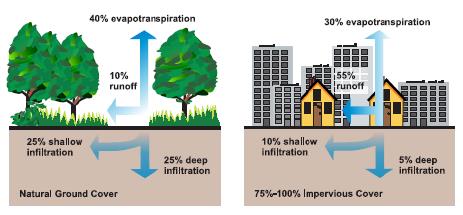
The consequences of such increases in run-off are numerous. Water quality issues include increased levels of pollutants such as nitrogen, phosphorous, and sediment reaching downstream water bodies. It can also result in changes to such a waterbody’s temperature, damaging the health of flora or fauna. In addition to the more obvious issues of flooding through increased run-off volume, water quantity changes can result in higher peak flows and subsequent erosion or scour, as well as loss of groundwater recharge, thus lowering the water table and/or reducing the base flow of local rivers and streams.
History of SWM in Maryland
SWM has undergone a significant evolution over the last 20-30 years. The more recognisable, traditional, approach to drainage used piped systems to convey untreated water quickly to a local outfall:


This practice then morphed into ‘conventional SWM’ which used large detention basins (‘dry ponds’) with a flow control device to outfall into the receiving water in a more sustainable manner. These practices mostly focused on treating quantity, though some ponds were later designed to hold a permanent pool of water. This resulted in them becoming known as ‘retention’ basins, or ‘wet-ponds’: these retention practices were able to improve water quality, in addition to quantity, as the permanent pool of water enabled settlement of suspended solids and breakdown of heavy metals prior to the water’s discharge into the receiving water. Two pictures of a detention practice are shown below:
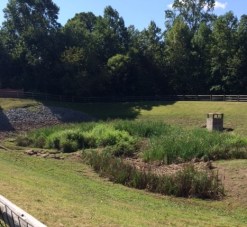
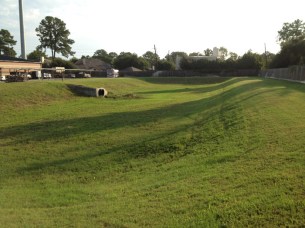
By the early 2000’s, modern sustainable drainage was taking shape and LID was conceived as a means of delivering the benefits of conventional SWM but through de-centralised practices, close to the source of run-off. This prevents concentration of pollutants and reduces the size requirements of individual practices, making them more easil incorporated into urban designs. These ‘Best Management Practices’ (BMPs) include practices such as rain gardens/bio-retention features, submerged gravel wetlands, and green-roofs etc…. The major improvement to conventional SWM being that LID/modern SWm promotes infiltration into the ground, thus re-establishing groundwater properties and mimicking a site’s natural hydrology despite development.
Examples
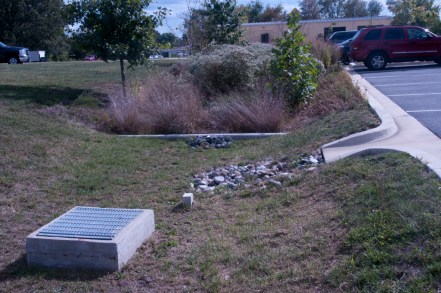
The image below shows a typical LID practice beside a car park. The gutter allows water to enter a grassed area with a concrete level spreader in the mid-distance enabling a small amount of ponding prior to overflow into a heavily vegetated bio-retention area. The grate in the near-distance provides an overflow facility which is modelled simply as a weir.
But LID is not just about saving the environment. Fort Belvoir’s hospital was fitted with a stormwater harvesting system (a LID practice) that connected the roof drains and air-conditioning condensate pipes into cisterns able to hold 160 thousand gallons of water. This water is then used for landscape irrigation, saving the hospital an estimated 1.6million gallons of water per year – this represented a significant saving in the building’s running costs!

 Holdfast Training Services Trial Blog
Interesting James
Is is a National or Federal application? – you seem to suggest National?
In the UK the Environment Agency is a stakeholder in a limited range of cases largely associated with proximity to river systems
The legislation enacted in early 2015 made the Local Planning Authority the main consultee and , although many lay down guidelines there is a caveat that the SuDs requirements must be economically proportionate
Hello John, sorry for the late reply.
It depends on what you mean by National… Various Federal (National) legislation is involved such as the Clean Water Act of 2010. The US Environment Protection Agency is responsible for applying the principles of this statute. However, much of the responsibility is delegated down in a similar fashion to English and Scottish Law: states demonstrate competence at managing their own affairs and then have the freedom of enacting their own regulations (whilst still complying with Federal Law) This continues all the way down to the level that even counties the size of small towns are able to receive responsibility for managing their own storm water discharges and setting water quality and quantity standards for developments.
The US have a similar approach to LID that LPA’s have to SuDS: uptake is to occur to the maximum extent technically feasible (METF).