Archive
Archive for 12/07/2018
Seismic Assessment of a Structure – Fundamentals (Direct Displacement Based Design)
12/07/2018
2 comments
Introduction:
- I’m trying to get my head around some seismic design for the building I’m working on. I’ve done a bit of reading – here is a quick description of my understanding so far, anybody else done any seismic and can collaborate? Any thoughts or corrections?
Assumption:
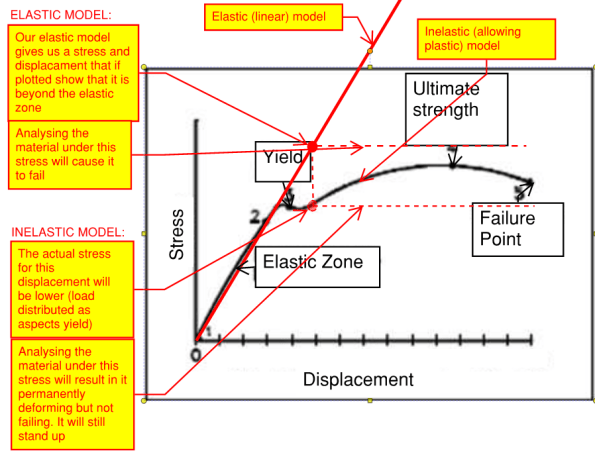
- EQUAL DISPLACEMENT RULE. (total displacement of an element is roughly the same whether you treat it as fully elastic or non-linear) – proven empirically but the theory is that energy is dissipated when a material yields and therefore the demand on the element is reduced.
Graph:
 Process:
Elastic Model (or elastic calcs) – FORCE BASED DESIGN (what we are used to):
- Input: Apply seismic loading
- Output: Displacements and stresses
- Compare displacements to SLS criteria (eg inter storey drift max = 0.015 x storey height)
- Check materials can withstand the stresses (in the example in the graph, it will fail)
- However the results may not be truthful to how the material/structure will actually behave – you may be in the plastic zone and as a result, overestimating the stress in the material. There are factors you can apply to bring the stress down but a more accurate approach is to use DIRECT DISPLACEMENT BASED DESIGN
Inelastic model (or non-linear calc iterations) – DISPLACEMENT BASED DESIGN:
- Input: Displacement – input the displacement our elastic model gave us (equal displacement rule). (if you are designing a new build then set your target displacement and start here). The target displacement is then sub divided to create start and end points for each stage of analysis.
- Iterations must be conducted in order to find the critical mode of deformation.
- Output: Stresses
- Check materials can withstand the stresses (in the example above, it will now pass (permanent damage but no collapse))
Other:
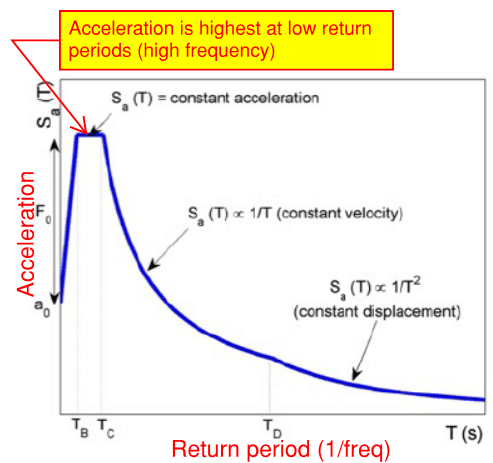
- When setting up the model, applying high levels of fixity at connections is conservative (the opposite to what I think is intuitive) because:
Summary:
- Force based design does not allow an accurate estimation of stresses within a structure for material that is beyond yield. Direct displacement based design allows for a more accurate estimate because displacements are more proportional to non-linear behaviour/energy dissipation?
Categories: Uncategorized
 Holdfast Training Services Trial Blog