London City Airport
Having started Phase 2 with BAM at London City Airport (LCY) two weeks ago I have finally worked out enough of what is going to on provide some useful information about the project.
PROJECT OVERVIEW:
The project was tendered at £85m aiming to increase the capacity of LCY by building a new apron and taxiway as well as extending the terminal. Currently planes have to taxi up the main runway if they want to take off from the 27 end, this is
serverly restricting the capacity of the airport. BAMs role is to deliver the piles and deck and for Bechtel to follow on and construct the terminal building.
The plan is to pile into the existing dock and use precast beams and planks with an insitu topping layer to tie it all together. The project is zoned, the original plan was to undertake sectional completion, starting with P1 in Dec 2018, then P2, P3 etc. This has not gone according to plan with the rows of the piles being completed east to west length ways rather than north to south as originally planned.

P1 is basically being run as a different job to P2-5 as it involves land based operations, whereas P2-5 are being undertaken primarily from barges.
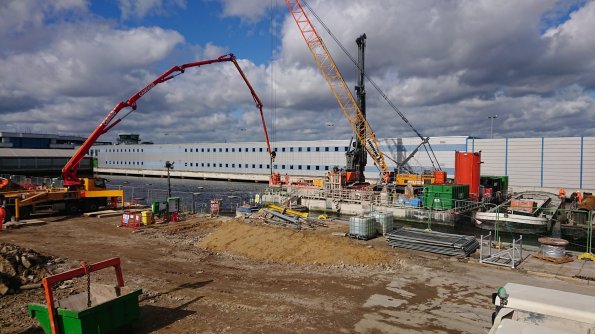
P1 Land based pouring and piling.

P2-5 Barge based piling, subcontracted to Skanska Cementation. Note the planks in the foreground, these are sheer links to tie in with the 150mm in-situ concrete deck.
KEY ISSUES:
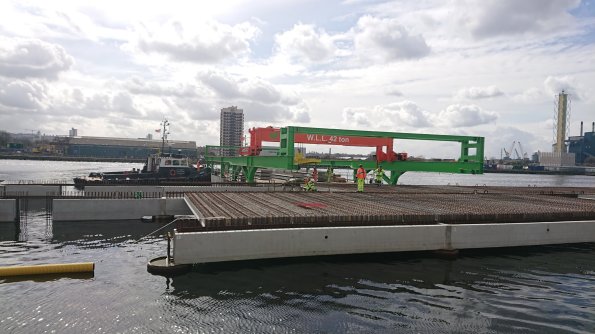
Logistics. Currently there are over 4500 precast concrete elements that are being manufactured in Ireland, by Shay Murtagh, with only 20% of the total delivered there is massive pressure on them to up production. With this increase in production there is added pressure on BAM to get them placed on site, which is difficult requiring a specially built barge to place them, shown below:
Design Change. The original design was created by TPS, a subsidiary of Carillon, which obviously didn’t end well, therefore the design has been novated over to Atkins who has majorly redesigned it. They drastically increased the number of beams and planks required and the deck reinforcement complexity. This has led to BAM scrambling around trying to plug the gap between the lump sum price they tendered and what they are currently forecasting, circa £150m.
The airport is operational. The airport is open which due to a 6 degree angled safety zone from the Dock wall restricts access for the piling barge to nights only, putting the works behind from the start. It also imposes lots of other silly little constraints which cumulatively gets in the way, putting the project further behind.
Overall the client is not on side and a very adversarial relationship seems to have developed with each side looking to blame each other. Not suprising really when the project is running at least 4 months behind and £65m over budget…..
MY PART:
I have been assigned to the deck team, which is currently planning on how to install 80,000m³ of in-situ concrete onto the precast planks. This is interesting due to the amount of different types of bar layouts, 32 at the last count. This coupled with the constraints of delivery and getting things onto site, often on the night shift, requires a lot of planning.
 Holdfast Training Services Trial Blog
John
You can turn this into a decent AER1
Add a bit more on the contractual situation ( when you say lump sum- you mean NEC 3 a or b type and reflect was this initially sensible?
Then describe the foundation and superstructure in regards of how it all works ( I am particularly interested in actions of moving aircraft) But also the way the piles are to work under loading) And include the geo situation.
Then why was such a heavy redesign necessary ?
Loads of stuff here Atts 1,2, 5 and then 7 – pcc from Eire.I hope it’s by sea!!
Interestingly it is NEC Option 3 option a, priced against activity schedule. The contractual argument between BAM and LCY at the moment is around whether their circa 150 PMIs make it the same contract BAM signed up for, you can guess which contract the two sides are fighting.
It is interesting BAM keep submitting their monthly program for re-approval and LCY have refused the last 4 stating they do not think that it accurately reflects the work and doesn’t cover the contract requirements. They also keep sending back their PMAs estimating BAMs CEs massively lower than BAMs QSs have. All in all an exercise in arse covering from both sides, which will inevitably end up in the hands of the lawyers .
Fascinating project.. Who are the designers? More questions no doubt as work progresses.
The designers were oringally TPS, a subsidery of Carillion. Now it’s Atkins, producing designs up to RIBA stage 4.
Sorry, yes you said so. I presume therefore that this is responsible for much of the required change and so the clients responsibility but with £65M overspend so far I’m also not surprised they are fighting it. Is this over budget figure the BAM internal cost of additional works or the cost to the client under the contract?
This is a BAM internal figure for projected costs. The client has approved only roughly £5m worth of change, taking their valuation of the project to £90m. It isn’t even close to the likely costs therefore it is almost certainly going to end up in the hands of the lawyers.