Scale of Temp Works
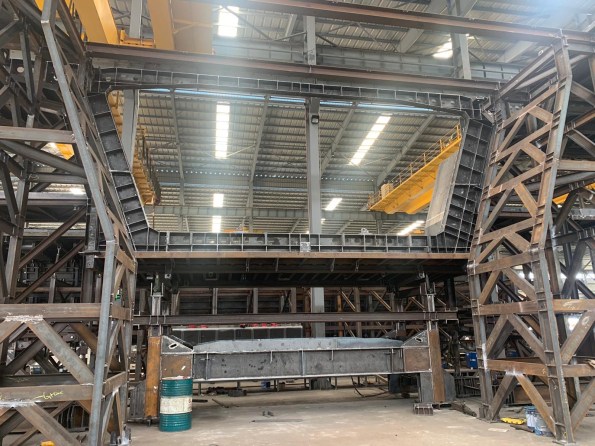
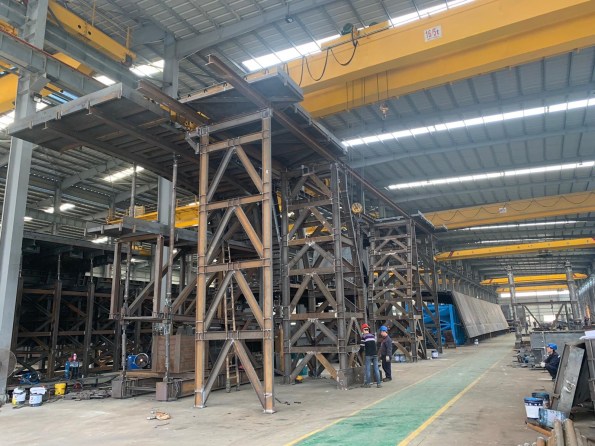
John I remember you telling us in Phase 1 you are always amazed at the scale of temp works that are involved in creating the permanent works. For my project the team are spending AUS $2.5M on establishing and running a precast yard. Below are some pictures from the trial erection currently underway in China of the pre-cast bridge segment forms. The forms are designed to be adjustable to accommodate the curves with the new segment cast next to the previous one to ensure continuity.
The average segment will be 11m long, 2m wide and 4.7m high. I’m not sure what the size the forms are but you can get an idea of their scale from the size of the people in the photographs. I’ll post more detail when they are installed on site and I understand more.

 Holdfast Training Services Trial Blog
Yep that’s pretty impressive. Amazed , in a sustainability sense, about this. The tunnel lining segments for CrossRail were cast in Chatham ( just by the Tunnel entrance) There was some discussion as to the sustainability of this since they were lorry transported to town.. I am amazed that a pc yard would not be set u locally to supply!
Worth a note regarding Att 7
Seems to be a common approach in Australia to outsource large scale steel fabrication to Asia. A short reply to share a lesson learnt from my phase 2, as our prop fabrication was outsourced to a subcontractor based in Singapore. BLUF, it is worth checking you have a robust quality assurance/control in place in China (or wherever the steel is being fabricated) before it is shipped to Australia (not just the word of the fabricator, but a quality team from your project).
On our project the client specification required all fabricated steel structures to conform with AS 4100 Steel Structures and AS 5100 Bridge Design, which require traceability documentation of all components used in the fabrication proving they conform to the AS. We fell short of this in the first few shipments and caused us all sorts of issues, in particular with weld quality/testing and component traceability proving the steel is the grade it is meant to be. Obviously this causes a number of issues with the design.There are a couple of key documents that the Australian Steel Institute produce to cover such situations (ASI Technical Note TN007 V2 – Compliance Issues and Steel Structures, and ASI Technical Note TN005 V3 – Guidelines for designing to AS4100 when imported materials are involved). Worth a read if you have time. I was involved in finding the solution when we realized the issue and we ended up having to carry out rectification work in Australia and locally purchasing components (nuts and bolts) which greatly increased the cost and reduced the benefit from outsourcing the work to Asia in the first place. I’m sure your quality team are already all over this, but I sort of expected that from my phase 2 quality team, and they weren’t…..
Echoing what Glynn said, Australia just doesn’t have the steel manufacturing industry set up to support the delivery of these large volumes of steel, so steel here is pretty expensive.
When I was researching TMR 4 I came across some research which suggested that steel frame structures make up only 13% of buildings in Oz compared to 70% in the UK; Driven perhaps by the cost of steel, or a lack of steady demand driving up the cost (chicken and egg). Compounding this I guess is the relative ease of accessing the Asia market where it is readily available and cheap. For now it comes down to the $$$s and the other sustainability factors take a back seat.
On the WGTP there was some grumbling from the subbies about the fact that they were being forced to meet certain targets for employment of local people, aboriginal people etc and contribution to the community, while we were then outsourcing our 2000T of steel for propping to Singapore…..
Also like Glynn we had issues with material traceability for our steel. The temp propping supplier was working to British standards for the manufacture and supply of steel and American standards for the welding. This created a number of issues in ensuring everything was compliant to Aus standards and in the end required a Project Agreed Exception to be signed of by the client and some extra weld testing. The full details are already becoming a bit hazy, but I know one thing was that the Aus standards required traceability paperwork for every member in a prop section, where-as the BS only need certs for the main member.
Like Glynn says it one to be aware of. We had people scrabbling to get the right paperwork from the supplier as we were throwing the props in.
Sorry the original post wasn’t clear. The precast yard will be established 16km from the bridge sites (work started last week) allowing the segments to be cast locally and transported to the bridge sites by road. The pictures are of the trial erection/assembly at the factory in China before the moulds are shipped over.
Apparently a number of different precast yard options were considered including Newcastle (440km) away with a plan to barge them to site along the coast. The decision to set up the precast yard closer to site was made to have more control over the rate of segment production, improved communication with the bridge construction team and to de-risk adverse weather/sea conditions affecting deliveries.
A very interesting piece of work. The steel formwork and associated falsework will take quite a hammering over the course of the project so I doubt there will be much flexibility on standards. I would also suspect that the trap of presumption that everything will be delivered in accordance with the specification rather than requiring an Aus team to go and make sure is both set and ready to close. I’d ask about this next time you get a quiet moment with the PM.
The expression you want for casting segments against their neighbour is ‘match casting’.
Ros Elliott had significant experience of the challenges of precast post tensioned bridge segments in the Adelaide superhighway. Indigenous labour requirements were met by concentrating the risk in the segment casting yard, where it then all went badly wrong. The knock on of not having the right segments available when required and segment lifters that didn’t work was a fascinating tale for CPR. Do you know what the assembly methodology is?
Shadi has asked if she can have any method statements and eventually time lapse images of the build please!
The comment about an Aus team to go to China to check the moulds is absolutely correct. The precast superintendent and precast quality manager/surveyor have just spent two weeks in China observing the factory conducting the mould assembly pretrial. Some issues were identified particularly with the inner mould tolerances. Which are currently being rectified.
The bridge assembly method is to use the cantilever method from the piers with segments lifted by cranes on floating barges. Each segment will be stressed back to the next segment/pier using post tensioned cables. The segments will be lifted on alternate sides to reduce out of balance loading. Due to bridge curvature almost every segment is different so with only two moulds for production casting the right segments at the right time will be critical as the process cannot be increased due to curing times.
I’ll try and get hold of the erection method statements. There is also a requirement for photography to document the project so I will see if there are any plans for time lapse of the build.
It appears we have the same thing happening on our sites Mark. The WGTP has set up a precast yard too (of which I’m hoping to visit soon) to try and meet the high demand of precast elements across the site. We’ve had to outsource a lot of it though as supply cannot keep up with demand, from what I understand. When I get the chance to visit I’ll upload some pics also and we can discuss.