Steel Pile Fabrication
G’day from Sunny Melbourne! this blog will be much shorter than my last!
I’m sure all the Phase 2 guys remember our trip to NU Steel back on Phase 1 prior to Ex STEEL (that might seem like a life time ago already for some!), where John provided us with the opportunity to see the steel fabrication of gantry elements etc.
I thought I’d just share some photos of the fabrication process being undertaken by ABFI Steel Group (specialists in the fabrication of large diameter steel and pipes – https://abfisteel.com.au/), the specialist subcontractors that have been contracted to fabricate and deliver the steel tubular piles being installed for marine based pier foundations in the Maribyrnong River, Melbourne.
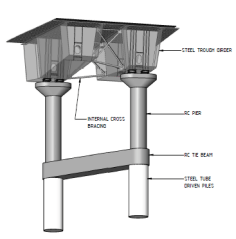
Typical marine Pier Section
The steel piles being installed in the river are 36mm thick, 2.2m in diameter (in the largest cases) and are being driven up to 35m RL. They have been designed to a maximum axial compression load of 28.6MN each. This poses a serious logistical challenge for delivery to site, considering the piles are being manufactured in Wacol, Queensland (only a 1021 mile drive – or 17.5 hours … in a car … ) and will be delivered by road. Clearly at 35m in length, the piles will require splicing on site, with sections being fabricated at roughly 16m sections. This will increase the number of deliveries, and of cause, creates issues with managing quality of splicing on site (a process that is being reviewed, in detail, as I write this). I will be involved in the Inspection Testing Plan (ITP) for these splices and will be required to ensure QA processes are conducted in accordance with the ITP.
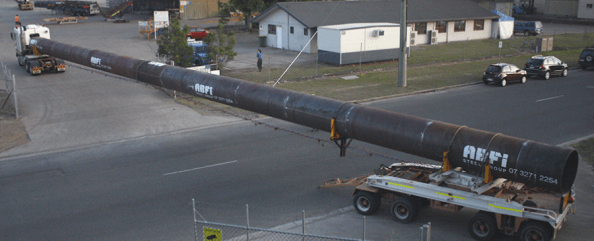
Example of a Steel pipe Delivery by ABFI.
Below are pictures from the fabricator’s workshop of piles being fabricated (unfortunately, at over 1000 miles away, I was not able to pop over and get the pictures myself). As can be seen, some serious work is being conducted in this fabrication process as tolerances/quality are tight. This has led to some serious interrogation of the subcontractors method of works and QA system to ensure the piles are competent once manufactured.
I look forward to seeing the piles arrive on site and being installed as part of a complex method involving two marine barges to facilitate lifting and driving of the piles in the river.


 Holdfast Training Services Trial Blog
That is certainly some pile; the tubes are MIG seam welded and, you may recall, on the visit to NuSteel we stopped off at a bloke doing QA of the welds. I’d guess that’s pretty importance here.
I would say that pitching these things will be interesting . The flexural pitching stresses might be higher than the compressive driving stresses. I ‘d certainly be interested to know how they are to be driven ; hammer or vibrating head?
John, sorry for the delayed response, for some reason I did not get an email notification.
Yes I remember the QA testing at NU steel. I’d love to get up there and see the fabrication and QA testing myself, but the distance is making that difficult. The piles are being driven with a hydraulic hammer (S-280), though I do believe that there is potential to use a vibrating hammer for the initial drive (this is what I have seen from previous projects whilst doing some background reading).
I also forgot to mention that the piles will be preaugered to the bottom of the first layer of basalt (arrox 12-20m) with temporary casing put in place to protect against soil/water ingress. From here, the piles will be pitched and driven through a Silty Clay (Werribee Formation – Stiff to Very Stiff) to the required toe depth (lower basalt layer – approx. 32m).