Constructionarium
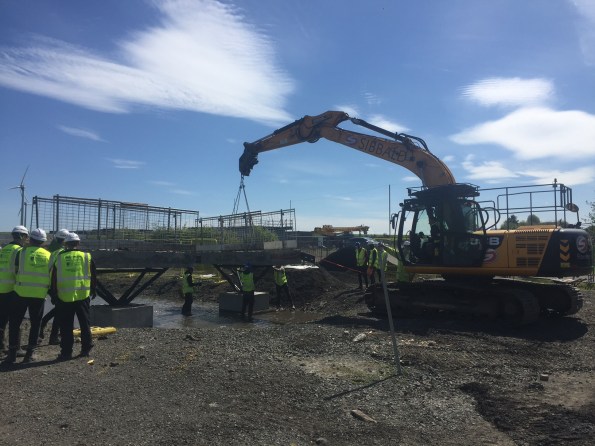
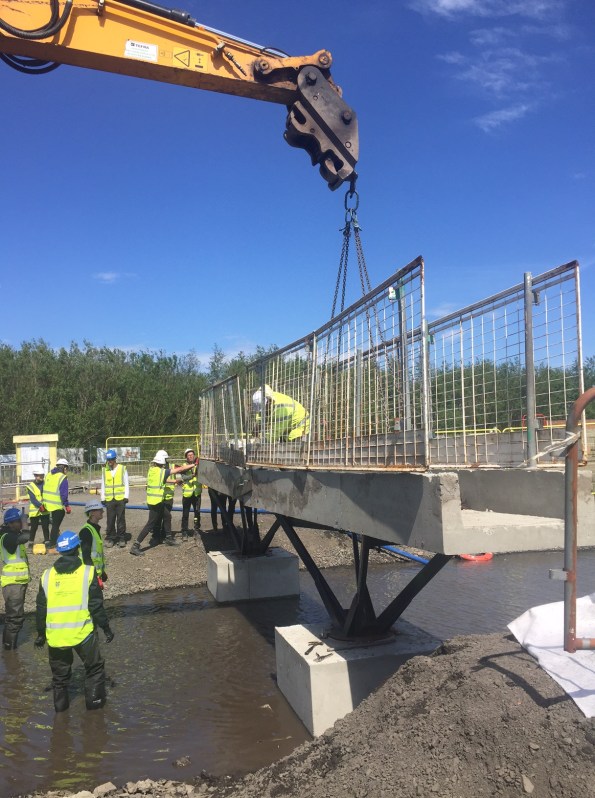
Summary. I recently attended Constructionarium in central Scotland on behalf of Multiplex. Here I acted as a client/mentor while Civil Engineering students from Glasgow University constructed scaled down versions of infrastructure and building projects.
Background. The scheme is ran across the UK with a large number of universities and companies sending their students/graduates on it to develop practical construction experience. Teams of approximately 12 are split into roles from project managers, setting out engineers and quantity surveyors and are given a set of drawings and specifications for their allocated project. Alongside their allocated role they act as operatives while skilled assistance is provided by the training supplier such as plant operators and appointed persons.
Detail. The event runs Mon – Fri and all the materials and equipment are provided by the supplier. The team are not however informed exactly what they need and so it is amusing to watch them level ground with shovels for 3 hours before realising they could have requested a light wheeled tractor. It is encouraged that the students are left to make mistakes as part of the learning process and simple problems like failing formwork provided platforms for discussion on structural analysis. They are required to produce RAMs, obtain permits to work, conduct toolbox talks, inductions etc all in line with realistic outputs of a competent contractor.


Military relevance. Constructionarium Scotland is a non profit organisation and the director was keen to promote its potential value as a training method for the military. I have summarised some pros and cons below:
+ All inclusive cost for 1 week training is £150-200 per person (including lunch, eqpt + materials – minimum numbers are 20 people). For context, 1 week pre deployment training (PDT) in Chatham for a B&SF costs approx. £750 per person.
+ Training can be tailored to suit learning objectives. For example more experienced tradesman can be pushed in areas of planning, health and safety, resourcing etc.
+ One stop shop would make planning of the training straight forward. Site is clear, free of contamination and includes welfare facilities and security.
– Obtaining financial approval for training from Brigade may be difficult, even if justified as PDT.
– Greater value was achieved through higher training numbers, for example we had 54 students and they could learn from different projects. Engineer regiments may struggle to get this amount of manpower available for additional training.
– Experiential learning training benefits are harder to articulate than straightforward courses. For example a week’s PDT at Chatham for a B&C may include a scaffold ticket whereas Constructionarium did not include this type of validation.
– PDT may be better utilised practising construction directly relevant to the projects to be undertaken on deployment.


 Holdfast Training Services Trial Blog
I seem to recall Bill Harvey was very involved with establishing constructionarium and know he was an excellent lecturer whilst at Dundee as well as very thoughtful and thought provoking regular contributor to The Structural Engineer. I have no doubt that this offers excellent learning and, for design office staff, provides the essential site experience not gained through exchange posts, which was once a requirement for CPR. This, or something similar, would certainly benefit the leadership (SNCOs & all officers) who are simply not adequately knowledgeable or experienced in structures and construction to deliver on site as evidenced by numerous failings an the employment of a civilian contract manager on Anemoi to plug the capability gap. I am not sure it would deliver artisan training as effectively as PDT here does but could be convinced. PDT here often runs for very low numbers (1-4 students) so I would be interested on how your cost figure is arrived and what a comparable figure might look like; clearly overheads drop rapidly as numbers rise. Was there a payment made for your presence?
I agree that the value is greatest for the management and CSCs as opposed to directly for the tradesmen. I think it would be a valuable experience for a Sqn to improve confidence and knowledge of construction practice and could let an OC expose shortcomings in advance of an deployment.
I have been on small projects in the past where Lts and even CoW SSgts lack the understanding or confidence to really apply what they have learned regarding elements like health & safety, site practice and document control. Constructionarium may let some of these issues be ironed out in a controlled environment.
The rate of approx £750 per person per week was the average we paid for around 20 tradesman of various disciplines to come to Chatham in 2017 before Ex PINESTICK. The groupings included 3 x B&SF, 3 x H&P, 6 x B&C, 2 x SVY etc. I think the cost of Constructionarium is reduced due to its CITB funding and considering PDT training budgets often remain unspent it could be a useful addition to any artisan package.
The involvement of 3 x Multiplex and 3 x Careys personnel was provided free of charge to the University as community engagement support. The Glasgow University programme has the potential to include a further 5 buildings over the next 6 years so I think the contractors are always keen to gain some credit with the client! If a RE Sqn was doing the training it may be worth investigating getting an expert presence from Chatham, an STRE, reserve unit or contractor working with DIO to provide guidance and to ensure best practice is implemented.