Engineering Judgement vs Specifications
Over the last 2 weeks we have started installing precast concrete piles on my site using, from what I can tell from research and talking with previous PET(C) students working in Melbourne, a very experienced piling contractor (Keller). The first 7 days of piling have seen several pile caps complete, with over 50 piles installed; a total of 548 are being installed over the next 12 months, excluding CFA and Steel Driven piles.
Those who read my last blog will have seen the QA and testing process implemented on site to ensure compliance of piles against the design specification. As the Project Engineer tasked with overseeing these works, I have been involved daily with inspections of precast concrete pile deliveries and PDA testing, whilst managing the site engineers.
Since my last blog, a concrete patch repair procedure has been accepted by the IREA (third party auditor) and the Nominated Authority (in house auditor), meaning blow holes can now be repaired on site. It should be noted, however, that cracks cannot be repaired using this at this stage.
As part of the Inspection Testing Plan, the Nominated Authority own the Hold Point of testing of the piles to ensure geotechnical design capacity is reached. This week, we have had a few issues arise. One is that some piles tested are not achieving pile capacity on either end of drive or on restrike (see my previous post for more info). This issue is being resolved with the subcontractor and the designers to see how this can be dealt with. My SPE seems to think that we can still get away with the results we have by proving the end bearing resistance with quick calcs … I’m not so sure how this proves geotechnical design capacity? To me, the summation of shaft and end bearing resistance has failed to mobilise enough capacity, even after 3 days of ‘setting up’ prior to restriking. I would assume additional piles will be required, unless there was enough design contingency planned?
It appears that no piles are reaching geotechnical design capacity at end of drive. As per my previous post, the first pile in a group is driven under PDA monitoring to monitor driving stresses and set the driving criteria for the remainder of the group. I spoke with the testing engineer about this, who has over 20 years’ experience of PDA testing and just so happened to work for PDA in America previously (so I’m taking his advice as rather expert). He does not expect any pile to achieve end of drive resistance due to the high design capacity required (2900kN is the ultimate design load for most piles. This is given a reduction factor of 0.75, meaning 3867kN is required) given the short 12m/14m length of piles but is confident that, where a set of 35mm (average movement of the pile per 10 blows) is achieved, the capacity will be achieved given time to set up; i.e. capacity will be achieved on restrike (clearly not the case for some piles above).
What has surprised me is the huge variability in the basalt rock layer the piles are being driven to. It would appear that all our lessons on ground being a risk couldn’t be truer. The rock levels from the ground model (created from interpolation of boreholes) shows a nice straight line to design the pile toes to. As can be seen from the photo below, this is not the case. In some pile caps, variability increases by over 4m and more. This creates a cost issue, as, under VicRoads Specification 605, restrike tests are required to be carried out where toe levels of piles in a group vary more the + or – 2m. Each restrike test is a cost to us.
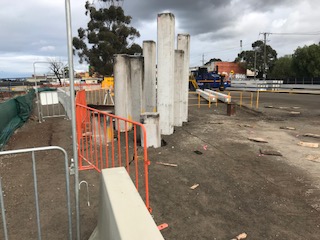
Front two piles can be seen to refuse much deeper than remaining piles due to variability in the basalt rock layer
The main issue we’ve had has been the releasing of a Hold Point under the Nominated Authority. If we are to go by the letter of the law, the VicRoads 605 specification and pile installation ITP (which takes the hold point straight from the spec) state that the first pile driven, which is under PDA monitoring, must have a restrike test if geotechnical design capacity is not reached on end of drive. For the pile and pile group in question, the first pile did not achieve the capacity at end of drive and is one of 10 piles in the group. It just so happened that this pile achieved the lowest set (21mm) of the group, with the highest set being 32mm. Under the VicRoads spec, only 10% of piles require a restrike, meaning only one pile required testing. Keller’s testing engineer, rightly in my mind, chose to test the pile with the 32mm set. For those unaware, the pile with the highest set is theoretically the pile in the group with the lowest geotechnical capacity. This is simply because the pile has moved more than any other pile under the same hammer weight and energy, therefore experiencing less resistance from the soils.
However, although ultimate geotechnical capacity was achieved on the restrike of this pile, the Nominated Authority refused to release the hold point because the pile test was not the first pile driven and monitored in the group. This seems silly to me. I would have thought that by proving the pile with highest set in the group, pile capacity of all piles has been proved? The logic of the testing engineer seems sound to me and I would argue that the intent of the spec is to prove capacity of the group, which I believe has been done?
The Nominated Authority, as has been the case with other issues, seem to blindly follow what is written in the spec and not apply any engineering judgement or consider the intent. In which case, what would be the requirement for engineers on site?
Either way, I have now had to raise a NCR to the Client to argue the case that capacity has been proven and that this method should be adopted moving forward.
 Holdfast Training Services Trial Blog
Interesting case
I have always found it strange that piles of such high capacity can be taken a proven on dynamic analysis testing only.
This is not the case in the UK and the difference becomes stark when high loads are being asked ( btw what is the concrete stress it must be knocking on the limit an maybe going way over in dynamic testing?)
As you say a rock head is, in my experience, alluring but dangerous;particularly in areas of (let’s call it) high chemical activity the head of basalt can be heavily and variably weathered- that’s where we get a lot of soil from!
I would like some of the pile records as it is a nice case study
Hi Jon.
It has been an interesting case and rather frustrating, as the NA and third party auditor seem completely bound to the specification making the whole process slow and at risk of delaying the programme.
The variability of the basalt has been very surprising to me; it appears this is due to high variability in weathering as you suggest. Keller were very confident in their pile lengths across the site, hence why they took the risk of pile length in the contract. This has clearly backfired on them and is costing them now. On two of our pile caps, piles were reaching a third of capacity on end of drive at design depth, meaning a request to change design to a spliced pile (5m and 14m) has been forwarded to the designers and has meant delay to pile completion in this working lot.
My understanding from the testing engineer is that these are very high loads for 12m/14m precast piles and he was not at all surprised that almost no piles were reaching capacity on end of drive. The required testing load is 3867kN, using a reduction factor of 0.75 of the ULS load. My understanding is that this is very high and requires high impact from the testing hammer (7000kg hammer being dropped at 1500mm) to mobilise the required resistance to test. However, in most cases, significant set up has occurred, resulting in some piles achieving in excess of 4MN.
The compressive and tensile stresses induced in the concrete, for the case of the pile cap in question, are 38.7MPa and -1.77Mpa during restriking. We are using Special Class S60 concrete for piles, making these stresses well within the limits.
I will email through some of the PDA and CAPWAP results for you as well as the hammer energy calcs used to prove driving hammer adequacy (using Hiley formula as previously mentioned) for the pier in question.