Archive
Melbourne is Settling!
I just thought I’d share a quick blog on some interesting settlement issues I noticed walking through the ground level storey of a multistorey carpark last week. Whilst passing through, I noticed some serious concaving of the pavement between column rows, creating a wave like effect across the whole car park. On closer inspection of the columns, I noticed that the top of concrete foundations were protruding out of the asphalt surface. The reason for these ‘dips’ in the carpark are due to some very noticeable settlement of the underlying ground.


Across the wider area is a varying depth of Coode Island Silt (aptly named after the area known as Coode Island in Melbourne where I am working). Having done some research into the geology for TMR 1, the existence of this silt layer is not surprising, considering Melbourne was found on a huge swamp along a large river basin.
The Coode Island Silt is a large alluvial deposit along what is known as the Yarra River (main waterway passing through Melbourne) Delta. It is a highly compressible soil which is only lightly consolidated and has a high voids ratio, making it very prone to settlement and creep when stressed – think back to the graph plotting voids ratio against effective stress; no stress history on a soil with a high voids ratio will lead to high strain. This limits the use of shallow foundations across Melbourne, making piled foundations a favoured solution.
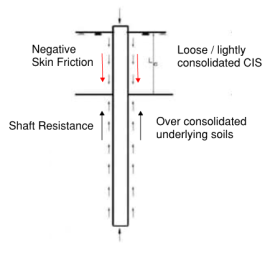
The inherent risk of both primary and secondary settlement is high for foundations formed in this soil and downward drag (i.e. negative skin friction) presents significant risk for deep foundations. From researching the GDRs produced for my project, downward drag from the Coode Island Silt consolidating is expected in less than 3 years. The forces induced will be a function of the rate and size of settlement at each pile location, the skin friction induced along the pile shaft (depth of the silt varies significantly across my site) and vertical movements under live loading; Negative skin friction is not considered for ULS design due to piles settling relative to the surrounding soil – as previously taught in Phase 1. This means it must be considered in SLS design to ensure long term settlement does not have negative affect – or cause issues like those seen in the carpark!
I hope this is of some interest to those who might not be working ‘in the ground’ and highlights the importance of the estimating stress history of soils.
 Holdfast Training Services Trial Blog