Steel Fibre Lightweight Reinforced Concrete
First patented in 1874 and used extensively for bomb damage repair to airfields in WW2, SFRC is a well established construction material with a number of potential benefits, especially when used in situ to form composite slabs on profiled steel decking.
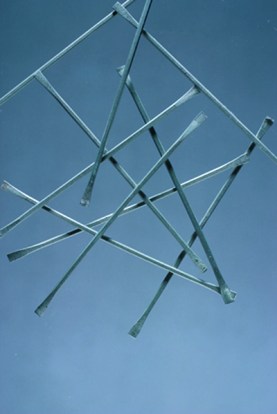
Steel fibres are graded I – V according to BS EN 14889-1
Steel fibres are often used to replace the steel mesh or fabric reinforcement in slabs. As well as composite slabs, they are used extensively in ground bearing slabs and pile-supported floors and can replace much, if not all, of the traditional welded reinforcement.
By mixing steel fibres into ready mix concrete at the batching plant you can avoid the need to pre-place traditional reinforcement. This gives considerable time and H&S benefits (manual handling, cutting, etc) as well as some secondary benefits such as reduced numbers of deliveries to site and less demand on crane time to lift bars and mesh into place. You are also able to better guarantee distribution of reinforcement through the depth of the slab, removing the risk of misplacing reinforcement within the depth of the slab.
On constrained sites (like mine) hook time is at a premium and there is limited lay down space for material. In addition, the build sequence only allows us to pour slabs once the two floors above have been steel decked to provide some measure of overhead protection (i.e. we cannot pour concrete on L01 until L03 has been completely decked by the steel erectors). On the other hand, once L02 and L03 are fully decked we have no way of craning our bars and mesh onto L01 as the lay downs will have been covered over. As a result the concrete contractor has to design, call-off , deliver and bulk lift all reinforcement for L01 eight weeks before he is able to access the level to place the reinforcement, run out pump lines and pour the concrete.
It seems to me that a large amount of this work could be rationalised through the use of SFRC in the concrete mix so I am wondering why it hasn’t been specified on this project. One issue could be that in order to provide a resisting stress under tension you need strain in the steel – in traditional (in plane) reinforcement the strain required is very low but in randomly oriented fibres there could be greater strain before the required stress is realised, resulting in higher deflections. Compression performance should be unaffected.

Steel fibres in a handful of the grey stuff
This project has 11 different composite slab combinations but the ‘generic’ case is a LC30/33 (Lytag) concrete on a profile sheet deck. The reinforcement is a H12 bar in every sheet trough (for fire resistance) and either A193 or A393 mesh in the top. Where this mesh is for crack prevention only I can’t (yet?) see why it couldn’t be replaced by fibres. The larger mesh is specified where the slab is designed to transfer diaphragm loads through the structure so there is more to be looked into there. I don’t propose replacing the fire bars.
Anyway, this is very much a new thought which may not go anywhere but I would welcome people’s thoughts or feedback from anyone who has seen this in action.
Oh, and do we still use it for airfield damage repair? I don’t remember using it.
 Holdfast Training Services Trial Blog
Interesting proposal. On the airfield damage repair, we did not use it at 39 when I was on LASS. I think with today’s jet engines the FOD risk of the fibers becoming loose on the surface would rule it out.
I think this is unfounded but I’d value any research. I suspect that a fibre is no more likely to come lose than aggregate and both are less probable than wind blown detritus from adjacent locations. The mass of fibres also means that they will probably do less damage to an aircraft on a runway than hitting a hailstone at Mach 2; again any research to support or contradict this welcome. The old anecdotal concern was of damage to tyres if they come into contact with fibres sticking out of a piece of concrete, again no evidence ever provided and a most obscure concept given the fibres are bound in and erode along with the surface (although slightly behind due to greater hardness thereby providing a minor improvement in surface texture).
Tom, ANEMOI used a fibre reinforced screed mix to reduce the depth of screed that could be laid and to prevent cracking. Although not structural concrete my understanding is there are parallels.
One issue with using fibres within concrete/screed is the clumping effect when mixing which can prevent thorough mixing of the constituent materials. This was one of the difficulties the ANEMOI MCF faced. Perhaps not so much of an issue of using ready-mix but the constant churning in a delivery truck stuck in central London traffic could cause similar issues.
Also have you investigated if there are any placement issues due to using SFRC in concrete pump lines? Probably a big problem if it goes well but if it starts clumping you’d have major dramas.
From my experience SFRC (and screed) are best left to professional tradesmen who know what they are doing and have developed their skills over time. For military engineering I suggest we should KISS and stick to standard RC.
The volumetric batcher procured by the Corps has a fibre delivery module that ensures even mixing. This was removed form the military variant (at a cost) because it was decided it that would not be used and therefore only added to the training and maintenance burden. Adding fibres by hand requires greater familiarity with equipment and materials than occasional usage provides. If only the procurement side was staffed by technical officers in key posts! The reason the RE do not use fibres was because there was a clumping issue with a trial done in the 1980s using personnel that knew little about concrete technology and were tasking with trying to find problems, and therefore did! Technology has moved on.
There is a difference between polypropylene fibres for crack reduction and fire protection and steel fibres for structural tensile strength. Fibres might also provide FPE benefits in minimising scabbing risks but this has also yet to be fully investigated (or I haven’t found the reports yet).
I would be sorry to see technical options dismissed out of hand. there is a place for fibre reinforcement as there is for admixtures . Probably within a grading of contractor competence from MFC with no technical staff delivering plain RC through CMT and B&C delivered works that might include admixtures, fibre reinforcement, special surface finishes and spray applied curing through to full blown specialist extrusion (standard for new airfields and many other forms of linear works)
Thanks for the blog Tom.
Given that you are saying the steelwork isn’t structural I’d see no reason why fibre shouldn’t replace all steel. Fire steel is only to provide escape time so serviceability limits be damned! And yes fibre should easily deal with cracking. If it was purely cracking I’d ask why not polypropylene fibre, this applies if you retain the bottom tough steel. There is an advantage polypropylene fibres if note required for tensile strength in that they dissolve in fire giving entrapped moisture an expansion space thereby reducing spalling. I believe this is enshrined in Spanish building regulations for tall buildings.
I hope that is a library photograph of a hand holding fibre reinforced concrete and not yours because the grey stuff is a caustic chemical burn hazard…
Thanks everyone for the comments. There is a lot of cross-over with concerns I have heard from our concrete contractor though there is very little experience of this approach in my office or among the structural designers. That said there has been considerable interest on the design side and it may yet gain some traction for later in the project,
Mark,
The risk of clumping is one that has been raised by the contractor and is one which could have serious consequences when attempting to pump to 16 storeys, The supplier is obviously very sure they can make it work wonderfully so somewhere in the middle is probably the reality. I would certainly class both supplier and contractor in the professional tradesman category though and if it can’t be done in London I’d be tempted to say it can’t be done.
Colin,
The contractor also mentioned a finishing issue where stray fibres are left protruding from your slab and need to be cut down by hand after curing. This is not only a dire task for a labourer, it is a considerable risk to aircraft tyres which may well be why we left it. I’m not sure this is an insurmountable risk though. It seems (on paper) that a high-strength concrete mix with its reinforcement in suspension would be a rapidly deployable and highly adaptable repair material. SFRC alone seems to work best in indeterminate structures, like ground bearing slabs, where the fibres add ductility which allows moment redistribution through the member, increasing the flexural capacity considerably over plain concrete.