Archive
Buildings as ‘urban mines’
On the same vein started by Ali wrt sustainability – a short read from the ‘lefties’ at the Guardian that I found interesting:
The construction industry accounts for 60% of new materials used, a third of waste and 40% of the carbon emissions. A few countries are starting to turn construction into a circular process, with ideas such as ‘building passports’ detailing every component for future re-use; ‘building elements as a service’, with ownership retained by the manufacturer and buildings never truly ‘owned’; and old buildings being ‘mined’ for useful materials.
In my (short) experience so far in a city based Phase 3 – the lack of space means that many of the projects are ‘re-imaginings’ of a current, in-situ structure. That being said, the place is gutted and, with a Client focus on ‘going green’, replaced with facades and services to achieve 6-stars (GreenStar). In this way Sydney is slowly upgrading its ‘old’ stock (bear in mind many of the buildings are less than 50 years old, modern Oz is young!) and improving its green profile.
Has anyone found this to be a trend in other major cities, or indeed wider? I get the impression that Europe is leading the way.
For those with experience with the RSME refurb – did they consider sustainability, or was it a ‘lick of paint’ for those old, drafty buildings?
Cost of Over-specification
High-Rise Concrete Pump Cleaning…How?
Walking around the high-rise construction in Melbourne I’ve been asking myself one question… How do they clean the static boom pumps and concrete lines after a pour? I know significant ALC charges were incurred for not cleaning the ANEMOI Volumetric mixers properly before shipping them back to the UK.
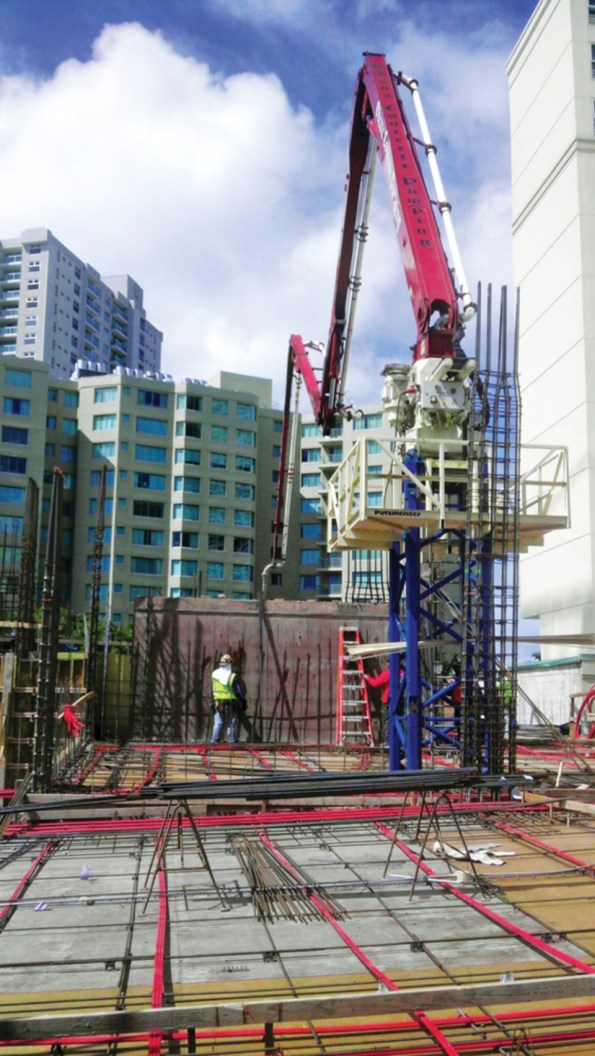
At Batemans Bay we cleaned mobile boom pumps via ‘blowing out’ into skip bins and washed water through the discharge hose but I’m guessing this isn’t practical in vertical construction.
When using a fixed/hardline pump a foam ball was forced along line at the end of the pour to remove all the concrete so the line could be left in place. I’m guessing a similar approach is used in high-rise construction. Does anyone have any experience or insight?
Another question I’ve been pondering is how are the pumps stages increased? Do you have to strip the top section and use a tower crane each time you increase a floor?
 Holdfast Training Services Trial Blog