High-Rise Concrete Pump Cleaning…How?
Walking around the high-rise construction in Melbourne I’ve been asking myself one question… How do they clean the static boom pumps and concrete lines after a pour? I know significant ALC charges were incurred for not cleaning the ANEMOI Volumetric mixers properly before shipping them back to the UK.
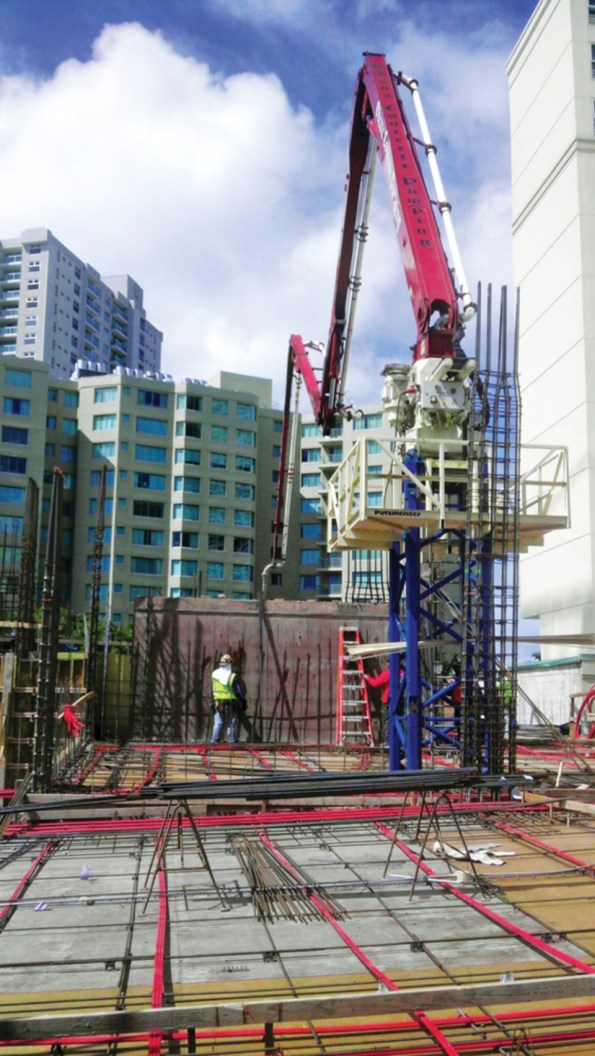
At Batemans Bay we cleaned mobile boom pumps via ‘blowing out’ into skip bins and washed water through the discharge hose but I’m guessing this isn’t practical in vertical construction.
When using a fixed/hardline pump a foam ball was forced along line at the end of the pour to remove all the concrete so the line could be left in place. I’m guessing a similar approach is used in high-rise construction. Does anyone have any experience or insight?
Another question I’ve been pondering is how are the pumps stages increased? Do you have to strip the top section and use a tower crane each time you increase a floor?
 Holdfast Training Services Trial Blog
Mark, check out what I just posted.
Mark,
At City Airport we were pumping horizontally 200m+ and we used a different method to the one described in Jim’s post.
We used a technique called pigging out using water. Essentially water is pumped under pressure to force all of the concrete along the line to the point of deposition not back to the pump. The method is as follows.
1. Once the required volume of concrete is in the line to finish the pour the line will be broken at the hopper and a 2 way valve is fitted to the line (I have pictures but I can’t put them into a comment).
2. Attach a pig catcher to the end of the line, this includes a valve which allows compressed air to be used to push the water back out of the line.
3. A rubber pig and 2 balls inserted into the line. This is to separate the 2 materials and avoid water contamination of the final meter or so of concrete in the line.
3. Use the pump to push the water and concrete through the line.
4. Once the pig reaches the end a compressor is used to push the water back out.
Risks:
1. The cube up has to be spot on otherwise you will have excess material or too little, both of which happened on our site multiple times due to the engineers not cubing up properly.
2. Concrete going off in the line and causing blockages. This means that the concrete may not be able to be pushed through. This is less dangerous than high pressure air however as it can be more easily controlled. if the line needs breaking however it will flood the site with a couple of cubic meters of water. Fortunately we never had this situation with water, we did however with compressed air and fired aggregate at a BA plane….
Opportunities:
1. Reduces waste as all concrete is used on site and none is wasted.
2. The line is effectively cleaned twice as the balls are forced back with the compressed air. This means that there is less likelihood that the pipes will have residual concrete in them, allowing the slip layer to continue to form easily on future pours.
Is it suitable for high rise buildings: Probably not.
This is unlikely to work on high rise buildings due to the high pressure head required. It makes sense to effectively use gravity to force the material back down the pipes not up. It however presents an opportunity for pumping tunnels etc.
Pump Cleaning:
In regards to cleaning the pumps after each pour, this is down to the pump operator who pressure washes the hopper and the accessible areas of the pistons out after each pour. There is a function to hold water in the hopper and use rinse out the pistons. After that there is a catch on the bottom of the hopper which then releases the dirty water into a container below. We simply used a timber frame lined with tarpaulin initially.
Thanks Jon, what you describe above seems similar to a combination of the two methods we were using on site although your method appears less wasteful.
Cubing up as you call it is never fun when you’re the engineer responsible because you’re unlikely to get it right and no one thanks you if you’re over or under…
Random tangent:
Jon – you mention ‘cubing up’, which I assume is civil jargon for estimating concrete requirement. I’d be interested to know the accepted tolerances for wastage on your site as a comparison to UK practice?
In Sydney I’ve seen up to 14 cubes dumped because of an overestimation. Although that was an extreme case, the usual was 3-4 cubes. It cost less to dump on site and have a sub-contractor ‘do us a favour’ than it did to send it back (with the obvious counter argument to estimate correctly in the first place!).
To me it seemed ridiculous, but it happened often and no one seemed to care. Wastage for reo was also frighteningly high.
I am hoping this may be more of an issue with leadership than a wider accepted practice?
In London it would cost you double to take away a cube of concrete after it had been delivered i.e. if you paid £200 per cube it would cost £400 for the removal and they’d bill you £600. And this was the best case – if the truck gets stuck in unpredictable City traffic and the concrete cures inside they’ll have you over a barrel. So in short we had to be pretty spot on with our take-off.
There will always be some over-run as you don’t want to end up short, but we’re talking max 1 cube (while I was on site anyway). This would be used to make handy ballast blocks or just poured into a shutter then broken up for rubble or for the skip.
Dave we generally had an excess of 1-2 cubes but occasionally the site engineers cocked up and had a full truck left over. The forecasts allowed for 5% wastage. Interestingly the piling team tracked their % wasted throughout their works package.
The hardest challenge with getting an estimate for a pour is calculating the volume required for priming the pumping system, general wastage and that wasted at the testing station.
Due to the requirement to discharge before taking a sample we were routinely generating 1-1.5 cubes in wasted concrete doing slump testing per pour. It would have been worse had we discharged the full amount required in the standard each time.
I’ve been thinking there must be a last wasteful method of sampling the mix. Any thoughts from the floor?
Dave, we once had 11 but this was an outlier. Typically we were in the region of 1-4 cubic meters. We got around the excess by building forms for Kelly Blocks to use and also we had a lot of screeding to do. The way we got around the exorbitant costs of the concrete supplier taking stuff away is discharge it on site, then once cured break it up and dispose of through our waste supplier which worked out at roughly £50/cube. There was an allowance of 10% within our concrete calcs to take into account the testing and trampoline nature of our precast.
People only really got excited when it is was above 3 cube, which is the generally accepted limit based on our foremans experience on multiple pumping jobs. I think this is due to the nature of how we pumped the concrete meaning that we had to make the call up to an hour of so before we needed it, normally 22.5cu before we actually finished the pour.