Archive
Powerhouse
Thought I’d share an interesting and beefy mechanical services problem I’ve been landed with over the last few weeks.
Following a successful competition bid, I have been placed on the ‘Powerhouse Museum’ mechanical services team.
The Powerhouse is a new event/museum/art space project (think a mix between Science Museum and the NEC) that forms the ‘largest investment in culture and the arts in Sydney since the Opera House’ and has a budget of around AU$400m.
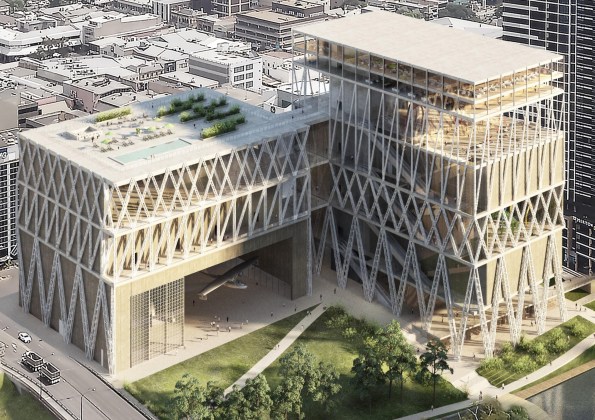
We’re at the very early stages of design and I’ve just finished knocking out the initial space conditions appreciation for the internal space in an attempt to provide some plant massing figures for the air handling plant.
All I’ve had to work with is a rough layout from the architect, depicted on ‘Rhino’ (coloured blobs depicting rooms/areas) and a very ‘strategic level’ project brief.
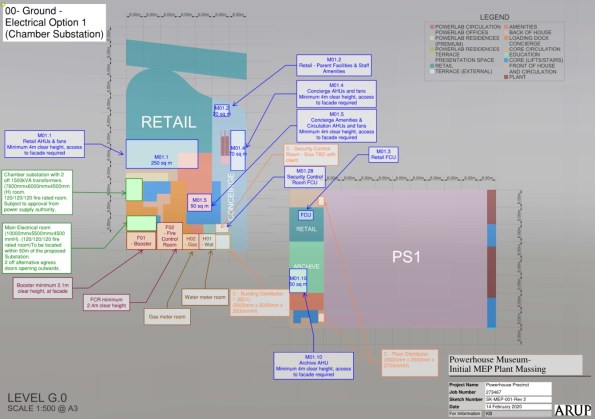
It quickly became apparent that there are some significant issues with what the winning architect wants, what is physically possible and what the Client (Govt. of NSW) can pay for. Not only has the building envelope shrunk by 30% whilst the expected space populations remain unchanged, the control level for the spaces is to the ASHRAE ‘AA’ standard (rigid temperature and moisture control to protect sensitive artwork).
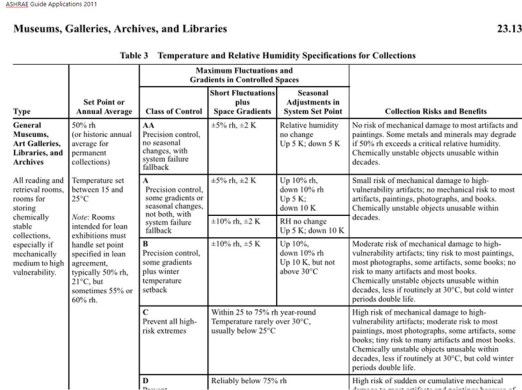
Helpfully the architects have allocated less than 1% of the floor area to plant space and are appalled that we may request more. Considering the location (summer 40+ degrees and high humidity) and the fact that the façade is all glass…my numbers are coming out silly sized!
Taking the largest presentation space as an example – the space is approximately 3000m2, with a floor-to-ceiling height of 30m. Current plans have this space with a peak population of 5000 people (0.5m2 per person).
I’ve had to make some pretty savage assumptions to ensure the entire structure isn’t just filled with plant:
- Firstly, the assumption that the population will reduce, so I’ve been modelling at 50% occupancy relative to the original value
- Secondly, we will only be treating the lowest 4m of the room
Even with this, to ensure minimum indoor air quality I need to deliver over 40m3/s of cool air to the space. This OA requirement, coupled with the estimated heat gains, sees a cooling load in the order of 1.4MW; and this is one of seven presentation spaces.
Another big issue is how we deliver the cooled air to the space. With a 30m high space, the means of controlling the mixing with the layer above 4m, which will have its own humidity, temperature and stratification presents a problem for control. ‘Top down’ delivery sees the air thrown 26m before it reaches the 4m layer to be cooled. I conducted a benchmarking exercise against other museums, which seem to favour floor level grills. These require thicker walls for the ductwork – however the spaces they are used are kept relatively small and are located at the core of the building to assist the plant.
What is inflating the numbers is the rigid control class and the population – these are our first targets to ‘manage’ with the architect. I get the impression that this is a once in a lifetime/legacy project for them and the museum curators; as such they’ve asked for all the bells and whistles.
Thankfully, the Client has appointed Arup directly – so there’s some leverage to play with when interacting with the JV of French, Japanese and Australian architects!
Does anyone have experience of controlling temperature in very large spaces? I’m thinking that airports will have similar volumes, albeit with more flexible control regimes. Can you throw air that far, still maintain control and not ruin the comfort conditions with the effects of draft?
 Holdfast Training Services Trial Blog