The sixth sense…
At what point in an engineers career is he able to look at a problem and sense that risks haven’t properly been addressed…?
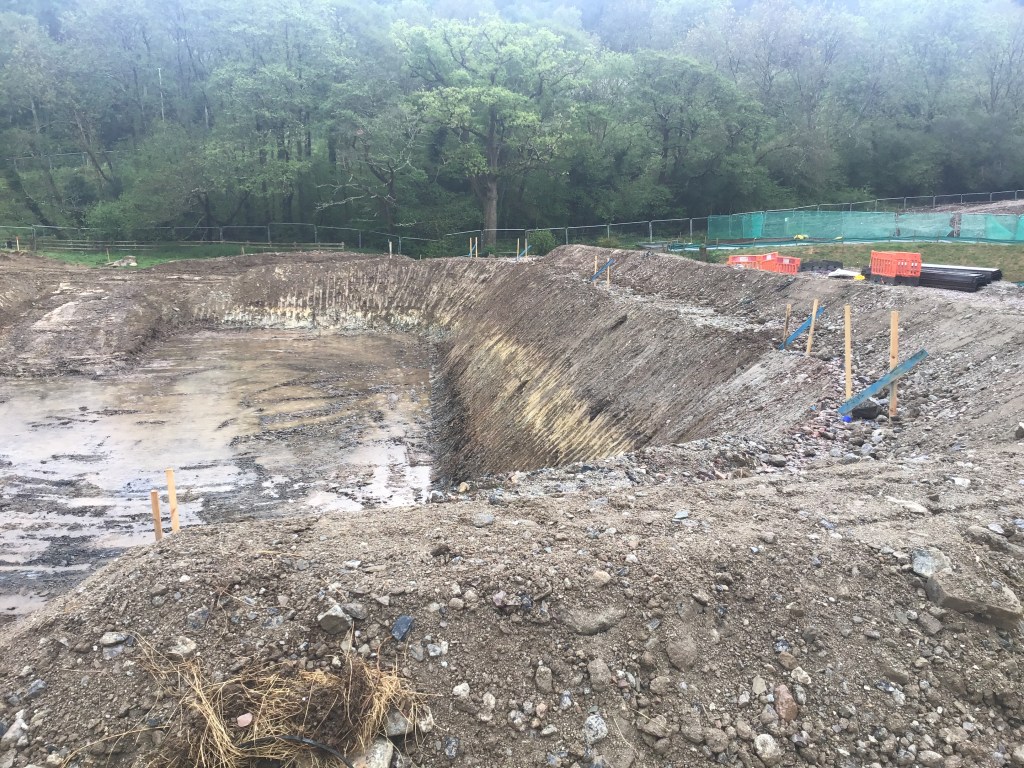
The risk in question here is safe. More specifically, slope stability of the excavation below. The slope is at a 1:1 batter at a height of 5m. The bund at the top of the slope (RHS) indicates the outer edge of the proposed site haul road (not yet operational), which will carry all laden plant. The bottom of the slope is ready for a piling mat for abutment piles. From this, I would suggest a surcharge of 20kPa at the top of the slope. The profile and design borehole is estimated below in the sketch.
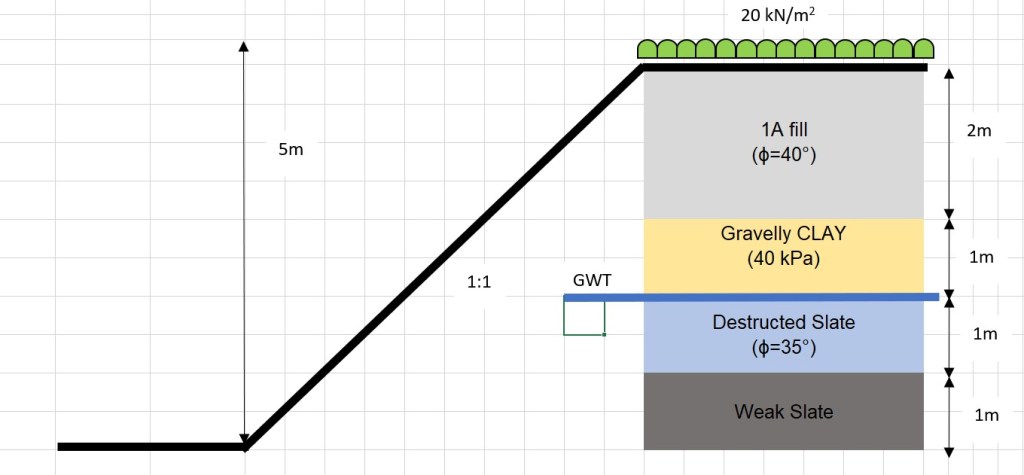
Strength properties have been taken from the principal contractor’s temporary works (TW) team for other designs. If is interesting to note that most TW problems to which the site team having varying opinions
The approach/opinion to this has varied dramatically on site. The opinions are: 1) “It will be fine”, 2) “This needs assessing by TW”, 3) This is unsafe”. All project managers (10+ years experience) and all with civil engineering degrees.
What is your gut reaction? for this problem? for other problems? What problems can you rely on your heuristics to address the risks?
Experience is critical but training goes a long way.
My personal opinion (without analysis) is a suitable assessment with either GEO5 and Bishop’s method is required to propose a technical solution and manage risk. Furthermore, I would need to do some re-reading of the rock classification and discontinuities to determine if this is unsafe. I would feel semi-comfortable on doing some analysis on this and making the call on site without TW design. Perhaps a feature of a TMR in the future.
 Holdfast Training Services Trial Blog
Hi Andrew, if you’re going to run some numbers two initial thoughts:
1) Is the assumption of 20kPa valid? This can be exceeded by site plant so you’ll need to check it against the largest plant you’ll have on site. Also if it’s the main site haul road will you have plant delivered on low-loaders? If so you may need to check their axle distribution as well.
2) From the sketch it looks like there will be 2m of imported fill added to the current works. This will also act as a surcharge on the current batter. Hopefully it’s been considered in the design but worth checking.
Best of luck with your assessment.
Mark – Thanks for your comment.
1) You’re quite right. Specific cases will be have to be checked. At the moment, no specific plant has been identified less generic site traffic due to the temporary nature, hence the 20kPa assumption. I believe this is what EC7 recommends although in the permanent case. The haul road above the excavation is currently OOB to all site traffic until the the appropriate TW cases have been checked.
2) The 2m of fill was placed prior to the abutment excavation so already accounted for.
Nice post Andy,
My initial reaction is that you have already partly answered your own question. That gut feeling of something appearing unsound or borderline which prompted you to post this is evidence of it. Quite rightly this has triggered you to initiate the approach of ‘if in doubt work it out’, which further refines competence in the future and your engineering sixth sense.
Let us all know how you get on so group heuristics can be further ‘zero’ed’.
CI
CI – Thanks for your comment.
Communication between those at home and those on site has become the key issue. The delineation between the structures team and earthworks team has been blurred. This has led to oversight of temporary works (TW) schemes that haven’t been designed and interfaces not considered with other areas of the project. The matter is still under review and I will provide an update when resolved.
Has the batter been constructed in accordance with any specific temporary works design? We had an issue on site where the subbie was looking to excavate for a retaining wall using their existing slope stability calculations. On inspection however those calculations were only valid for a particular soil profile that did not apply to this area of the site. Therefore it was easy to tell the subbie that a new calculation was required before works could commence.
Colin – thanks for the comment.
No specific TW design was produced for this. All TW designs for excavations are down to the sub-contractor and then checked by us. In this case, the sub-contractor proceeded with the works working to 1:1 used in other areas of the site. Those calculations had no influence of a GWR or surcharge. This sounds very similar to your experience.