Archive
Writing an Effective Scope of Services – NEC3 Professional Services Contract
I’m currently in the process of preparing an Invitation to Tender for six sustainability consultants. My first task is to create a suitable scope of services within the framework of the NEC 3 PSC, which I’ve completed in draft form, I’m waiting out for feedback from the procurement and contracts manager. In the meantime I was wondering if anyone had any advice or experience they could share regarding writing an effective scope of services?
Would Photovoltaics Cut the Mustard
The sustainability goal for the project I’m currently working on is a 554,000 kgCO2 (554 carbon tonne) emission reduction per annum, and it is to be achieved by project completion. Due to two late design ommissions of wireless thermostatic radiator valves and large scale photovoltaic arrays it is projected that this carbon target won’t be realised. To offset these ommissions it is suggested that a heat pump be utilised to provide low grade heat to a suitable application: which the design consultant has identified as the on-site swimming pool hot water demand via two existing plate heat exchangers. To amplify the carbon savings of the heat pump it has been suggested that photovoltaics can be used to provide the electrical demand of the heat pump, there are no explicit calculations to support this assertion.
Design consultant calculations:
Between 38 – 58 kW water heating demand based on modelling software.
That is all the design information that the consultant presents, below are some of the questions that I’ve worked my way through to arrive at an overall conclusion.
Small Selection of Heat Pump Specific Questions:
Can the consultant software be relied upon?
Can I validate their hot water demand calculation with an energy balance equation?
What local viable heat sources are there?
What are the seasonal temperature profiles for each source?
What are the theoretical seasonal co-efficient of performance (SCOP) associated with each heat source?
Why use SCOP? Does the heating demand of the pool vary with the season?
What is the real SCOP likely to be based on empirical evidence?
Is the hot water demand of the pool constant? 24/7? all year round?
How do I obtain an electrical energy load profile for the heat pump?
Won’t the electrical demand of the heat pump vary with source temperature profile?
What should I consider to determine worst case operating conditions (Highest electrical demand for the heat pump) i.e highest flow temperature required, coldest heat source temperature, lowest plate heat exchanger efficiency…?
Small Selection of Photovoltaic Specific Questions
What determines the viability of a photovoltaic solution: cost, land required, installation practicalities, servicing requirement?
Is battery storage necessary and if so how will it be designed to modulate the electrical supply and demand between the PV array and heat pump?
How can I best estimate the annual PV energy yield of different sized systems?
How can I validate the PV energy yield software/calculations?
Can I utilise a two-axis tracking system? Would the extra cost be offset by the increased annual energy production?
In a nutshell: Due to space environmental set point temperatures, the swimming pool hot water demand can be approximated as constant all year round with the energy balance equation resulting in a loss of 31.2 kW (Mostly through evaporation and mains temperature renovated feed water). The best heat source is the lake due to the highest SCOP, the COP for the lake can drop as low as 2.6 in winter conditions with a corresponding heat pump electrical requirement of 12 kW. Based on the SCOP (for the highest flow temperature of 65°C, SCOP = 3) the annual electrical energy demand is ≈ 96,000 kWh, with an average electrical requirement of 10.4kW. For a monocrystalline flat panel PV array in London, with a 180° azimuth, 33° tilt to the horizontal, module efficiency of 19% and no shading losses an area of ≈ 500m2 is required to provide the average annual electricity requirements of 96,000 kWh. That area requirement exceeds the space offered by the swimming pool roof, and adding into contention the significant shading losses (Due to nearby buildings) and sub-optimal orientation angles from the slope of the roof, it would be necessary to either increase the size of the system or relocate it (introducing the potential for significant voltage drops and increased cable size and cost)
The added complexity of utilising battery storage to modulate and supply the varying electrical input from the PV array to the heat pump would be the next steps to assessing the viability of the coupled system.
In short, the consultants assertion is likely to be impractical.
West Gate Tunnel Project Contract Dispute Continues…
This week there was some interesting developments in the ongoing dispute between the WGTP Client and Contractor. As a reminder, Transurban is acting as the Client and funding ~£2.8Bn with the State Government funding ~£0.82Bn.
Australian Financial Review Article
In summary, Transurban is seeking an injunction at the Supreme Court to prevent ‘premature’ arbitration by the Contractors over the disposal of contaminated soil. In Supreme Court documents, the contractors have stated Transurban has engaged in “misleading or deceptive conduct…in relation to the extent of PFAS affected spoil likely to be encountered at the site.”
This case highlights the importance of ‘back-to-back’ contracts as Transurban have repeatedly approached the State Government requesting to terminate the Project Agreement if the Contractor’s claims of a force majeure event are successful. The Victorian Government’s response so far is “that no force majeure event has occurred”. I think the merry-go-round will continue to spin for a long time yet.
My assessment is that Transurban’s attempts to delay arbitration proceedings is to buy time to gain a better understanding of their predicament. More time gives the lawyers more opportunity to find wiggle room in the Project Agreement. Knowing where they stand with the Project Agreement provides increased certainty on where final arbitration costs or penalties could end up (quite literally passing the buck…). If Transurban enter arbitration proceedings knowing the Project Agreement is/isn’t going to be terminated, they will have a stronger negotiating position and will know how much they will need to ‘invest’ in the process and their lawyers’ fees.
Work on the project sites continues however job losses are now at 450 (~11% of the workforce) due to the impasse. Although initially targeting site operatives this month the engineering and management teams have been hit with further cuts at engineering level expected. On the day John Holland posted a ~£33M annual loss, its ironic that the only winners in all of this will probably be the lawyers…
Defence Lecture – Sustainable Engineering: Carbon Neutral by 2050
The ICE members will have recieved the June newsletter yesterday with an invite to online lecture on 22 June. For the E&Ms the good news is the lecture is sponsored by the InstRE so I’m hopeful you can also attend for free. As an added sweetener, Maj Gary Jackson (E&M) is one of the 4 speakers.
Registration is via the ICE website (link below) or the InstRE website (details to follow).
https://ice.org.uk/events/defence-lecture-carbon-neutral-by-2050-london
I thought this is an excellent CPD opportunity for us all as military engineers and is likely to be a dominant theme for the rest of our careers so is probably not one to miss! The only down-side is it starts at 0330 (3 June) for the Australian students but a more reasonable 1830 for those in the UK.
As military engineers are we asking questions like Why are existing MOD buildings not covered in solar panels? Why there aren’t more wind turbines in training areas/camps? and Can we make more use of rainwater harvesting across the defence estate?
Why do I think sustainability will be a dominant theme for us in future? Below are some references for your consideration.
ICE sustainability Route Map and links to UN Sustainability Development Goals: https://www.ice.org.uk/knowledge-and-resources/sustainability-route-map
How is DIO promoting sustainability? https://www.ukconstructionmedia.co.uk/features/dio-promoting-sustainability/
Sustainable MOD Strategy (2015-2025) https://assets.publishing.service.gov.uk/government/uploads/system/uploads/attachment_data/file/498482/Sustainable_MOD_Strategy_2015-2025.pdf
Sustainable MOD Annual Report 2017-2018 https://assets.publishing.service.gov.uk/government/uploads/system/uploads/attachment_data/file/754154/SustainableMOD2018.pdf
DE&S Sustainable Procurement https://www.asems.mod.uk/sites/default/files/documents/EMP/Sustainable%20Procurement%20V2%20Intro%20Guide.pdf
When British isn’t Best….
I would just like to signpost you to a great article by Rob Ridley on defence connect comparing of British and other national approaches to infra. Some very valuable observations are made, and no doubt all of you are vectors to influence future change beyond PEW.
CI.
Polystyrene Formwork
Some pent up blogs to follow now that I have permission from the project office to blog. * DISCLAIMER. The contents of this blog have been made available to the author for academic purpose and are not to be disclosed other than for academic use.
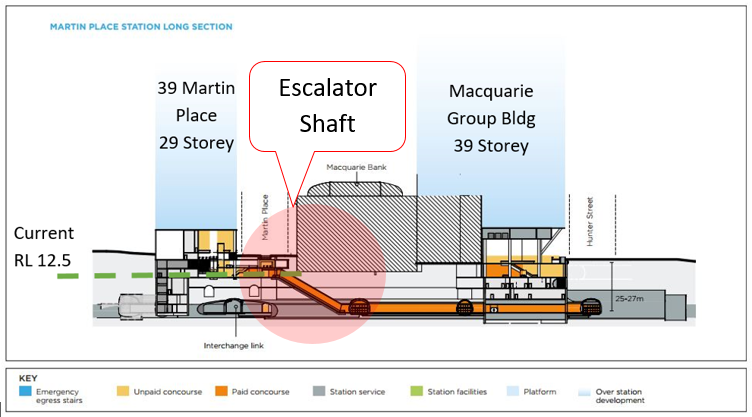
The Martin Place Metro Station site has two deep excavations either side of Macquarie Bank, a heritage building (Australia’s equivalent of the Bank of England and looks a bit like Gringots!). As per my last blog, the North Site has since been purchased by the bank, as has the over station development rights for the South Site. Long and short of it we have tunnelled beneath an important historic landmark and now need to excavate a diagonal escalator shaft from -10m below the front door, back underneath the bank and into the station cavern below. Best not to crack any of the marble…
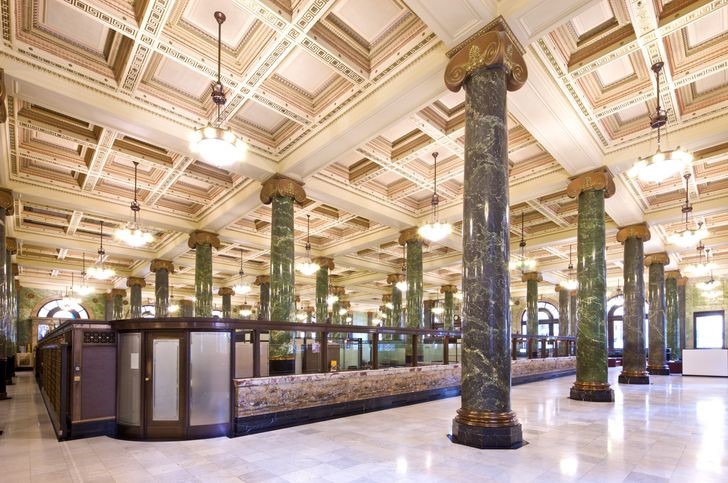
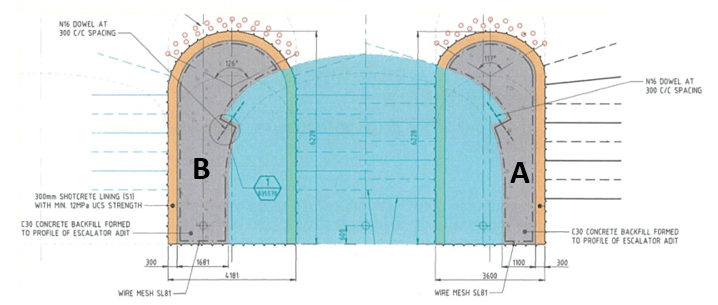
To sure up the Hawkesbury Sandstone rock beneath the bank and prevent settlement the designer has proposed three large reinforced concrete pillars be installed beneath the bank. Pillars A and B have been installed since I have been on site. The requirement for Pillar C is yet to be determined based on monitoring the bank buildings response. Pillar C could be constructed in the future by the follow on contractor, Lendlease when they start the tunnel and station fit out contract early 2021.
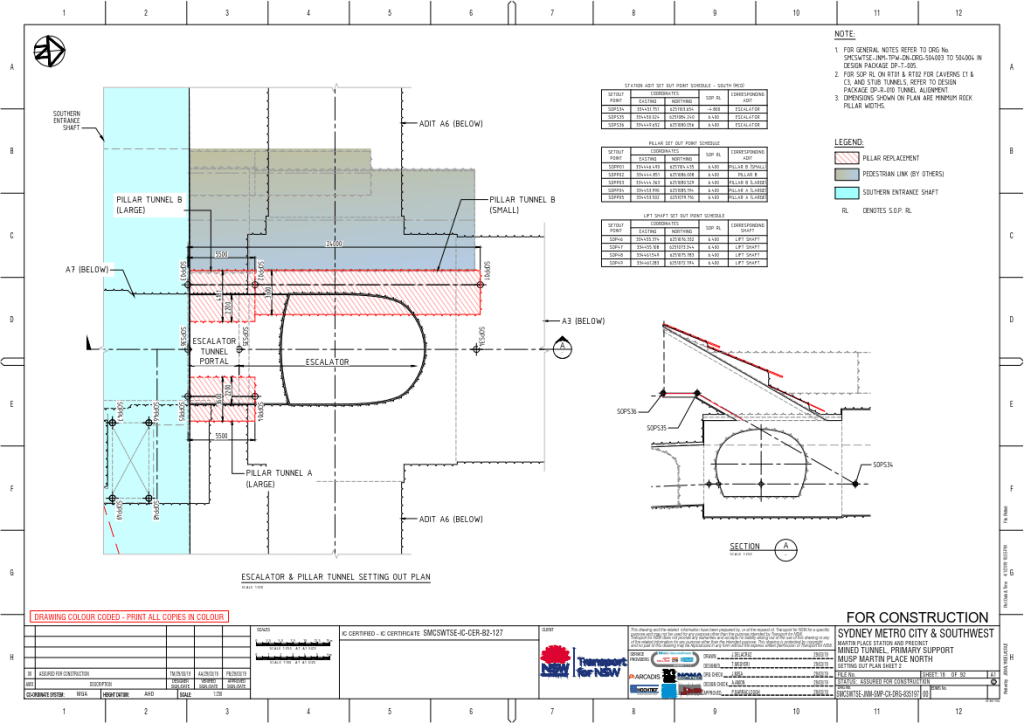
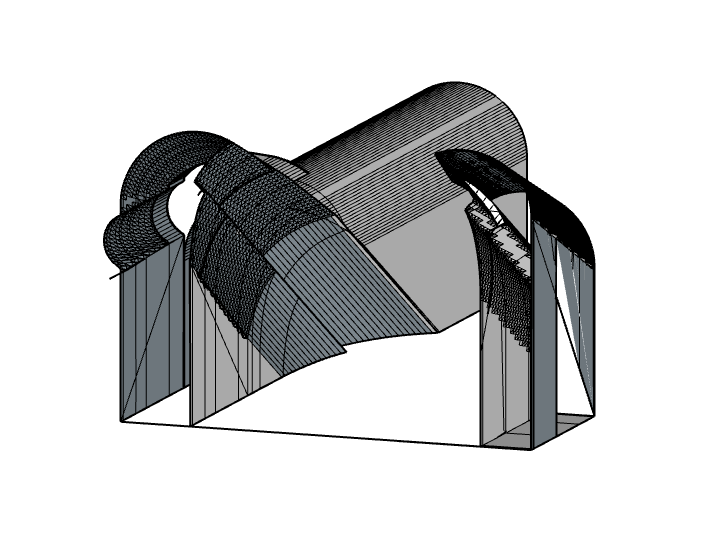
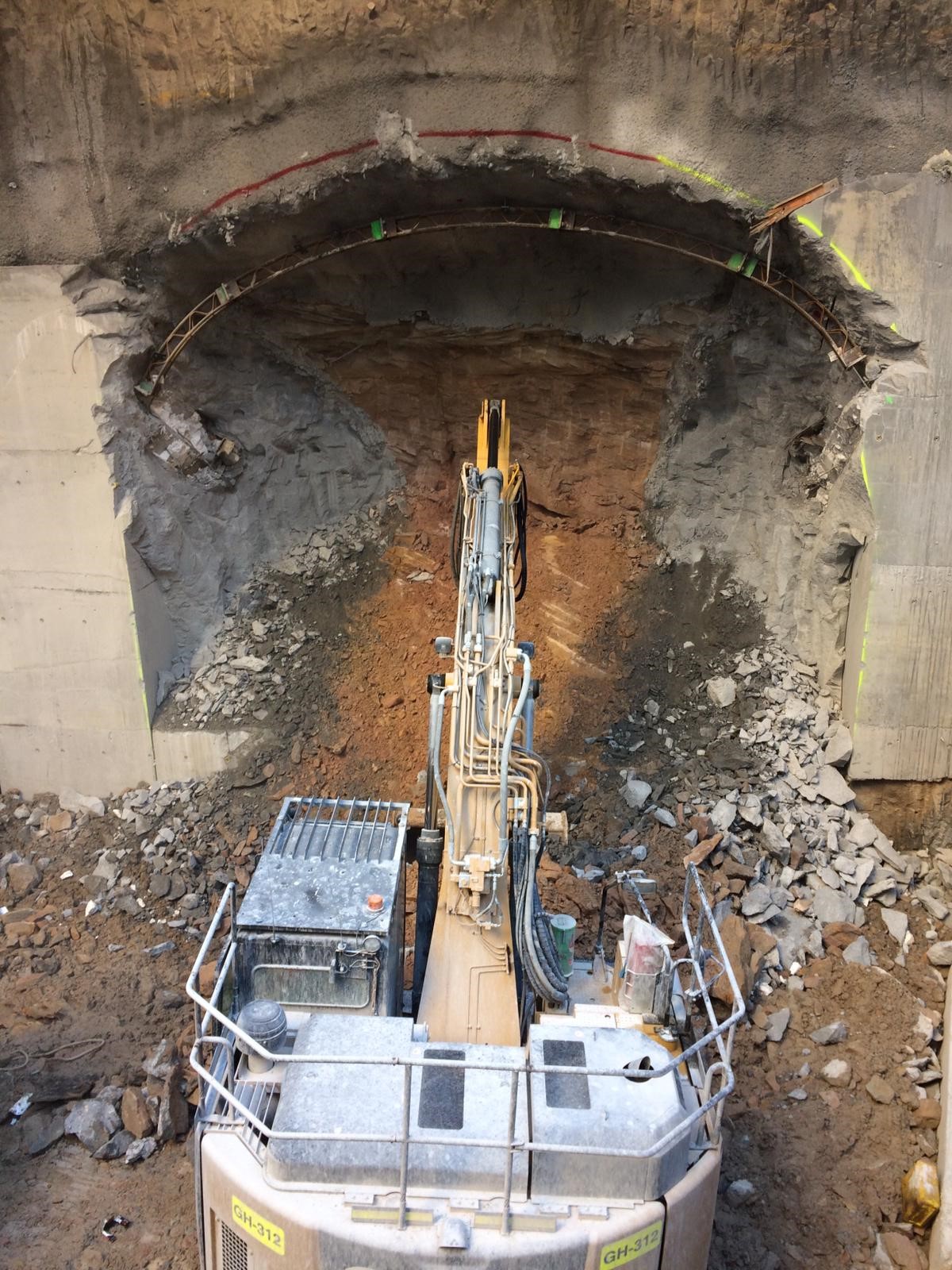
The profile of the escalator tunnel is constant as the portal descends. At the tunnel opening and throughout the descent there is a portion to be excavated which overlaps with the pillar tunnels leading to a challenging shape. Approximately half of each pillar tunnel will overlap the escalator tunnel portal. The notches at either side are critical for the installation of lattice girders, providing temporary support as fresh rock is cut, prior to temporary support (lattice and shotcrete) and the final reinforced concrete lining. A derivative of the New Austrian Tunneling Method. The challenge was how to create such a complex shape.
1. Change the design;
- Alter the profile of the escalator tunnel crown so that it is consistent for the whole profile
- Change the profile of the lattice girder support of the escalator tunnel crown and where they sit on the side walls.
These ideas were briefly explored by the senior site engineer however the time it would have taken to push through the RFI process and redesign would have caused delays. We have had to accept the challenging shape and come up with a temporary works design solution for the formwork.
2. Change the method;
- Pour half of the pillar with the notch space created by formwork
- Pour half of the pillar and fill in the notch or block it out
- Pour the whole tunnel with reinforcement through half and create a block out notch within the pour
The Formwork, Reo, Pour (FRP) Senior Engineer and Shaft Senior Engineers did a quick appraisal and cost for each scheme. We have a very experienced concrete subcontractor on site (Kenny’s) and they also could not find a cost effective formwork. In the end we opted for the whole pillar pour with a block out.
3. Selection of materials for a block out;
- High Density Cardboard had been used as a block out elsewhere on site earlier in the project – needless to say it didn’t work as cardboard is porous it turned to mush and did not prevent the ingress of cement and leave the desired shape.
- Wood creates a splinter hazard when hammered out and could have caused shrink/swell issues with moisture. It was also relatively heavy to manoeuvre into position within the tight reinforcement cage. The weight of wood also made it difficult to create an internal supporting structure within the form. It was have been hard to form a seal between sections of wood too.
- Polystyrene. Create a custom shape blockout to fill the entire void within the form. Light weight, easy to work with, can be purchased to exact size and dimensions.
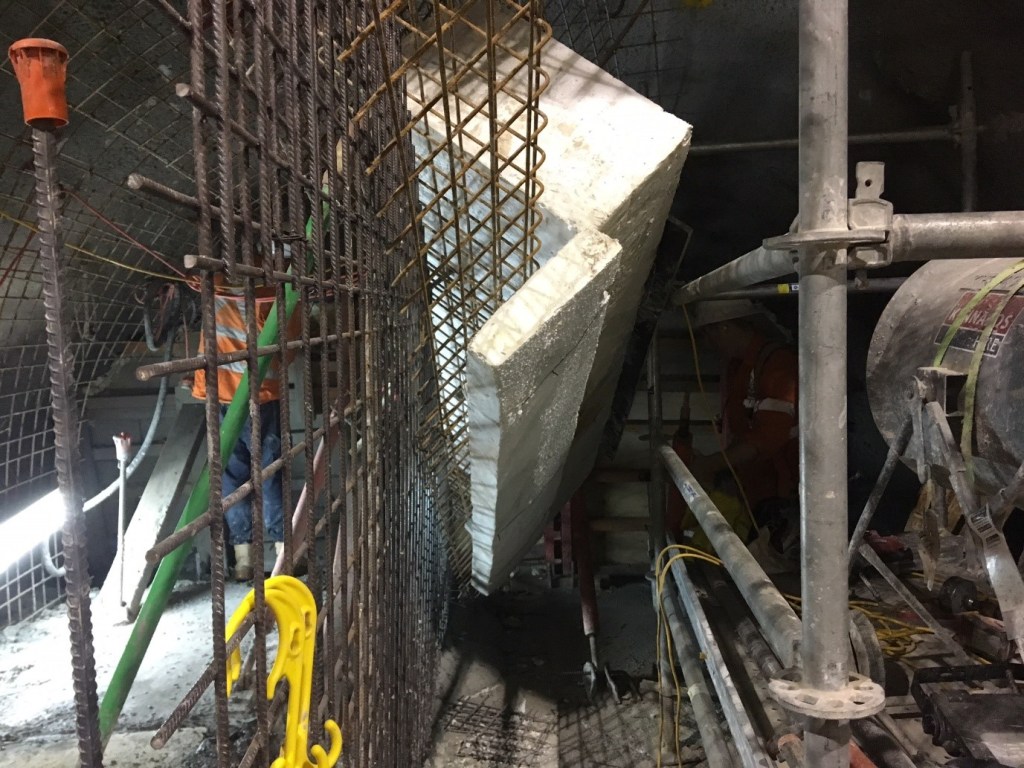
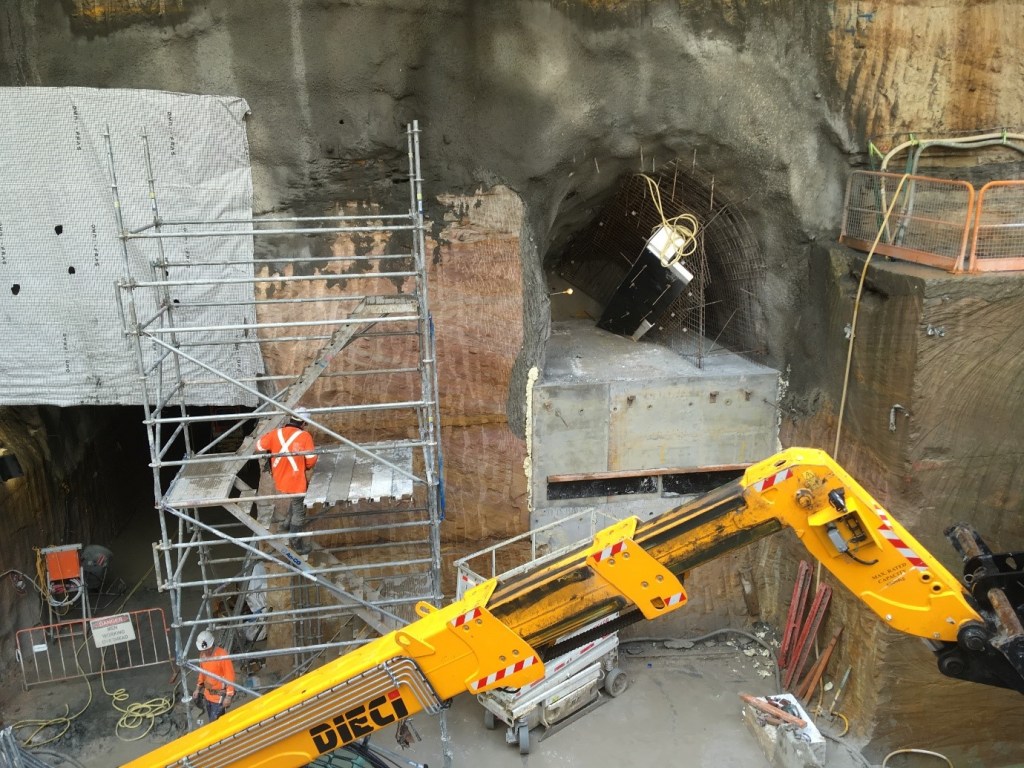
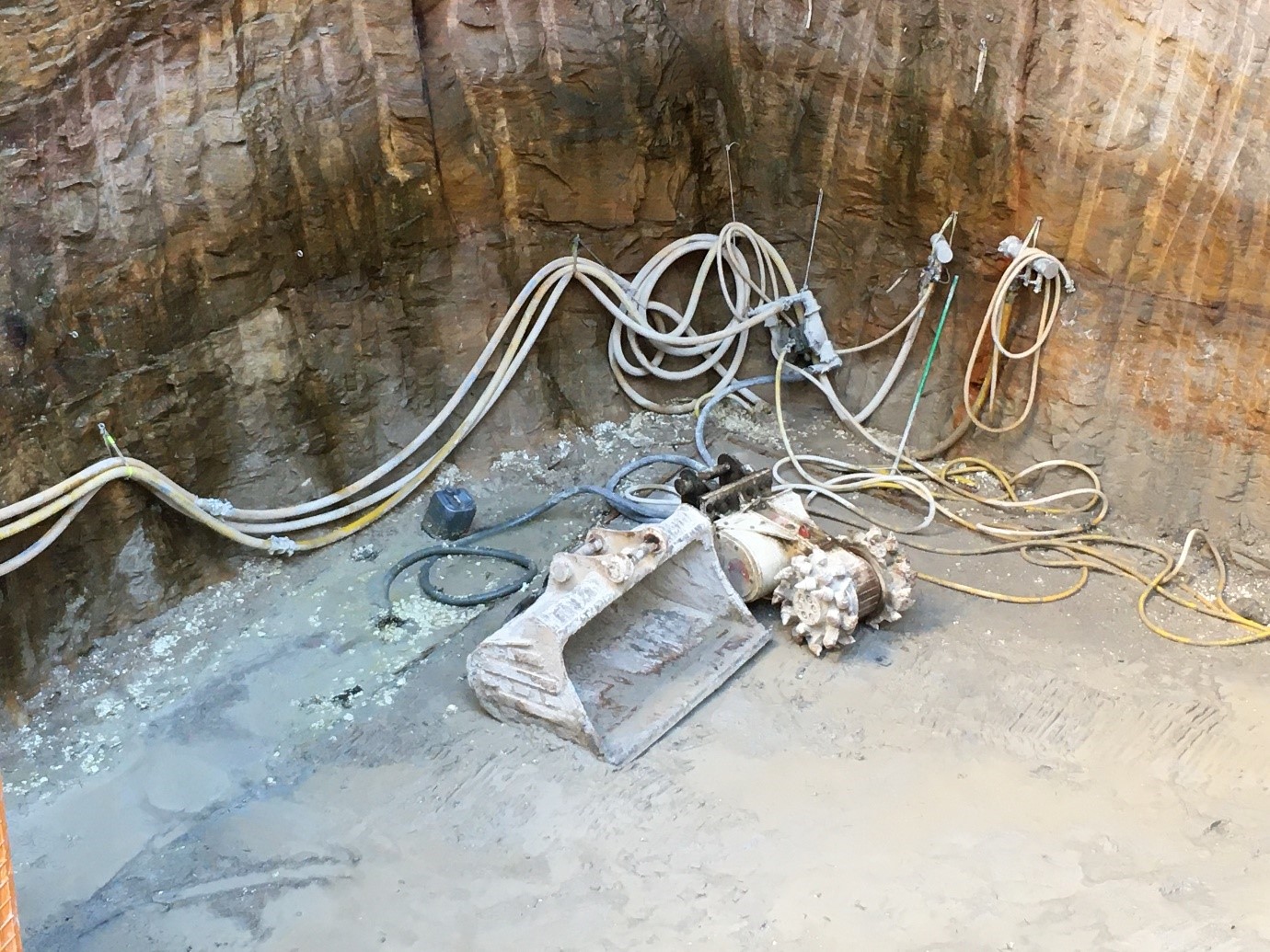
The polystyrene block out worked really well however the choice to pour the entire cross section of the pillar caused a one week delay to the programme during excavation as the 50MPa concrete was difficult to break out. Two unforeseen secondary effects also occurred. Excavation in sandstone generates a lot of silica dust and water suppression is vital. Pumps operate daily to remove the slurry and water from the blinding slab. Broken segments of polystyrene and the tiny balls within it subsequently blocked and damaged two pumps and polystyrene still litters the site nearly two months since it was dug out. Secondly, the spoil disposal subcontractor picked up on the polystyrene content of waste leaving site. Virgin excavated natural material (just the rock) costs $29/tonne. General Solid Waste Recyclable costs $115/tonne. For the rest of the 320m3 (7680 tonne) of excavation the spoil was often reclassified as GSWR. Not all loads were deemed GSWR but those that were costed the site an additional $15,000. Perhaps the complex formwork would have been cheaper after all.
 Holdfast Training Services Trial Blog