Long term lessons learnt?
Yesterday during the Comdt’s backbriefs the issue of lessons identified/learned was raised. This prompted me to finally write the blog post I planned to write a while ago and never got round to completing but with different conclusions.
The apartment I’ve been renting in Melbourne has 14 storeys above ground and a 2-storey basement. As far as I can establish, the building was around in 1996 so is at least 24 years old but could be older (internet research is currently drawing a blank).
Why is this important? Yesterday we discussed whether we are failing to truly identify and learn our successes or failures immediately after an event. Generally, the consensus was that we are bad at ‘learning lessons’. If we fail to do this in the short term, I suggest we are even worse at identifying our successes or failures further down the line… say 24 years later.
Our car parking spaces are on basement level 2 so approximately 6-8m below ground level. Following rainy weather, there is always water on the floor of the basement (Melbourne’s climate is similar to the UK so there’s a fair bit of rain). The water appears to enter the basement around the service penetrations (ventilation ducts) and through construction joints in the diaphragm walls and at the wall-column interface. I’ve taken a few pictures to show what I mean.
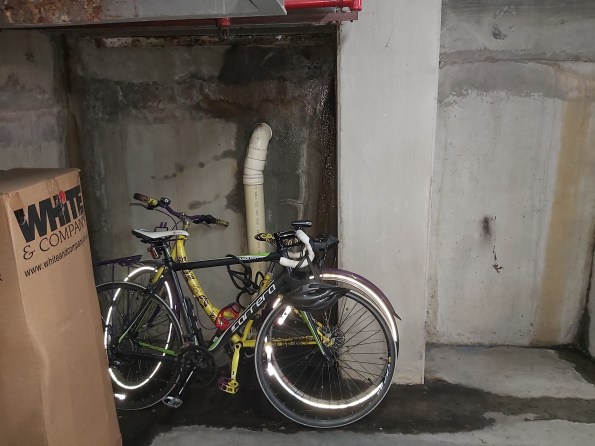
(Note the water penetration is from the vent ducting at the top of the picture and not the pipe.)
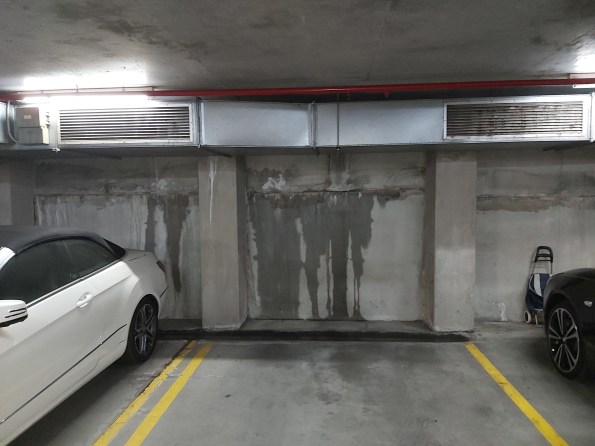
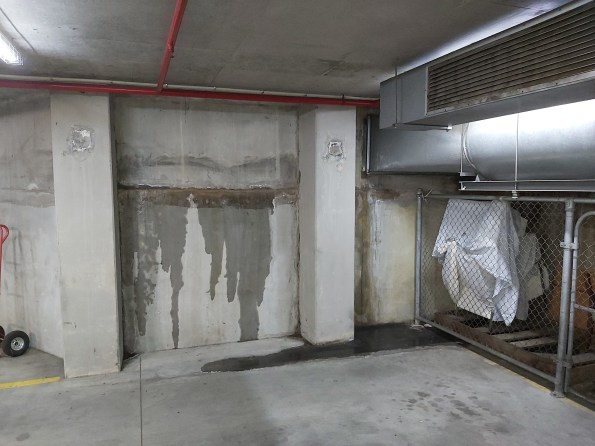
Why is this an issue? Well for me and the other residents our stuff gets wet. This is annoying but can be worked around. The bigger issue is structural durability because the ingress of water can increase the reinforcement corrosion rate and could lead to early failure of the wall. At the service penetrations and column-wall interface, there is likely to be sufficient cover to protect the reinforcement however at the mid-height wall construction joints there won’t be. I’ll hedge my bets that the contractor didn’t apply an additional protective coating to the rebar at this location meaning the reinforcement will corrode quicker.
So here are my thoughts on reviewing the construction/design issue 24 years later:
- Why were construction joints used at mid-height?
- Could the pour height have been increased so the basement walls were poured in one go? If not (due to concrete drop height or safety issues) could additional reinforcement be provided at the construction joint or a protective system employed to mitigate against corrosion?
- Was the ventilation service penetration part of the original design or was it added at a later stage?
- Was the sealant around the ventilation penetration fit for purpose and was it installed correctly?
- Has the sealant’s design life been exceeded and not replaced? Is poor building maintenance an issue here?
- Have any of these issues been highlighted to the Designer/Contractor to influence their future decisions/works? I suspect not.
My consultant does a lot of inspection of old bridges for asset owners which allows them to identify issues with historical designs that can be adapted or mitigated in their current designs, hopefully avoiding similar issues in the future. I’m not sure if the same exists in the vertical construction space but a feedback loop from building condition surveys to designers would be one way to improve future designs. I admit I don’t have the answers but hopefully, this post will spark some further discussion.
 Holdfast Training Services Trial Blog
Hi Mark,
I hope all is well.
Are you sure it is a diaphragm wall? You would expect vertical joins between panels for diaphragm walls. I suspect this has been constructed with traditional RC underpinning, hence the horizontal CJ.
I believe (quick google) there is no waterproofing standard for basements in Oz. Most websites refer the reader to BS8102 as the suggested standard to be followed. The below NHBC link is useful for a short description. In this is suggests car parks should be grade 2, but as this is an insurance scheme so it could have a higher standard.
I haven’t got a copy of 8102 but google shows table 2 stating carparks can be grade 1 and therefore ‘some’ seepage is acceptable. Suppose the issue is defining some…..
Regardless of the construction method or waterproofing standard, you are right to bring out corrosion particularly if the basement is in aggressive ground or GW conditions. Failure due to corrosion of the vertical rebar changes the bending to that of a vertical cantilever from the slab and roof. Could be an interesting TMR if you have any left.
It is usual to put a water stop material at there CJs for which there are loads of suppliers. Most suppliers only offer up to 20 years warranty nowadays. Old products tended to be asphalt based which dry and crack resulting in leaks, perhaps yours has failed?
Regarding longer term feedback loops, I would suggest that this is exactly why we have BS, technical notes and good practice guides. These get updated to include the learning from previous issues/failures. I have always found the CIRIA guides good, 139 and R140 cover basement waterproofing. The Concrete Centre also has a basement waterproofing guide, I suspect both will be on IHS if you are interested.
Hope this is the discussion you where after, it’s certainly filled my CPD for the month.
Brad
Click to access filedownload,43882,en.pdf
Brad,
Good to hear from you. Hopefully the new job is interesting. I’m glad the blog has helped fill your CPD this month.
I meant diaphram in the sense of a vertical diaphram (shear wall). I’m not 100% sure it was constructed using the diaphram method but there appear to be vertical CJs at the columns. The Melbourne area is covered by a very soft clay layer called Coode Island Silt which will have determined the foundation and subsurface design and construction methods. Other basements under construction in the local area are currently using the diaphram method but admittedly will be considerably deeper.
Your quick googling has highlighted the only solution I could see – building standards, engineering codes and industry guidelines/best practice. In the case of the BRE, CIRIA or NHBC I would be confident in their authority at time of publication but what is the review process and when should we as Designers question or challenge best practice?
Thanks for providing the link to the NBC document. An interesting read.
Sadly all my TMRs are in but I did have a similar issue across my desk during Phase 3 where I assessed the impact of reinforcement corrosion due to non-conforming cracks. Hopefully due to the shorter building design life it won’t be as big an issue in this case.
Update: In my last week of living in the apartment the quarterly newsletter was released. The newsletter stated an engineer had conducted an assessment and produced a report into the basement flooding and that remediation was being planned.
Sadly no further details were provided to the residents.
Thank you both for the posts. It’s ticked some of my CPD needs as well! Interesting for me was the look beyond ‘how do you feedback and prevent it in future’ to ‘what you can actually do about the issue in front of you’. There is a similar leaking concrete structure issue in one of the piers of the Thames barrier and, after numerous proprietary products have been tried as internal applications with predictable result, the final solution seems to have been found in closing over the doorways and vertical shafts to minimise heat loss and providing trickle heating at the base. This has lead to warming and expansion of the concrete and closing over of the crack(s). There is now a much reduced inflow rate which might also help calcification occur.