Island-Building
I’m sure you’re all aware that within the last ten years, China has been building artificial islands in the disputed south China sea, but what you may not know is that the US has been doing this type of engineering since the 1990s. In the Chesapeake Bay, an artificial landmass called Poplar Island is nearing completion after 22 years of construction under the supervision of the US Army Corps Of Engineers (USACE). The island consists of over 1600 acres of uplands and wetlands and serves as an ecological sanctuary for flora and fauna within the Chesapeake Bay area. It ticks another sustainability box too, as it’s constructed using soil dredged from the bottom of the bay in the creation and maintenance of shipping lanes; soil which is often highly contaminated and therefore usually needs to be transported long distances for safe disposal.

But how are these artificial islands created? Here is a very basic method statement:
1. First, the location is selected. Typically this is where an existing island has been eroded over time, as this offers a good foundation and relatively shallow waters.
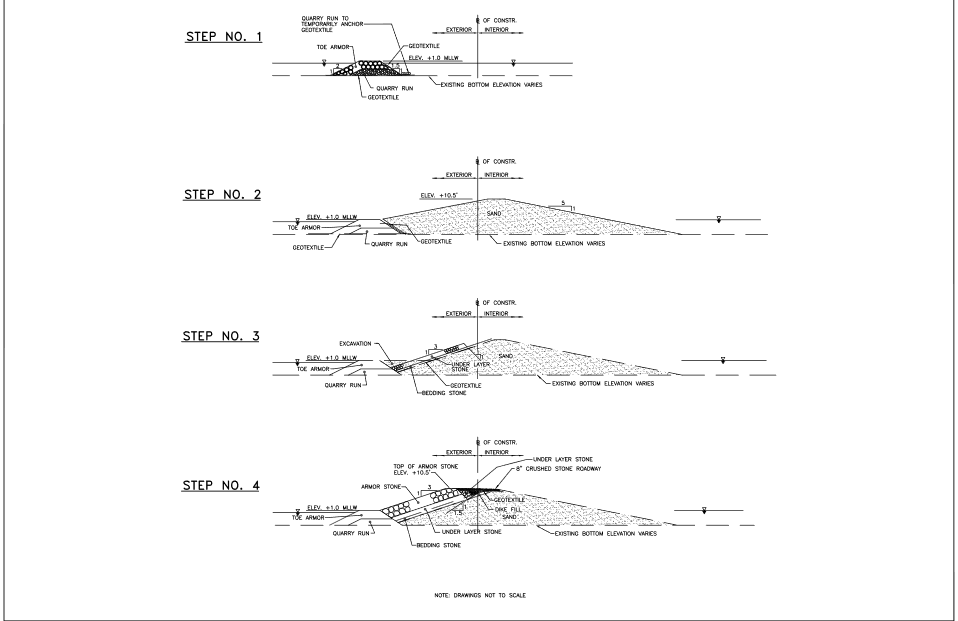
2. Second, the new island perimeter is established by creating “toe embankments”. For this, large rocks (rip rap) are dropped from barges into the water until they form an embankment that protrudes from the water at high tide. This is the protective embankment that allows further engineering to take place.
3. Then the main embankments are created by pouring sand behind the toe embankments. The rip rap toes prevent the sand from washing away with the tide, thereby allowing sedimentation to take place (sand sinks to the bottom, water is pushed to the top). These sand embankments are built much higher and wider than the toes in order for construction vehicles to be able to operate on them as the project develops.
4. Sluice gates are then built into the embankment. This requires the construction of a cofferdam.
5. Next, dredged material is pumped into the enclosed perimeter and sedimentation is allowed to occur. Once this has happened, the sluice gates are opened to allow the water to run off into the Chesapeake Bay. This outflow is monitored for turbidity and other signs of contamination. If any of the safe levels are exceeded the gates are shut and more sedimentation is allowed to take place. This process of “pump in dredged material, leave to sediment, and open the sluice” is repeated until all the water is gone.
And that is basically it. USACE will soon be assisting with the design of another artificial island in the Chesapeake Bay and in an age where sustainability is being pushed and China is using such methods to extend their influence, I can’t see this kind of engineering losing any momentum.
 Holdfast Training Services Trial Blog