Archive
Thank you, this is exactly what we wanted 10 years ago.
HS2 was proposed by government in 2009 and is now earmarked for completion in 2033 (partial completion 2026). The Shard opened in 2012, 9 years after gaining planning permission. Roadworks cost the UK economy £9 billion in 2016. The office type projects I’m working on are taking around 6 years from finalising a detailed project specification to taking possession. In February 2020, China built / assembled two hospitals (1000 & 1500 bed) in two weeks. A 2012 report noted that the Palace of Westminster was in urgent need of extensive restoration, this work is scheduled to start in 2025 and take 6 years. COVID will change everything / some things / nothing….
While project timelines and associated costs vary wildly, for many projects with moderate complexity a timeline of 10 years from conception and 6 years from specification with funding is reasonable. Such a project being completed now will have been conceived as the Arab Spring ushered improved living standards for the people of Libya, Egypt, Yemen, Syria, Bahrain, Iraq, Lebanon and Sudan. In 2010, the most popular electric vehicle was the Nissan leaf (73 mile range) which worked with the G-wiz (50 mile range) to show that electric cars would only every be driven by people who had given up on getting anywhere or were playing golf. The EU had supported nations struggling through the financial crisis showing the strength of the union while the Russian President had visited the White House for the first time showing a thawing in relations.
With so much changing between design and benefits realisation, it is not surprising that partial re-build or re-designs are often necessary in construction. Such a process involves wastage (labour, materials, equipment) while incurring disproportionate costs for additional work (short notice labour, materials, equipment + weak contract negotiating position). The delays incurred here also create a feedback loop due to further separation between benefit realisation and project specification. Watching this occur on my site with a simultaneous tender process going on for future buildings, it feels the incentives of most elements within the process are working against a more realistic design methodology which focuses on uncertainty.
Primarily construction projects are costly for business and often funded through debt. Convincing someone that a venture will be successful can be more about conviction and confidence than substance. The importance of a precise scope was highlighted during P1, but as is often the case, is there less focus on accuracy than precision? Would a scope which focuses on flexibility and uncertainty be seen as pragmatic or evidence of a party not sufficiently understanding the problem?
Design proposals are presented with 3D avatars from a future population, not as wire models or generic individuals to show scale, but as individuals of diverse abilities, goals and culture. These avatars move around with purpose (but not rushing) along optimally occupied but un-congested pathways. The below render of a future Euston Station has detailed a child’s shoe colour and will be presented along with a timeline and cost that most involved will expect to at least double. Clearly these renderings are not literal predictions of the future. I do however believe this is indicative of an industry which currently relies on both implicit and explicit over confidence in predictions.
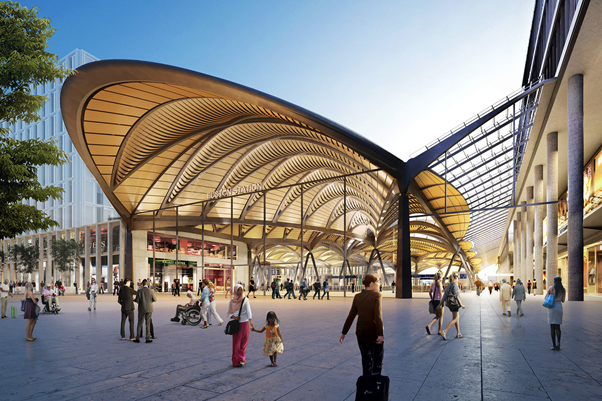
Many aspects of construction (and large military projects) seem to rely on getting the ball rolling with the understanding that, once started, the inertia of sunk costs will keep things going. Contractors bid low hoping to make up the difference on changes, funding is approved on the most optimistic of cost estimates and “fluff” is delivered before a capability to prevent downscaling in response to spiralling costs.
This is the opposite of the highly successful AGILE project management methodology which broadly focuses on delivering a minimum viable product (most basic product that achieves the customer’s key requirement) and then iteratively improves it once the requirement has been clarified and confirmed. Coming primarily from software development, AGILE clearly isn’t fully applicable to construction but aspects of it can be brought across. Car parks can be built to allow for simple future vertical expansion, false floors / ceilings allow for rapid interior changes and modular / small scale power generation reduces the need to predict future demand.
Despite this, the construction industry seems outwardly to continually project that mistakes were made in the past but we’re now at the point when the lessons have been learnt so can predict with confidence. Has this been the experience of others? Do people have examples of projects efficiently changing throughout construction as the requirements clarify?
 Holdfast Training Services Trial Blog