Archive
Service diversion.
This week’s blog will revolve around the services along the western boundary of phase one. The services that are currently in position were put in by Carillion last year as per the agreed design. These services include HV cabling that provides power to the temporary transformers on phase one as well as phase 2. That’s 3.75 MVa of power for phase one alone. The key point to takeaway is the HV cabling is live and being used. The other key service is the foul water, which needs to be in situ to allow commissioning to take place.
Unfortunately (for the client) the as built services now appear to run smack bang through where phase 3’s basement (crisscrossing in and out of the sheet pile wall) will be. Phase 3 cannot be re-designed so the services are going to have to move in order for phase 3 to go ahead. This ideally needs to be done by October this year as that’s the start date for phase 3 (main contractor not announced yet) and it needs to be done whilst keeping the power on to phase 2 and 3. To complicate matters phase 3 is being built on top of the Northern Line extension (NLE), the ground works for which have already started.
Carillion were briefed by the client’s consultant Burro Happold (BH_ two weeks ago as to the situation. Three COAs were presented and the preferred (selected by the client and BH) COA identified for CCL to pursue. We will be back briefing this week. The brief we received with respect to the three COAs considered was:
COA 1 single stage plan
The first option for diverting the Western boundary utilities and drainage is a single stage diversion. This entails providing temporary power generation to the ongoing Phase 1 and 2 construction works. This will enable all of the existing utilities requiring diversion to be removed and constructed along their permanent alignment in one single stage of works. Once complete, the diverted utilities and drainage will be energised and temporary generation/alternative supply will cease. This will then result in the phase 3 sheet pile wall being installed as close as 1m away from buried live HV.
COA 2 two stage plan
To avoid the need for alternative supply and generation to the ongoing Phase 1 and 2 construction works and subsequently piling in close proximity to a live service, a two stage diversion plan was considered. Within the two stage plan, power supply is maintained via a temporary HV diversion within the Phase 3 site, avoiding the basement secant piling wall line. Once the temporary duct alignments are installed, a swift switch over is undertaken at convenient connections to the existing HV network, facilitating the required diversion works to all of the utility networks along the western boundary. Upon completion of the diversion works, piling along the western boundary corridor can commence within the Phase 3 basement. Upon completion of piling, power and water supply can be swiftly switched back to the new diverted utility alignments, with the temporary arrangements subsequently de-commissioned.
COA 3 Tunneled Drainage and Phased Utility Diversion plan.
To avoid the need for alternative supply and generation to the ongoing Phase 1 and 2 construction works, a tunnelling option has been explored for the installation of the diverted foul drainage network to remove the majority of the required diversion via open trench installation whilst maintaining live services. Within this option, the launch shaft at an existing location will be utilised to tunnel the diverted foul drainage route north to a new reception shaft. From this reception shaft, the remaining 30m of required drainage diversion can be installed via open trench installation.
Upon completion of the foul drainage diversion, works can commence on the diverted HV supply alignment. The new HV alignment has been designed to avoid the existing live HV supply where possible, however some crossings are still required (notably at the existing entry and exit to the existing switchgear). In addition, the diverted HV alignment is required to cross the existing Phase 1 water supply. The plan would then be to conduct one shutdown and switch over in a very ambitious 48 hour period.
Chosen COA:
The tunneled drainage and phased utility diversion plan has been selected as the preferred COA for the Western boundary utility diversion works. The key risks associated with each COA are summarised in fig 1. BPSDC and BH highlighted the main drivers behind the selection of the preferred COA as being the costs and procurement risks of temporary HV supply as well as the potential to delay the final commissioning of the Phase 1 building (which requires completion of all associated utility networks) at the end of 2015. As the Phase 3 piling works are unlikely to commence until October 2015, it was deemed inappropriate to consider the two stage plan.

Fig 1. Risk matrix
Thoughts / reflection
Every time I re-read the three options that were presented by BH and the client and look at figure 1 I can’t help but think that the client is placing programme and cost implications well above the safety of the work force who will have to carry out this work. If something goes wrong I’m struggling to see how they will be able to prove that they did everything practicable to remove the risks that working close to HV presents; despite the use of tunneling the chosen COA will still involve new services crossing existing HV with hand digging installation method, which the client wants to keep live, 4 times. This is completely avoidable if either of the other two COAs were chosen. This is going to be highlighted at the back brief to the client, but I very much doubt we will get them to change their mind. The only thing that may throw a spanner in the works is that Carillion policy is to not work with live HV. So the choice of COA 3 may yet still result in temporary generation being required.
Questions for the PET community.
I’d be keen to know the civil’s view on piling so close to live HV. E.g. What happens if piles start to fail? The current plan is to place visual guides at the locations the piles will be driven as we place the new HV cable. This is to give the piling contractor an additional degree of certainty that they are not about to hit a HV cable.
I’d also be keen to know if the M&E community thinks I should be getting involved in this. Obviously the services themselves are M&E base, but a lot of the work associated with getting them in is civils. I think there could be an opportunity to get plenty of B1-3 competency experience. Thoughts?
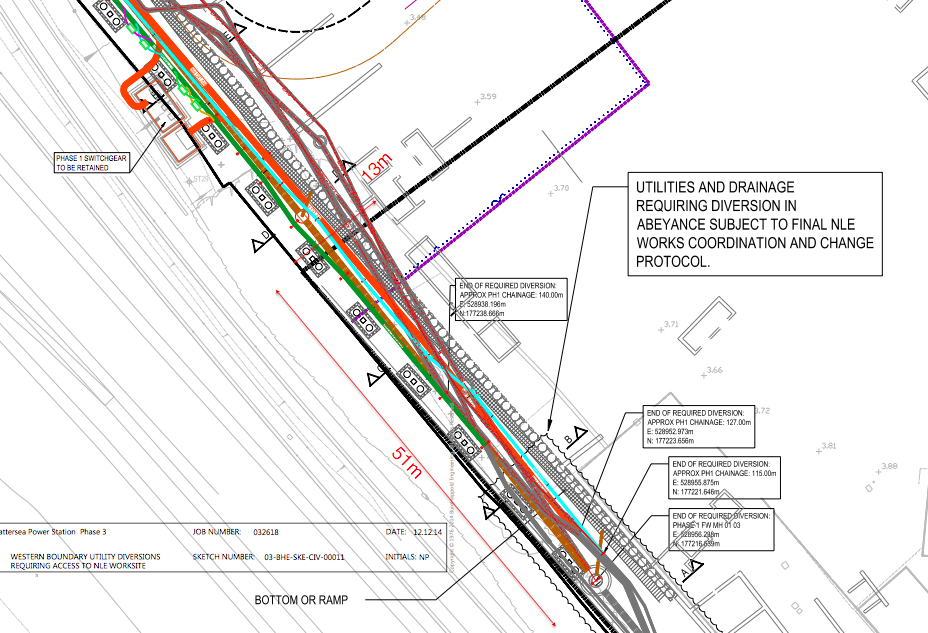
A drawing attempting to highlight how tight everything is going to be. Orange is new HV, brown is is new drainage. Existing services are greyed out.
No engineering.
For anyone interested in professional engineering content read no further. This blog from myself will not deal with life on site, but is a random tangent of life living as a member of the military in London.
This week on the way home from work I popped into a local take-away (for the first time). Whilst waiting I couldn’t help but over hear three young men complaining about the state of British foreign politics, the theft of other countries resources and the fact they were under constant surveillance from the security services. At this point I should have probably decided to wait for my lamb kofta and walk out of the door. I didn’t. I decided to try and engage with the three young men, to find out why they held the beliefs that they did and possibly have a reasoned conversation / debate surrounding the issues. Unfortunately this didn’t occur; I was confronted by a stonewall. I became slightly hopeful when one of the three mentioned that his thoughts were part of a thesis and who was I to question it? Perhaps it would be peer reviewed and I could read it on publication? No. It wasn’t that kind of thesis. In the end I did have a reasoned conversation, but with a bystander, which was very positive. Having concluded my conversation I left the three young men to enjoy the rest of their evening. When I left them they were still certain that they were being pursued by the security services, that the UK’s aim was to de-stabilise the world and that the September 11th disaster was a conspiracy theory.
The area in which I had this conversation was Kingston. The average house price is well over £500,000 and the borough has previously been classified as the third least deprived borough in London. The individuals I had the conversation with were articulate in their responses. I suppose my questions and concerns with regards to this encounter are: why do people in such a privileged area hate the country they are from (although acknowledging they themselves may not be privileged) and at what point should such a hatred become a concern with respect to security. How can they be engaged? It’s certainly not by a random chap having a chat in a kebab shop!
Temporary HV
Last week I was surprisingly involved in the installation of temporary electrics. I say surprisingly, because at the start of the week I didn’t think I’d have any involvement in this area of the project. Before I go on any further I’ll explain what the current temporary electrics plan is and how it was / is planned to develop.
The temporary electrics subcontractor is Wyse power. There are currently two temporary substations (TSS) set up in a radial to provide power to the site, with a third that and has now been delivered to site and is due to be energised shortly in order to allow a ring main to be established. The HV power comes onto site through an intake substation just off phase 1 and runs under the road on the western boundary before coming into the basement at TSS 1. From here TSS1 is connected to TSS2 via an internal cable. Another cable was pulled at the weekend which will eventually be connected to TSS 3. TSS3 will subsequently be connected to TSS2 via an internal cable allowing the ringmain to be completed. (Please refer to single line diagram).

Single line diagram showing the temporary HV set up.
This blog will deal with the delivery to site of TSS3 and the pulling of the cable that will eventually be connected to the ISS and TSS3.
My involvement in the delivery of TSS3 and the pulling of the cable came about because someone was on holiday and I was apparently best placed / willing to get involved. This is despite being only aware of what was happening and not read into the detail.
The delivery of TSS3
The delivery of TSS3 should have occurred last Wednesday. The plan was simple, use a tower crane to pick the TSS up from the delivery vehicle and drop it directly into its final resting place.
Problem 1? The substation didn’t arrive on Wednesday and the concrete subcontractors were due to be placing falsework in the area where the substation needed to go. Once the falsework was in position there would be no opportunity to directly drop TSS3 in with the crane as the falsework was for a slab pour. Unfortunately for me the Carillion construction team had been told in no uncertain terms that any delay to the concrete contractor was not acceptable. This led to the area I needed the TSS to go being filled with false work and covered over in preparation for a pour.
Solution 1: Placing the TSS as close as possible to where we wanted it to end up and then sliding it into position once the pour had been completed and the falsework had been removed (the TSS isn’t due to be energised for another few weeks, so curing time wouldn’t be a problem).
Problem 2: Wyse power were telling me that the TSS was going to be approximately 2.5 x 2.5m and weight in at around 5 tonnes. This meant that there wasn’t physically a route to get the TSS into its final position from the available intermediate positions.
Solution 2: When pulling the HV cable that would link up to TSS3, pull as much cable as possible into the basement in order to maximise the chance of being able to reach the TSS without having to pay for a cable joiner to come out.
Final solution: In the end the TSS arrived on site and measured only 1.8 x 1.6m and only 3 tonnes. Therefore, more by luck than judgement, we were able to place the TSS into a position that would allow it to slide into its final position at a later date.
Cable pull:
At the weekend that has just gone the cable that will eventually connect the ISS to TSS3 was pulled. This required the power to site to be switched off due the cable being pulled being in a duct parallel to the existing temporary HV power. Getting the HV power turned off is a relatively big deal involving having APs on site as well as the DNO – everything needs to run smoothly! The weekend prior to the cable being pulled preparatory works were conducted (cable pulling pits established) in order to allow the cable pull to proceed smoothly. The back brief everyone in Carillion had received was that these preparatory works had gone smoothly and that we were ready for the cable pull. However a quick chat between the groundworks supervisor and myself highlighted that everything wasn’t quite so squared away. In order to get the cable into the basement there needed to be a hole in the kingpost and sheet pile walls for the cable to pass through – there wasn’t. Fortunately this conversation happened at the start of the week, so it was fairly simple task to get the sheet pile wall cut down (the capping beam has yet to be put in position and will be formed around the cable duct), and a hole cut in the king post wall.
Comments / reflection:
My involvement in the temporary electrics came about because someone was on holiday. In future I need to do a bit more of an estimate as to what might come my way when people are away so that I can better prepare myself.
Everyone knew when TSS3 was supposed to be being delivered, but nobody had highlighted the critical nature of the delivery window – communication is key. A 5 minute conversation between the MEP team and the package manager for this part of the building would have highlighted that the falsework was going in imminently and could have led to the delivery date being brought forward to allow for unforeseen delays, or additional pressure being placed on Wyse power to ensure the delivery date was met.
Wyse power didn’t know the specs of their own transformer – everyone is a middleman. This detail should have been known in advance. In addition I should have questioned Wyse Power’s dimensions more. I could have looked at the dimensions of similar MVa transformers as a reality check on what Wyse Power were telling which would have simplified the issue of getting the transformer in position.
The groundworks contractor knew that the HV cable had to run into the building and that there weren’t any penetrations in the basement wall. Why didn’t they report this first thing on Monday morning? Why did it take a chance conversation to highlight the problem? Talking to people when you’re walking about on site it key to finding out and confirming what is actually going on. Also don’t take what you’re told at face value, question it and check for yourself.
Mañana? I’d be happy with tomorrow…
The excitement and novelty of working in a civilian environment is now starting to wear off and the reality kick in. I used to think terms like “military efficiency” and “planned with military precision” were something of a joke given how inefficient and chaotic Army life can often be. I am now coming to realise that I was pouring scorn on these phrases from the point of view of a person who has only ever worked in a military environment and presumed that the drive to make money in the private sector would ensure things ran smoothly. How wrong I was…
“Ask twice a day, every day for two weeks and it should get done.”
This is actual advice that was given to me by my mentor within the MEP department with regards to getting some work out of the Carillion structural team. All that I need from the structures team is an instruction allow some BWIC holes to be cut through the concrete slab and sheer walls for service to penetrations. The holes were on the original drawing but were either put in the wrong place or missed off when the pour took place, so it shouldn’t take much work for Buro Happold (structural consultant) to approve the holes. Having read Nick’s blog from earlier in the year with regards to civilian’s interpretation of tasks, and from my own experience of working with civilians as a staff officer I was aware that a simple email wouldn’t suffice. A conversation with the appropriate member of the structural team, email and additional conversation later I was confident that the task would proceed. This is when I was given the advice in the quote above. As my mentor predicted a week has passed by and various excuses have been given, the problem passed around the structural team and all attempts to pin down a date for a solution been dodged – for what should be a fairly straight forward task. I am now thoroughly bored and embarrassed with the daily grind of asking the same question (although this appears to be the SOP here) and have decided to take a different tack – apply some military process to the problem. I’ve managed to get the buy in of the structural team to using a simple tracker so that we know what needs to be done and produced a request for work template which specifically details the works needed on one piece of paperwork as opposed to several emails and drawings. Hopefully this will clarify what needs to be done and make the job of approving the work easier for the structural team so that they will turn it around more promptly. We’ll have to wait and see….

Rose wasn’t too impressed when she found out how Carillion do business.
Although the novelty is starting to wear off I am enjoying phase 2. Life in London is great – I’d definitely recommend it as a location for anyone on next years course if there are any jobs available. I’ve got a quarter in the Keep, Kingston-Upon Thames. The quarters aren’t going to win any awards for architecture and certainly don’t blend in with the Victorian town houses, but they are very nice once you’re inside. Richmond park is a 10 minute walk away as is the Thames and it’s possible to be in central London in under an hour on the train. I am currently getting my PT sessions in by cycling to work most days, which at 50 minutes each way is a quicker commute than the the train by about 15 minutes.

One of the stags I regularly pass on my cycle into work.
At least they got the specification of the biscuits sorted…
As promised last week, this blog will aim to outline what my role will entail, detail the main challenges associated with the project and highlight some issues that I’ve already come across.
Job role
I’ve been given the job title of Building Services Manager and as I mentioned last week I am being given responsibility for the services in the basement; although it looks like I’m going to be shadowing the principal building services manager whilst I earn my spurs. The M&E services within phase 1 are being delivered by one main sub-contractor, Skanska. My role will involve setting benchmarks for different areas / services within the basement and ensuring these are complied with, reviewing & approving risk assessments and method statement (RAMS) and conducting Inspection and Testing Plans (ITPs). There will also be an element of facilitating Skanska’s work within the basement and coordinating with Carillion’s project manager for the basement. Any feedback from the PEW staff or cse 55 on whether this seems like a sensible role for working towards passing professional review would be greatly appreciated.
Project Challenges
The most significant challenges on the project appear to be logistics, the programme and design.
The logistics issues with the site are caused by the lack of available space on site for storage, the size of the build and limited hook time (despite there being 10 tower cranes on site) available. The service risers, corridor modules (horizontal pipework distribution), bathrooms, apartment utility cupboards (consumer unit, DHW and MVHR) and plant rooms are being pre-fabricated and brought onto site as modules for final connection. Byrne brothers, the concrete contractor, have priority on hook time, so Skanska are having to move their stores onto the appropriate floor between 1730 and 2200. The demand on lift is also stopping waste material leaving the site promptly and is having an impact on housekeeping. The logistic issues look like they will be a challenge throughout the construction phase although I am looking at options to alleviate this in the basement by getting round the reliance on the tower crane.
The programme has had to change for various reasons and is becoming more aggressive as acceleration is used to try and claw back the 22 weeks of delay. Work is regularly being carried out until 2200 during the week and the site is open on Saturdays. Hopefully a final version of the programme will shortly be agreed when the client and Carillion come to a consensus on how the existing delay and future variation that I previously mentioned will be dealt with.
The final challenge is the design, which is still evolving as the client varies his requirement. Again it is hoped that this should be finalised shortly. There does appear to be some method in the client’s madness to changing their mind constantly; there is a general push to complete the entire redevelopment as quickly as possible to capitalise on London’s high property prices. Therefore phase 1 construction was started before the remaining phases were designed and this is causing issues and additional costs where there is inter-dependency. At least it looks like there is no inter-dependency or requirement for change when it comes to biscuits. Whilst wadding through reams of project documentation I came across the following clause in the employer’s requirements:
The Contractor is to ensure that…a selection of biscuits is to be provided at all times which should include but not be limited to chocolate digestives, chocolate bourbons and ginger biscuits. Cadbury’s chocolate selection and pink wafer biscuits or similar is to be provided for Principal and Project meetings.
The story so far.
To date I’ve generally been shadowing people around site and reading into the project documentation. A recent walk-around produced an interesting turn up for the books. Skanska had been craning some of the pre-fabricated service risers into position. Due to their allocated hook time this was occurring late into the evening. During a walk around on Friday morning the following was found:

Service riser with non-RAMS compliant edge protection.
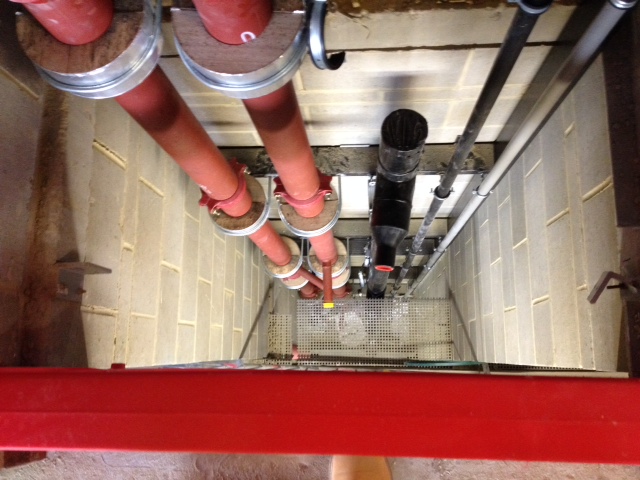
3m fall behind flimsy plastic barrier
Essentially the service risers had been left without Dura grid in at each floor, the protection in front of the riser was not as per the RAMS and was deemed to be unsafe. The immediate solution was that works were stopped until Skanska had rectified the issue, which was achieved within a couple of hours. This final solution was the installation of anchor bolts on each side of the riser to which ply board was bolted and the appropriate warning signs attached. What I found particularly interesting was that initial discussions were that a near miss should be created for the issue, despite the fact that nothing had fallen down the riser and nobody had come close to falling down the riser. However, as soon as the Integrate Systems Management (ISM) manager highlighted that a near miss would need putting on AIRline and impact on Carillion’s Key Performance Indicators the situation was de-escalated. A decision was instead made to produce an internal report rather than a near miss. My conclusion is that safety is taken seriously but so is performance and reputation. It also ties in with what Guz mentioned with regards to the five times the tipper truck on his site could have rolled but wasn’t recorded. The real cause of the problem is undoubtedly the time the work was carried out. Skanska’s hook time is in the evening, but their operatives work throughout the day as well. It is more than likely that it is guys from the day shift who are working overtime in the evening and an attitude of let’s just get the job done and get home is what led to it not being finished off properly. The programme does not allow for evening works to be cancelled and so it looks like the solution will be to employ additional supervisors specifically for the evening to ensure RAMS are being adhered to.
Initial blog from Battersea
After three weeks leave, I have now arrived on site at phase 1, Battersea Power Station and started working for Carillion. This blog will outline the scope & set-up of the Battersea development and identify what seems to be the most significant M&E elements to phase 1 in order to set the context for future blogs.
The entire power station development will be split into 7 phases, phases 1 – 3 of which are now up and running. I’ll expand on phase one in the next paragraph. Phase two is the development of the power station which is being carried out by Skanska, phase three is just beginning and will be an extension to the Northern line. The entire development is scheduled for completion in 2025. The client is the Battersea Power Station Development Company, which is a Malaysian consortium investing approximately £8bn into the redevelopment. The client’s architect is Ian Simpson Architects, structural advisor – Burro Happold, M&E advisor – Hoare Lea, Quantity surveyor – Gardner & Theobold and Project Manager – Turner and Townsend. The client’s team has designed the project up to RIBA stage D.
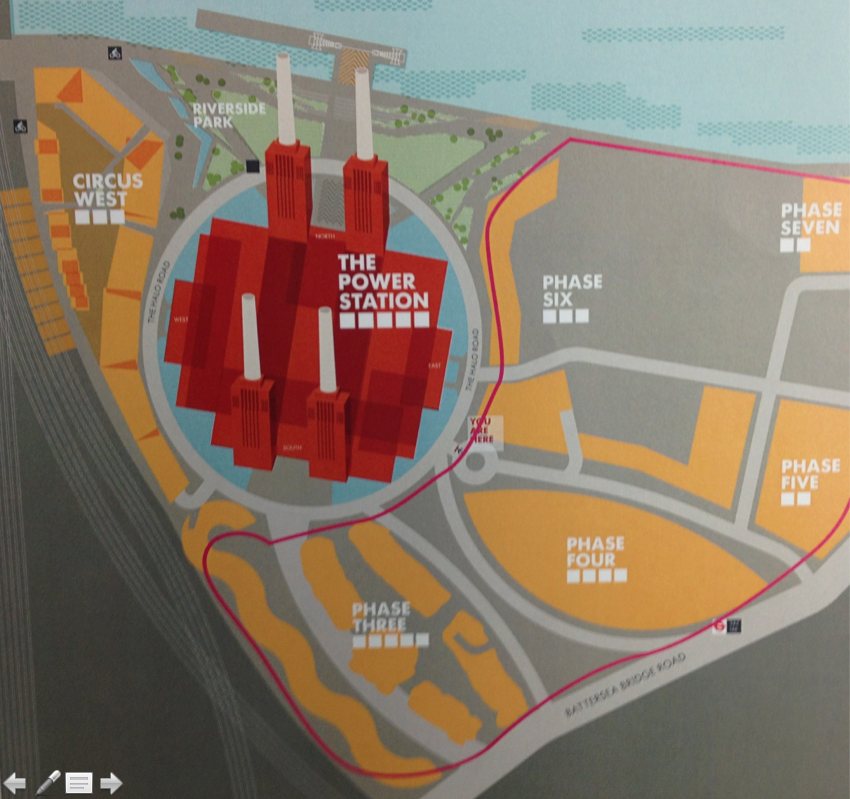
Overview of the Battersea Power Station Development. Phase 1 is labelled as Circus West.
Phase 1 consists of 866 luxury apartments located in the North West corner of the Battersea site; between the railway line into Victoria, the river Thames and the power station itself. Carillion are the principle contractor working under a JCT design and build contract to take the project from stage D to completion. Apartments range in price from £800k for a studio apartment to £4m for a four bed. The build is split into seven cores (A to G) which form RS1A, with a further five cores (H to L) which make up RS1B. RS1A is 14 stories tall with two basements and RS1B eight with two basements. Phase 1 is currently 74 weeks into a 148 week schedule, although this is likely to be extended.
The heating & cooling to the apartments will be provided by mechanical ventilation with heat recovery linked to a communal energy system. The most significant M&E engineering element associated with phase 1 seems to be the construction of an energy centre in the basement of core G. This will involve the installation of 2 x 4.2 MW boilers & 1 x 7.2 MW boiler, and 2 x 1.5MW & 1 x 3MW chillers. The original concept design saw this energy centre (which supplies services site wide, not just to phase 1) being constructed as part of phase 2. It appears the client is unable to complete this work prior to phase 1 & 2 being handed over and occupied. Therefore a variation has been made to phase 1 to install the energy centre in the basement of core G. This variation looks as if it will bring significant challenges with it. The current building design does not incorporate flues for the boilers that will be in the energy centre. This means a solution to take the flue gases across to phase 2 and up one of the power station stacks is having to be explored. The space available and limiting factors of working in the basement of block g means that certain elements of the energy centre will still need to be located remotely. This currently looks like it will involve the build of a remote cooling compound incorporating two cooling towers (let’s hope we don’t get legionnaires) for the chillers and life safety system generators. The remote cooling compound will be located somewhere on phase 4’s real estate and cross phases 2 and 3 to connect it, which will bring its own challenges. This remote cooling compound will bring about significant costs, effort to construct and is only temporary. The long term plan is build the original energy centre at the front of phase 2, connect it to the energy centre in the basement of core g, allowing the remote cooling centre to be removed in time for construction on phase 4 to start.
The Carillion M&E team currently consists of 6 personnel; head of M&E, 1 x design , 2 x commercial, 1 x delivery and myself. My role is looking like it will focus on the basements and the energy centre in core g, which should provide plenty of opportunities, but will involve working in a damp dark basement for a large portion of my time.
That should do for setting the context of the project. I’ll aim to provide another blog next week which outlines a little more of what my role will be and more details on the challenges / risks associated with the project.
 Holdfast Training Services Trial Blog