Archive
Incentivising environmentally considerate construction
My project recently received an environmental advisory letter, from the Environment Protection Authority (EPA), for tracking mud from the site on to a public road. There was no fine and no complaints from any of the local stakeholders, however the senior leadership team seemed disproportionately upset about the incident. After a bit of digging, I found out this was the project’s second advisory letter. When a project receives three or more advisory letters or has a serious breach of license, a project may be issued an infringement notice. These notices sit on the parent companies’ records and will count against them when a company is reviewed at the tender stage.
In the UK the local council or environment agency (EA) issue permits governing the operation of equipment and activities that could pollute or affect the current water cycle[1]. The permit issuing body and charges for each type of permit are mostly governed by the administrative burden on the council or EA who are assessing and issuing the permit[2]. In NSW, Australia, the Environment protection authority (EPA) is the single point of authority for issuing environmental protection licences (EPL) to the contractors carrying out the construction. In 2015, the EPA revised the way they issue licences to industry and construction sites to better incentivise environmental compliance and reduce the administrative burden for both the EPA and the clients. Each project has a single licence issued from the EPA that governs all types of emissions from noise to stormwater discharge. There are two types of scaling that change the cost and level of scrutiny the project receives.
Risked-based licencing – the EPA risk assessed the proposed construction activity, potential impact on the local environment, and management history of the contractor. This risk level (1-3) sets the level of oversight from the EPA, and the cost to the contractor of the licence. This provides an incentive to the various construction parties to maintain compliant behaviour to reduce their costs, administrative burden and levels of audit and scrutiny from the regulatory bodies.
Load-based licencing – this scales the cost of the licence proportionally to the limits on the pollution loads, thereby incentivising contractors to keep their noise, dust emissions and other pollutants[3] as low as possible, not just at the legal maximums. This also allows a project to calculate its own most cost-effective commitment as well as the offset between different pollutants on their scheme. It has also launched a scheme to allow large contractors to trade emissions between different projects on their portfolio.
My project has tried to take advantage of the ability to offset different types of emissions by committing to a water treatment regime that has very low analyte levels to compensate for some of the noise and dust impacts on the local community. This has backfired on the project’s bottom line. Land contamination means the water treatment plant is consuming filters and ion exchangers at ten times the rate initially estimated and costing four times the operational budget. Due to the pressure to uphold the EPA commitments, the reputation of the company, and avoid a further advisory letter, the project is spending money to treat water to a higher clarity level than the EPA minimums, and for very limited environmental benefit. Arguably the environmental cost (CO2 equivalent) of manufacturing and transporting the filters is more harmful to the global environment than the higher analyte levels in the storm water treatment.
I’d be interested if anyone has examples where environmentally considerate construction is incentivised successfully or unsuccessfully beyond fines and cost per unit emissions/discharge.
[1] https://www.designingbuildings.co.uk/wiki/Environmental_permit_for_construction
[2] https://www.gov.uk/government/publications/environmental-permitting-charges-guidance/environmental-permitting-charges-guidance
[3] https://legislation.nsw.gov.au/view/html/inforce/current/sl-2009-0211#sch.1
Subbies – Better the devil you know?
We have an on-site dilemma in sub-contractor management and wondering if anyone has similar experiences or tips in the management of under-performing subcontractors.
A civils works contractor was awarded the subcontract for the installation of the stormwater pits and drains across a new inner-city road scheme as a $3.5mil AUD lump-sum contract. The tender process was completed prior to my arrival on-site but I’ve been told they were awarded the contract as the cheapest tender as well as on the approved subcontractor list as an ex-employee of one of the parent companies on the JV.
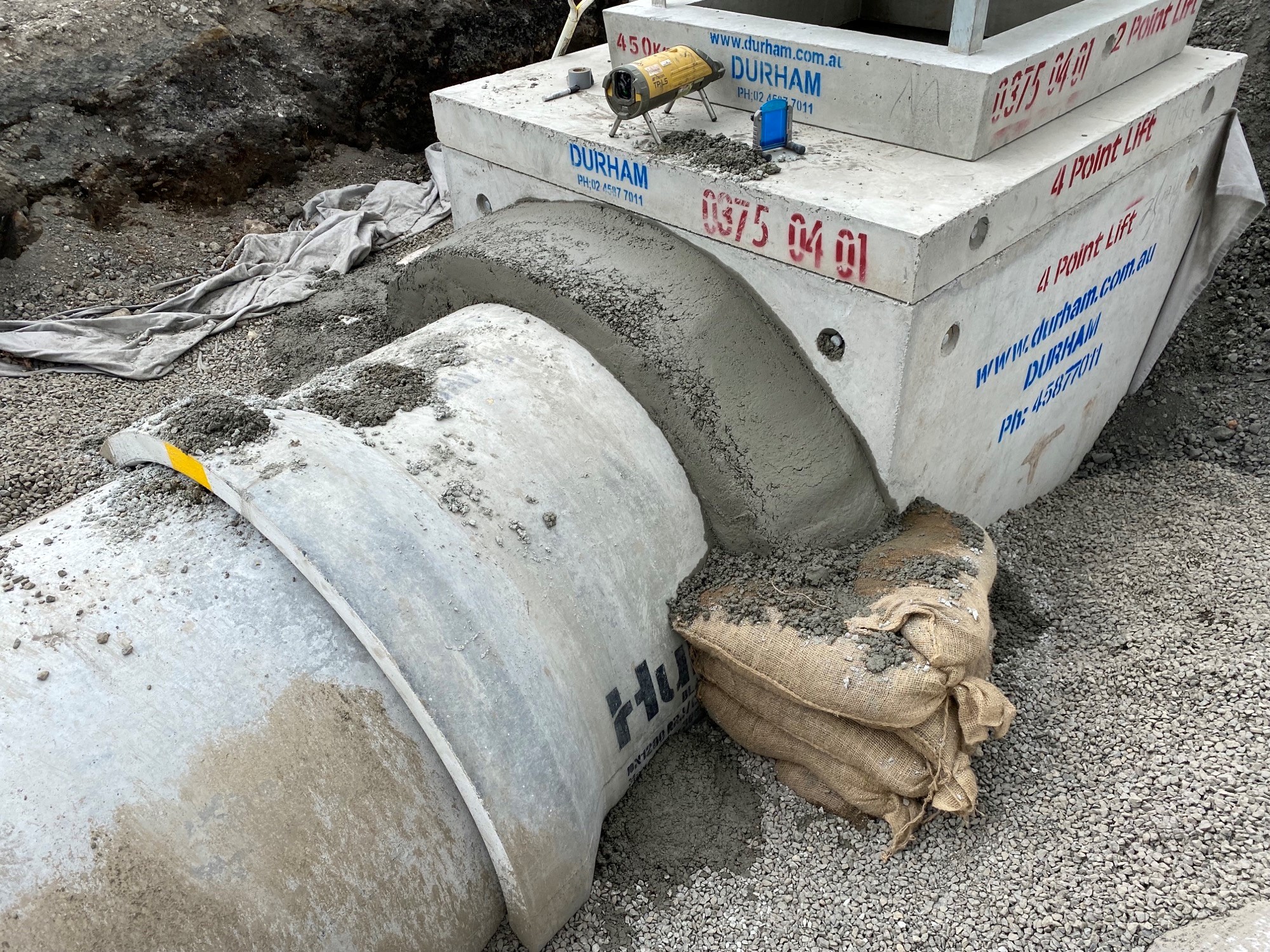
Currently, 10% of the work is complete, 3 months behind on a 12-month programme. A litany of issues including formwork blow-outs and poor workmanship leading to non-conformance reports and re-works are already 3 times the value of the whole contract retention. When I posed the question if the JV should cut its losses early and find a new subbie, the response, from middle management, was to propose a site engineer manage this subbie full-time. The engineering team is already undermanned, with an extra engineer to look after this subbie at least 3 months away.
It is often easier to progress with the status-quo because it is more straightforward to deal with the problems in front of you than try and challenge the underlying issues. Everyone on site is already busy, and taking the time to re-tender would eat into project overheads, therefore the commercial management direction is to treat the known risk with supervision instead of terminating and engaging a less risky contractor. From an outside perspective, this feels very short-sighted but shows the monthly cash flow commercial drivers of the project outweigh the quality and customer satisfaction considerations at this stage of the project.
 Holdfast Training Services Trial Blog