Archive
Handy – from Phase 1
I thought I would post a quick note to mention something from Ph1 that I have continually found to be useful, from a civils point of view obviously. Quite a lot of my time on site is centered on rebar drawings, which can seem fairly impenetrable. Although it was only around a days worth of taught time in Ph1, and incorporated into a design exercise, the lesson on reinforcement detailing has continually proved invaluable in allowing me to add some value and hence afforded me some credibility on site. Don’t get me wrong, I haven’t had to DO any detailing (yet), but understanding how I could means that I can read the drawings and conduct checks.
Multiple Drawings
Following on from that I picked up an error in some rc walls the other day which are going to house some utilities. The rc chambers are being built to hold pumps and ‘stuff’ which will tie into main water tanks (chilled and non potable). The water tanks are steel and are off the shelf, arriving at the CUP at a later date. What’s interesting, in inverted commas, about the error is why I picked it up. I was using shop drawings, for which no contract drawings exist as the tanks were not part of the original design work. (There is simply a bit in the specs saying that there are tanks required and that the Principal Contractor (PC) is responsible for sourcing them.) The PC was using an updated set of field drawings. These are typically slightly different to the contract drawings in as much as they account for the amount of steel that is going into whatever feature of work it is they are for. A cut from the drawings I was using are below, with the offending bar highlighted in red.
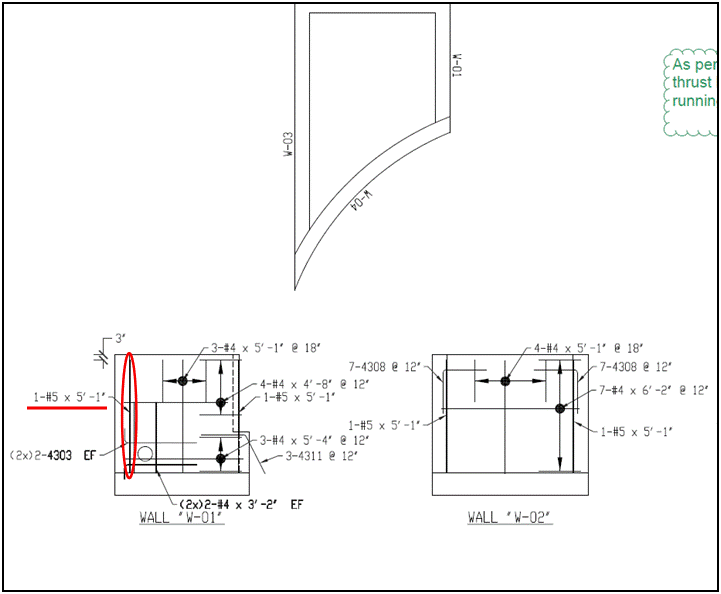
Excerpt from PC Shop Drawings
That bar, is a 5/8” diameter. (annotated ‘#5’) bar which should go on each corner, as you can see in wall W-02, with the remaining bars being number 4’s (#4) which are ½” diameter. On site #4s had been used all the way across. I was able to ascertain that the #5s hadn’t been called out on the field drawings, which is an error on the part of whoever produced those drawings. So the error arose, and was caught by the fact that multiple versions of the same drawings existed. If we had both had the most up to date drawings the error may have slipped by. I guess the lessons here are try to always obtain the most up to date drawings, and ensure that they are correct! This brings me onto another point…
RFI Tracking
… How does everyone else keep track of the RFI’s and various changes that occur to the contract drawings? When I go out and conduct checks I always take the contract drawings and the field set. Before I go out though I have to print out the relevant contract drawing and highlight the RFIs and amendments to it in pen, using a hardcopy set of drawings onto which all RFIs and amendments are noted as they come in. A picture of what on earth I am talking about is below.
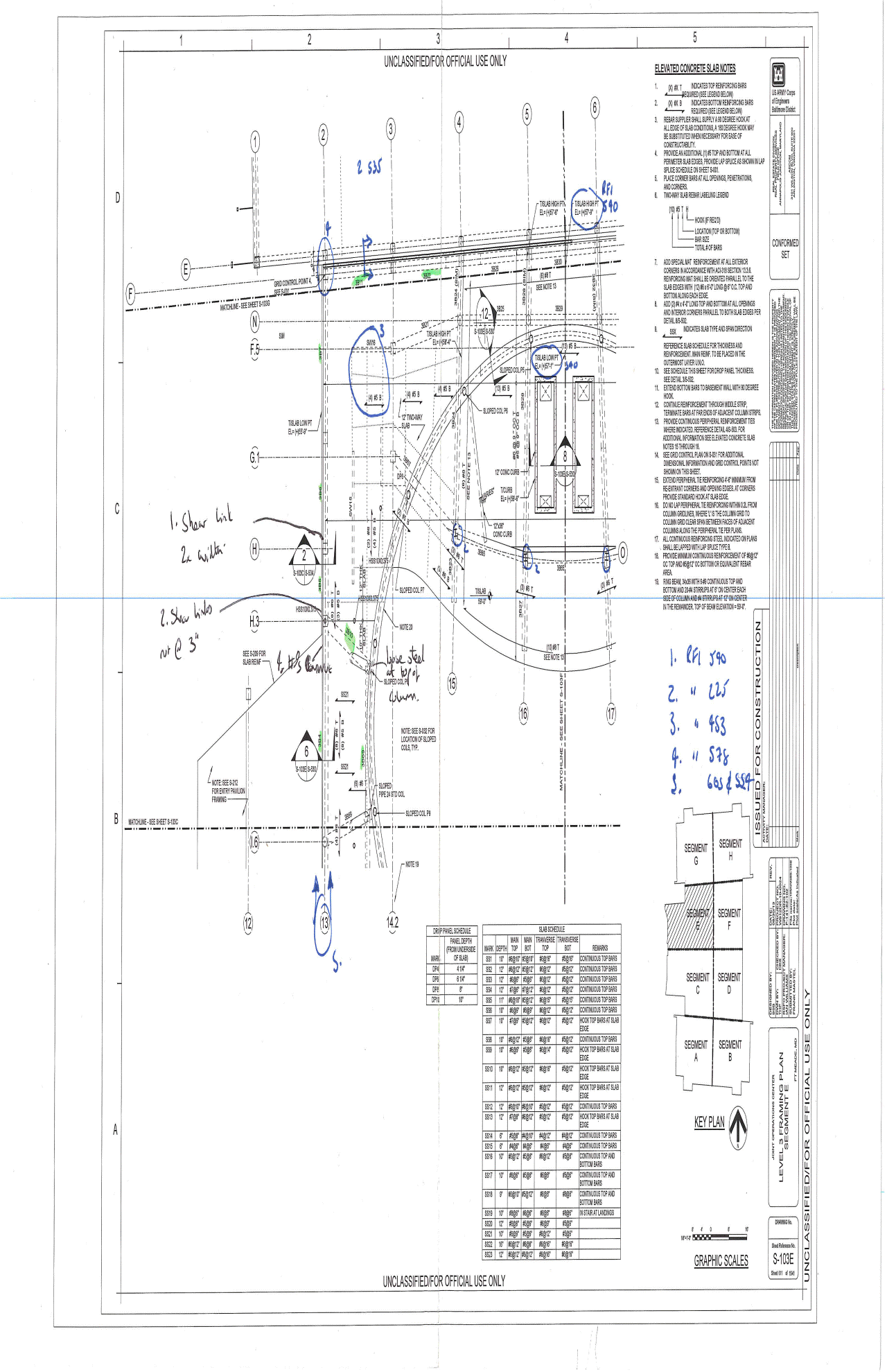
Mandraulic Updates on Conformed Contract Drawings
This is a drawing from one of my last checks. In pen are the RFI numbers and where they relate to. (ignore the bits in black, they are notes from the inspection itself) Before I go out I have to read what the RFI was and what the amendment is. Fairly laborious. Now, the pc who is clearly doing fairly well for itself has deigned it more productive to supply all its engineers with iPhones and iPads, with indestructible cases. They are all therefore able to download any drawing whilst on site. All their field drawings are updated by CAD Wallahs and replace old copies as RFI changes occur. Since the government doesn’t have CAD Wallahs its contract drawings don’t get the same treatment so we are stuck on the original conformed set, with ever increasing notes and cross references to RFI numbers.
Since everyone else is working for high flying engineering contractors I am curious, how do you do it?
LEED
As I suspected in my last blog the LEED issue has reared its head again. I sent back a submittal ‘E’ coded (re-show) for not having the required third party certification showing VOC levels. The pc called, stating that the manufacturer doesn’t have third party certification, nor is it willing to get it for one product on one job because it costs c. $30k. I suspect that the pc is less than enthused about paying either. From a government point of view and on reading through the specifications there is a very clear requirement for certification. As far as I am concerned it is the contractor’s responsibility to obtain the certificates, a point I will articulate. However, in the interest of not being a complete douche about the situation, and in the interest of maintaining positive relations I am currently investigating an ‘out’ for them. I know that any material that is installed out of LEED compliance can be ‘offset’ through focusing on the installation of super low VOC content material in the vicinity of the non-conforming material. What I am less clear on is whether this is for accidentally installed material, or as would be the case here deliberately placed material. I have sent the question to a LEED appointed person who sits with the client for their consideration. Another option I will table is the use of a different material altogether. The problem with this is that I have absolutely no input / exposure to the procurement process where I am at present. I don’t really know if this is a stupid recommendation but I will speak with someone at the pc end and ask, since we are currently on talking terms!
And finally
This is a picture from the historic Ft McHenry. It is where inspiration for the Star Spangled Banner comes from and is the site of an unsuccessful British attack. The bridge in the distance, which you can just about make out, is where the British Ships bombarded the fort from, retreating, presumably, when they got bored. The distance to the bridge was slightly further than the reach of the canons in the foreground, but just about the maximum range of the British canons.
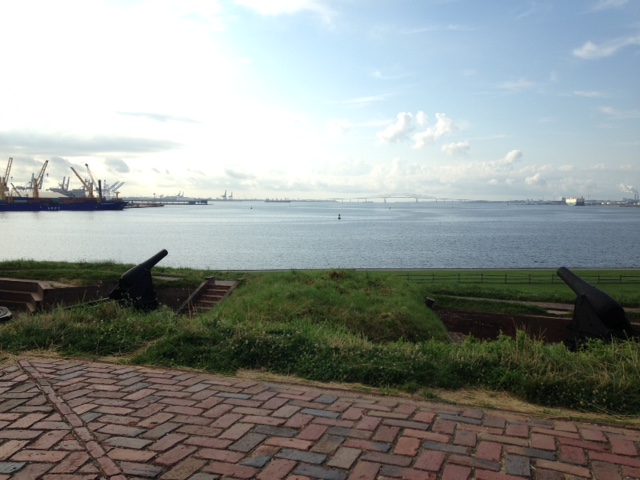
Fort McHenry
I tabled the idea of a future OPD event to the newly arrived District Commander that we should do a battlefield study about how the Brits could do it better next time.
Bits and Bobs
Things are progressing in the usual manner so I’m going to summarise a few of points of interest from over the last week or so. In no particular order.
- I’ve inherited a Cadet this week. He is an exchange student, currently at the University of North Dakota studying Construction Management. He was essentially dumped in my lap late last week as the Lieutenant who is supposed to be looking after him is out this week. Since I am the only military guy in the office at the moment I went to the airport to pick him up and he is ‘reporting’ to me. Since it was pretty much out of the blue I’ve just been trying to get him inducted, fam’d up on the vehicle fleet, online and then sending him off to the Gym!
- The slides below were presented at a recent talk to the USACE by the Designer of Record (DOR) for one of the projects here. It is a risk assessment tool. I thought I’d stick it up out of interest for everyone to see as it’s something a little different to what I usually see.
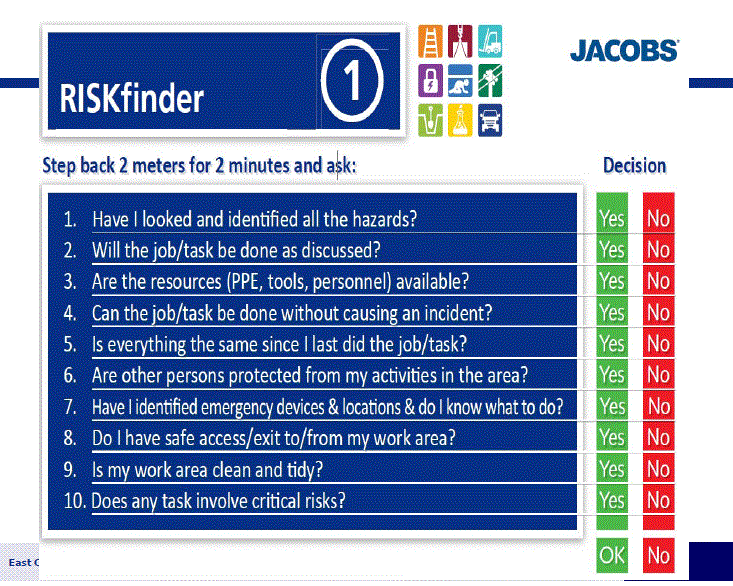
Excerpt from DOR presentation. Step 1.
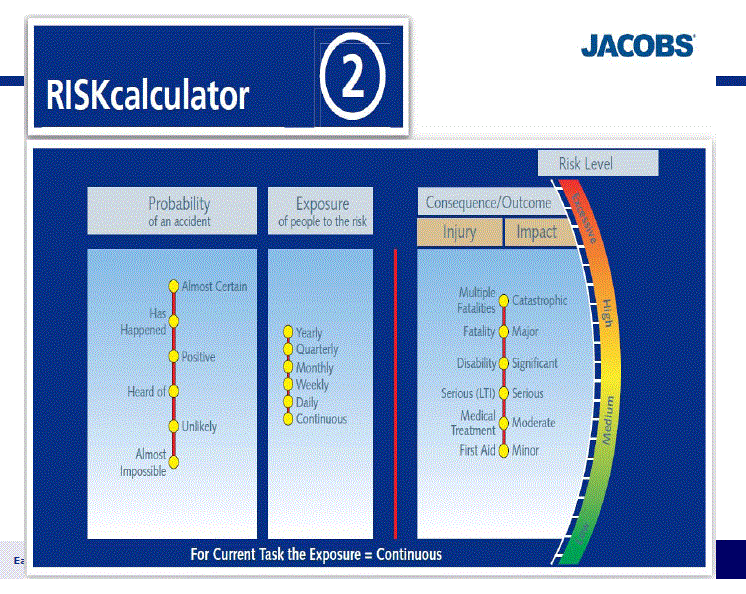
Excerpt from DOR presentation. Stage 2

Excerpt from DOR presentation. Stage 2
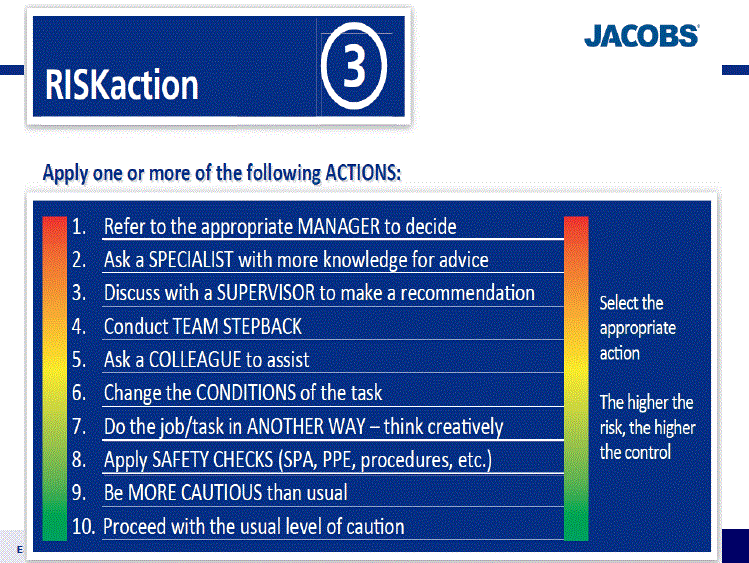
Excerpt from DOR presentation. Stage 3
3. There have been a few developments at the Central Utility Plant (CUP). I had an RFI come through about a column mounted Jib crane, which took me by surprise for a few reasons, not least because I didn’t know what a column mounted jib crane was. A quick Google search sorted that out. The next issue; there is nothing in the specs about the crane at all, or anywhere else, other than a note on the contract drawings giving direction about minimum hook heights, weight capacities, conformance to CMAA-70 and a requirement to swing 180 degrees. A cut from the drawing is below:
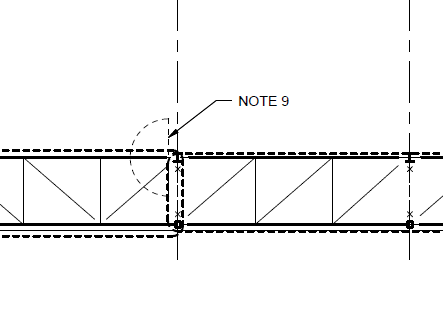
Excerpt from contract drawings.
Now, Damo has probably noticed that the crane appears to be mounted into the Web of the column; more on this later. Specifically the RFI that I got was to accept a proposed off the shelf solution. It contained some product data and drawings etc and requested that the RFI be sufficient for acceptance without a formal submission. I had a few reservations about this, I had also noticed that the crane appeared to be mounted in the web of the column. And that it appears to be over nothing, even when cross referenced with other drawings. I sent a question to the client asking what the intent of the crane is but have thus far heard nothing. Nobody here seems to know what its for either.
The designer reviewed the RFI and had no issue with the actions that the crane would impose on the column but I still had misgivings, specifically with regards to how the Contractor was intending to mount the crane (welded plate I guess) and maintain the 180 degree reach. I therefore asked for a formal submission with the connection details articulated more clearly than a manufacturers drawing which, in my opinion, won’t work as required. I spoke with the Contracting Officer’s Representative about this because the designer will be able to charge to look through the submission because it will be out-with the originally agreed submission requirements.
4. Specialized (sic) Engineering are the QC sub-contractor that conduct tests such as concrete slump, soil compaction, weld integrity and the like. For my structure they are required to come and check bolt tension, weld and plumb of the building. The most interesting thing, for me, of the last Specialized visit was the apparatus used to test the plumb. The Bazooka bob is an enclosed steel tube with a string tied at one end and measured increments at the other. It extends out and attaches to the steel magnetically. It is 10’-5” with increments of measurement of 1/8th of an inch at the base. A measurement of 2/8” at this distance represents the 1/500 allowable deviation from vertical so if the string falls outside of this you know that the column is deficient. Simples. All the measurements taken on site were within tolerance.
- The cooling towers (a mechanical feature which will eventually sit in the CUP) submission is being bounced around from Principal Contractor to USACE to Client to USACE to… The proposed towers (by the Principal Contractor (PC) were submitted a while ago and returned as deficient with c. 21 comments. The PC re-submitted the same towers with, what I consider, rebuffs to the client comments. I was in a meeting yesterday where the client essentially ‘kicked off’ at the situation questioning why it was that clearly erroneous submissions were being sent in, especially since the crux of the issue is that the cooling towers proposed are so far away from the Basis of Design (BOD). Again the PC had an answer along the lines of “we can ask for a variance to the BOD,” to which the client pretty much said “provide what we ******* ask for in the specs.” Fair enough – it was a heated meeting. This is interesting, not just because of how stubborn the PC is being but also because the cooling towers in the BOD are anchored to the steel building at 12’ centres. The PC preferred towers are anchored to the building at 14’ centres. You can no doubt guess at what spacing the steel frame has been erected, snapped, decked and welded.
- Another BOD issue; I am lead LEED representative at the moment whilst the actual lead LEED lady is on maternity leave. (LEED is essentially the same as BREAM). I have split responsibilities with another guy from the office who is also here temporarily. I reviewed my section (recycled content and regional materials) and had a scan through the rest of the submittal before passing the it to the other guy. I noticed that the PC had made a comment that they were making no effort to submit the 3rd party VOC certification required by the specs for Environmental Air Quality because the material suggested in the BOD didn’t come with it as a matter of course. I gather that they got this information from speaking to the manufacturer named in the BOD. I advised him to ‘E code’ (re-show) the submission and request the PC to send of material to a 3rd party lab for testing and certification. What interested me about this was that the material and manufacturer named in the BOD wasn’t compliant with the specs as a matter of course. I am waiting out to see if the PC gets back to me on this issue or if they will just send the material off for testing. The cooling towers issue hints at the former.
- Another area of contention has been due to backfilling activities (and I mean to echo Guz’s sentiments about good and bad engineers, but also add in ‘Lucky’) For me the issue started when I spotted a sub contractor backfilling some utilities into fairly wet excavations. What didn’t help was that there was water ponding in the weld pits and there was no effort to remove it prior to backfilling. To me this seemed ‘a bit weird’ as a gut reaction although admittedly I wasn’t clued in on the method of backfilling in the specs. I made a call to the PC and said I think the water should be pumped out of the weld pits as a minimum, prior to backfilling, and went to lunch. When I got back from lunch someone from the mechanical team came up and shook my hand for a ‘good catch.’ Apparently what I had witnessed was out of spec (shock) but also another in a long line of deficient practices with respect to the placement of utilities. Whilst I was at lunch the civils project engineer went to have a look at the site, taking along with him 2 other QA reps and some of the mechanical team. The PC superintendent noticed the collection of people and called his QA team . The PC was requested to prove that they had been backfilling properly to which one of their team jumped into the excavation and promptly sank in soil, which was presumably not within 3% of the optimum moisture content called for in the spec. This is an ongoing issue which could well form the basis of a TMR but the point I make here is to echo something I am sure I have heard around PEW but I cant attribute it to anyone in particular; if something doesn’t look right, it probably isn’t. I was fortunate to be passing by the activity when it happened or it mightn’t have been noticed.
In other news: This.
Illegal Steel Erection
Firstly – Nice job Guz, Swimmer and Fat-Bloke.
The Coffee CUP is nearing completion of sequence 1 / 4 structurally. In the main things have progressed smoothly, with the odd schnell evacuation due to the recent thunderstorms. Minor glitches include the incorrect placement of anchor rod bolts which attach the baseplates of the columns to the rc pad foundations. This was a quick fix with the erroneous bolts cut down to the profile of the bottom of the base plate (essentially so the base plate was resting on top of the cut down bolts) and new HILTI bolts epoxied into newly drilled holes in the correct location.
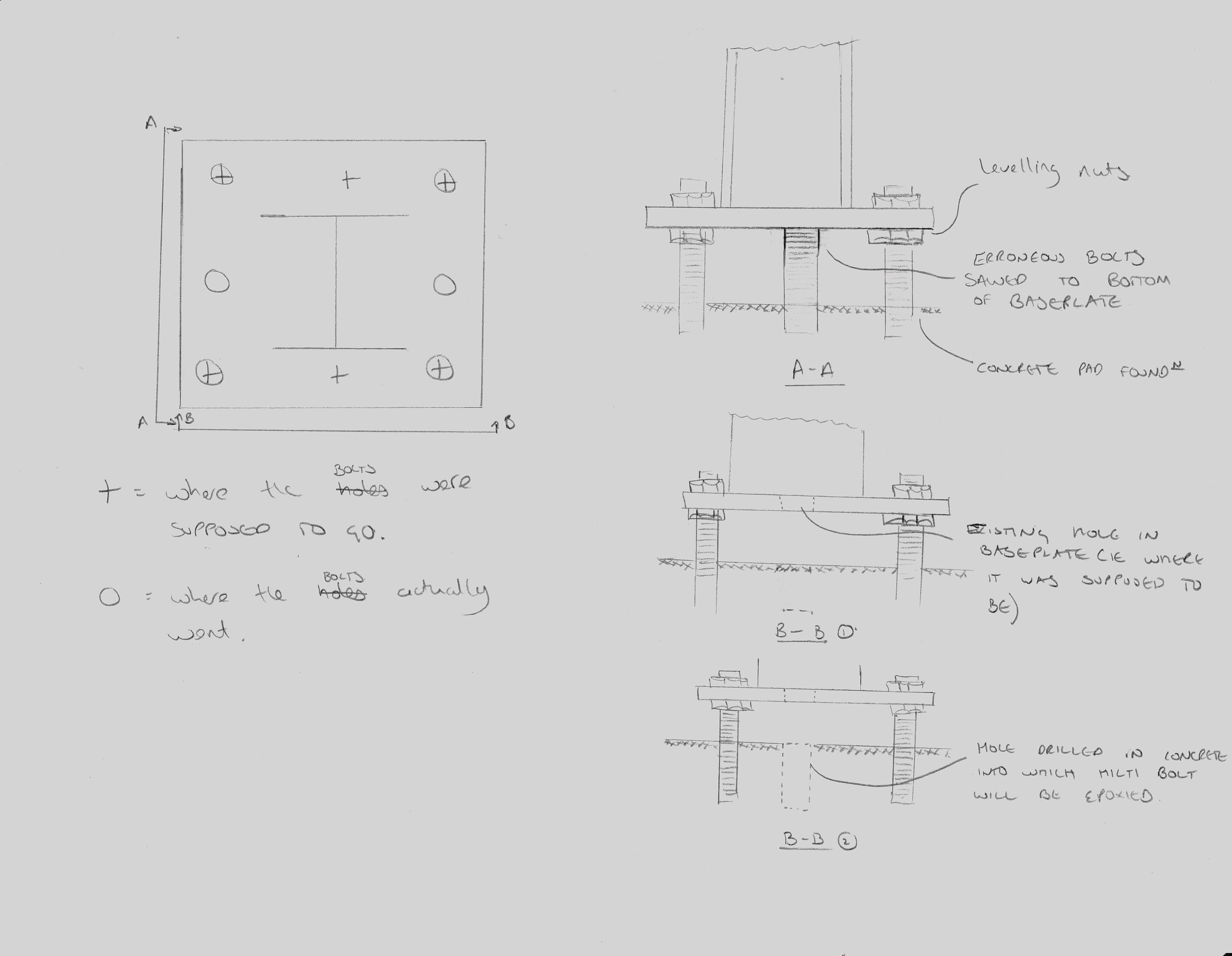
Sketch of Baseplate anchor rod correction
The washers used at the base plate location also need replacing with larger ones so that they entirely cover the drilled holes in the base plate. This will allow any uplift forces to be properly distributed to the baseplate through the entirety of the washer.
A more serious problem arose at the placement of a double bolted connection. A double bolted connection is essentially a shared connection between two beams on opposite sides of a single column. This is a fairly common connection type however the method of erection is supposed to be controlled for safety reasons. This is stated by the Occupational Safety and Health Administration (OSHA) para 1926.756 and also in the USACE HQ document EM385-1-1 at OSHA and EM385-1-1 (Cl 27 E)
Erection in a manner contrary to these documents is essentially illegal so in order to prevent the issue correct erection methods are stipulated in the contract documentation (spec) and checked for in the steel erection plan submittal which is required by the government before work can start. In cases where shared connections exist there are three standard ways of staying compliant with the regulations. These are sketched (crudely) below but are 1. Cut outs in the end plate. 2. Staggered end plates. 3. Welded or bolted shop or field attached seats. These methods are designed to either support the first beam directly or by allowing the minimum single snug type nut and bolt to remain in place whilst the second beam is flown into position. This removes the risk of the first beam slipping its connection and falling during the process.
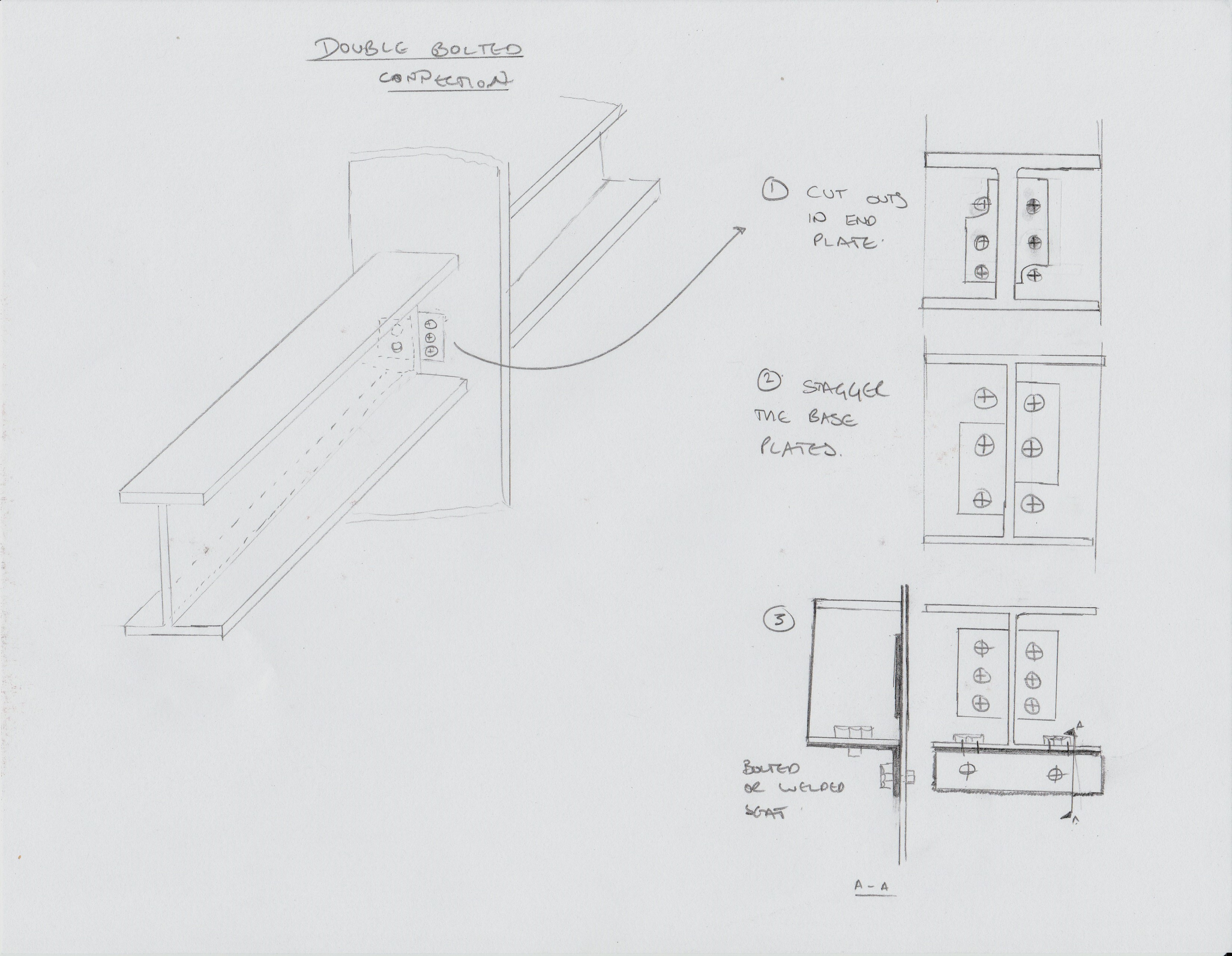
3 methods of fabricating for double connections
On site the majority of the shared connections are staggered (pic 2) to allow for this method of erection, however some have neither a cut out in the end plate or staggered base plates. When asked exactly how he had placed the beams the subbie admitted that he had removed the nut which had been placed after the first beam had been flown in and one of his lads had stuck his spud wrench through one of the other bolt holes. Highly naughty. We chatted about the situation for a while and figured that there must have been some sort of detailing error because it made no sense to not stagger the connection plates, and even less to not detail a factory fitted seat. Since he was the sub contractor I am not supposed to give him direction, unless it is an imminent safety issue, so I had to speak with my counterpart at the Principal Contractor in order to resolve the issue.
I went back to the office and was able to corner the resident steel expert who pointed me to the US American Welding Society document D1.1. This thrilling tome has within its many many pages a calculation for the strength of a fillet weld which is basically a function of the area of the weld and the grade of steel of the rod that is used during welding, with a factor of safety thrown in. I was able to assess from the field drawings what the heaviest beam would be in the whole construction and based my calculations on this. I proposed a 1” x ¼ “ fillet weld which could be applied in the field to the first beam that was flown in. This would be more than sufficient to hold the beam in place whilst the nut was removed in order to fly in the second beam. Obviously my proposal was only a recommendation and the actual design would need to come from the Principal Contractor. I highlighted this to them and requested that they submit an RFI for the field solution so that an audit trail would exist.
My proposal was questioned with an air of refusal by my counterpart who said that she had spoken to her manager who didn’t see the problem. A quick scan through the necessary paperwork, including EM385, the Specs and the Steel Erection Plan and a face to face with some relevant paragraphs printed out highlighted the government’s position. The issue remains unresolved as we wait for the RFI but the last I heard the Health and Safety guy had waded in and written a deficiency. This takes the issue in a more ‘formal’ direction which I had been trying to avoid.
Incidentally – I tried to find a similar clause in CDM but didn’t get on so well. Does anybody else know if there is one / where it is?
In other news – my wife and I went on a road trip to Niagara falls. Wetter than an otters pocket.

I also navigated one of the more arduous ‘trails’ in typical local attire fuelled by suitable amounts of coffee.

Standard US hiking Garb
The Coffee Cup
As the summer weather sets in construction of a new part of the campus begins and I have been given the responsibility of ‘Structural Lead’ for what will eventually be a Central Utilities Plant (CUP) building which will provide the cooling loads for the buildings on site. The structure itself is around 55m x 65m and is a steel braced frame construction sitting on a mixture of shallow concrete strip and pad foundations. The exterior will be clad with insulated metal panels, with one of the elevations detailed so that it can be disassembled at a later date and expanded, as and when the campus is expanded. This bit of the design echoes the nature of the entire project, which is expansion and longevity of the campus. The site is located on what will be called Coffee Road, and so some of the funnier members of the team have taken to calling it the Coffee Cup. All of the footings have been poured, with base plates set into them onto which the steel columns can be placed. Late last week I conducted a random check on some of the steel that has been delivered to site and cross referenced with the shop drawings whilst the contractor who is responsible for constructing the CUP structural steel surveyed the base plates to ensure that the concrete contractor had placed them in the correct location. All but one were approved on the as-builts and so work has just started erecting the steel, with an RFI submitted with regards to the erroneous plate. I had a slightly harder time however because for some reason the numbers on the steel work corresponds to the field set of drawings, which in turn do NOT correspond to the shop drawings. Quite why is a mystery however after much panicking I got to the bottom of the issue and the simple one man task became a difficult two man task with me cross referencing field drawings and shop drawings in order to ascertain which bit of steel we were looking at and whether or not it was correct.
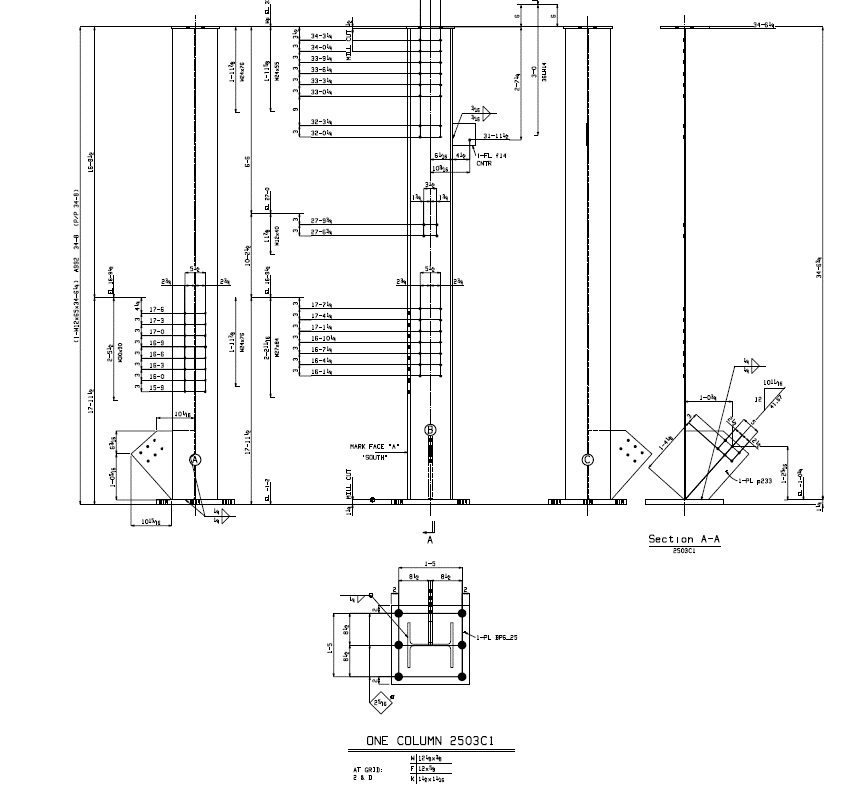
Example of Field Drawings for QA
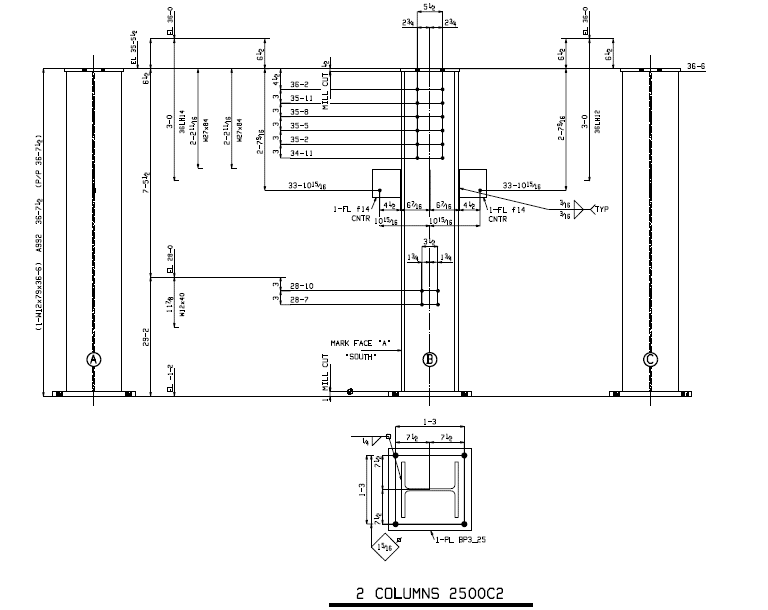
Example of Field Drawings for QA
Note also the lack of scale, which was initially confusing. The upper and lower holes are separated by c. 10”
Concurrently to this the concrete Slab on Grade (SOG) is being poured, with the second of four (2/4) pours complete already. The SOG is 6” thick with minimal bottom reinforcement and so the QA checks were fairly simple. An earlier RFI for the masonry walls location caught me out however as the approved reinforcement detail for the starter bars at these locations was drilled dowels, to be installed at a later stage, as opposed to what was shown on my field plans, which is the normal bent rebar protruding upwards.
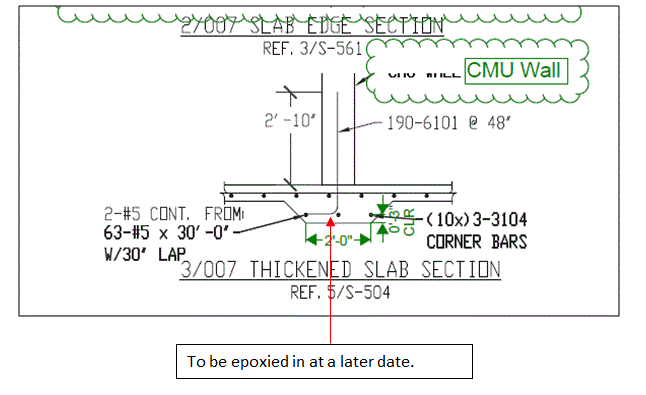
Lesson – keep abreast of the RFIs.
Mostly the pours went well but I saw an impact on the project which some of you may or may not have come across, but which is very difficult to mitigate.
About a quarter way into the 2/4 SOG pour at the point of the second slump test there was a recorded measurement of 11”. This is 2” out of tolerance and should have been caught as the first concrete came down the chute and into the pump. It is at this location where the first of arguably three slump tests is taken.
The worker here, who works for a third party QC contractor, is hugely experienced and can estimate to within a half inch what the slump of the concrete is. The reason I say that there are arguably three slump tests on the concrete is because as it comes down the chute he is supposed to estimate whether the concrete is compliant or not; if not the truck is immediately told to cease pouring so that only minimal deficient concrete enters the pump. This is done because the actual slump test cannot be conducted on the first 10% of concrete in accordance with ASTM C172 and ASTM C143. In short the issue is that the contractor at the chute should have identified the fact that the concrete was deficient. Instead he had given a positive reading to us that the slump was only 8”. Some might call this a lie.
As it turns out there is a bit of history with the worker in question who is, by all accounts, a disgruntled employee for reasons which I won’t go into here. Since it was too late to turn the truck away at this point and deficient concrete had already been placed it was noted exactly where the deficient concrete went in the slab (2 locations) and additional cylinders were ordered by the Principal Contractor. It is anticipated that these will close out the deficiency when tested as the slab is only rated at 4500psi (30N/mm2) and most of the tests come out higher than spec. but if not then core samples will be taken and the way forwards decided from there. Since the incident the worker in question is closely supervised. I’m not sure of the politics but to my mind he is tying up additional manpower and should probably be re-tasked.
Away from this I have had my first Health and Safety impact on site. The issue was to do with a slope stability problem next to one of the haul roads which runs adjacent to a sizeable chiller pipe chamber (essentially a big hole) As I was driving from the Coffee Cup back to the office I noticed that the batter angle on the slope was near vertical, and that there were track marks right on the edge of the road. I recognised the signs of a slope failure which I attributed to reduced shear strength of the soil (due to afternoon deluges we experience) and surcharge (of the tracked plant). My concern was that given the location of the tracks, which were right on the edge of the haul road, and the location of the haul road with respect to the gaping hole that a vehicle could easily cause further failure and would subsequently topple into said hole. I called the Principal Contractor who agreed to ‘have a look’ at the area. They obviously agreed with my assessment as the road was re-graded the next day and concrete barriers were placed along the edge of the road to prevent vehicles tracking too close to the edge again.
In other news
My car MPG is noticeably lower of late. As I’ve mentioned the weather is hotting up. The only reasonable explanation, from an E&M point of view, is that this has caused the many thirsty horses under my ‘hood’ to become thirstier. It did pass a rigorous 5 minute annual emissions test though. I’m not sure how, I can only assume that the test is to verify that it does have emissions.
I also recently participated in ‘Organization Day’ which marked the 240th birthday of the USACE, which is two days older than the Army apparently. It was a good day out with ‘soccer’ and volleyball tournaments. I was more use to the soccer team, with 2 goals helping ease the RSFO team to the trophy. Unfortunately I did little to halt the demise of the volleyball team, losing as we did 25-9. Good ‘cook out’ (BBQ) though.
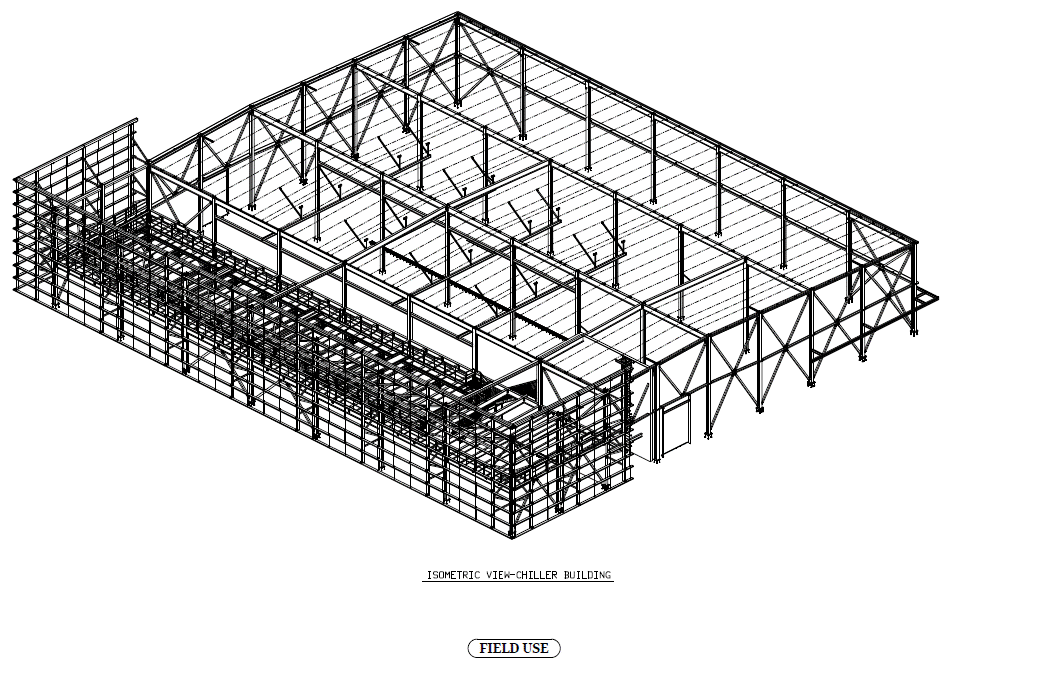
The Coffee Cup
The Splice of Life
Work continues on site at a fairly decent pace and there is much focus on the project interfaces especially now that the Notice to Proceed (NTP) has been given to the third project on the site. There is talk at present about the selected construction methods for the project I am working on with regards to the erection of the structural steelwork. This will form a part of the central atrium and will ultimately be the architectural feature of the whole building. At present the proposal is that as the steel columns are placed they will be tied from the outside of the building until the relevant roof truss section is placed and the element of the frame becomes self supporting. However due to delays on the adjacent project and subsequent efforts to make up the time they now require the space where the ties were supposed to go. This means that either 1. The ‘ties on the outside’ idea will now have to become a ‘struts on the inside’ idea to accommodate work on the façade of the adjacent project. 2. Shift work. This is still very much a work in progress.
Away from the structural steel side of life a recent check on one of the columns revealed that the lap length was insufficient. Initially this was spotted by comparison to the contract drawings, which have a little table showing the required lengths based on steel type (60,000psi or 75,000psi) and diameter. This makes QC fairly easy. The specified length was 63” however only 54” was measured. The root cause of the issue was a sequencing error on the part of the contractor.
The column in question was a central column which had tie in to two elevated two way slabs at differing levels and the RC beam which forms a part of the monolithic frame of the building. This means lots of steel. The general idea can be seen in the diagram below – which is a general detail with the column rebar drawn in red for clarity. DEFINITELY NTS!
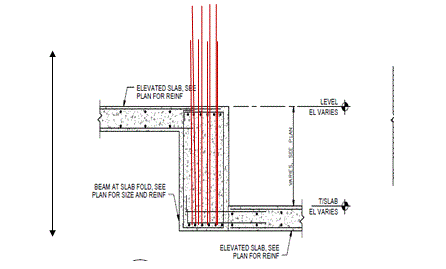
As you can see the lap measurement is intended to be from the base of the lower slab. Because of the ATFP requirements and the amount of steel required in the beams my suggested sequence would be to place the steel cage for the column and construct the beam through it. In this case however the steel for the beam was placed, and then poured with starter bars left protruding for the column cage to tie in with. This reduced length is obviously insufficient and outwith the specification.
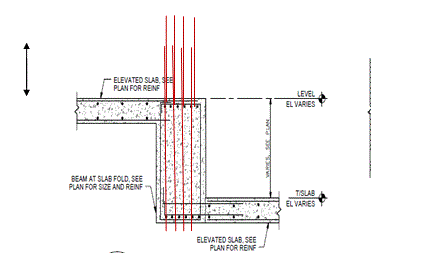
The error was immediately highlighted to the Principal and sub- contractor who were informed that they couldn’t close up the formwork and must put a hold on the following day’s pour. This obviously meant knock on delays to follow on slab pours. The only way forwards that I could see was to strip out the pour and start again, at huge cost in time and money or to lengthen the bars by welding, couplers or some other suitable method. I spoke with one of the other Project Engineer on site who checked the measurement and agreed that the error was too far out and we discussed a way forwards to try to minimize the delay. We looked at the lap length specified and he suggested looking to the Codes for a way out – specifically ACI318-11 which is the US version of the BS EN1992:1-1:2004. I broke out into somewhat of a cold sweat at the suggestion and was just about to propose ironing certain parts of my anatomy as an alternative but when he started to take me through the codes and to the relevant section on ‘splices’ I noticed that the code seemed somewhat user friendly – it even has a commentary section.
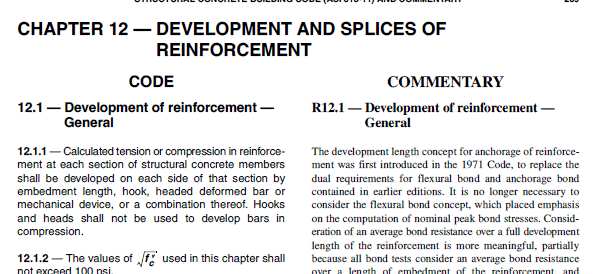
Excerpt from ACI 318
There is still the whole Eurocode-esque requirement to flick back and forth between referenced clauses, however in the e-version of the document these references are hyperlinked, so switching back and forth between clauses is somewhat less of a naus than the frantic wheel scrolling endured on the design exercises. Anyway – the calculation for the splice length is quite simple, just 1.3 x the calculated development length because this sort of splice is a Class ‘B’. In true Code style though, the development length calculation was almost an impenetrable mash of greek symbols.
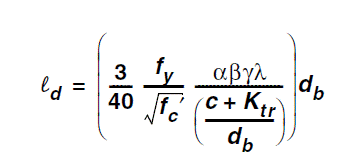
The commentary provided useful direction and actually most of the factors are taken as 1. So it can be seen that the development length is actually a product of Fy, Fc and bar diameter. In this case though I knew what the actual length was; I knew what strength steel we had and the bar diameter and so I adjusted the strength of the concrete until the calculated length matched the measured. This solution was acceptable, just about, based on restrictions in the design code about the acceptable strengths of concrete that could be used. It was calculated that a 10,000 psi instead of the 60,000 specified concrete would suffice. The proposal was obviously sent to the designer for their approval, which came back fairly promptly to proceed with the higher strength concrete. In the end the pour was only delayed by around two days, and now there are some super strength columns in the structure so everyone was fairly happy.
In other news we have a birds nest in our garden which has become the focus of some evening entertainment. So far the attrition rate of the chicks is around 50%. We are not sure if the two that we found lying dead on our patio were pushed by the other two, or if they just fell but at present king of the ring is a fairly brutal affair. Also, me and Danielle went to the tallest waterfall in Maryland.
More Bent Stuff
This weeks thrilling instalment follows on (inadvertently) the theme set by Guz and Olly. Apparently.
I have just completed my transition week, which now sees me as a Project Engineer out of an Area Office (a more familiar construct for those who have been / are in the US) working on two projects and also minor obligation back to the PM and PrM Office running the contract I have set up. As will be usual for most I had to undergo a site safety induction, ran by the principle contractor of the site on which I will be spending most time. With reference to mine and Henry’s last comments; the brief was actually fairly impressive and many of the standards that are in place are similar to those I experienced in the UK, with a few exceptions (so far – The rickety ladder of doom, no requirement for banksmen for reversing vehicles, gloves optional unless doing specific tasks)
Site itself is fairly dynamic and its not unusual for it to be almost unrecognisable from one visit to the next, particularly with concrete pours; movement of fill material from one area to the next to facilitate access; creation of new haul roads etc. This will only become more disorienting with the award of, now, two new jobs on what is already a complicated and congested site. An area that I am tracking is the interface between two projects, one of which is responsible for the placement of services and utilities in an area which falls within the new project’s Limit of Disturbance (LOD – AKA a boundary). This is an interesting issue because there was a change order submitted to accelerate the placement of the utilities months ago, however this was cancelled when the schedule for the new work was reviewed and it was seen that no work was going to take place until after the utilities were originally scheduled to be placed anyway. So, a requirement was included in the contract for the two Principle Contractors to de-conflict activities where there were pinch points in LODs. There are now mutterings however that the principle contractor on the new job (who is apparently very savvy when it comes to working with the government) is expected to submit claims to the government due to a change in site conditions, which precludes him from going into an area that he doesn’t intend to go into anyway. Good!
On a more real time issue, myself and another Project Engineer inspected a deficiency yesterday on a basement structural RC beam. It is still propped and not fully load bearing yet however there is a large crack running pretty much the length of the beam (c.3.5m) which varies from around 300mm wide in places to c. 50mm and is deep enough to expose the reinforcement. (For Damo’s amusement I have attached a Sketch)
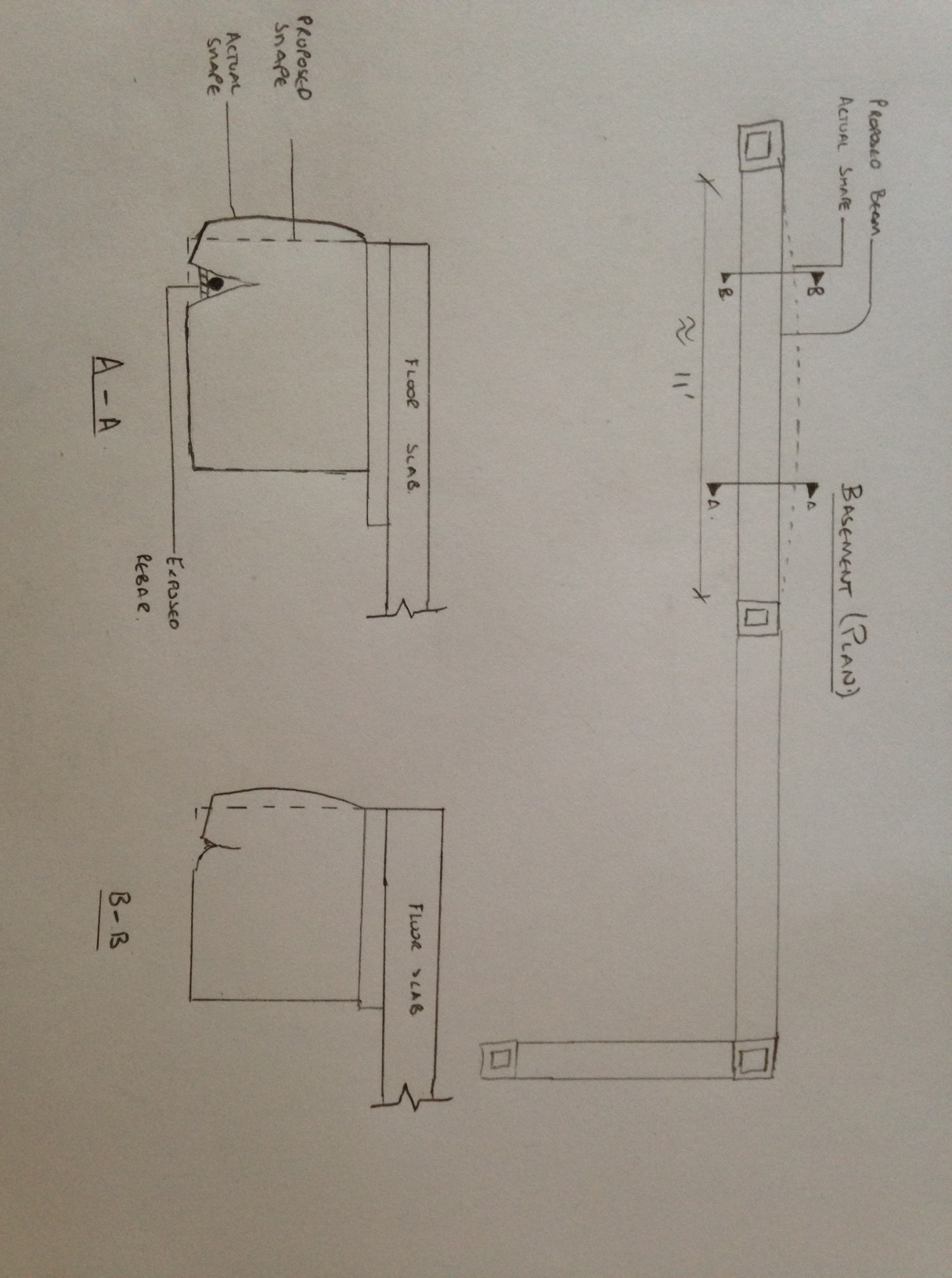
There is significant bowing to one side of the beam which seems to indicate that the formwork has failed which has allowed concrete to pour onto the floor below and caused the deformation of the beam. The deficiency has been highlighted to the designer for inspection and comment. I expect that there will be a requirement to chip away the majority of the side of the beam where the deficiency is and either replace the concrete around the existing pour as is, or epoxy some steel dowels (form savers or similar) and replace the concrete. There may be some practicality issues with this solution as the beam is obviously supposed to be flush with the floor slab.
Other ‘interesting things’ I have seen:
- Mixing of red dye into concrete surrounding some electrical utilities so that any future workers will be able to identify what they are potentially about to dig through. I thought this was ingenious – is it common practice: have I just completely shown myself up?!
- The way that schedule changes affect the engineering of a job. The basement slab has not yet been poured due to weather delays and a desire to get out of the ground. Therefore the basement walls (essentially now cantilevered) have been extended in order to resist the moment imposed due to the active lateral earth pressure
- The utility of a road traffic sign (presumed stolen) as part of some pretty sketchy looking formwork. It was only a pour below knee level or so, and was not structural.
- An excavator, almost excavating under itself as it sat atop some fill material, which was clearly exhibiting signs of face slippage. I highlighted this to the Engineer I was with (Geotechnical background) but he didn’t seem bothered. Apparently if the Operator were to ‘feel it going’ he would simply put his bucket down to the ground. ‘They’re pretty quick off the mark with those buckets.’ Good to know.
- Slump testing concrete at point of arrival and point of placement. There was a bit of pushback when this was spotted in the specification from the designer, however they would not budge. Personally I can see the utility for pumped pours where some slump is gained after pumping. For one, any sub-standard batches are caught before the pumping begins, for two, any batches that are close to the limit (4”-8” in this case) at delivery can be verified at placement and the requirement to return a batch ‘just to be on the safe side’ is mitigated. This is important where timing is critical, especially on larger pours, when the formation of cold joints in the slab is a potential issue. (seen before on the site)
- Construction sequence affecting design – whereby holes have been left in the first floor slab to allow for stores to be lowered into the basement at a later date when the basement slab is eventually poured. This has meant additional reinforcement requirements at the corners and the placement of form savers to allow rebar to be placed across the void at a later date (screwed in) to allow continuity. Also – similar gap exists adjacent where the tower crane currently sits.
I also attended a webinar event ran by the NCE titled ‘Building the Age of Resilience.’ It pretty much took the form of plugging the following product (which I have never heard of) : www.globalcalculator.org
From what I can gather this tool enables the user to postulate future global scenarios of energy requirements, industrial output, global consumption of meat, fuels and goods etc and simulate the effects on global temperature. This video https://www.youtube.com/watch?v=2_6flonHN0o is a brief tutorial on how to use the tool but it’s fairly self-explanatory. From what I can gather unless you are the CEO of a company trying to assess some strategic direction, or the Prime Minister then it’s really just an interest thing, but it is actually, sadly, quite interesting! I guess if you are trying to assess the future impact of a single project you could potentially (at the concept stage) adjust a single ‘lever’ and see if the economic impact to the project is worth the engineering effort? Perhaps.
You’ll Get What You Pay For
Contract Stuff
Last week I intimated that there was a potential issue pushing a new contract through the procurement process in time before the base contract to which it would be attached expires. At the start of the week we got confirmation that the course of action we pursued was OK with the KOR and I received verification that I could have the funds fairly quickly, which was good. My week then spiralled down into deep, dark, depressing realms of frustration, repeated work and government bureaucracy.
To relate everything I have been required to do will induce eye-stabbing levels of boredom in the reader, and no doubt some level of confusion. I will therefore ‘paraphrase’ and highlight key points.
One of the many hoops I have to jump through along the procurement process is an Independent Government Estimate (IGE) which is essentially a method of making sure that the contractor isn’t ripping us off. This is a fairly important part of being responsible for spending tax dollars on behalf of the taxpayer. Using the Scope of Work I produced I was able to attribute a level of staffing that would be required to fulfill the requirements of the scope and, using pre-negotiated rates from the base contract, attach a cost. In parallel to this I sent a Request for Proposal (RFP) to the Contractor who did the same.
When I received the proposal back from the Contractor I had to wait before I could open it because I still had to get sign off on the IGE; to open the proposal prior to this would be illegal. Office policy dictates that if my IGE and the Contractor Proposal are within 10% of each other I can combine the next stages of the acquisition process into one. Fortunately, when I was able to open the proposal, the bottom lines read within 6% of each other. This meant that I could accept the proposal, no questions asked – as long as I could justify and explain the minor discrepancies in a document called the POM/PNM (this document goes against every JSP101 principle and is judged by weight, not content). On the face of it I could quite easily justify the discrepancies, however when I dug into the weeds I found that the pricing strategies used by myself and the Contractor were wildly different. The overall level of effort was essentially the same, except it was allocated to different task lines. This was a bad thing as it meant that the acquisition would have to go through a negotiation stage, which we don’t have time for. Fortunately, one of the experienced contract officers here recommended that I simply conduct a “scope clarification conference” with the contractor*.
At this juncture it is important to note that negotiating with the contractor without first sending a copy of the Pre-negotiated Objective Memorandum (POM) through the District office is against official policy, however if you call and clarify the scope with him and he sends you an entirely new proposal. Well, that’s fine. Happily the scope was a lot clearer to the Contractor after we had negotiated had our scope clarification conference and I received a second proposal, for a similar amount but broken down in a similar way to the IGE.
Now, the other aspect of this is deciding what pot to pay for the services from. In order to put the scope together I had canvassed opinion around the stakeholders in the various offices as to what level of effort they would require for the period of performance so that I could write a suitable SOW to meet their requirements. However when I called a Purchase Request and Commitment (PR&C) meeting to discuss the issue of paying there was a huge reluctance to stump up the cash! Issues varied from just not having budgeted for what was requested (then I’ll adjust the SOW and you’ll lose your scheduler) to suddenly realising the costs involved are too high to justify. Fortunately for me there was an adult in the room who was able to bat away some of the niff naff poor drills excuses and so the meeting was actually really useful, and there was resolution on who was paying for what…as long as I adjusted the SOW, IGE and POM/PNM…
Lessons –
- The importance of an absolutely watertight scope from the outset, written in consultation with the key stakeholders.
- The importance of lining your funding sources up. Always figure out who is going to pay and then hold them accountable.
- The importance of not leaving anything contractual to the last minute, and then trying to rush task orders through to buy more time to deal with them.
- The sheer amount of interpretation that goes on with regards to rules and policy. This is where the area managers earn their crust and put their head on the block.
Health and Safety Stuff
I echo Henrys sentiments with regards to Health and Safety. I have been on site twice now (not bad in 2 months) and have been assigned some more site based responsibilities. I will retain responsibility for the contract I am setting up, including running it once it’s/ if it gets through, but I am also shortly to be a Project Engineer on 2 projects.
In outline I am working on a site that is home to (currently) three large scale construction projects; all part of the same programme in all but funding; at various stages of construction (from 0 – 30% project completion; 0 – 90% structural completion). I will be working on one that is around 7% complete (out of the ground and having cast in place concrete pours on level 2 presently) and one multi level parking structure that was awarded to the principle contractor around 2 weeks ago. This is due to break ground in c. July.
On my walk around I noticed that the method of access to the second floor slab of one structure was by a wooden ladder, no handrails, which seems to have been erected by a class 2 chippy. There was no method of holding on, other than to hold the rungs, and no tie down at the top or bottom! Good. The edge protection, whilst similar in height to UK spec was also knocked up by the same chippy. There has been a recent revision by the Department of Labor (sic) and Occupational Safety & Health Administration (OSHA) which has placed more stringent measures to site working practices. This might well be a blog in itself.
Chartered Engineer – Professional Engineer Stuff
I have been chatting to the US engineers out here to get a flavour of their ‘route to chartership.’ I won’t go into details for fear of this tome getting even more tomier, but the interesting comparison to draw between the US and UK is that US Professional Engineers (PEs) are pretty much ten a penny out here, compared to the UK, where I gather a Chartered Engineer is rather a rare beast?
And also,
Myself, Danielle, Henry and Jo enjoyed Intercourse immensely. I would highly recommend it to anybody who visits.

Pun intended.

- The sports model.
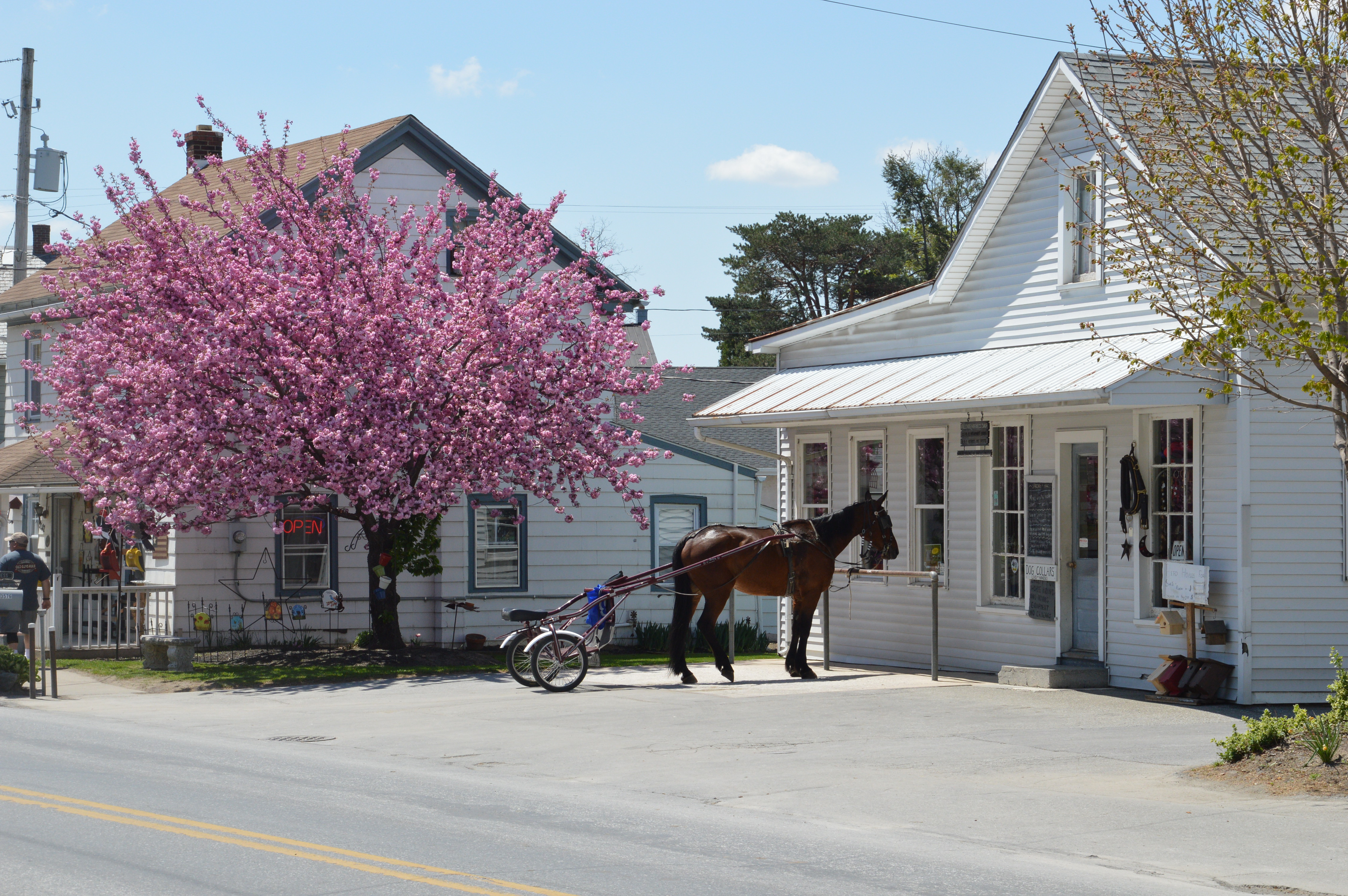
Decisions Decisions.
Progress of my contract has been slightly disjointed by the activities of last week, which was great exposure to the wider work that the USACE undertakes. Timing for this contract proposal is not a little tight and therefore I had to ensure that the proposal was with the contractor before I left last week so that concurrent activity could take place (me, on a jolly, him pricing up the proposal).
Whilst I was away the contractor who I am trying to set up the new contract with had a look through my Scope of Work and had got back to me with a few RFIs. Normally this wouldn’t be a problem, but the Contracting Officer’s Representative (KOR…yes, with a K…) was away on leave until midweek and has such a tight rein that decisions became almost impossible.
The crux of the issue was that I had been asked to develop such a broad scope that there was overlap between an existing contract, which expires shortly but might be extended, and mine. Understandably, with hindsight, this confused the contractor somewhat who wanted to know if there was an entirely new requirement, which would mean restructuring his organisation or even hiring new personnel in order to source additional manpower, or if this new contract would effectively supersede the old one. Fair point, well presented.
Now, my supervisor and I both knew that it wasn’t the former; therefore it must be the latter. However exactly HOW the KOR wanted to skin this was what my supervisor was worried about; should we supersede the old contract and replace it with a new one (which encompasses everything on the old contract anyway) or re-submit the Statement of Works (SoW) removing the overlaps and have 2 contracts? The contractor didn’t mind either way, but for a while there was a real prospect of having to wait until the KOR returned before making a decision.
What I proposed is, that given we seem fairly content on the KORs intent*, we price up my new Statement of Work in its own right (ie to supersede the old contract) and give a brief to the KOR upon her arrival back to work about what we had done. (Begging forgiveness in my supervisors eyes – sort of mission command in mine) I re-sent the amended Statement of Work to the contractor with a covering e-mail which highlighted our position and followed up with a telephone call highlighting in quite open detail what we were trying to achieve. He seemed like a fairly good bloke who understood and was grateful that things were progressing. The contract seems to be worth giving the stupid brit some latitude for error in any case. (Incidentally he sent me his RFIs and CC’d in the entire world, and their dogs, so my error was in fairly stark contrast!)
On a plus note I submitted the reservation for the $1.8m in good time and am just waiting for the nod that I can have it. On a super plus note I now have another ID card. This one gets me onto site, no questions asked, no escort required. Win! Those who read my last blog should see the implied ‘thing’ here…Foreign or not, I must be a good egg!
On top of this I chaired another meeting between project managers and schedulers and our scheduling contractor in a continued attempt to get the Integrated Master Schedule back up and running. Last weeks meeting was fairly fruitless because the contractor hadn’t actually managed to input all of the task lines. This made drawing logic ties between them particularly tricky. What it did allow me to do though was to identify key players who actually had useful things to contribute, and who was there for their own agenda. The distribution for this weeks meeting was significantly cut.
And also
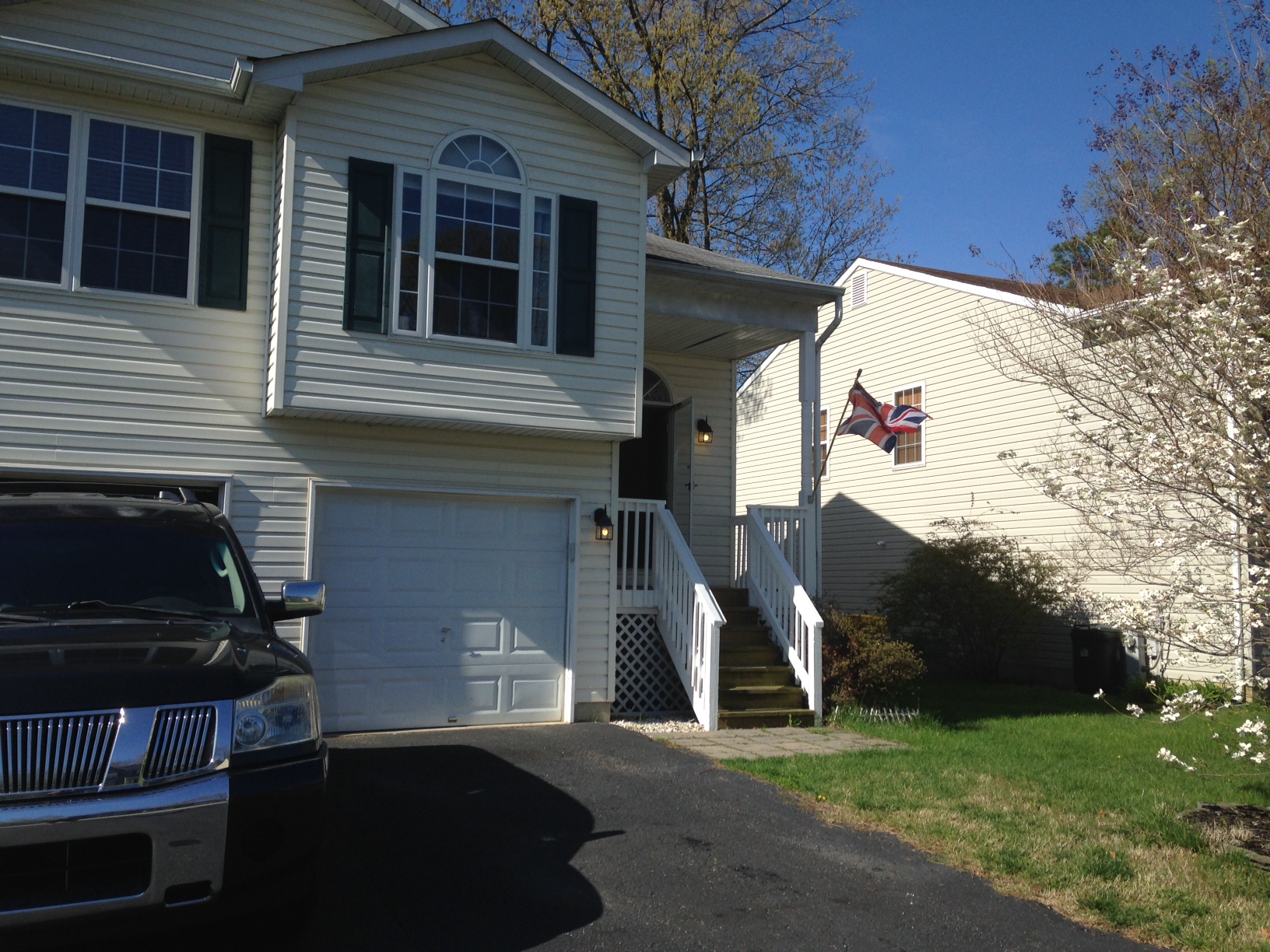
We hosted a tacky soiree on our estate, complete with Union Jack, BBQ, Bratwurst and red plastic cups; a real melting pot of cultural ideas. There was beer aplenty and burnt sausages were being heartily gobbled (not a euphemism) but at around 1430 when I returned from a pressing engagement elsewhere I found my wife, ably assisted by Henrys wife, handing out cups of Tetley tea, (British blend)… much to the confusion of the American contingent. They still don’t understand 1000hrs T&T either. ..yet.
Truck MPG; Confirmed bad. 18Mpg.
*and because it was less work to reach the some outcome…
Captain Britain
So I’ve been slightly ‘under the RADAR’ since we arrived Stateside I guess. That has absolutely nothing to do with my work – more lack of it. Since we landed we have been through many a bureaucratic system which, when meeting the stupid foreigner, is akin to the unstoppable force meeting an immoveable object. Not a lot happens fairly slowly. However – I am now a fully fledged member of the office, with photos in the foyer to prove it and a modicum of responsibility to keep me out of trouble. I also have a Nickname, ‘Captain Britain.’
I will echo Henry in saying that this is fairly light on the engineering because, being a foreigner, I am still not allowed to go on site (an issue which is currently being resolved) however what I have been given will still be a fairly important piece to the overall programme.
The Programme – East Campus.
There is a lot of work in the area of camp which used to be a golf course, but is now known as East Campus. Currently there are 3 separate projects going on which are in various stages of construction, from 7 % – 90% complete. The largest of these is worth around $650m and the smallest is around the $50m mark. There was a contract awarded last Friday for another project, again at the $50m mark which makes the current programme close to $1Bn…so far. The interesting thing about all these projects is that each one is completely separately funded, procured and built. The reason being that government can’t politically allocate enough money in one funding cycle to build a whole campus. The overall strategy to mitigate this has been to procure each project separately and bid on separate funding cycles to senate for more money once it has been proved that the last chunk of funding has been properly managed and spent. This means that although there is an overall vision for what the campus will look like, there is really no way to say that it will all receive funding and be completed as imagined. This way of working has also led to huge issues with scheduling. With three large projects in various stages of construction in such close vicinity (one project also structurally ‘ties in’ to another) there have been inevitable conflicts in space and resources.
There is currently a ‘Master Integrated Schedule’ (MIS) which is supposed to help identify cross project conflicts before they happen, however much of the information is out of date and individual project managers are reluctant to release their un-approved schedules. The other issue is that the contract for provision of the scheduling service is due to expire shortly.
What I have been asked to do.
I have been tasked with getting the MIS running as it should, ie as a useful forecasting tool, and to deal with the issue of the expiring contract. What I proposed is that there be some more engagement with the Area Office (who are separate to the office I am working for, although still the same organisation. Think 2 Sqns in one Coy) and that the product be given grace to undergo a few iterations in order that tweaks can be made and input gained from the end users so that an accurate and, more importantly, useful tool can be produced. I also got someone with more clout than I to request the individual project schedules be released to the contractor so that a rough integrated schedule can be produced. I have called a meeting next week to discuss inter project logic ties so that any changes to one project will highlight impacts to neighbouring projects. I am hopeful that this will nudge the MIS in the right direction and that in a few iterations a useful forecasting schedule will drop out, rather than a few disconnected, out of date and inaccurate reports which the Project Managers view as an embuggerance to contribute to.
The other piece is to extend the contract that is used to produce the forecasting schedule. The contract itself is a Task Order (one of many), which is a part of a base contract for ‘scheduling, estimating and programmatic support.’ The base contract was for 5 years. The desire is to extend it although there is no specific clause to allow this (however the missing clause is referenced elsewhere in the contract). This issue has been referred to the Policy Department for a decision. If it can’t be extended that leaves until 25 May to push a new Task Order through. This will be a clever move because although the Base Contract will have expired, if a Task Order under the Base Contract is enacted prior to the final date of the Base Contract the Task Order and all money allocated to it is still usable until the Task Order itself expires. The money still remaining on the Base Contract is around $2m so I have drafted a Statement of Works for scheduling, estimating and programmatic support, under the provision of the base contract, and attached the $2m to it. This will accompany a Request for Proposal (like an ITT, but to the Contractor named on the Base Contract. Essentially asking the Contractor if they would like $2m to continue what they are already doing) to the Contractor who will then submit an estimate based on what I have asked them to do in the Statement of Works. I am also required to complete an Independent Government Estimate which needs to be within 10% of the contractor estimate in order to progress the application. More on this at a later date.
So what was all that about?
With the Base Contract expiring it appears to me that USACE wants the provision of service to continue, but a) missed out a clause allowing the extension of the base contract or b) forgot to put another Base Contract out for tender. Essentially, what I am doing (all legal by the way) is exploiting a technicality which will allow for the provision of services to USACE by the Contractor even though the Base Contract under which the services are provided has expired.
Other Stuff.
A letter, stating that I am a good egg, is in the pipeline which will hopefully allow me access to site. From there I will be able to start getting some more engineeringy posts up. Photos might be an issue. If I don’t get on site then you will all know that I am not, in fact, a good egg.
For Ollie’s Infantry shooty delectation; today I have been shooting with a buddy. He bought along a nice selection, including an FN SCAR and AR-15. Ages on the range varied from 8 – 68yrs. All good clean family fun.
Truck MPG – TBC; suspected low. Am hopeful it won’t be a DO 7.C fail in CPR.
Photos.


 Holdfast Training Services Trial Blog