Archive

Author Archive

A fresh start

Background.  Since February 2016, I have been employed by Multiplex on the Brisbane Casino Towers (BCT) project, in South Brisbane.  I left the BCT site on 28 November 2016 and started my Phase 3 attachment, at Multiplex Head Office, Queensland, Australia. I am currently employed in the design team working to the only chartered engineer in Multiplex Queensland. I won’t cover specific technical issues as Andy B has already done an excellent article on his beam design.

Experience so far.  After completing the preparation for the removal of the retaining wall restraints at BCT, I moved to the Head Office Engineering Design Team.  Since I have arrived I have mostly been providing project support to the Jewel project on the Gold Coast and my old site BCT but, I have done preliminary work for the New Business Team.


Roles and responsibilities. I am involved in providing technical advice to three areas of the business.

  •  Project support. Core business of the design team is to provide assistance in resolving issues with the projects’ design consultants. The design team provide oversight capability to designers ensuring quality is maintained, designed to fit for purpose, are constructible and cost-effective. The early identification of design risks, is critical to maintaining the projects’ programmes.
  • New business. The design team has considerable day-to-day contact with the new business team. They technically review all designs prior to tenders being submitted. They provide oversight on design consultants’ rates, comment technically on sub- contractors’ initial bids and conduct preliminary assessment on the suitability of designs. Risk identification is an essential part of this task. Alerting the new business team to potential hazards early on in the tender process allows risks to be suitably managed. Recently they have had significant involvement in the geotechnical assessment of future projects.
  • Novel technology. Multiplex employee a group of academic engineers to come up with novel solutions to engineering problems. However, they are not often best placed to understand the limitations of the project. The role of the design team is therefore to interpret the requirements of the site and project teams and brief the academics accordingly.

Stakeholders.  Given that the Design team are often called in when an issue has been identified.

  • New Business Team.  Supportive and routine relationship.
  • Consultants.  Cautious and sometime hostile.
  • Project Teams.  Supportive but cautious of exposing their own errors to head office.
  • Sub-contractors.  Neutral to hostile compared to the details of the issue.
  • Clients.  Generally cautious between neutral and hostile.

Current Projects.  There are several ongoing projects but I will concentrate on the ones I am working on now.
img_5789

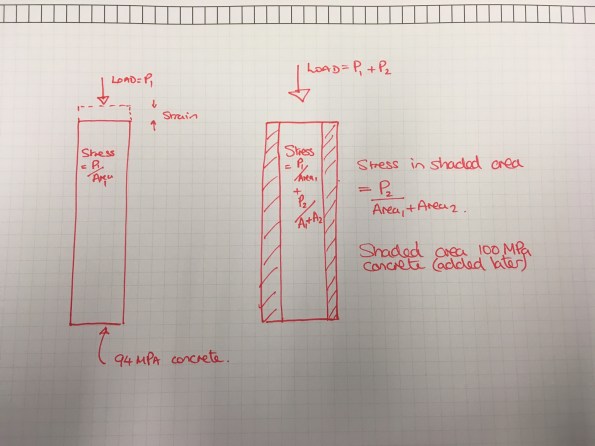
BCT continues to have issues – What happens when a basement column fails to achieve strength (100 MPa)

Brisbane Casino Towers (BCT).  ($108M) My old site continues to be an utter disaster.  The latest debacle is that the concrete strength is failing to come up to strength so remedial works are going to hare to be made to the basement columns.  The Johnny age 5 sketch was an attempt to show why you have to allow for the current strain when determining the extra amount of concrete to add around a column that has not reached strength. Long story short the stress from the half built structure is already in the 94 MPa column and any additional load is shared between the existing column and the extra concrete.  An interesting couple of days on this one – pouring through Australian Standards and contracts.  BLUF – the concrete supplier has been very naughty and needs to fix this and compensate Multiplex for time lost – @ $35,000 a day – very expensive!

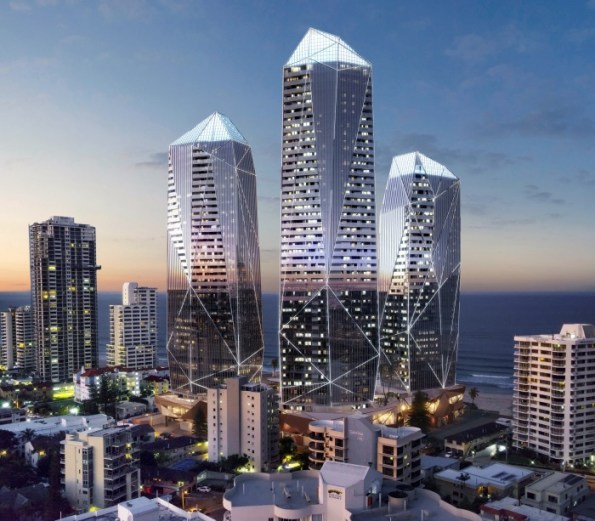
Jewel.  ($600M) The Jewel will be Australia’s largest beachfront mixed-use development and the first absolute beach front development on the Gold Coast in more than 30 years.

The luxury development is located on Old Burleigh Road in Broadbeach, the three-tower development will include a three-level podium, a six-star hotel comprising 171 suites and 512 one, two and three-bedroom luxury apartments and premium residences. The development will feature three levels of basement parking to accommodate 816 cars.


Problem 1.  I have been conducting a value management exercise on the design of the slabs.  I have cut the reinforcement by a third at Podium Level 2.  I have cut several slab thicknesses down by 25%.  I am planning to do a TMR on this value management exercise and why consultants over engineer designs! (more to follow).

Problem 2.  The Towers are connected by steel foot bridges which presents a problem during wind loading and earthquakes.  The footbridges need to be able to accept deflections of up to 850 mm because the towers will move independently.  Currently ther is only an expansion gap of 50 mm so this needs addressing.  Additionally, the last slab level to connect the towers (ground) becomes a tension member during an earthquake and this needs to be allowed for with extra reinforcement so I need to conduct some checks to ensure this is done.
151207__jewel__v26__1454451540.jpg

Future Business.  Key new Business that we are looking to win.  
Queen's Wharf.png

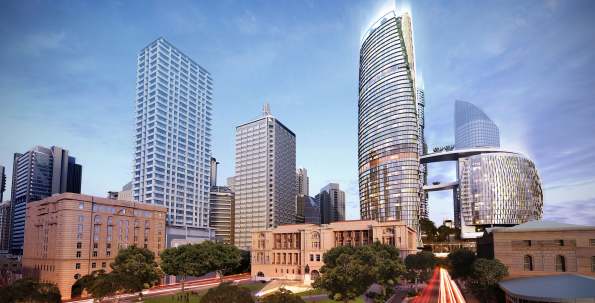
Queen’s Wharf.  ($1B+) Queen’s Wharf Brisbane has the capacity to realise Brisbane’s growth and profile aspirations by delivering a truly-place defining precinct with significant transformational impacts on Queensland’s economy, jobs, tourism, visitation, liveability and image.

The Destination Brisbane Consortium vision for Queen’s Wharf Brisbane is to design, build and manage with excellence a place for which Brisbane will be renowned and its people immensely proud.

The Destination Brisbane Consortium will deliver an iconic redevelopment at the city’s heart that invigorates the entire precinct and delivers striking landmark architecture as part of the best integrated resort in Australia.

Destination Brisbane Consortium’s development of the Queen’s Wharf Brisbane precinct will deliver transformational impacts on the Queensland economy through job creation, training and tourism.

The Development of Queen’s Wharf Brisbane will include the following key features:

  • The iconic signature “Arc” building
  • A spectacular Sky Deck, giving stunning views of the Brisbane River and skyline, complete with restaurants and bars
  • The repurposing of existing (Treasury casino and Hotel) heritage buildings to maximize their contribution to Brisbane
  • Five premium hotel brands, including the world renowned Ritz-Carlton and Rosewood brands plus the introduction of Brisbane’s first six star hotel
  • Infinity resort pool overlooking the Brisbane River and Southbank
  • Fifty restaurants and bars, from hatted fine dining to pop-up cafes
  • Moonlight roof top cinema, black tie event space and a variety of outdoor lifestyle opportunities
  • Cohesive Bridge-to-Bridge precinct, integrating heritage and new architecture
  • 12 football fields of public event space.
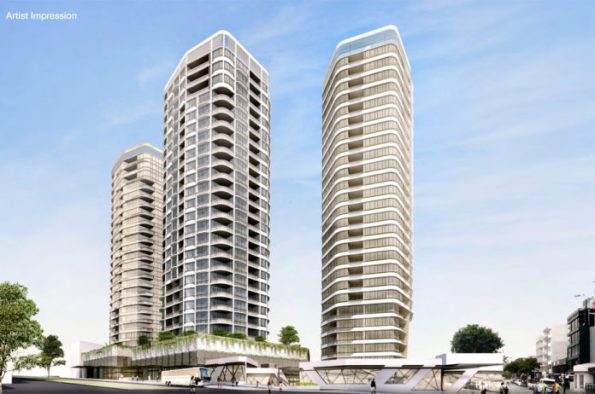
toowong-imageStockland Toowong.  ($200M)  Three 25 storey residential towers located at 23-79 High Street Toowong, on a 1.3 hectare site, currently the site of a Woolworths supermarket.  Interestingly from a geotechnical point of view the area is situated in very low to very high strength phyllite and alluvium deposits. The basement will be below the water table and due to the proximity of other buildings there will not be any underslab drainage so there is significant hydrostatic uplift on the ground bearing slab.  The basement is going to be a nightmare to build.  I am the technical lead for this project – so no doubt more to follow.  Stages.  The project will be split into three stages.  With sales from the first stage being essential to provide funding for the others.

  • Stage 1: 25 storey residential tower (184 units), with ground level retail uses (1,354m2 GFA) and an expansive plaza, and associated parking and servicing. This has a 3 storey car park basement.
  • Stage 2: 25 storey residential tower (172 units) fronting High Street, ground level retail uses (328m2 GFA), expansive podium private open space plaza and associated parking.
  • Stage 3: 25 storey residential tower (174 units) fronting High Street, ground level retail uses (267m2 GFA), expansive podium private open space plaza and associated parking.
Categories: Uncategorized

Having a cracking time – wish you were here!

There have been a lot of posts about concrete recently so I thought I would throw my hat into the ring with some issues I have been having with reinforced and post-tensioned concrete.  The client was walking around site and went mad about some surface cracking that we are experiencing in the car park.  This sent the PM into a flap and I was sent out to investigate.  I took these photos of the area she was concerned with.

IMG_5557[1].JPG

Surface Cracking caused by rapid water loss.

IMG_5554[1].JPG

A crack along the top of a ramp – not really a concern though.

If you are having problems seeing them then you are not alone.  These cracks are in a reinforced concrete slab and are confined by reinforcement and other than cosmetic reasons are nothing to worry about.  The slab was made from 80 MPa Concrete poured in 37 C heat and a crack free finish is difficult to achieve.  Netherless I have to speak to the concreters and consultants to determine that they are not structural and to determine what QA can be done to prevent other slabs cracking.

However, while on my crack patrol I came across this crack- that hadn’t been spotted by the client or the PM.  Now it is big enough to fit a credit card into so I was concerned.  I immediately checked the propping and found it to be in good order.

These cracks are in a post-tensioned slab that has not been tensioned yet and are a very different beast.  Normally PT slabs are initially stressed 24 hrs after pour and then stressed again after 72 hrs.  The advice I had from a consulting engineer from another company was that you should expect big cracks to form because PT slabs are not as heavily reinforced.  The small cracks turn into one big crack, so don’t worry about cracks until the slab is fully stressed.  I called the engineers working on this slab and other than a visit yesterday they have slipped into radio silence.  We are leaving these tendons until last but, we are stressing the rest of the slab now.  If we have still heard nopthing back form the engineers our intention is to isolate the area and then stress the tendons.  I will let you know how it goes.

Categories: Uncategorized

What I wish I knew before starting phase 2!

This kind of links in to AER3 and a discussion that the civils were having on WhatsApp.  I will leave the concrete supplier conundrum to Jo. But I hope my fellow Phase 2 PETs will all add comments. 

I wish I had agreed from the outset that I would do 6 months on the site team then 6-8 weeks with the commercial team. 

I also wish I had more of a data base of TMRs and AERs to baseline against. 

Categories: Uncategorized

This has one got me stumped

I was doing another highly exciting enviromental walk around site and surveying the latest damage to the basement.  I spotted this black fluid coming out of the anchors that have been built over at Basement level 5 (RL -10 m).   The anchors are drilled into medium strength phyllite rock  at this level and this fluid should not be here! Note:The black fluid that you see coming down the wall is not leaking from the piles but has come from the anchors holes .   The drainage pipes have not been finished yet so the water is finding its own way to the drainage tanks.  So what you see running down the piles is it leaking from B5 into B6.

why-its-not-ass-2

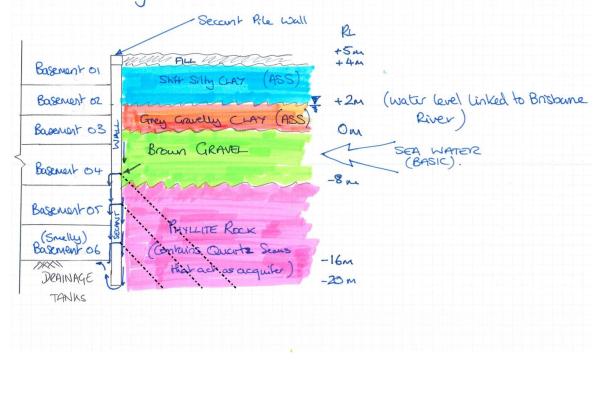
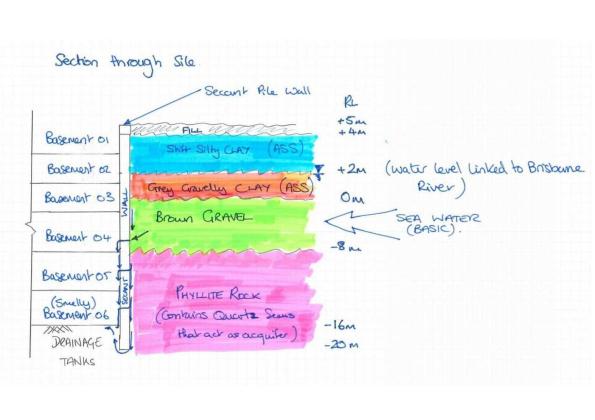
A section of the secant pile retaining wall showing anchors and ground horizons. 

Some people on site thought it might be acid sulphate but the anchor is set at a 45 degree downward angle and penetrates about 14 m of phyllite rock in this area.  So the toe of the anchor is at about -20 m.  In addition acid sulphate water is rusty and stains concrete an orange brown colour.

I thought it might be residual oil from the drilling process that has gradually been pushed back into the basement by the seepage of ground water.  I have gone back to the sub-contractors but I am confused.

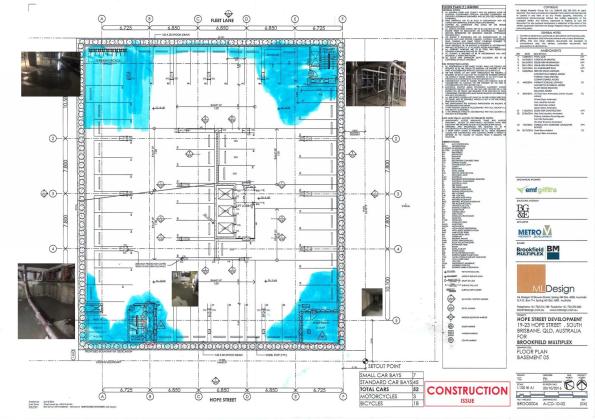
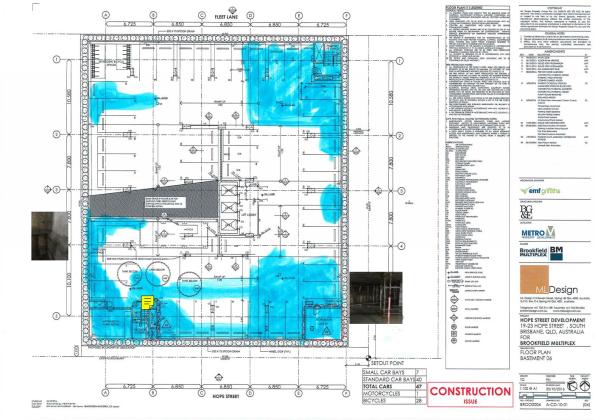
Regarding the damp basement, I have recently done a study and after clearing all the spoon drains and removing the fines build up that was washed down by the hydro demolition. There are three issues that are causing the problems as I see it.

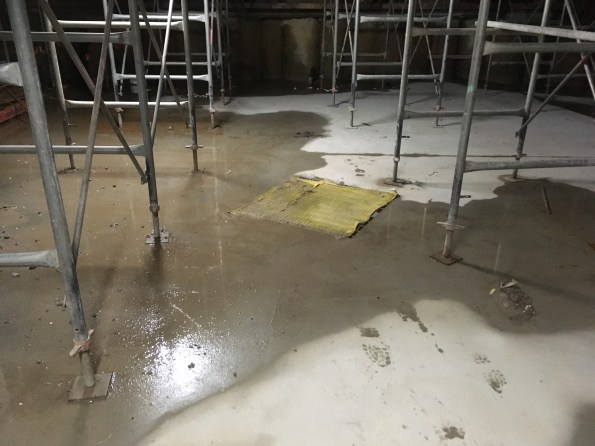
  1. The pumps and tanks have the capability to deal with the amount of water but are prevented from doing so because water is not properly draining into the spoon drains.  The slabs currently do not slope down to the drains.  This is particularly noticeable around the base of the ramps and around the hoist on B6.  Water is pooling in these locations and then finding its own path down the ramps.
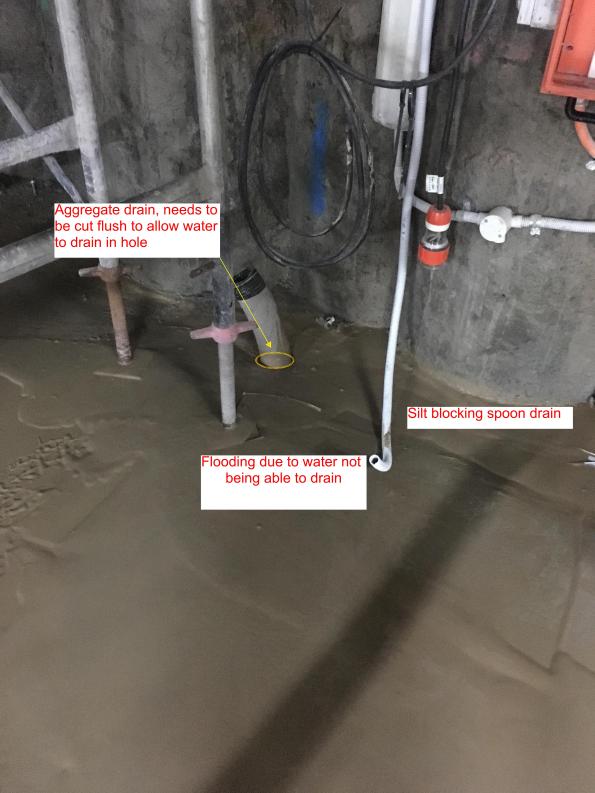
  2. Spoon drains are blocked by the plumbers using aggregate pipe because they are worried about the tanks silting up.
  3. Spoon drains are blocked up with silt because they haven’t been cleaned.  The problem is made worse by the channels changing in depth and width along their length.

water-pooling-page-001water-pooling-page-002water-pooling-page-003

How can this be rectified?


  1. Multiplex construction workers to sweep clean and dispose of silt blocking drains – by the end of the week.
  2. The plumbers to cut the aggregate drains flush – by the end of the week.
  3. Once an assessment needs to be conducted to determine what needs to be ground back.
  4. Concreters grind back the concrete so that the drainage works.
  5. There needs to be a weekly maintenance set up for cleaning the spoon drains.  The state of the spoon drains will be inspected during the weekly enviro inspection.
  6. Prior to Xmas shutdown the spoon drains need to be checked to ensure that they are clear.

Drain blockage.jpg


Categories: Uncategorized

Trouble at Mill No 2

As you can tell by the title it has been yet another fun week at Queensland’s premier building site – Quality and safety are our number 1 priority.  It all started so well.  We were are back at ground level, the sun was shining (30C) and all was right with the world.

Then Frankipile (Piling Sub-contractor) showed up to trim back some of the out of tolerance secant piles that are protuding into the basement and things started to unravel.  Franki’s plan was to use a sub-contractor to trim back the piles.  Unfortunately this needed to happen so that we could build the stairs in the basement.  The original plan was to use hand tools to cut the piles back but we were concerned about noise and dust.  So Frankipile brought in a hydro-demo subbie to keep the dust down.  Now in the initial Sub-Sub-contractors Recce I asked 4 things:

  •  Would they put up screens to stop the flying bits of blasted concrete going everywhere and clean up afterwards?
  •  We are a Tier 1 site and therefore a Unon site so are you Enterprise Business Agreement (EBA) Compliant?
  •   How much water are you going to produce?
  •   Can they submit Safe Work Method Statements (SWMS)

The SWMS are a kind of method statement and and risk assessment in one.  When I and the safety manager checked them they were amongst the best we had seen, so we thought we were dealing with a professional outfit.  However…

  1. What actually happened.  None of the guys were in the CFMEU union and the company was not EBA compliant so the Union delegate refused to let them on site until they were being paid at Tier 1 rates.  This took half a day to organise.
  2. Quite simply you pay peanuts and you get monkeys.  After being cock-a-hoop that their  wages had double they tried to walk on site without PPE.  They hadn’t brought any PPE with them, any signage or crucially barriers.
  3. Quite simply I have seen JDAMs make less mess than these idiots and the noise was absolutely deafening (think jet engine).  I managed to confine them to the lower basements but the Union delegate was doing back flips.
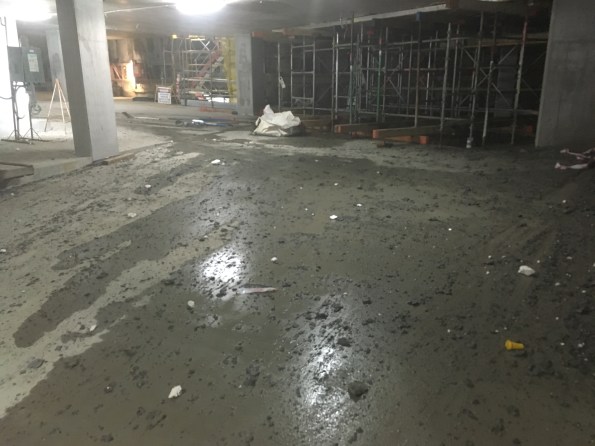
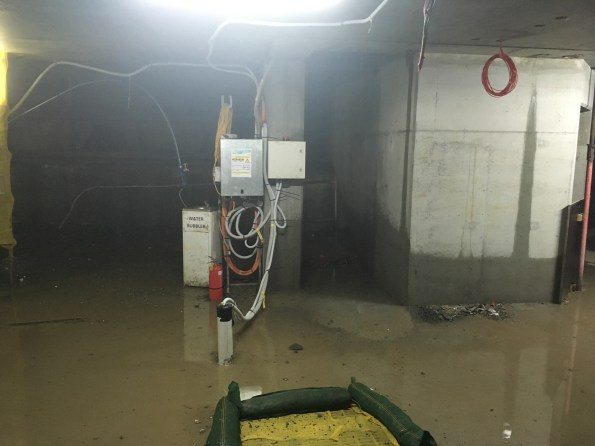
  4. Water.  I had asked that they bring sediment sock with them to filter the water before it went down the spoon drains and into the drainage tanks but there was so much water and so much debris in the drains that they soon flooded the slabs.  Which soon ended up going through every penetration we had in the floor. Now Ozzies don’t do rain or water.  If they get wet they go home on full pay so this became a serious problem I had to solve.
  5. Supervision.  Frankipile exercised no control over their sub-contractor so it became my problem.  I gave their Engineer a good gripping and told him to get his backside down to site with a crew ASAP to start cleaning up the mess. I had to get the electrician out to shut down several electrical boards and have spent the last 3 days with cleaners.  Smashed concerete was everywhere and I ended up filling 8 skip loads with the rubble from only 10 piles!  I have had to fight tooth and nail to get these skips exchanged as in military terms I am off the main effort.

img_51871

img_51851

Basment 6 – Electricity and Water a winning combination.

On Thursday the Union took the opportunity to do a snap inspection during clean-up and came mob handed (5 Union officials) to shut down the job.  The irony is they told the guys who were cleaning up to stop because it needed cleaning up.  The mess wasn’t the only thing wrong with the site but, it certainly didn’t help.  These union inspection always have their own agenda other than safety, which goes some way to explains why 5 delegates turned up.  I don’t know the full details but the Saturday shift has been cancelled (every cloud) – and my clean up was on the main effort.

So what have I learned:

  • After spending 3 days clearing rubble and water, I no longer trust anyone.
  • I should have thrown them off site in the morning.
  • I will always check companies are EBA compliant before they arrive.
  • I will insist that the sub-contractor provide a supervisor to manage their subbies – work will not start without one.
  • I will stop work if it does not adhere to the SWMS.
  • All sub-contractors are idiots unless verified otherwise.
  • Clear everything with my comrade delegate (commissar).


Categories: Uncategorized

Removal of props

img_5065

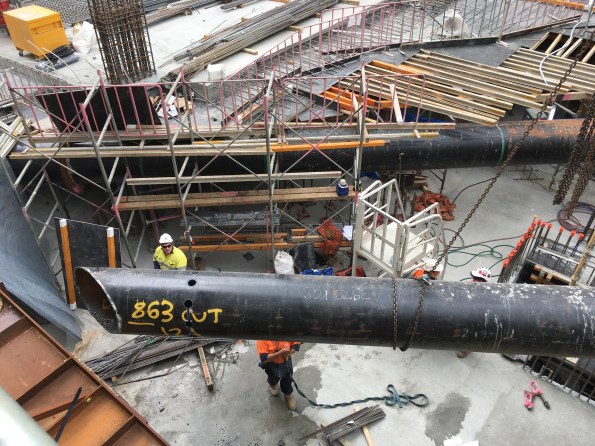
A 700 mm CHS being removed.  Note the remaining props being built over. 

A few weeks ago I promised to keep you updated on how the removal of the props was going.  You can see by the photo the infill around the stairs has been filled and that I followed the advice of cutting 100 mm holes in the props to de-stress them.  The removal of the props occurred pretty smoothly.

The only problem I encountered was that my boss had misinterpreted a consultants advice which caused me to check the capacity of the steel left and the concrete slab.  After determining that it was ok, and after the said consultant went dark and refused to answer his calls we proceeded with the demolition as planned.

Anyway all went well but a tense moment and that was a floor ago.

What the site now looks like now – We are back at ground level and currently building the transfer slab with PT concrete.

20161025170055.jpg


However – I am still dealing with what we have left behind.  More to follow…

IMG_5145[1].JPG

In foreground a 900 mm CHS and Double 1200 WB left behind. 

Categories: Uncategorized

I smell gas is that your ASS again?

Just when I thought that I had heard the last of Acid Sulphate Soils (ASS) they rear their ugly head again.

img_5407

Almost out of the basement must be time for Phase 3

Those of you that are familiar with my blog posts will be aware of the regular discussions I have with my brother comrades in the CFMEU Union.  The latest affront seems to be that our Basement level 6 stinks!  There is concern that this is a ruptured gas line.  At 22 m below the surface, this would have to be a very deep gas pipe! Personally, I cannot smell gas but I thought it might be have  a faint smell of ammonia.

We have checked the area with a gas sniffer and the air quality is fine.  The guys are not making it up though and it really does stink down there. We still have water coming through the holes made for the ground anchors and while the quality of the piles is pretty good there is a small amount of water leaking between the secant piles. I suggested that it might be due to mould that is starting to grow on the piles and areas of stagnant water (caused by blockages in the spoon drains).  This was pretty quickly shot down because if it is mould we can expect our site to be shut down.  Some bright spark has hit on the idea that it is water contaminated in Acid Sulphate Soil.

img_48631

Basement 6 ‘the dungeon’ – It puts the lotion in the basket

Here comes the Science again:

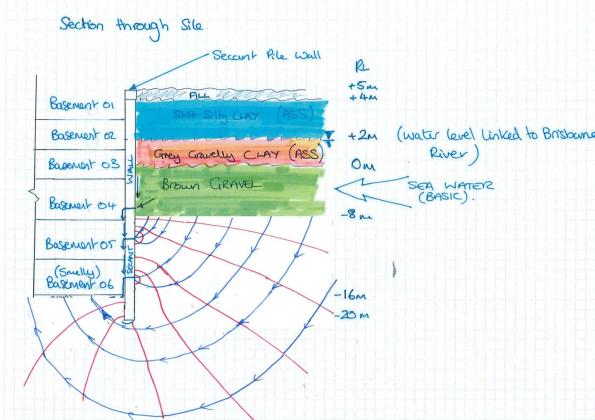
ASS occurs when sulphates in the soil are exposed to air and broken down by bacteria.  On our site there is a clay layer that contains a high concentration of  sulphates.  During excavation we exposed this soil to air so it oxidised and produced Sulphuric Acid.  Now we have finished excavation and all of the ASS has been removed.  The only ASS around us what is left outside of our site.  Now it is possible that the ground water around the site seeps through this soil and flows into our site through the anchors and from under the ground bearing slabs, where it is then collected by the site drainage system.

why-its-not-ass

What I think is happening behind the wall (Not a flow net!)

flownet

A less than perfect flow net. 

However, the soil outside of our site has not been excavated and therefore cannot have been oxidised.  The site is approximately 200 m from the Brisbane River to the North and the West. As you can see from my diagram the area is flushed by sea water with the tide .  Sea Water is naturally basic and so counteracts any effect of the ASS. When I last had the water tested to get approval for discharge into the stormwater drainage the water was mildly alkaline and similar to the pH of the Brisbane River. SO NO IT’S NOT MY ASS!

What are we doing about it:

I now have to hold a workshop with the blokes to explain that it is not gas or ASS in the meantime the guys are cleaning up the walls to remove any mould (although there is no mould officially there) and remove the stagnant water that is on site.  We are installing some temporary fans to move the air around the basement until the permanent fans are installed.

Categories: Uncategorized

Makes you wish you had volunteered for submarines!

I have just returned from an awesome week away with the family in Noosa.  However, today reality has hit hard.

We have rapidly built our way out of the basement and have reached basement level 2 just underneath the props.  Now that the permanent structure was in at B2 – B6, it was time to start removing the props that were used to support the basement.  The culmination of nearly 3 months planning was coming to fruition.

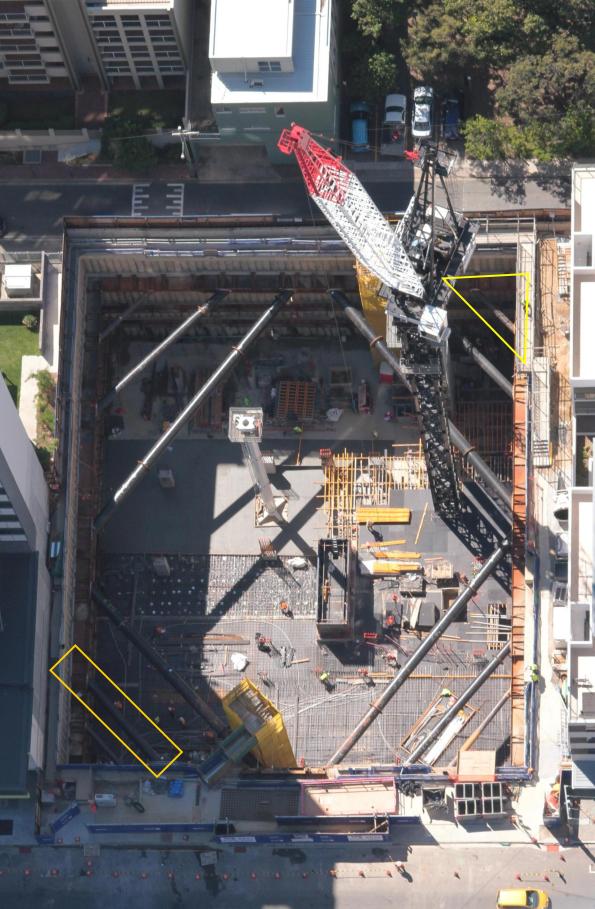
prop-removal-aerial-photo

Old aerial photo of the site (highlighted area props to be removed, North is up).

I started my checklist:

  • Cylinder crush results above 25 MPa – check
  • Slab over 3 days old-check
  • Exclusion zones in place – check
  • Construction Union on side – check
  • Actions and loads – check
  • Risk assessment complete  – check
  • Access way in place – check
  • Agreement from designers – check
  • Confirmation that slab is in place from the structural site engineer – check
  • Risk/Issue registers reviewed – check
  • Final walk around and confirmation…


img_48801

SW Corner – A big hole where a slab should be

Someone hadn’t built the stairs!  (North is left)

Things started to unravel pretty quickly when I discovered that the stair penetration had grown from 4 x 2.5 m to 7.8 x 10 m.  I attempted to find out what capacity I had in the slab/secant pile wall/walers in order to avoid a 5 day delay but to no avail.  Despite pressure from the management, I called off the demolition.  This will now result in $150,000 in lost time and considerable extra work.  I now need to supervise the closing of this penetration and the adjustment of the programme.

Morals of the story

  1. Trust but verify!  If I hadn’t checked up on other people this could have gone badly wrong.
  2. If there is a corner to be cut, people will cut it.
  3. Don’t assume that just because someone has been doing a job longer than you that they know what they are doing.
  4. Integrity, the pressure to crack on was extreme but, if in doubt don’t.

Where I would have rather been today…

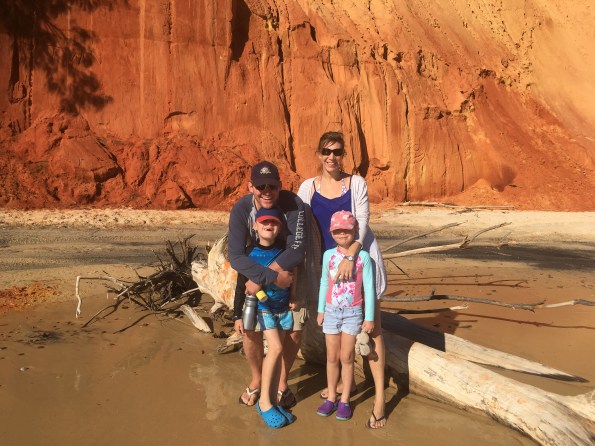
img_47721

Great Sandy National Park- The sand cliffs behind were formed during the last ice age from blown sand dunes and are a great place to study slope stability of coarse grained soils.  The rusty colour comes from the oxidation of the Iron in the sand (Can I claim this trip on JPA now?)


Categories: Uncategorized

Any ideas for removing props when stressed?

I am currently trying to build my way out of the 22 m hole I have dug for myself in South Brisbane.  Progress has recently accellerated now that the excavation is over.  In the last 3 weeks the structure has completed Basement levels 6, 5 and 4.  we are currently at Basement level 3 and in the next week we will be at the same level as the props (Basement level 2), which presents some challenges. The props are significant pieces of engineering and consist of 900, 752 and 508 mm Circular Hollow Sections in each corner.

In order to keep the job moving we will have to remove two of the props that clash with the permanent structure (highlighted) and build over the remainder.  This flies in the face of conventional wisdom but, lets focus on the problem at hand.  The removal of these props is potentially very  hazardous, since they were installed the wall has deflected inwards by up to 26 mm and as consequence the props could potentially be under 2-3 MN of compression.

Prop removal-aerial photo.jpg

Aerial photo taken of site (this was taken 3 weeks ago when we were on Basement 6)

While the permanent floor levels will be in, they will not relieve the pressure on the props.  This is because the retaining wall needs to move so the slabs can takeover restraining the wall.  So when we make the first cut it will mark the changeover from the temporary restraint of the basement to the permanent retention of the wall.  All very romantic but, more importantly, it will mean the release of the energy stored in the props.

Having just received my sub-contractors method statement (similar to how a lumberjack would cut down a tree).  I concluded that they will kill someone so I have consulted the ‘hole diggers bible’ (CIRIA 517).  Unfortunately, the struts are welded in to the walers so it removes a lot of potential options.  I believe the only method left to follow is to cut progressively larger holes in the CHS while supporting them from either the deck or the tower crane.

Given that the deck will just have been poured and would require propping all of the way down to Basement level 6, I am reluctant to recommend this option.  The sole use of the tower crane is equally unpalletable but, if it was conducted at a time when the majority of the site was empty it could work.  I am  open to any better  ideas though.

20160912-Access-Arrows-Nelson.jpg

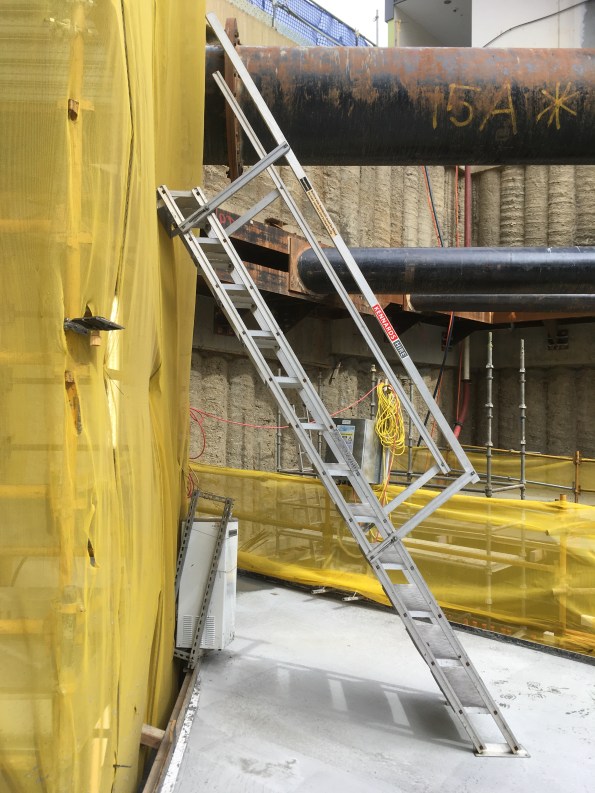
Access. The props will block access around the site, so I have had to ask our scaffolders to build an access way on top of the walers.  Unfortunately ladder access is frowned upon, so I have found some safety stairs  that will be able get from the working deck to the temporary scaffold access.  The safety stairs will be used in areas marked in yellow (above)  that cannot be accessed by existing the existing stairs. We tested this on site today by placing them against the existing scaffold stairs.

Things are about to get very messy – I think its time to go on leave.


img_47091

They are getting closer! -Photo taken from Basement level 3 of safety stairs against , props and walers in background (note we have built over the ground anchors now).


Categories: Uncategorized

Top Errors of the week No2

So we have finished digging and have started to build back up.  I have moved to the Contract Admin department to focus on getting a bit of commercial experience and  prep for the removal of the temporary supports.

In the last week we have finished of Basement 6 and have poured three quarters of Basement 5.  The productivity has really got to some people and we have had a number of safety incidents this week.  I have had to adjust this as I have just heard of another classic.

In 5th place is the site supervisor who poured 100 MPa concrete into a 50 MPa column, failed to puddle poured a 20 MPa slab, and then continued to pour a 100 MPa column on top.  We now have a 20 MPa weak spot in an otherwise overly stiff column. 

In 4th place is the guy who electricuted himself while drilling in a puddle.  He is ok but, the site was shut down for 2 hrs.

3rd place goes to the guy who brought his own cutter on site which had some of the wires exposed resulting him getting a shock.  He too is ok but, another loss of 2 hrs.

2nd place goes to the guy cutting rebar next to a spray can and the sparks caused the spray can to explode – no injuries but site shut down for two hours.

This week’s top pick though has to be the idiot who cut holes in my ground anchor walers to get his falsework in. The designers are after welding steel plate back on but, this will delay our programme. So this is now an issue.  When I was inspecting the damage one of the formworkers then told me it was shocking that they hadn’t cut off more!  Looks like it is time to bust some calcs.

IMG_4577[1].jpg

IMG_4595[1].JPG

IMG_4591[1].JPG


Categories: Uncategorized