Archive
Hobnobs and concrete
I’ve spent the last couple of weeks bouncing between office based negotiations to continue to try and get the Danville flood protection project off the ground and the HQ site. The former continues to be frustrating; I have spent many hours checking through submittals for USACE approval from the contractor for lift plans, labour training, concrete mix designs, schedules etc – the majority of which I have rejected as they just don’t meet the USACE construction specifications or our Health and Safety requirements manual…frustrating when they have the same documentation that I do to work through and cross-check! They are either trying to cut corners at every opportunity or are still trying to get their heads around defence contractual requirements and rigidity (this is their 1st) – I am optimistic and think it’s the latter, but having seen some of their method errors I am starting to worry about their ability. Work plans to start 7 July, and end Dec.
The HQ site is starting to look remarkably different now that pre-cast curtains are being installed. In a non-official manner I have been assisting the QC team as the QA inspections tend to be purely the final product which quite rightly contain few issues so I am learning far more hitting issues immediately after or during construction alongside the QC team – this has actually made the QA inspections even smoother, plus having a uniformed guy, with a British accent and a USACE hard-hat emblazoned with safety control logos tends to create confusion in the ranks of hard-nosed tobacco-spitting sub-contractors resulting in less-arguments. Despite being ‘qualified’ inspectors, it is interesting how little structural knowledge they have, and I impress myself at explaining to them why rebar is placed where it is as they ever keen to learn as well. I have noted that the QC has a non-purposeful habit of swaying towards areas that the QA inspects the most – for example QC checks on rebar prior to a concrete pour tends to focus on cleanliness of the deck surface and rebar ties, rather than what I’ve continually brought out – ensuring drawings are abided by (and rectified if needed!), spacings are correct and dealt with correctly around vertical conduit, and rebar has the correct clearance vertically and horizontally.
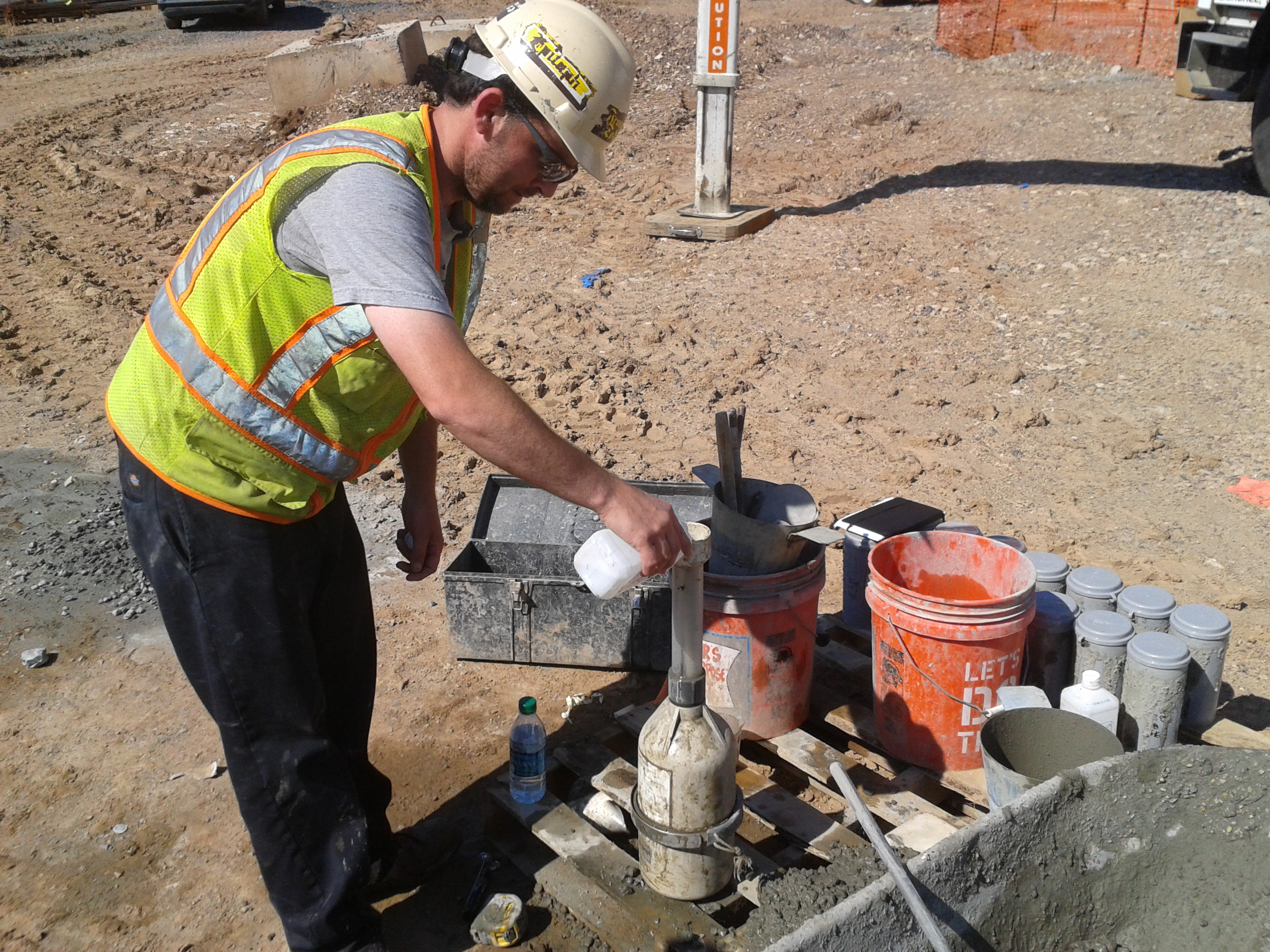
Conscious the blog is a means of sharing in order to educate, rather than just a site-diary I thought some may be interested in some of the testing methods and concrete I am involved in. Deck concrete has to be pumped to three floors high so we’ve used air-entrained, lightweight concrete. This has used pumice as the aggregate – a featherweight volcanic porous rock. Slump tests have been done, as standard, on every 2nd truck, aiming for a slump of 180mm- 230mm, making it very easy to work with. 28 day tests have given a strength of 52000kN/m2, when all that’s desired is 27600kN.m2 – this has consistently been the case! The second on-site test we’ve been doing is to measure the amount of air-voids as it’s air entrained – the specs require 5-7%. Air entrainment tests take one of three forms:
1. Pressure testing: using a pressure device, you measure the air content of fresh concrete based on the pressure-to-volume relationship of Boyles Law. Pressure is applied to the sample to compress the entrained air in the pores, then measures the change in air volume to detremine the air content. We couldn’t use this due to having porous aggregate.
2. The volumetric method or roll method (pictured below). Relying on an instrument with an in-built gauge, it is filled with fresh concrete and agitated with an excess of prescribed water and alcohol.
3. Air Indicator Kit: This kit provides a quick and easy method to check air content. A sample is placed in a vial and alcohol is added to free the air. The change in level of the alcohol in the vial stem indicates the air content.
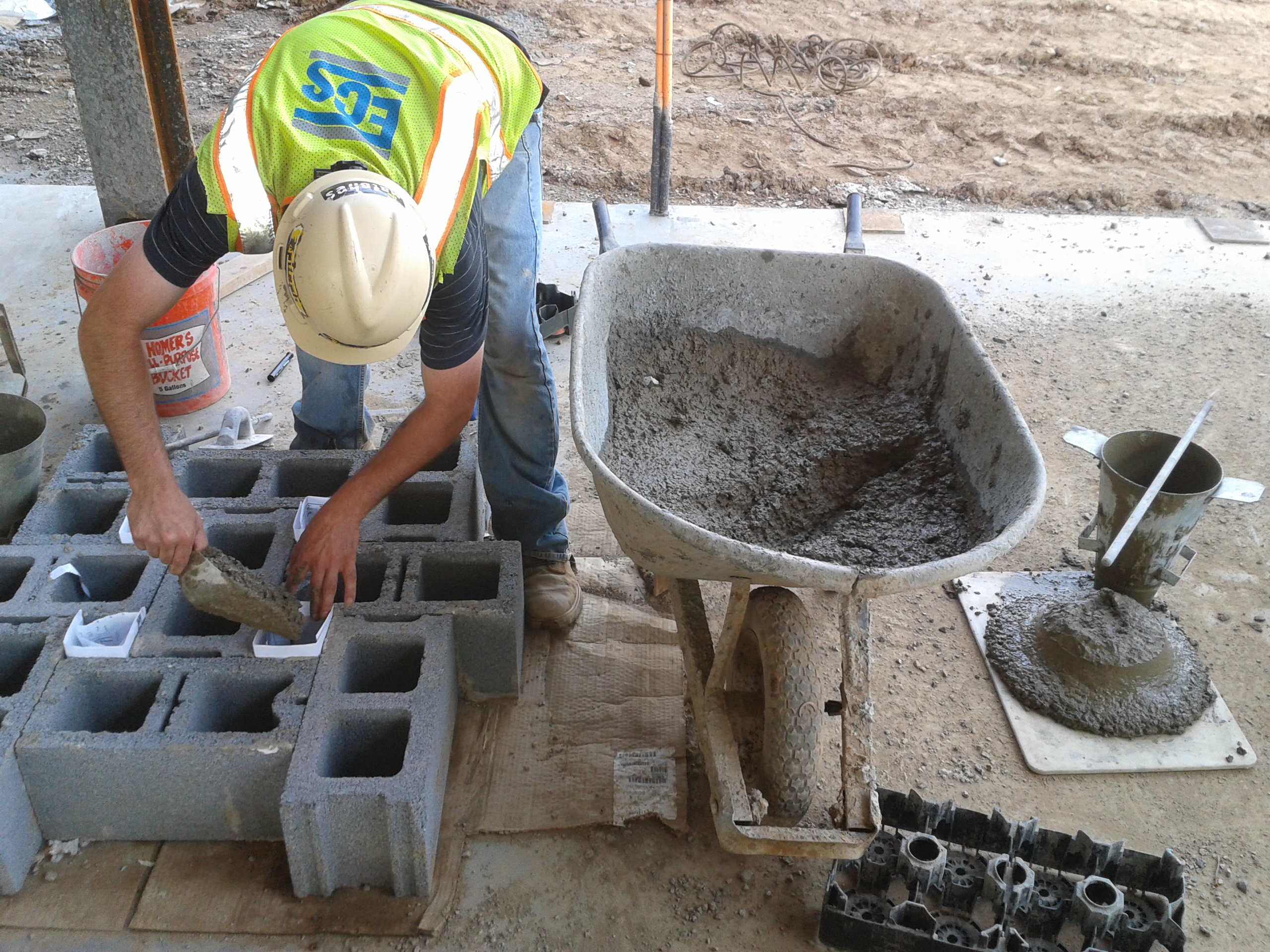
I have also been conducting grout testing for the stairwell masonry – this has involved the rather non-tech grout block testing pictured below. The paper enables a cube to be moulded whilst also allowing a transfer of water out of the grout to simulate the grout in-situ where the bricks absorb some of the water with cementitious materials in solution. We are still awaiting test results but we require 20500kN/m2; slumps 200-280mm.
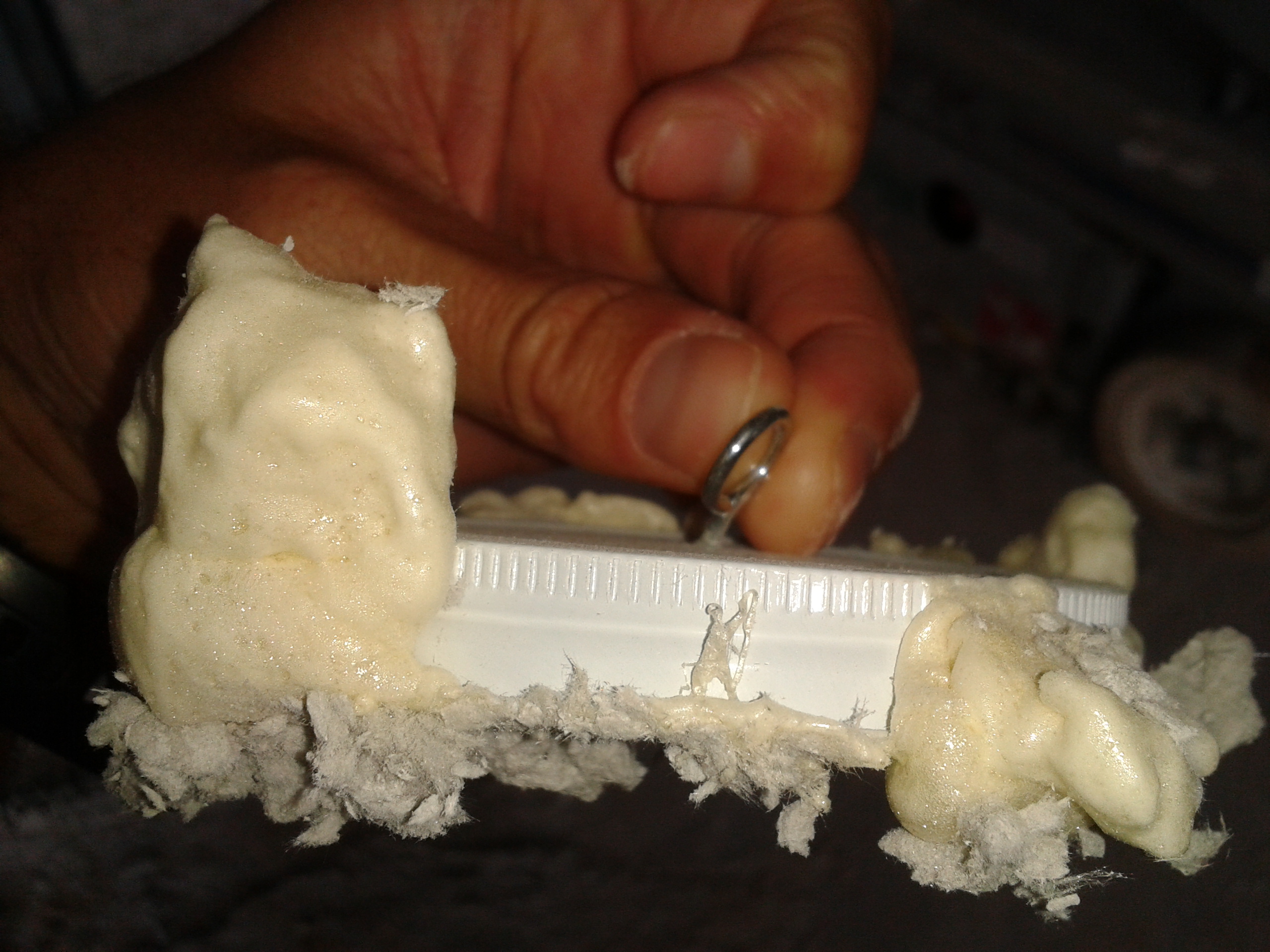
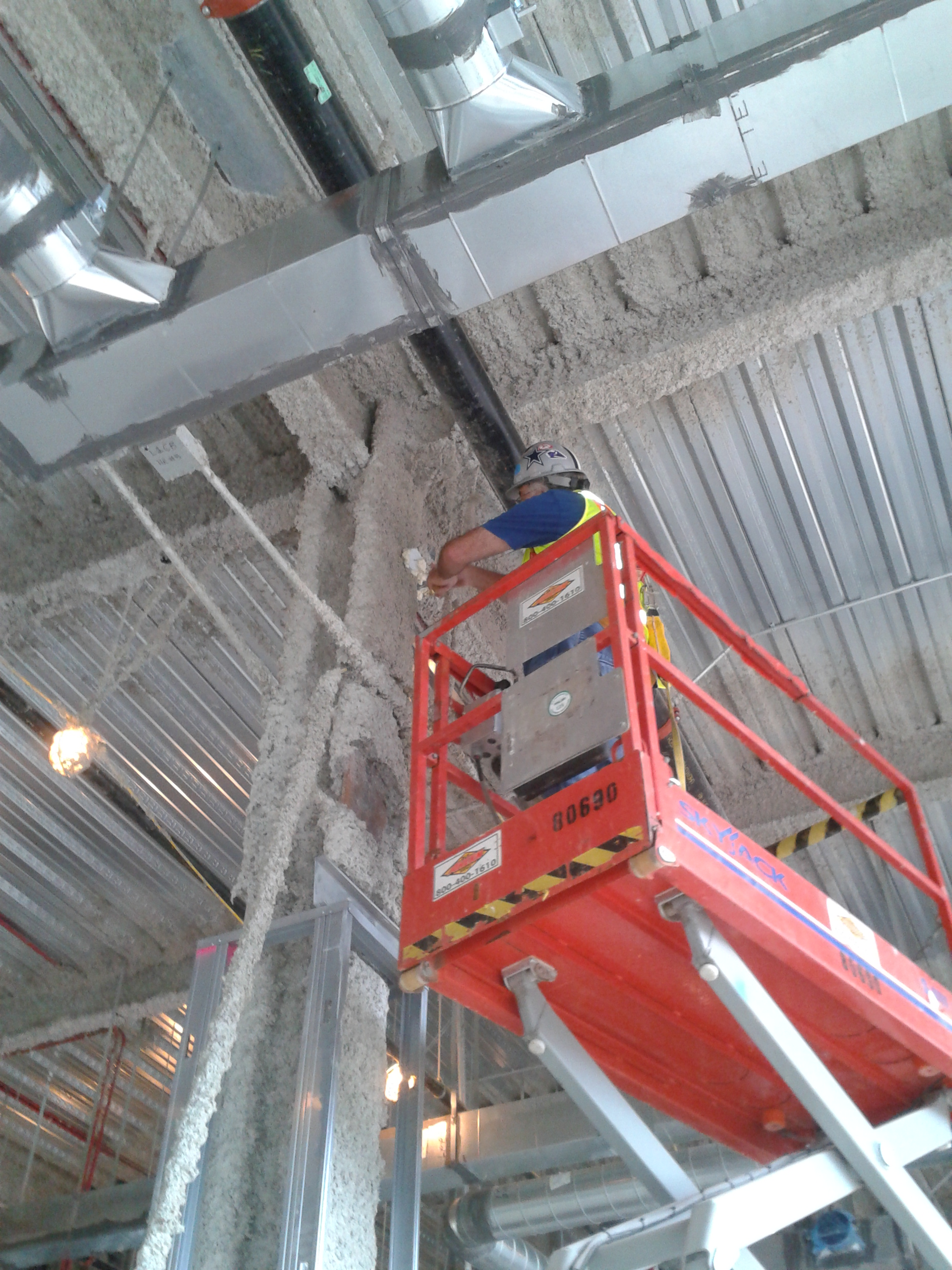
30 days post steel beam fireproofing we’ve jumped onto testing them for density and adhesion. Again, a very crude method but clearly laid out in the ASTM (EC equiv). The density test is done with a 12×9 inch removed area and lab-tested, while the adhesion test is done as follows: a mason jar-like cap with a hook is mastick’d onto random vertical and horizontal areas. After 24hrs of setting, the hook is pulled. In our case with a 1,75 inch thick material it must withstand at least 12psi of pull, unfortunately the material itself broke apart with a mere 5psi….oh dear! This has quickly shot up the pay-grades and we await a plan forward and response from the fireproofing manufacturers!
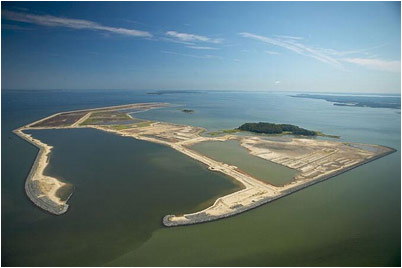
On a side, I made the most of being able to jump on the back of the District Commander’s diary so tagged along for some hobnobbing with a US Congressman who wanted to see the USACE island restoration project in the middle of Chesapeake Bay – Poplar Island. I was blown away…sustainability and PPP’s at its best…reconstituting an eroded island with rock armour and dredged material from Baltimore and Virginia ports and Chesapeake Bay that enables deep water harbours to remain open, prevents open water dumping, all whilst making a carefully balanced ecosystem haven that harbours 1000’s of terrapins and over 180 species of birds acros 7km squared. 2.4million m3 are dredged each year in the areas mentioned; the island at its present perimeter can house 30 million m3 of which 19million has been used; an expansion of the island is being applied for which will enable an aditional 23million to be used.
Holes and rattlesnakes!
There has been little tangible movement on the flood repair since my last blog other than to’ing and fro’ing of submittals from the contractor for his dewatering plan (or lack of), erosion and sedimentation plan and random others such as concrete and pozzolan specs. It has taking even longer when the chain comprises of the subcontractor, contractor, USACE area office, USACE design office and then additional third parties – state Dept of Transport or State enviro guys – I sit in the middle getting annoyed and cross-eyed. Even with my immature engr eyes I have picked up errors in submittals as simple as not supplying the right concrete ‘psi’ despite it being clearly stated in the specs. Despite the paper-pushing, the clock has started for the contractor; I can only persuade and remind them of the repercussions of late completion but this is preaching to the converted somewhat so the ball is really in their court.
I have continued with the QA on the HQ site. Today was my first soiree into the E&M world…..DALT testing! A quick google search as to what exactly that meant – Duct Air Leakage Testing. Thinking I’d be out of my depth, I was pleased to see that in the initial briefing and explanation for 12 of the witnesses (incl me) that it was quickly apparent that only about 2 of them knew what exactly was going to happen having been baffled by a handout of 20 pages of which 2 pages were only relevant, while the rest all kept quiet trying to look both interested and knowledgeable – the veneer crumbled rapidly when the uniformed guy in the corner with a funny accent started asking questions!!
Adjacent to the office is another USACE project I have been keeping my eye on – a large warehouse that has just started foundation work. The ground is a mix of silt, sand and clay and general debris (having had an entire ground penetrating radar scan) with a high water table of approx 0.5m. The line of attack therefore is to build geo-piers (otherwise known as rammed aggregate piers). The technique is exceptionally simple – a 12-15ft shaft is formed by the ‘rammer’, it is then withdrawn and layer upon layer of aggregate is poured and rammed/compacted into the hole – see below.

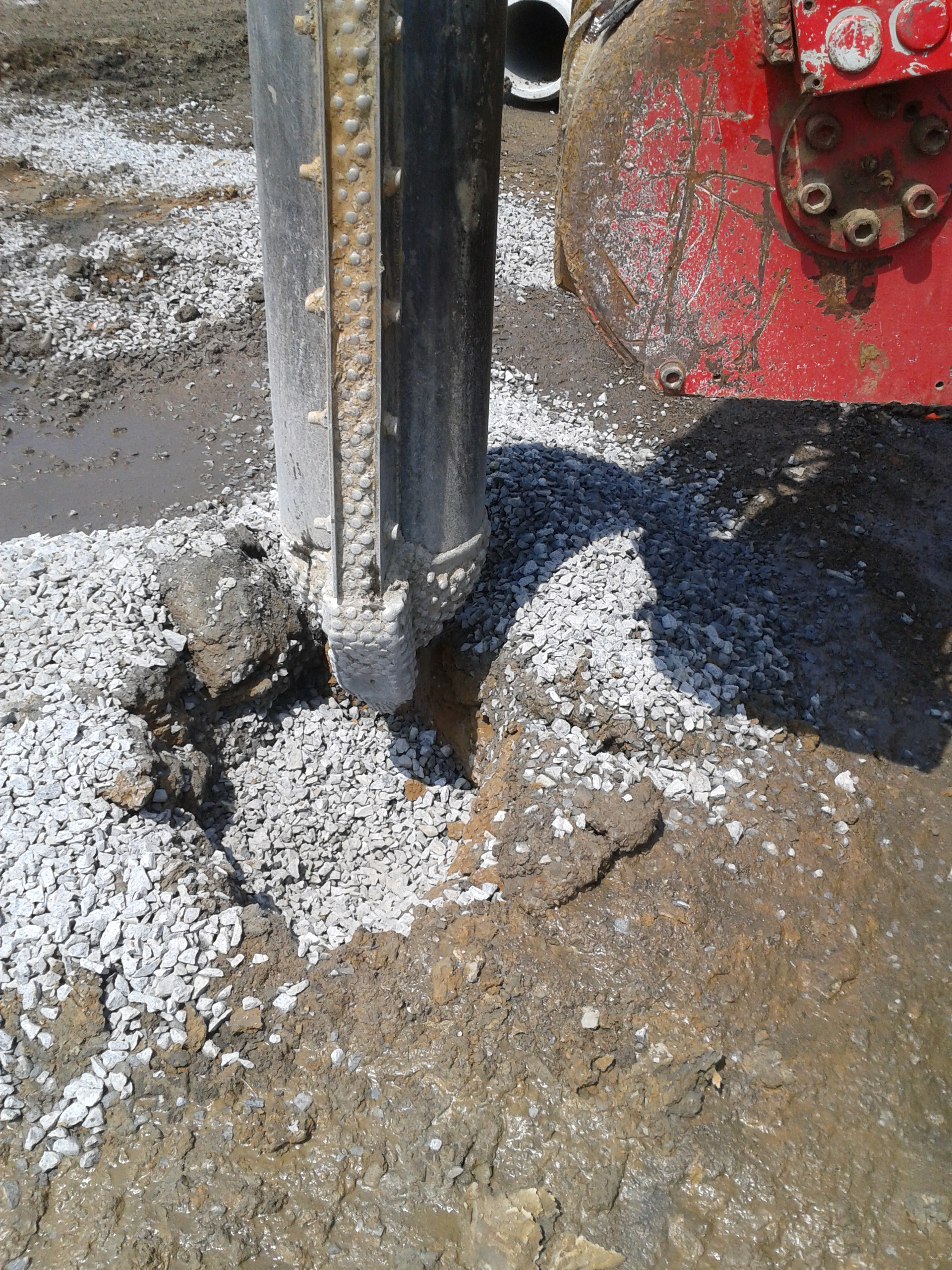
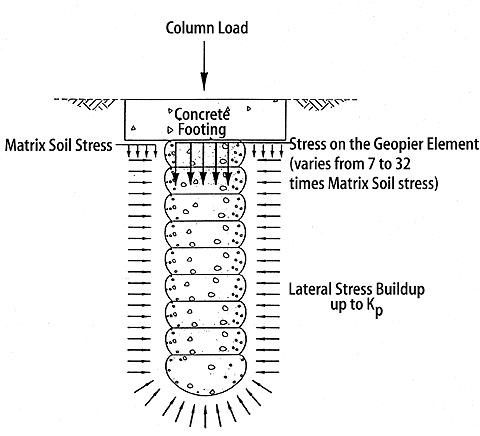
I sense John putting on his reading glasses now….rather than our typically taught shallow or deep foundations, these are known as ‘intermediate’. The rammer tool has 45deg edges to press the rock laterally – this ‘preconsolidation’ technique pre-strains and pre-stresses the soil below the drilled bottom, creating a bulbous base of aggregate upon which succesive layers are piled and compacted (each layer no more than 0.3m). The ramming therefore creates a very stiff dense rock pier (”load goes to stiffness”) but also improves the strength and stiffness of the soil surrounding the pier, through compaction >> increased lateral stress >>increased effective stress >> increased shear strength (Mohr’s circle) . It does however involve a huge amount of piers, 3600 for that matter under a warehouse approx 200m x 100m, but each rig can complete approx 50 piers per day; one more is inbound (with a top hopper). In this case no steel is being used, but it can be incorporated to prevent uplift.
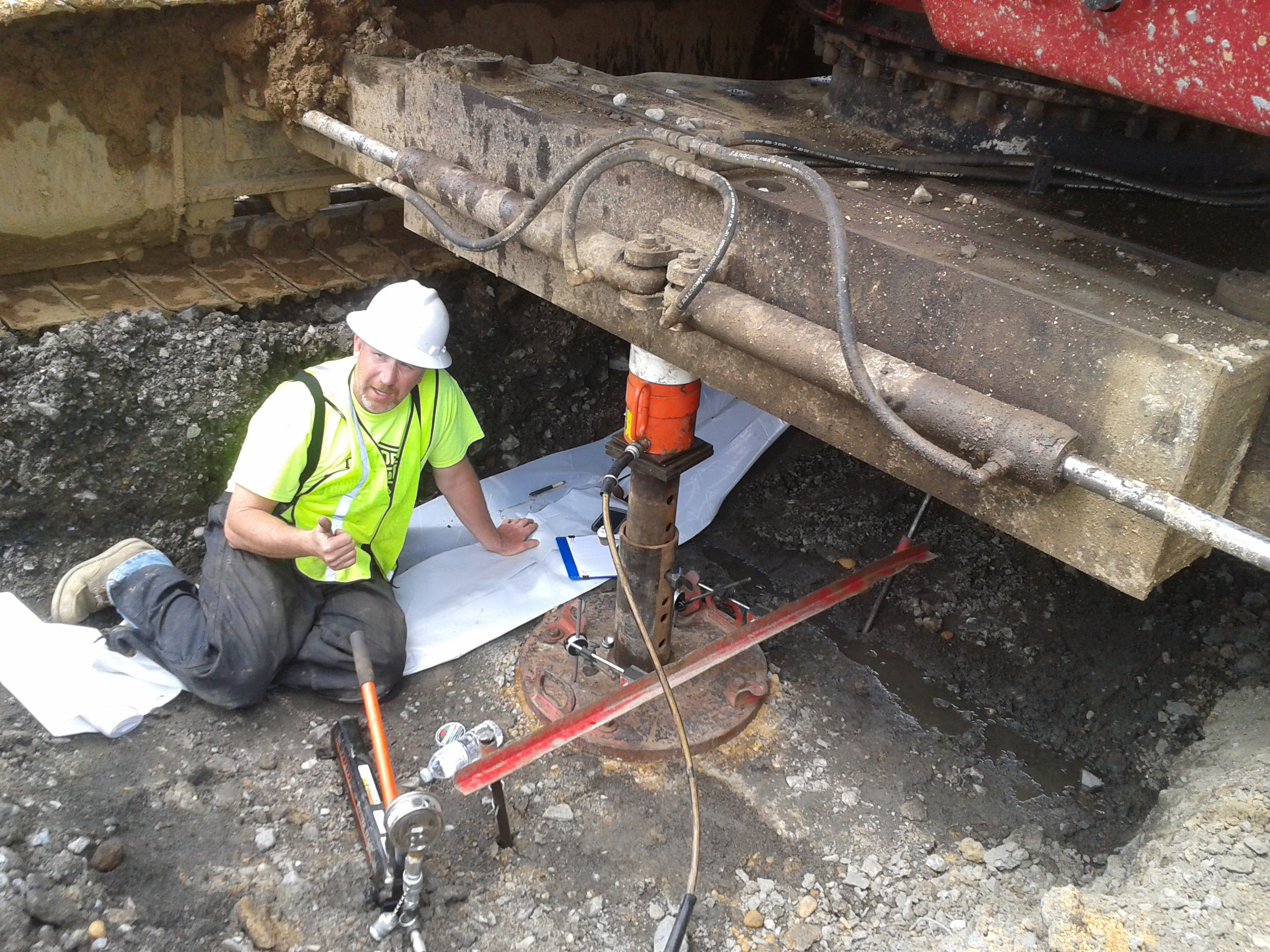
One day in we conducted the modulus test on one pier – the top foot (sacrificial) of pier was hoed back, while a pressure of double the design load was placed upon it (550kN/m2). Settlement was then recorded as pressure was increased, as was the rebound when pressure was released. We await exact figures and analysis but down and dirty figures were a total settlement of approx 8mm, with a rebound of 7mm – recall the consolidation curves.
In other news, we just enjoyed a long wkend (memorial day yesterday) full of BBQs with friends and family. Smoked, slow cooked, pulled pork is the food of choice for BBQs out here having eaten it 3 days in a row – certainly not complaining!! The SI joined us for a few days last week – no doubt he is telling tales of our 10ft rattlesnake fight on the Appalachian trail…I certainly am! Weather has now hit the 30deg C so the outdoor pool at work got a visit today at lunch – tough life!
The ground is a risk…(contd)
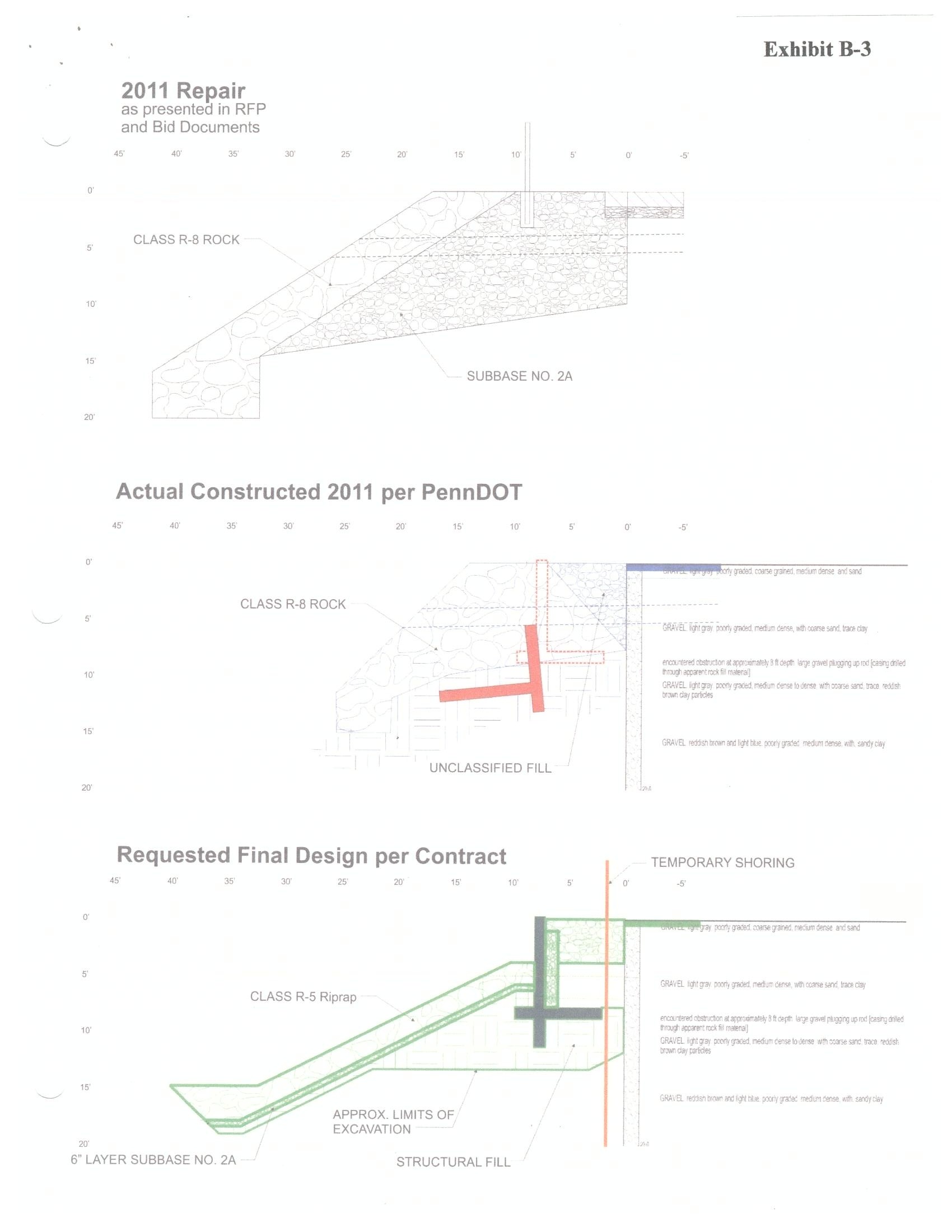
PSB for the cross-sections of drawings. For clarity the top drawing is the repair drawing (inaccurate) that the government provided the contractor in the bid – the vertical protrusion is a fence post.. The middle drawing is the actual representation of the repair that took place – thick red line representing the present loc of the fallen cantilever wall and thick blue line indicating the road and side pavement. The bottom drawing is the ‘as built’ and desired end product. (PennDOT = Pennsylvania Dept of Transport)
The ground is a risk!!!
I always knew the orator’s words would come back to haunt me – it was just a matter of time!!! On the prowel for some more work to complete some more of my DOs, particularly contractual experience, I approached my supervisor 2 days ago to give me some autonomy and contractual experience conscious that the HQ project is mainly sewn up by another project engineer whose toes I have been wary of treading on too much. The response…”I got just the thing fir y’all, why don’t you run with Danville?’ ….Trusting her completely, within hours my desk was covered in paper, emails started flying in, and my head was buzzing with negotiations, primes, change orders, REAs (request for equitable adjustments), …the list goes on!
It is Dev Obj gold dust which is great; I will try to summarise the can of worms on my desk.
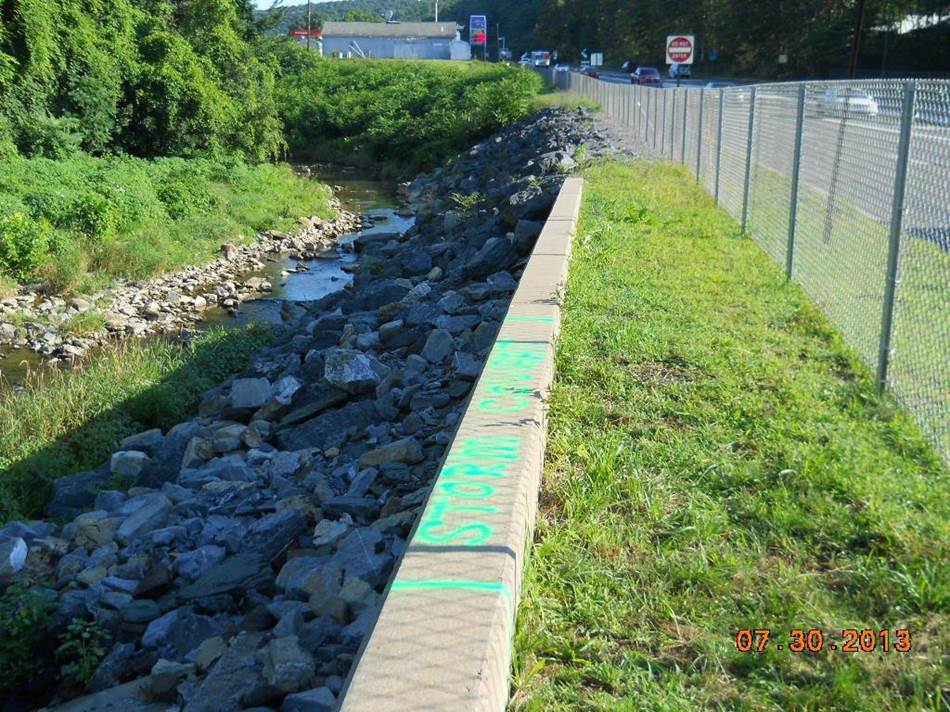
Background: The Mahoning Creek naturally runs into a highway in northern Pensylvania, which has been artificially diverted 60deg’s through the use of a reinf concrete retaining wall (retaining the highway), and embedded within 40” riprap is a concrete cantilever wall (location: http://binged.it/1ugdIxL). Sep 2011 saw a 1 in 500yr flood that undermined the riprap and concrete retaining wall ripping a whole lane out of the highway. Emergency repairs taken by the state were to fill the hole with more rip-rap, aggregate and then road surface on top. The photo shows in the foreground the sound structure; as yuo move away the wall then stops and is replaced by riprap – this is where the wall, riprap and road were undermined – now band-aid’d with a shed load of riprap and a road surface plonked on top. USACE then contracted out the proper repairs; the winning contract deciding to drive sheet piles to hold back the road, whilst the rip rap was removed and a new concrete wall and cantilever with rip rap were installed. However… upon the contractor taking initial boring samples, it was clear that the drawings we provided (courtesy of the local council) did not reflect the fact that there is actually about 20ft of rip-rap rather than the illustrated 3ft!!! The anticipated sheet piles were therefore a non-starter. Works were therefore suspended on 1 Jul 13 until 1 Mar 14, to allow for demobilisation, geo assessment, new permits etc etc, and a new completion date set for 1 Aug 14. The gov also presented a change order for few thousand dollars to compensate for suspension costs
Present/Issues: 1. Work has still not commenced, 2. the contractor has put in an REA for an extension of time as permits still haven’t been attained (what has he been doing all this time?), incl. an REA of almost $100K for susp costs (we estimated about $6K, so this should make for interesting negotiations). 3. Costs for the proposed new construction method (see below) are to be negotiated next week, there is a relatively small delta between our and their estimates (c.$200K) so this shouldn’t be too painful – negotiations start next week which should again be great DO fodder. 4. The geotech investigation has been negotiated to approx $76,000. 5. Funding approval (80% federal, 20% local borough – the latter is the issue dep on the result of negotiations)
The new method statement is summarised as follows: 1. Build cofferdam from haybales and plastic and commence permanent pumping – funding does not allow for grander piling ideas, 2. Construct temp support of the roadway to prevent lateral collapse iot allow for excavation of rip-rap. This will consist of soldier piles and lagging, with soil nails…if curious here’s a great simplified video: http://www.youtube.com/watch?v=hrlBu1d5PBM. 3. Excavate rip-rap, remove collapsed concrete wall 4. Rebuild concrete wall, cantilever and replace rip rap. 5. Replace road and sub-terrain material. I need to get to the bottom of the engineering principles behind the rip-rap and embedded cantilever wall – when negotiations and flashing US$’s calm down I will try and get my head round it. The obvious question of: ”Why rebuild a design that has proved to be faulty?” is that funding for repair projects as a result of natural disasters (provided they have been previously inspected by USACE) is caught up in Public Law 84-99 which grants federal funds for repair; PL84-99 dictates that repairs must be ‘as-built’ unless failure has occurred at least twice whereupon authority can be sought from Congress!! Barking considering the fatal implications and the fact that it has clearly proved it fails if this kind of storm event happens again..but then again the pot has to be tightly controlled!
In short, not a grand project (total contract c.$1mill) by some scales but autonomy, contractual depth, and DO ticks all round.
Projects aside, next week will see Nic and I do some ‘Offr prof dev’ in and around Washington DC with approx 10 other US Army offrs from USACE visiting Capitol Hill, Pentagon, Arlington mil cemetery and major USACE projects around DC (Bethesda’s intelligence university, Spring Valley and the Washington aqueduct), interspersed with fitness tests and some fine wine and dining…thereafter the obligatory family week in Disney! A family pic from a recent trip to DC..
.
Team America!
Last week saw the ‘topping off” ceremony for the HQ project. ie the last piece of steel being lifted and fixed into place…this is a common-place all in team love session! Designers, struct engrs, clients etc travel from miles to come and put their autograph on the steel; work across site stops while all workers gather for a quick TY from the PM and Site Engr. With stars and stripes fluttering in the wind the graffitied I-beam is lifted and fixed into place – completed with a compulsory face stuffing session of sodas, subs and cookies! Good stuff for team bonding!
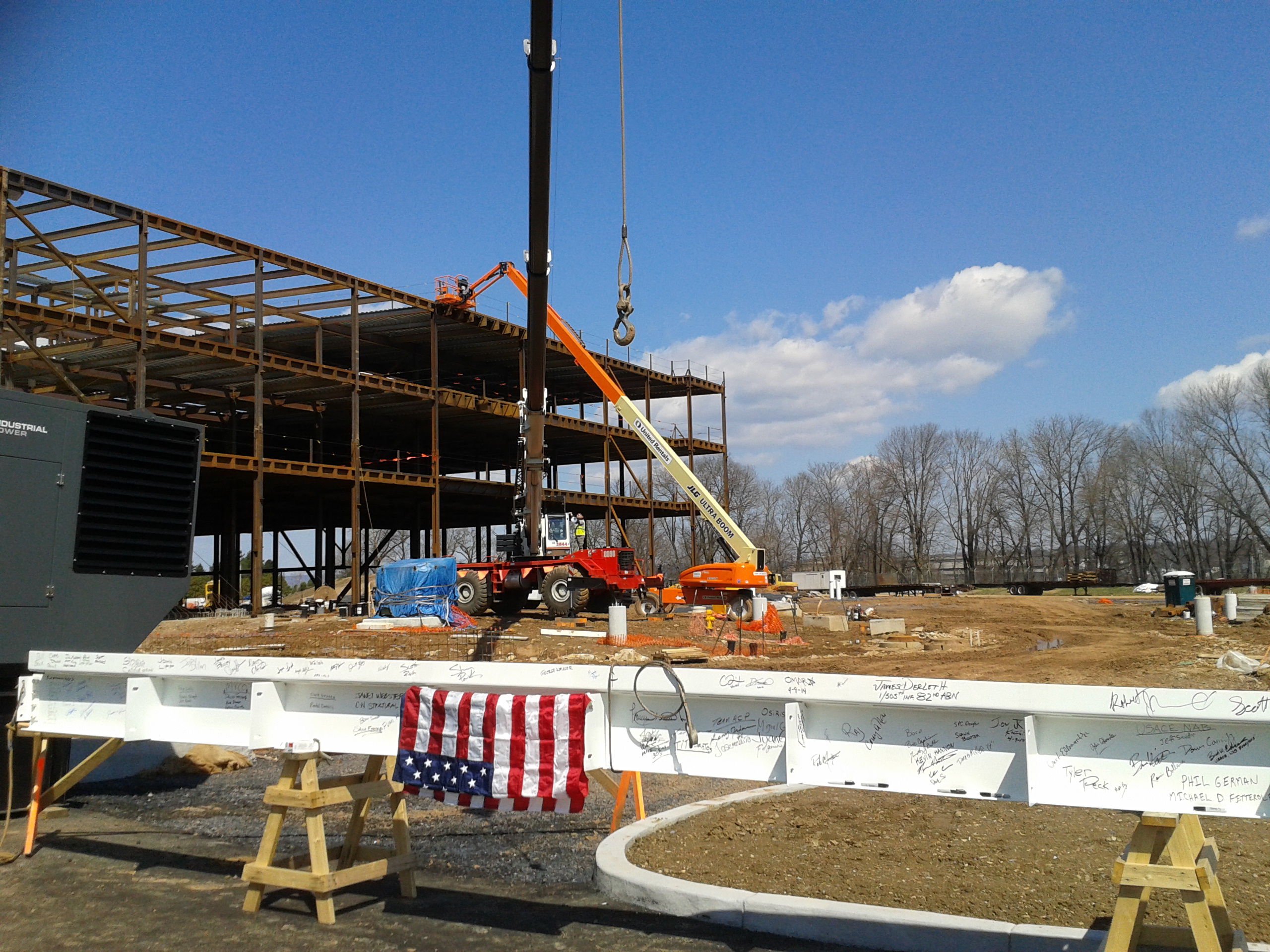

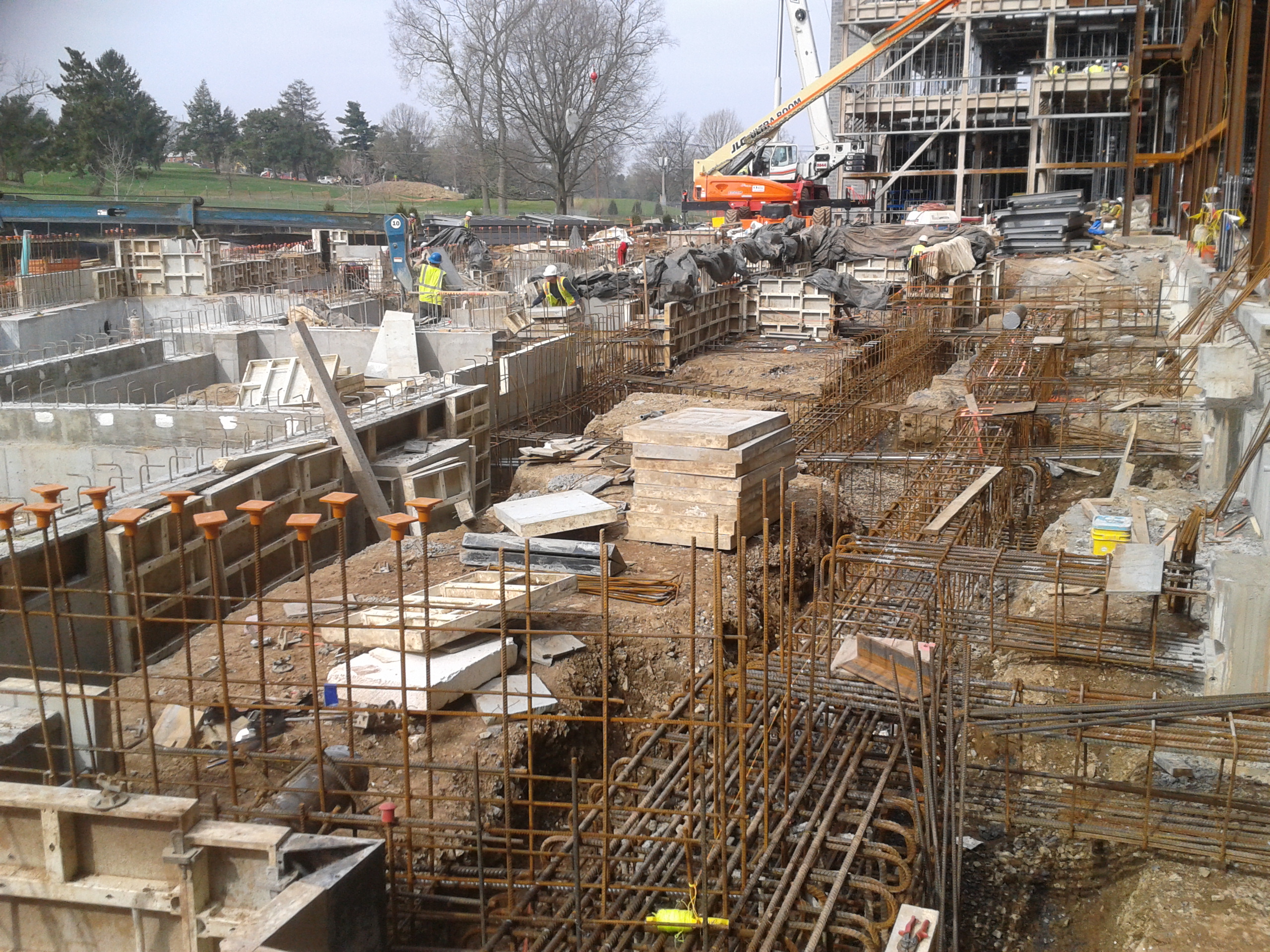
Now that temps are more like spring/summer (despite a one night sudden sub-zero drop and more snow!!!) work on site this week is going full steam, although I’m starting to believe more and more that there’s no way the contractors are going to meet the deadline of occupancy in 14 months – the pre-cast concrete curtains are still to be fitted; awaiting site clearance for space and lots more steel fabrication and welding. Though the contractors wont admit it to us, it is becoming evident they are under pressure particularly when today they started dropping rebar on the 3rd storey without finishing the steel connections on the ground floor! I look forward to the schedule conference in a couple of weeks. Concrete has been laid on ground areas A-D, while steel and formwork are being set-up for the foundations for the amphitheatre.
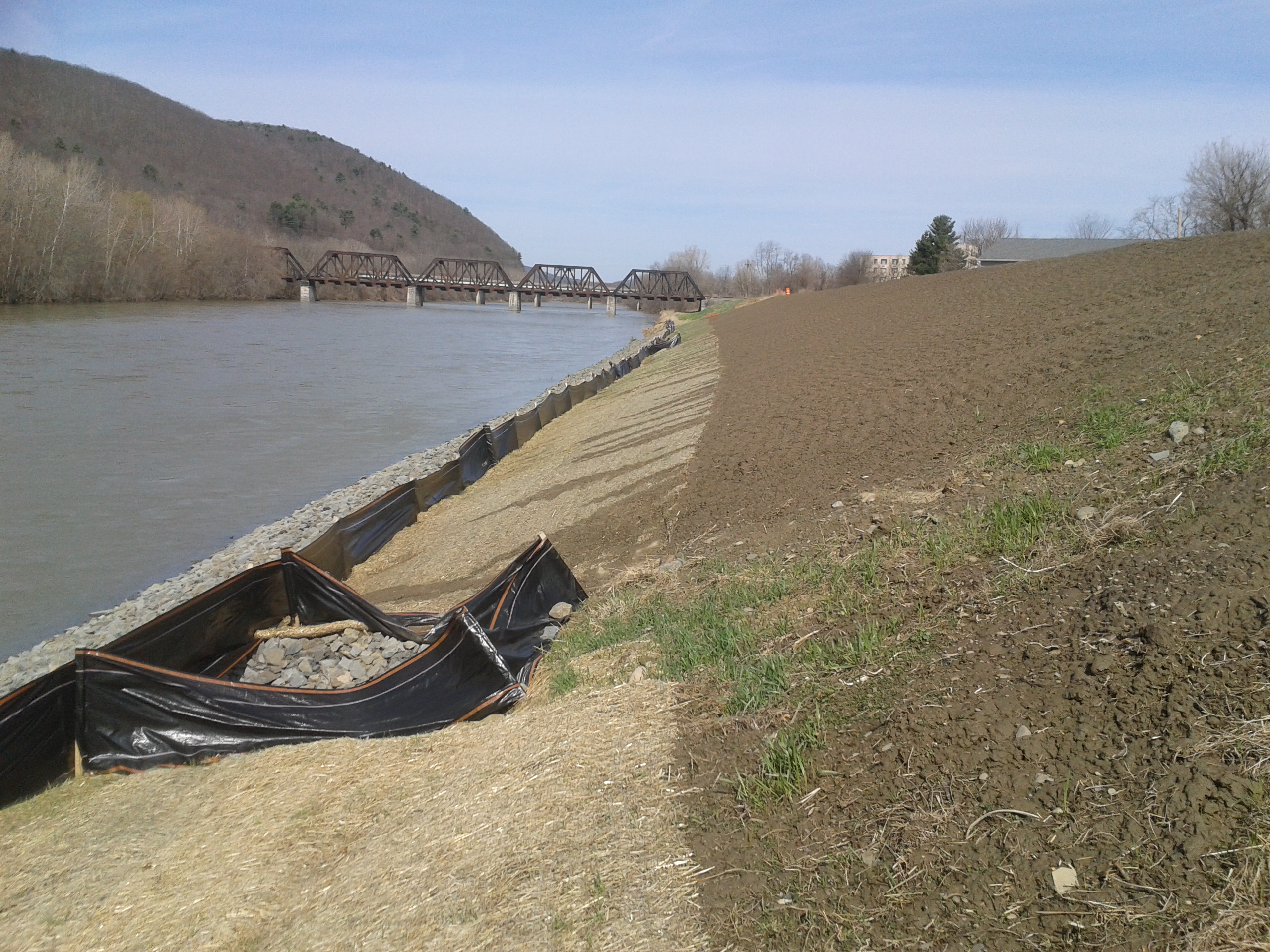
I am STILL awaiting approval for access to USACE computer systems and to have an email so I continue to be rather ‘impotent’…8 weeks after arrival in country…the top brass have now waded in and the bureaucratic system is slowly starting to move so I have been told it should be by the end of the week! In a contd quest to make the most of it I joined one of the PEs on a pre-bid meeting/visit to a levee repair on the northern Pennsylvania/New York border (a 9 hour round trip in a day!). Levees are big ticket items that regularly involve congressman wading in to deal with complaints raised by local residents. I have been absorbing issues of staged construction, repair, grading, erosion and sediment control (E&S) as well as nuances/issues of the ‘Public Law 84’. I was amazed at the accuracy of grading and levelling needed on the 14500 miles of national levees…one slight divot or undulation and a river can target it and rip it open when in flood. Below is a completed levee repair (protecting the town of Athens) that is awaiting spray-seeding; note the grading of 1:2, rock armour at the toe, grass matting above the toe to control erosion in the interim. The remaining matting has been blown off in recent storms.
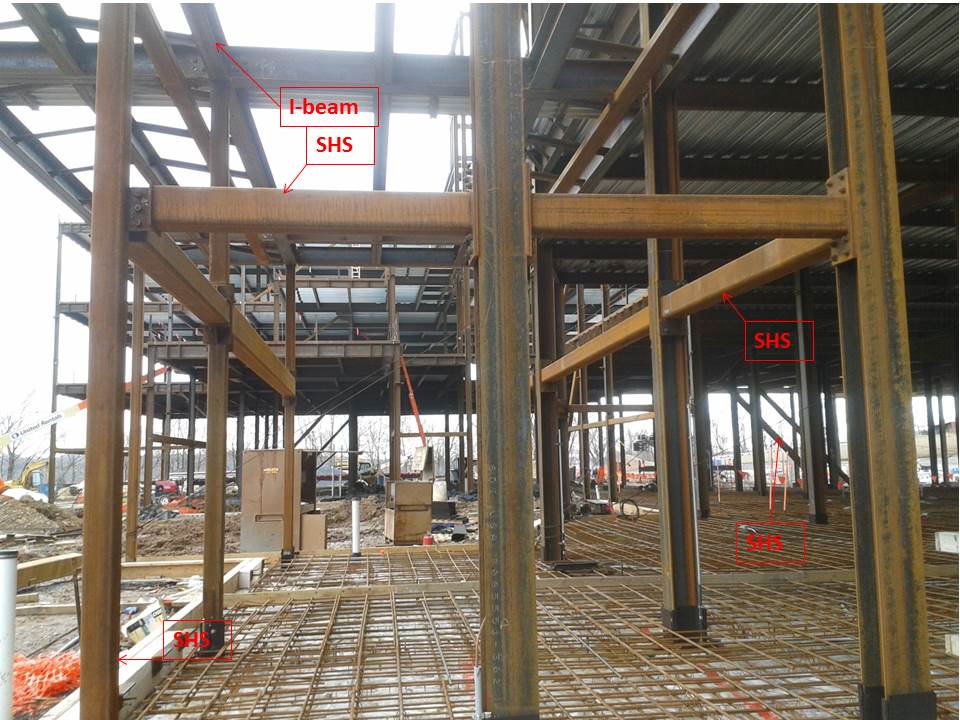
SHS vs I-beams???
Steel buffs unite!….I’m trying to decipher why the structure has used I-beam columns throughout the site and then occasionally SHS columns (generally on the outer columns). In addition, the ground floor horizontal cross bracing uses SHS rather than I-beams. On questioning the contractor – who were not the designers – they could only assume it was for blast protection. Maybe so, but I’m not convinced as it’s also used within the building for diagonal bracing. Thoughts?
With the sudden onset of Spring, the contractors are making hay whilst the sunshines…at least a bit of it anyway. Concreting has commenced once more, although one would have anticipated more being laid in the time available. It would appear that the subcontractor thinks it cheaper to have less manpower and work longer, rather than swarm the site and lay more concrete in one go…once again, we can only speculate, it is the contractors baby to manage as they see fit and from the last schedule review we held with them they guaranteed us they can meet the deadline within 3-days….a big shout! Precast concrete curtains have started to arrive on site and should hopefully start to be put up next week.
I still haven’t got access to the USACE system. They have reworked the application process for ‘foreigners’ and I’ve just found out that I’m the guineapig…the problem is that no one knows what to do with this guineapig when it comes to IT; frustrated to say the least. Nevertheless, I’m trying to make best speed of what I can do without access so am also now undertaking reviews of upcoming construction of two main access control points to the site we are on…encompassing a large amount of environmental, drainage, wetland mitigation as well as interesting security and VBIED mitigations.
Radon and Snow???
My primary project is the construction of a Headquarters Building for the US Defence Logistics Agency – a $81 million project that should be complete Oct 15. Artistic overview below:

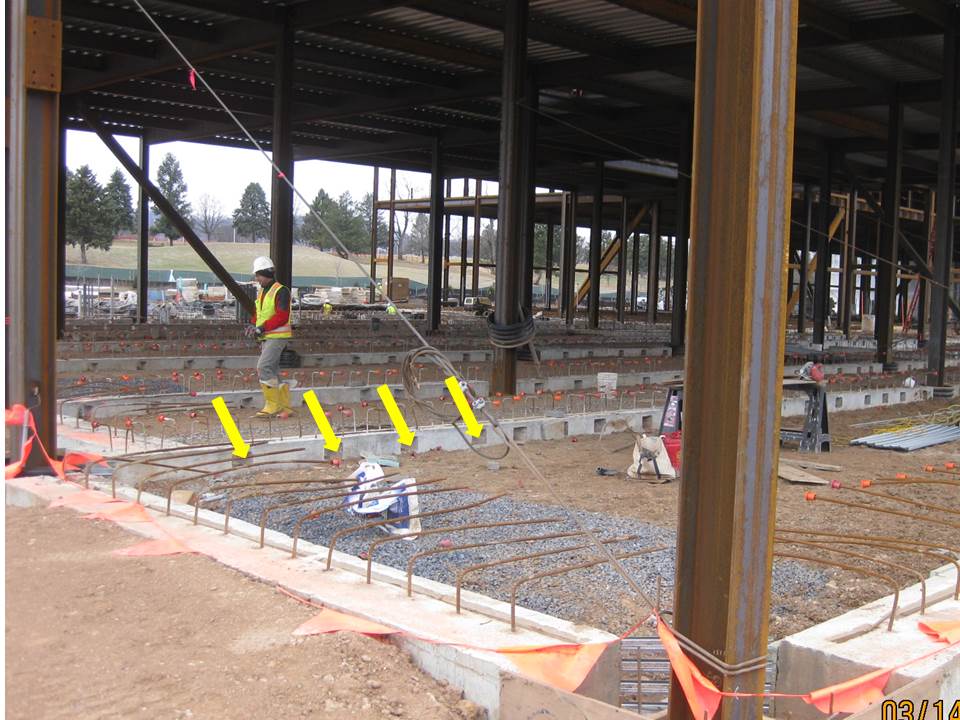
An interesting point to blog-share….Radon…??? I was curious as to what the holes indicated by the yellow arrows were? Well, they are to allow for the spread and extraction of radon across the area beneath the concrete floors. Radon is a natural occurring gas that is radioactive and causes the highest number of lung cancer cases in the USA amongst non-smokers. Little did I know, but the Pennsylvania area (Appalachians) has the one of the highest concentrations of radon in the USA. You will note an aggregate bed – this is approx. 0.2m thick upon which the non-structural concrete floor is laid; the compacted aggregate provides a bed upon which to lay the concrete floor but also a permeable band for the radon to move through.
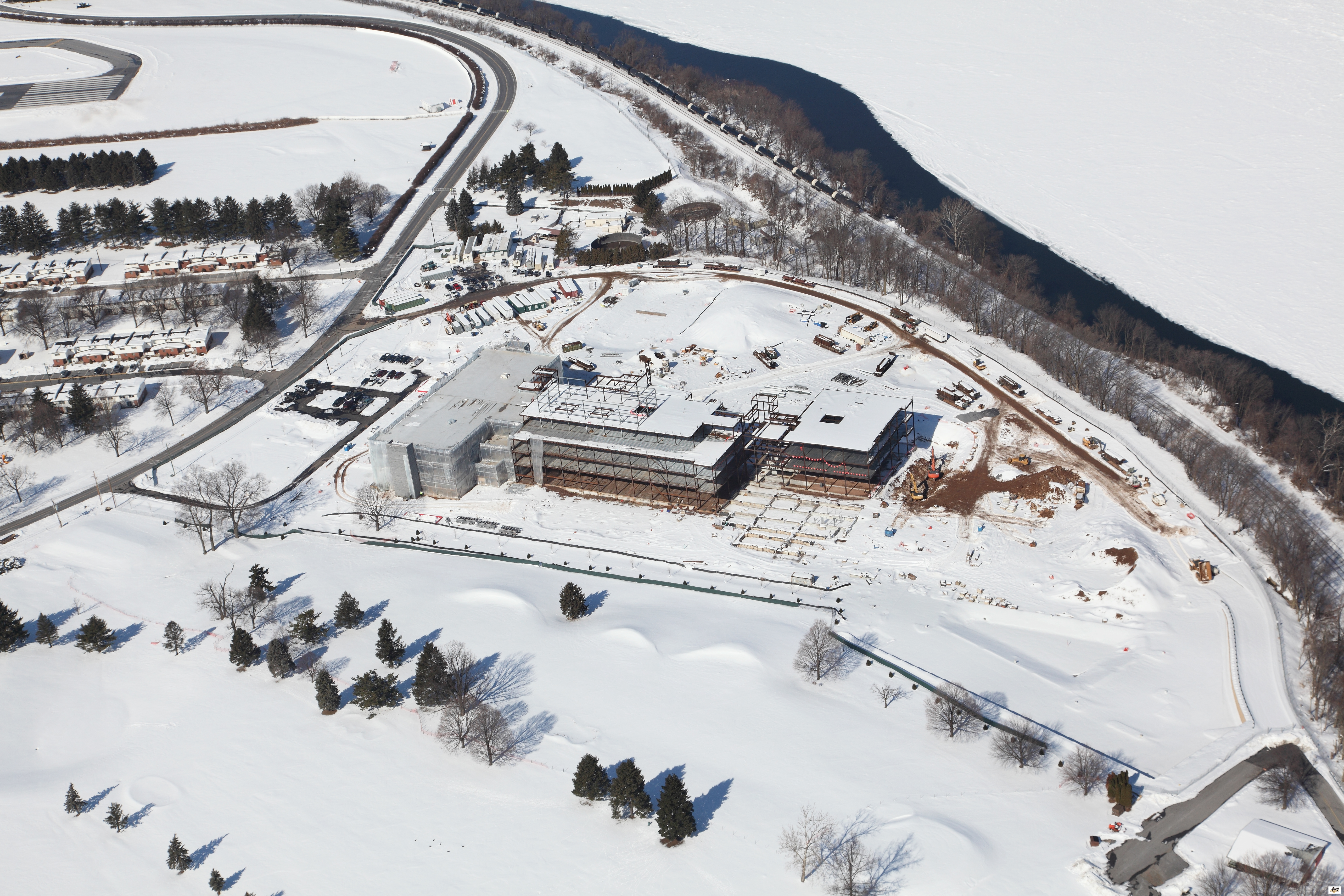
Weather has been a major issue with progress – one has to approach a problem differently in these climates. Despite local advice, the contractors cracked on with completing all the steel for the entire building – made sense from their point of view as its easy to continue one thing whilst you’re on a roll and all equip is on site. The problem now is that none of the concrete can be laid, particularly inside the building as it is too cold. To expand on this: there has only been 5 days since the end of November where temps have been above 5 deg C…the min temp needed to apparently maintain satisfactory curing. Our advice was to put up steel in one segment of the building; clad in the precast concrete walls in order to allow them to have an enclosed space to heat easily, where stairwells and flooring could then be poured. Instead contractors are making the best of a bad situation and installing M&E in as much of the building as possible. The photo below shows the site last month….it looks exactly the same this afternoon as another bout passes through!
USACE – a cultural experience
 So what exactly is the United States Army Corps of Engineers (USACE) – it wasn’t what I thought….
So here’s how things work out here: the following USACE ‘customers’ will submit their engineering demands to the US Congress:
- Any US military installations around the world.
- States that need hydrological works on any of its waterways (these are classified as civil works and include everything from dredging to dam building).
- Federal emergency response services (flood/fire/tornado etc)
Congress will then approve a project, set the budget and hand it over to the USACE in that area to run. The laydown of the USACE can be seen below; my AO falls into the Harrisburg office of Pennsylvania. Escalating upwards on the CoC – 1UP: Baltimore District office (situ in downtown Baltimore), 2UP: North Atlantic Division (situ in New York); 3UP: USACE HQ (Washington DC).
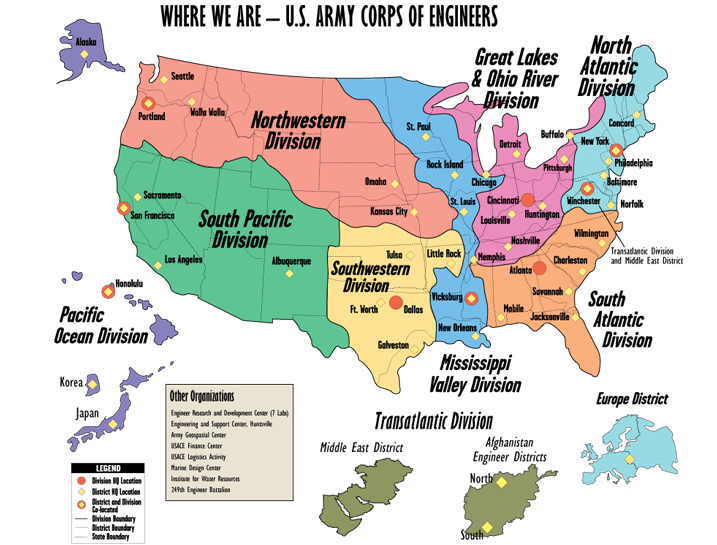 The majority of USACE construction projects compose of one of the following: (a) ‘Bid, Design, Bid, Build’ type contract i.e. the design process is put out to tender, then the construction is put out to tender, or (b) the design is done in-house by resident USACE architects and engineers (using BIM!!) who then put it out to tender for construction. The USACE do not actually conduct any of the construction – they are the eyes and ears of Congress to ensure that US taxpayers’ money is being spent correctly and that the government construction guidelines and H&S standards are being abided by (which are far more stringent than those outside the gov system).
So why on earth, I ask, would a contractor bid for a government contract when the administrative burden is so high, H&S is so strict, the gov can terminate a contract at a moments notice and you have the USACE keeping you in check at every turn??? Well, simply because payment for work is done by a payment schedule, and once work is approved by the USACE inspector the contractor will have their money in their account from the government within 14 days. If they were outside of government works, payment can apparently take months. Pockets therefore stay flush!
In order that such high standards are delivered, a large amount of SMEs are needed. The Baltimore office alone occupies an entire unmarked 10-storey office block in the central CBD. It is full of everything from archaeologists, GIS wizzes, environmental specialists, tornado trackers, emergency control rooms to lawyers….with only 3 uniformed servicemen (the Comd, Dep Comd…and the Brit!).
On a different note; food is the most talked about subject in the office (a close second to engineering). Recipes are swapped between cubicles (‘cubies’), men vie for bragging rights on their wive’s pancakes, ladies bring in herb-rubs every morning to ‘sniff’ and ‘swap’….I look forward to the upcoming lunch social where a 6 foot (yes – 6 foot) meatball sub will be brought in by an Italian bakery down the road to feed about 20 of us!!! I promise to send you a photo Pete.
Also, the fact that I wear uniform into work brings an interesting dimension to ‘commuting’. Railway ticket conductors stop their work , shake my hand and thank me for my ‘service’, beggars holler the same from across the street, mothers would thank me in shops, old men at petrol stations etc etc…humbling! Even the lady in Subway gives me a free cookie…I’m going have to watch my waistline!
ps The chance of me taking in any photos at this point is nigh on nil unless I clear it through Obama personally – but I’ll try a bit of artistic license to keep in engaging!
 Holdfast Training Services Trial Blog