Archive
Introduction to Civil 3D
Introduction
Upon arrival at my Ph3 Design Office my Line Manager had me complete a Civil 3D AUTOCAD course. I am sure that many of the Civils are most likely using this or a similar software package in their design offices. However, if any of you aren’t or are only just beginning to use it then I felt this would a useful opportunity to share my experiences with you. Additionally the course deliver has permitted me to share my electronic course notes, which are a useful handrail for using Civil 3D’s specialist features.
Recommendations
The Professional Engineer Wing are invited to note the following recommendations:
- PEW should become an AUTOCAD approved course deliverer. This would formalize the CAD lectures on the course and enable students to achieve recognized AUTOCAD qualifications, which would aid them during Ph2 and Ph3.
- Civil 3D should be taught, to the Civils, as part of the PET course. As AUTOCAD is already taught as part of the course, it would be useful for students to know and understand how to use the specialist plugins available to civil engineers.
Civil 3D Specialist Features
The following is a brief summary of the specialist features that are incorporated as part of the Civil 3D software program:
- Digital Terrain Modelling. Civil 3D allows you to directly input survey data and from that data build a topographical surface. It will also reference the nomenclature of those points to input terrain features like trees, manholes etc. automatically.
- Road Design. Civil 3D has specialist features for designing alignments, profiles and corridors. Additionally it has many roadway features such as junctions, roundabouts etc. preloaded. It references data from legislative safety standards and will adjust the design to ensure they’re met.
- Grading and Earthwork Volume. Civil 3D enables you to grade with ease, this can be used for road design or simple surface manipulation for drainage etc. Additionally, it is able to use the data from grading to determine earthwork volumes.
- Gravity & Pressure Pipe Networks. Civil 3D is preloaded with the vast majority of conceivable pipe network fixtures and fittings. This makes designing and understanding the flow in pipe networks as simple as drawing polylines.
For more detailed information on how to use the various specialist features in Civil 3D, please refer to the course notes below.
Summary
So far in Ph3 I have been responsible for designing surfaces using Civil 3D to ensure that storm water on a new development will drain in accordance with the Maryland Department of Environment’s state legislation. Additionally, I will soon assume the design responsibility for foul water drainage system as part of a new military facility.
I have found the specialist tools in Civil 3D to be highly effective and huge time saver, in creating the designs for the aforementioned projects. I wholeheartedly recommend the software to my peers and hopefully you will all find it as useful as I have.
Course Notes
How to meet nICE people abroad
Engagement with Institutions when Seconded Overseas
One of the attributes considered by all institutions during Professional Review is a candidate’s level of commitment to their respective institution. UK based students are able to show their commitment through their attendance at institution events and engagement with wider institution activities. Though all the institutions have an overseas presence, the footprint of their overseas members and events is often vast and spread across entire continents. This hampers the ability of overseas students to effectively connect with their institutions and limits their exposure to valuable personal and professional development opportunities.
This blog post will explore how to successfully engage with your institutions when deployed overseas and the developmental opportunities I have found during my short tenure in the USA.
Recommendations
For the benefit of all, current and future overseas students are advised to note the following recommendations:
- Contact your institution’s international representative.
- Blog about your own experience.
Additionally, the Professional Engineering Wing is invited to note the following recommendations:
- A centralised list of international institution contacts should be established and disseminated to future overseas students.
- The Chief Instructor should meet with Dr. Peter Goodwin during his next visit to the US and potentially discuss the opportunity of PET students working closely with UMCES beforehand.
First Contact
I initially reached out to the ICE delegate for the USA to try and identify what ICE activities and events are run in the US. Whilst I received some useful information he was unable to provide me with anything of substance. Success came when I reached out to Deborah Oyelaja, ICE’s International Administrator. Deborah maintains a database with the location and contact details of all ICE members located overseas. Using her database she was able to pass my details onto all the ICE members on her books living in the vicinity of Baltimore. The vast majority of the ICE members she contacted on my behalf reached out to me and I have received invites to attend a wide variety of CPD activities across the North Atlantic Coast.
The ICE only has a formal presence in New York. Their planned events and activities can be found on their webpage – www.iceusa.org. The president of the ICE NYC society has invited me to attend their events, which occur quarterly. Outside of NYC, a number of ICE members have volunteered to host myself during a visit to their in-country facilities. They have also been kind enough to extend this invitation to the other PET Students, Cs and E&Ms, who are also located in the States.
CPD Opportunities
Between NYC Society and the ICE members that have reached out to me, I have been invited to the following activities:
4 May 18 Visit Horn Point Laboratory, UMCES
5 May 18 IMET Open House
18 May 18 Lunch with US DoT representative.
21-22 May 18 Transport Research Board, Washington DC.
TBC Jun 18 ICE NYC Debate
Whilst not all of these activities may be as fruitful as others, making contact with professional engineers and world-leading academics will always be a worthwhile activity.
Horn Point Laboratory Visit – 4 May 18
Dr. Peter Goodwin is a Chartered Civil Engineer and world-renowned expert in ecohydrology. Currently the President of UMCES he is a key influencer in Maryland and was very eager for the other PET students and I, to visit Horn Point Laboratory. On 4 May 18, the other 3 PET students in-country and I took him up on the offer to visit one of UMCES’s facilities.
One of the responsibilities of USACE is the maintenance of waterways for shipping operations. For USACE Baltimore District this includes dredging to keep the waterways open, underwater construction of reefs and channels as well as the responsibility for the water quality of the Chesapeake Bay. UMCES are a key partner in this element of USACE’s mission and are consulted on the sustainability of dredging bay and the maintenance of the quality of the water.
Horn Point Laboratory is an oyster hatchery. Oysters are key to maintaining the water quality of the bay through denitrification. Each adult oyster can purify 115l of water per day. Though the visit was largely focussed on how the laboratory operates the wider discussion into the environmental aspects of sustainability and the underwater civil engineering challenges of building and maintaining oyster beds were exceptionally beneficial.

Figure 1 – Heated Beds used to simulate spring and speed up the reproductive cycle of the Oysters.
Whilst the interest for a Civil Engineer was limited, the Electrical and Mechanical works were extensive and cutting edge. Furthermore, the control system utilised to heat, feed and replace the water for the oysters was exceptionally intricate.
Dr. Goodwin and the other academics I met at the facility are exceptionally eager to host future visits and have extended their visits to UMCES remaining facilities. From a ‘C’ perspective I feel the most valuable area to look further into would be the natural flood prevention measures which UMCES take the lead on. For ‘E&Ms’, there is a huge scope of opportunities – UMCES are constantly investing in optimised their electrical and mechanical works, with most of their optimisation ideas coming directly from postgraduate Thesis work.
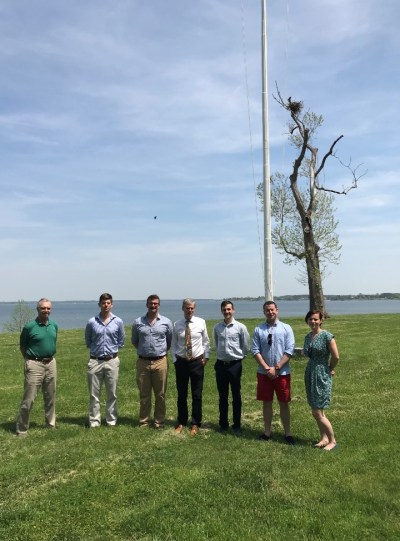
Figure 2 – Group Photo with Dr. Goodwin overlooking the Chesapeake Bay.
Dr. Goodwin has also invited me to attend some upcoming conferences with him over the summer in New Orleans and Panama – though I suspect I may have to pay for my flights to go this far afield for CPD. He also is very eager to establish a permanent relationship between UMCES and PEW, one of which I feel would be of great benefit.
Summary
Though Horn Point Laboratory didn’t prove to be the opportunity I had hoped from a purist Civil Engineering point of view, it was still an exceptionally valuable visit. From a Chartered Professional Review perspective, I have shown my willingness to engage with the ICE and gained some valuable sustainability and environmental knowledge that I would not have otherwise acquired.
I feel the opportunity for PEW students to work closely with UMCES is an excellent one, particularly for E&Ms. Not only might it yield an excellent opportunity to produce an engaging TMR or Thesis but it also ties into the wider defence engagement mission which is a component for ensuring this valuable attachment to USACE is maintained.
Useful Contacts
The ICE’s International Administrator contacted all the ICE members listed as being located in North Eastern USA and made my initial introduction to them all. I wholeheartedly advise all ICE members seconded abroad to contact Deborah.
Deborah Oyelaja
ICE International Administrator
Email: deborah.oyelaja@ice.org.uk
Tel: +44 (0) 20 7665 2130
Dr. Peter Goodwin is the president of UMCES, his Biography is located here and more information on UMCES can be found on their website – www.umces.edu. I feel Dr. Goodwin is a valuable contact and recommend trying to establish a permanent relationship with his organisation.
Dr. Peter Goodwin CEng
President of UMCES
Email: pgoodwin@umces.edu
Tel: +1-410-221-2000
Abbreviations
UMCES University of Maryland Centre of Environmental Science
IMET Institute of Marine and Environmental Technology
DoT Department of Transport
NYC New York City
USACE United States Army Corps of Engineers
 Holdfast Training Services Trial Blog