Archive
Walter Reed Army Institute of Research (WRAIR)
Hello all. Just a quick update on my mechanical adventures in America. My sites at the United States Army Medical Research Institute of Infectious Diseases (USAMRIID) are drawing to a close so I was asked to head down to military Medical Research camp known as Forest Glen to fill in a gap created by their resident Mechanical Engineer retiring. Forest Glen is home to the Walter Reed Army Institute of Research (WRAIR) and is located just north of Washington D.C. The distance from home is actually smaller but with D.C. traffic (rumor has it that it is intentionally bad so as to act as a deterrence to invading forces!?!) my commute time has increased.
WRAIR is the largest biomedical research facility administered by the U.S. Department of Defense (DoD). The task at WRAIR is to repair ten air handling units (AHU), three of which are located in the basement with the other seven located on the roof in three separate “penthouses”(see image 1). These AHUs supply a variety of rooms within WRAIR including everything from animal laboratories, patient observation areas that monitor brain injury, and sleep management, photo development rooms as well as offices.
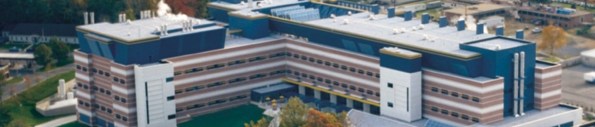
Image 1: Three Penthouses located on roof
Due to the fact that constant clean air supply is key to the operation of these rooms disruption to the AHUs has to be kept to a minimum. “Repair” is a bit of a misnomer as it is more of a full renovation of the inside of the AHUs while keeping the outside shell. For this to work correctly temporary AHUs (see image 2) are located beside each AHU prior to the beginning or work. The temporary units are then connected to the system as close to the existing AHU as possible.
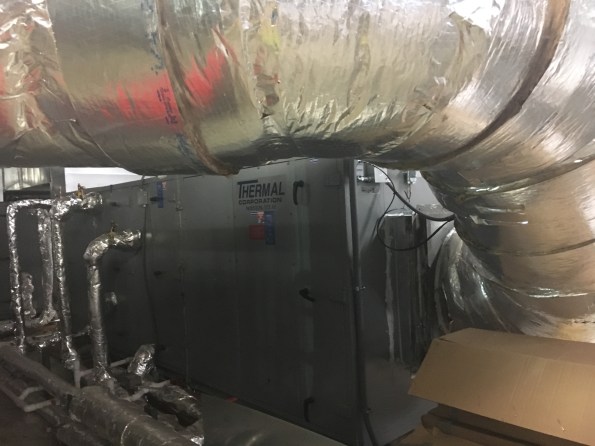
Image 2: Temporary AHU
The existing AHU is powered down at the last possible moment with the temporary AHU immediately kicking in so as to avoid disruption to the labs downstairs. To further avoid disruption this always takes place at around 0500 when no humans are in the building and the ambient temperature is naturally low.
The repair of the existing AHUs consists of effectively gutting the interior (see image 3), installing a divide in the middle so as to allow maintenance of the AHU in future without the requirement for temporary units and then replacing the filters, the copper cooling elements (see image 4), humidifier, fans and mixing chamber.
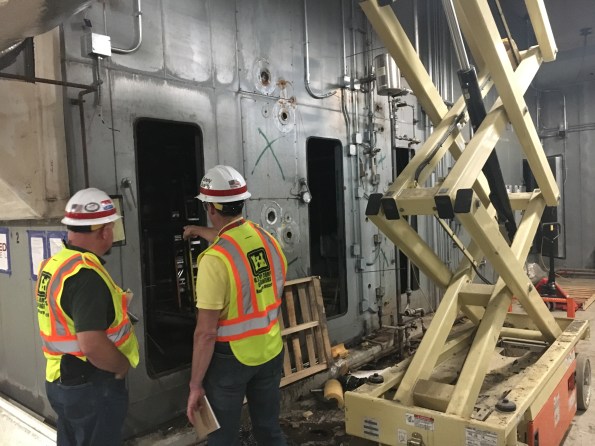
Image 3: Gutted AHU
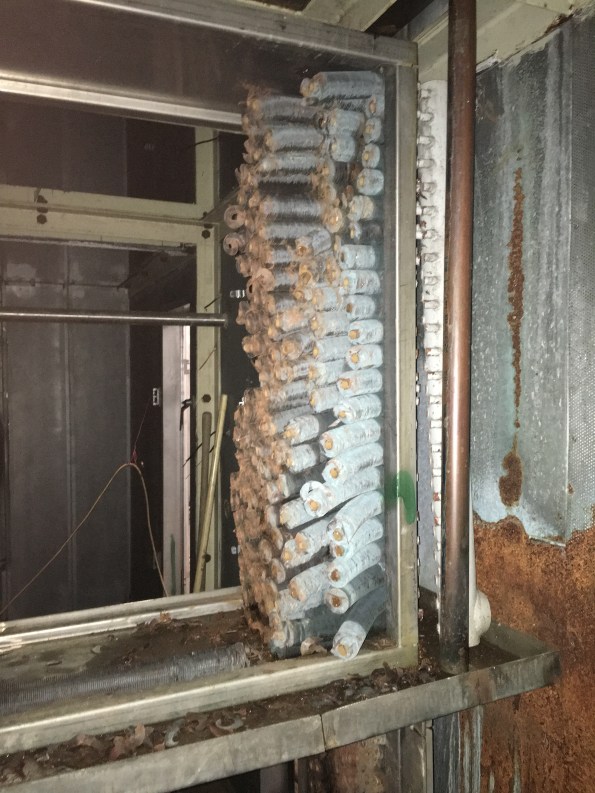
Image 4: Removed cooling coils
Currently we are on the 3rd AHU of 10 with roughly 2 months allocated to each unit. The project is currently ahead of schedule but due to the limited times the AHUs can be shut off or tested once completed any delay could easily devour the existing lead.
Coming to America
I have just arrived on site so this initial blog will be light on details and my actual role within tasks has yet to be finalised but I thought I would post something so as to get into the habit and as a method of recording information and actions that I can refer to when needed at a later date.
My first 7 months will be spent at Fort Detrick with the United States Army Corps of Engineers (USACE). Historically, Fort Detrick was the center of the US biological weapons program from 1943 to 1969. Since the discontinuation of that program, it has hosted most elements of the United States biological defense program. Originally the site was intended as a location to centralise all research into infectious diseases. Technically this did happen but as with the UK, people didn’t like sharing their train sets and there are now four completely separate facilities dealing with infectious diseases, each belonging to a different agency, one belonging to the Army, one to Navy, one to Homeland security and one to the National Institute of Health (NIH) in Fort Detrick.
I will be working on the new United States Army Medical Research Institute of Infectious diseases (USAMRIID) site. This is due to replace the original USAMRIID building which was built in the 1950s. The site includes Entry Control Point (ECP) 9 (Yes this means there are at least 8 other entry control points on campus) and the USAMRIID itself. ECP 9 has entered its testing and commissioning phase which I am involved with while the USAMRIID has entered the “red zone” meaning it is 80% complete.
ECP 9 is 4000 square feet building that will act as the primary entrance for all foot traffic into USAMRIID. The building is completely independent and uses Solar power for domestic water, a boiler for heating, two transformers (one for the building itself and one for the nearby parking area lighting despite the fact that there are already two other external transformers supplying said parking area), a back up generator and cooling tower. My hosts were quick to confirm my initial impression that this was the most over engineered guard room in an already secure base.
While receiving my orientation I witness a member of the Department of Public Works (DPW) call a stop to the testing of the air-conditioning as the individual doing the testing was “unable to demonstrate with enthusiasm” that the system was functional. The USACE have a standard “script” that must be followed during the testing and commissioning of a building. Failure to follow results in a big fat no. Does a similar “standardised script” existing in the Royal Engineers? Perhaps construction in Kenya would have been of a higher standard if there was a script for OCs, who themselves would not be subject matter experts, to follow when testing and commissioning or doing a handover/takeover.
Also as part of the testing and commissioning, videos for the use and maintenance of all equipment in the plant room is produced by either the contractor who installed it or a representative from the manufacture. This removes any possibility of those in charge of maintenance once a warranty ends claiming they haven’t received proper training. Once again this would have been beneficial in Kenya although closer to home I can’t help but think that the coffee maker in the Officers Mess would have benefited from something similar.
Oh and Regans complaints on fuel consumption are pretty ridiculous considering I bought this…

 Holdfast Training Services Trial Blog