Archive
Are your briefings understood?
We had an incident on site last week where a 9 tonne dumper rolled over. The driver was OK, he escaped with a broken wrist and collar bone. The initial, unofficial, assessment is that this was a simple case of driver error as it appears that he reversed off of the haul road. However, as often seems to be the case in situations like this, there is always more than meets the eye. It turns out that the supervisor has only just joined the job and was authorised as a ‘competent person’ by the project director just 6 days before the incident. The usual foreman was off on holiday and was not providing the same amount of supervision as is normally applied in the area. (I should stress that this is routine business; if a foreman or supervisor is away on holiday, their workload is often shared between others of the same grade.) Finally, had the dumper driver understood the daily briefing?
Our labour (ground workers, excavator operators, multi-skilled operators etc) tend not to have English as their first language. Of the 19 gangs we have on site, only 3 have a supervisor where English is their first language. Adding to this complexity is the fact that the gangs are not made up of people who speak a common language, the language used on site to communicate is English. But how much does the Romanian ground worker understand the brief given by his Indian supervisor? What about the Pakistani dumper driver receiving instructions over the radio from his Albanian supervisor? Not only are we communicating in a language foreign to everyone, the language that is being used to communicate between them is being delivered by someone else who does not always have a good grasp of English.
This begs 2 questions; firstly, where is the British workforce? A ground worker earns £22/hour and many of them work 11 hours a day for 6 days a week. You do the maths, but this is a lucrative job for an unskilled labourer. The foreman are mainly from a British background, but that won’t be true for much longer if there is no one coming through.
Secondly, and more importantly, should we be adjusting our method of communication to ensure that everyone understands daily briefings? Should we be asking our supervisors to use a translating software so that the brief is input accurately by whoever is giving it and clearly understood by the one receiving it? Surely our responsibility is to ensure that everyone works safely and if we have to make allowances by changing our communication style, then we should be doing it!
Does anyone else have similar challenges? Has anyone already overcome this problem and is already doing briefings using a translating software?
Surrey based CPD – a tour of the M25/A3 Junction 10, Heathrow Airport and Data Warehouses
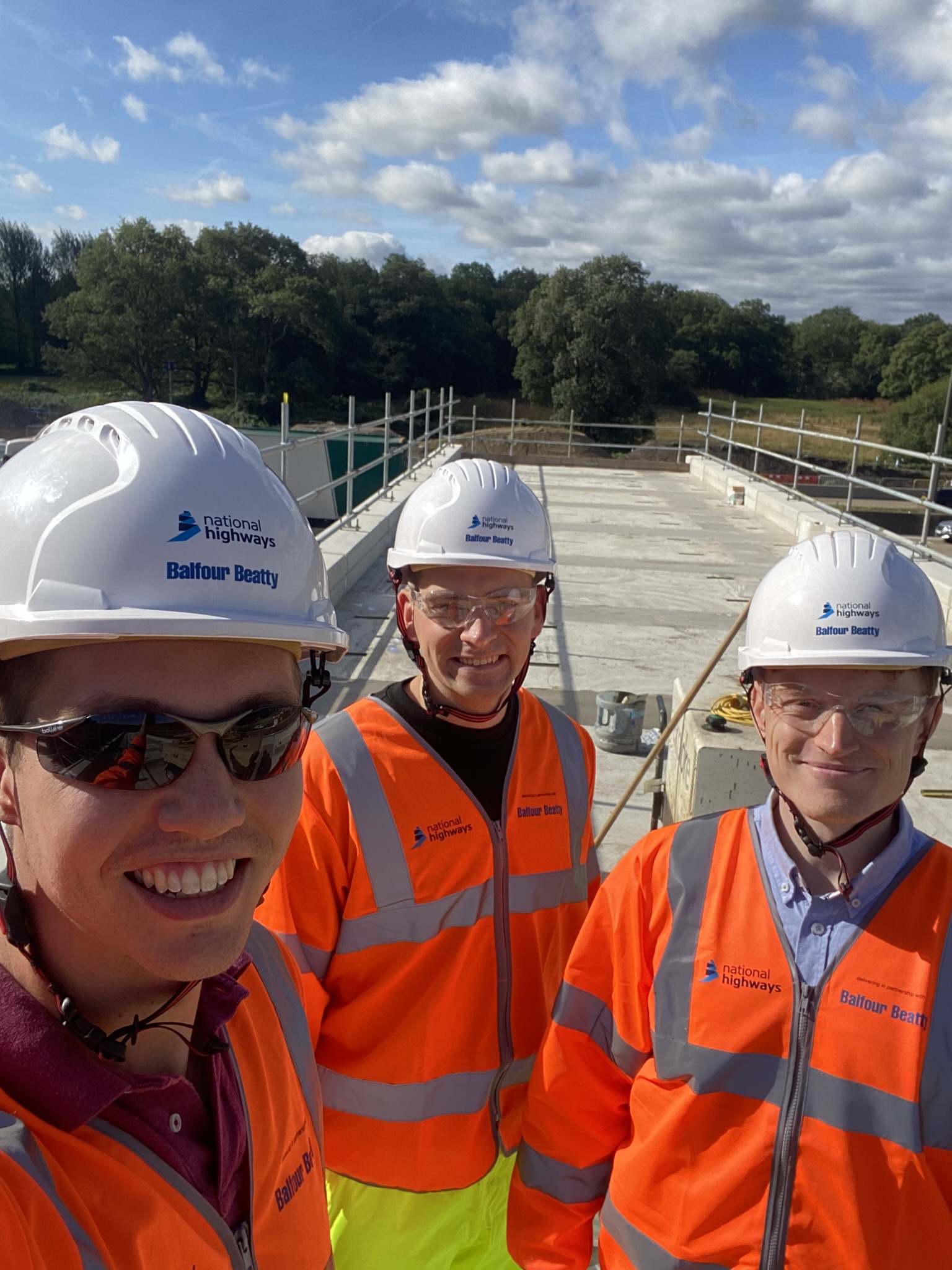
On Thursday 15th August, Capt Rich Swarbrick, Capt Joe Nield and I (Capt Joe Solway) managed to finally co-ordinate ourselves and spent the day taking turns to host each other on our respective sites. We started our journey in the M25/A3 Junction 10 traffic, before Rich gave us a flying tour airside of Heathrow and Joe took the after lunch shift in the data warehouses.
We started the day at Nutberry compound, the base location for the M25/A3 Junction 10 upgrade project where I showed Joe and Rich a 5 minute video put together by National Highways outlining the scheme. If you want to give the video a watch yourself, you can find it here: https://nationalhighways.co.uk/our-roads/south-east/m25-junction-10/#panel-id-41261b7e-591a-4f9d-bbd6-5ae9a9043c9f.
After the video we headed out to site to see a bridge that is being constructed alongside the M25 in a place called Buxton woods. The bridge is a composite bridge with 2 steel beams approximately 3m deep with a concrete deck. They deck had just finished being poured and we were able to climb up onto it to have a look further. I was responsible for constructing the working platform which was quite problematic (future blog post will provide further details) and also for constructing all of the platforms that will be used to move the bridge into place.
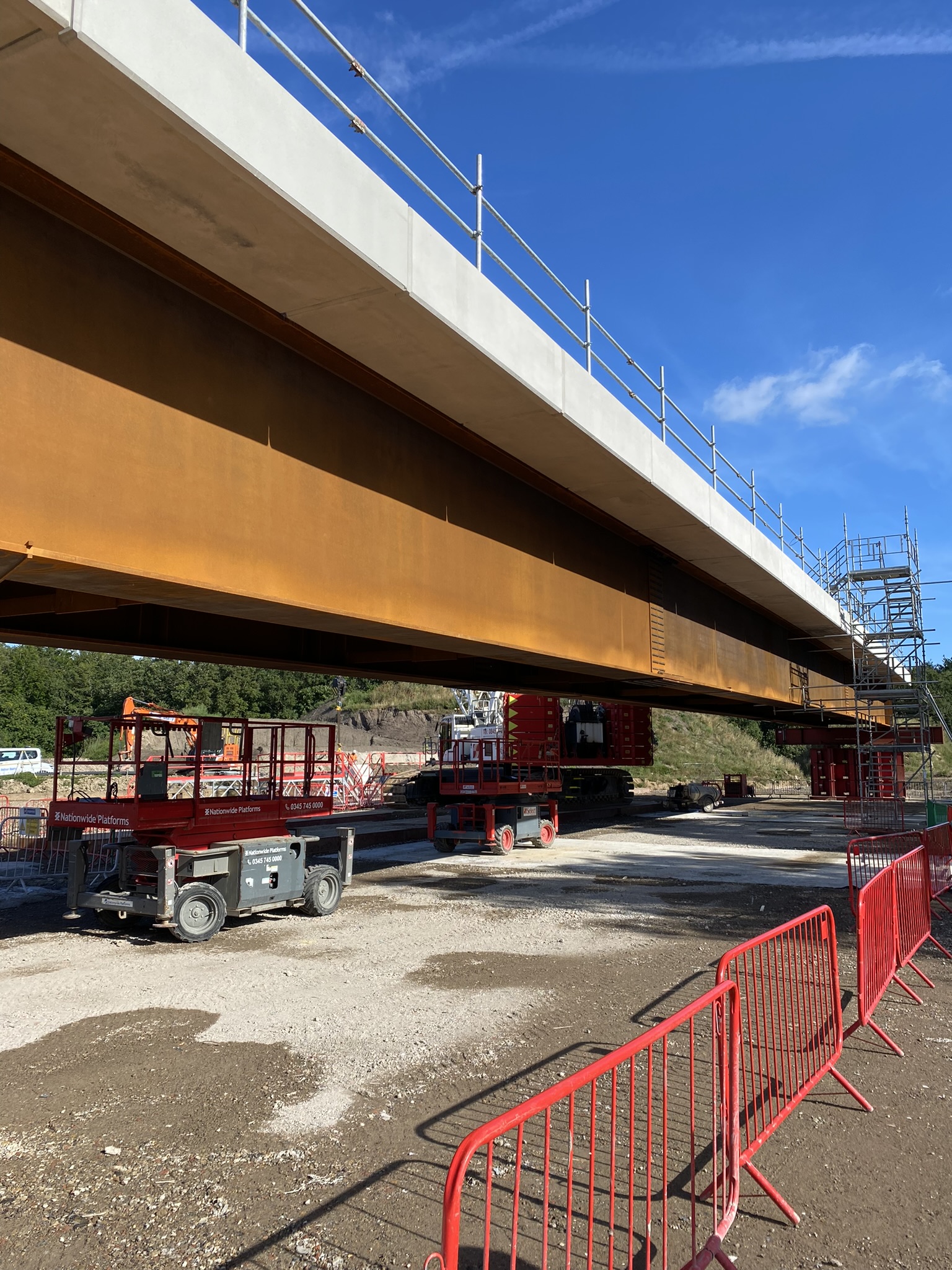
The bridge is being moved into location via a self-propelled modular transporter (SPMT) on a full road closure (currently booked for October for those in the local area!) where it will be driven out across the M25 and moved into position at Clearmount, about 100m away. Frustratingly, one of the platforms that was constructed for this has been dug up by the drainage sub-contractor, with new drainage laid right underneath where the bridge will be travelling. This is going to pose some challenges in the future, but hopefully nothing that will slow the project down even further! We discussed the challenges associated with sub-contractors and their own programmes and how sometimes construction appears to take place out of sequence and causes more problems than it solves!
At Heathrow Airport, we visited the various airside projects which Rich is involved in and discussed the unique challenges and risks associated with them.
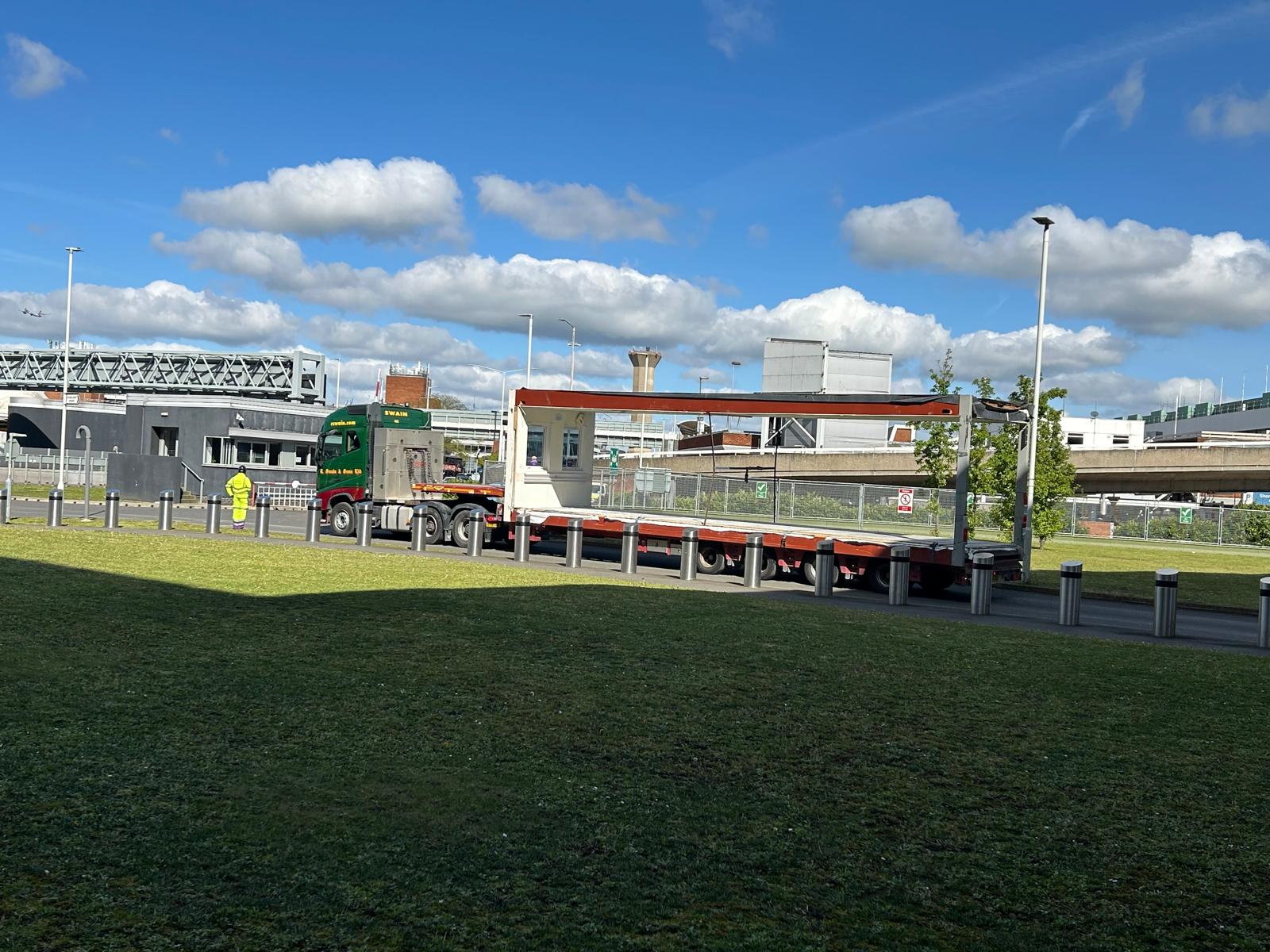
At Starlight Point, the topic of his TMR 1, the final crane lift had been successfully carried out earlier in the week. We discussed the logistical burden surrounding the dismantling and transport of large modular units through a congested Central Terminal Area, and how the risk of Foreign Object Debris has been mitigated.
We then discussed the challenges surrounding Reinforced Autoclaved Aerated Concrete (RAAC) at the airport, including how it is being managed, the research which is ongoing to better understand it’s properties as it reaches the end of design life, and how the risk is being managed with support from specialists within the engineering industry.
Next we looked at the moth-balled Terminal 1, due for full demolition over the next decade. Within the building are a multitude of services such as HV cables, security and data feeds which are still active and must be fully identified, and subsequently diverted or protected during any works.
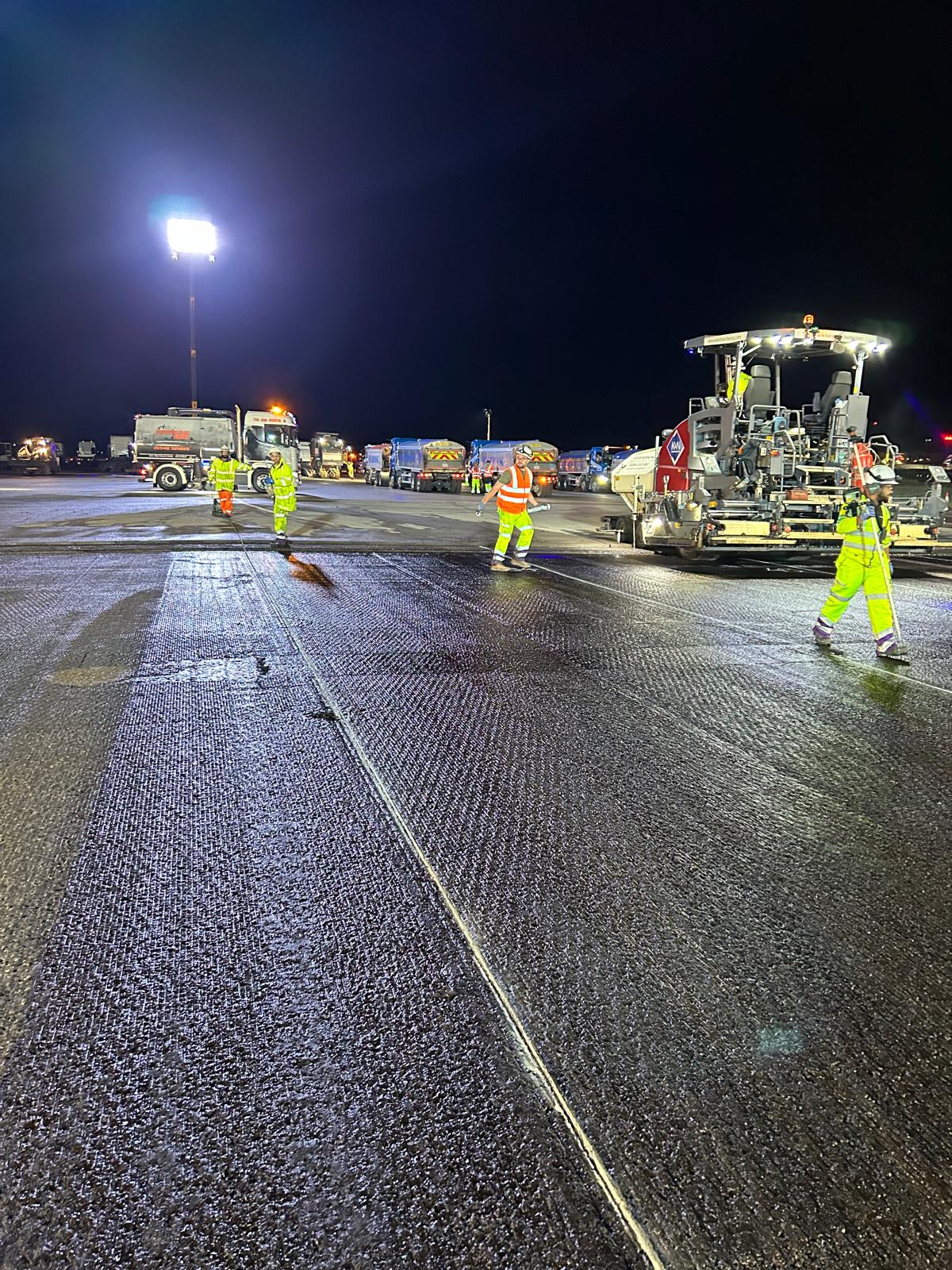
Finally, we visited the asphalt batching plants being used for the Southern Runway Rehabilitation project. We discussed the works which are being carried out overnight to plane and re-lay the top two layers of the runway, all within a short overnight working window, at massive risk to the airfield operation.
At the Yondr data centre campus, we visited a 3-storey 30MW building. That building alone utilises 26x 2400kW generators, 26x 904kW electrical plant rooms and 24x 1697kW chillers. The ongoing works included installation of chiller noise attenuation, low voltage cable pulling, cladding install and the relocation of site accommodation.
We discussed an ongoing challenge to route new underground services through a congested zone to supply the newest data centre, involving two different Principal Designers and Principal Contractors. A scope gap in the contracts meant there was a 30 metre (approx.) stretch that was undesigned by either team. This has been an important interface between civils and M&E specialists, trying to adhere to underground service code/regulations whilst carrying out considerable ground works.
We then looked at the considerable redundancy across a data centre, from diverse power streams (utility and generators) to chiller resilience (4n3 system, where 4 chillers cover each 3-chiller duty). This was most evident in the ‘technical corridor’ where many of the building services diverge. We ended with an introduction to hot-aisle containment, a common environmental control strategy within data centres. Fan wall units interact with the chilled water system to draw heat from the server racks, maintaining server integrity.
M25 Junction 10/ A3 Wisley Interchange Upgrade Project
I have recently started phase 2 of the PET course working as part of the earthworks team in Balfour Beatty who are delivering the M25 J10/A3 Wisley interchange upgrade. The project includes the widening of the A3, free flowing left hand turns at every corner, the widening of the existing interchange roundabout, an 8 mile long non-motorised user road and 8 new bridges. There is also an increase in the road furniture and a number of re-wilding projects to offset the impact of the removal of green space along the M25 and A3. A brief overview of the project is below.
Client: National Highways (formerly Highways England)
Contractor: JV between Balfour Beatty and Atkins
Budget: £317 million
Project Start: Summer 2022
Estimated Finish: Summer 2025
Website: M25 junction 10 – National Highways
The earthworks team is responsible for cut/fill, sub-base and temporary working platforms across the whole project. The cut/fill is occurring around sheet piling operations to remove excess material, after existing bridges have been demolished and back filling behind new bridge abutments. The temporary working platforms are used primarily for sheet piling operations, CFA installation and self-propelled modular transport (SPMT) bridge construction. The construction of the platforms to enable these operations is my primary focus at the moment. Some of the temporary working platforms will be used for enabling horizontal drilling operations for services, something that will become a blog post in the near future. Below is a selection of photos of my time on site so far:
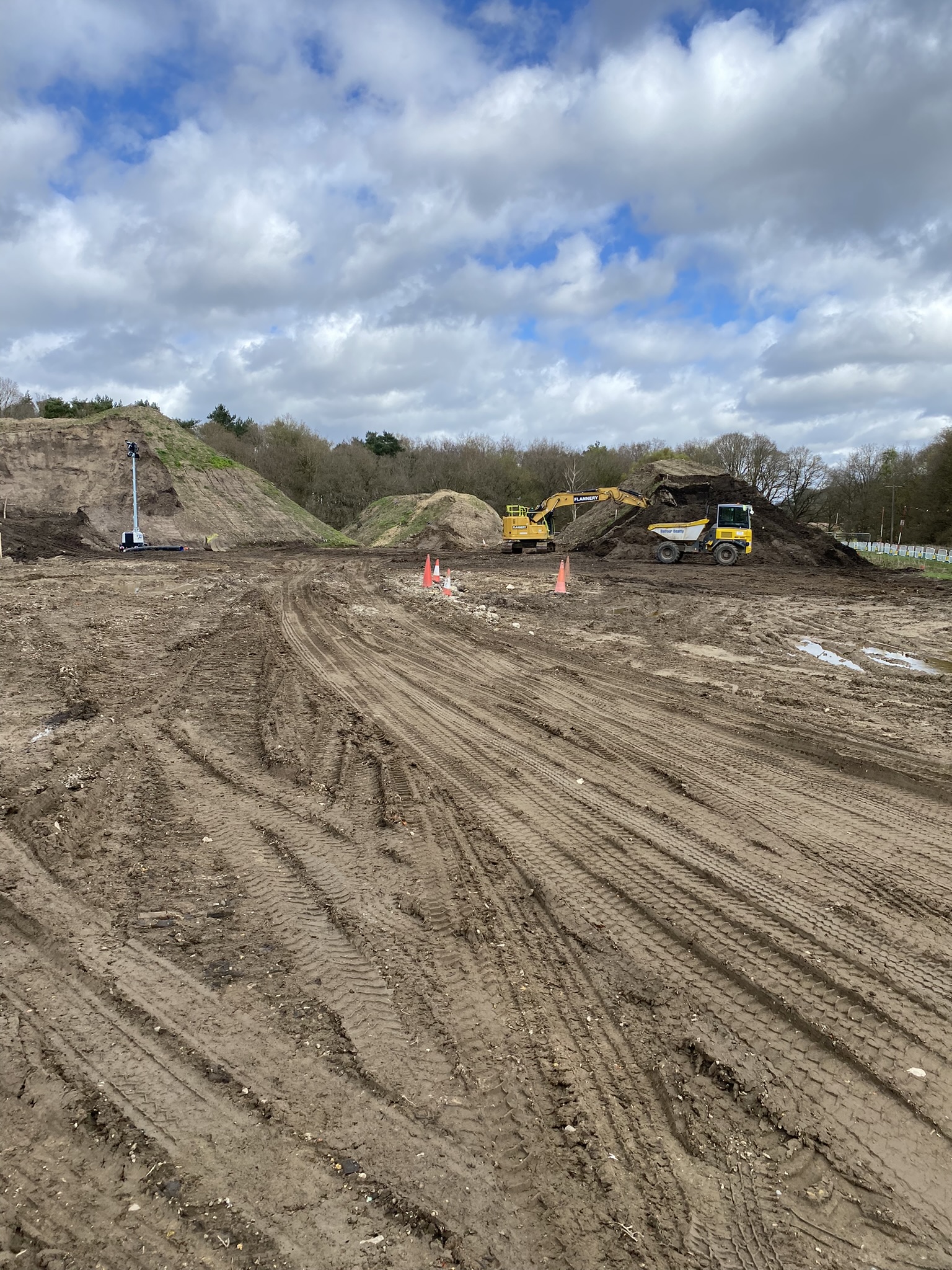

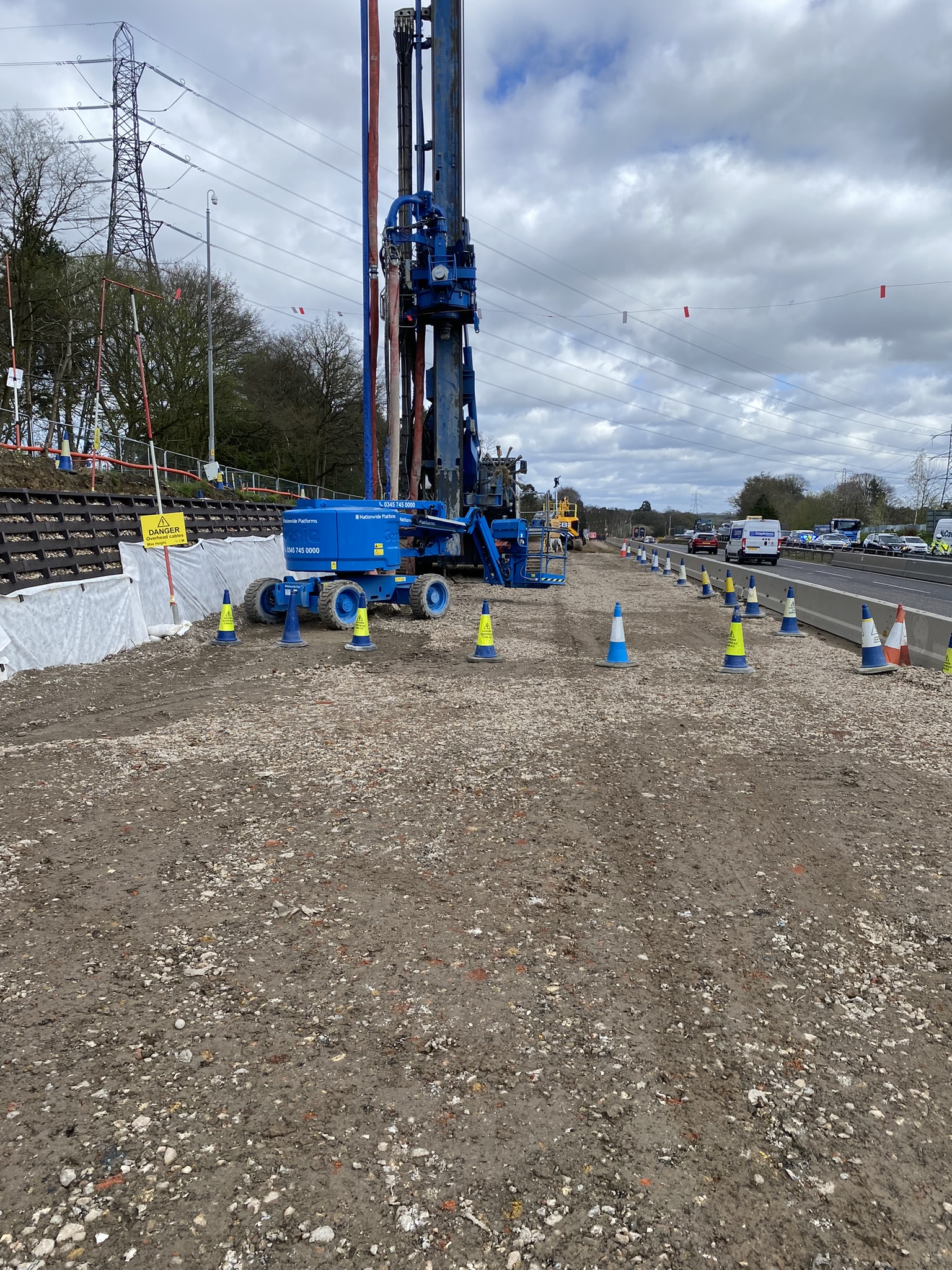
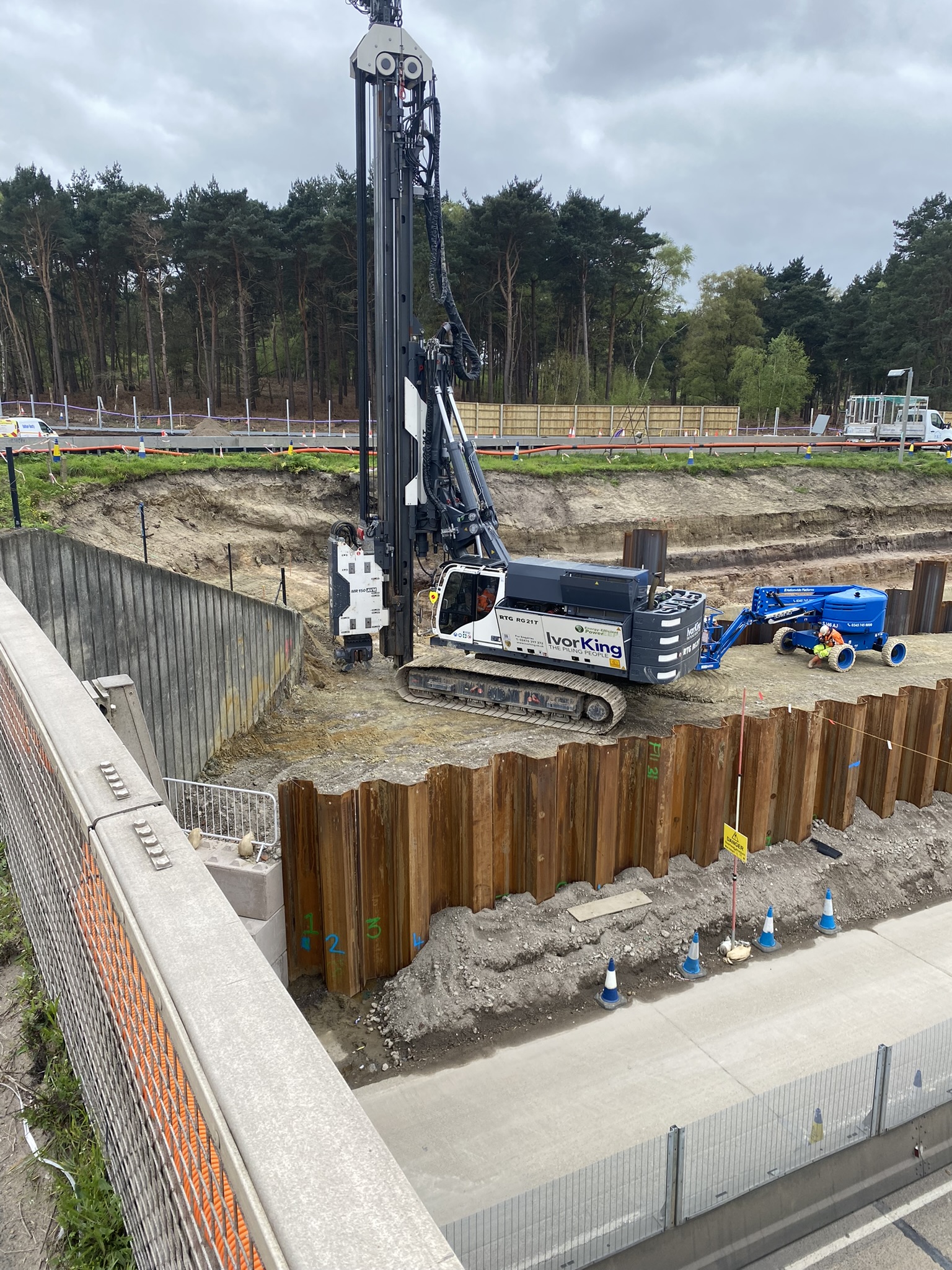
Note: all the photos are from different areas of site but demonstrate the amount and variety of temporary working platforms that are being installed. The sheet piling operations are all temporary works and are being conducted just to install some piled foundations for a bridge abutment. All of that work will be taken out once they have been installed.
A number of challenges have already become apparent on site. As often seems to be the case, there is a disconnect between the designers (who are not geographically co-located with the site team) and the reality on the ground. Some temporary working platforms have co-ordinates that place them in the middle of live traffic which is clearly not a workable solution. Others have half of the platform at the road level and the other half 5 or 6m higher with no scope to batter or step the slope due to site boundaries. When this occurs, a significant amount of time is then spent trying to establish what the designer is trying to achieve and how the platform is going to be used. This involves engagement with designers and sub-contractors so that we can construct something fit for purpose and in the right location.
I’m looking forward to getting more involved in the project; there is a lot going on and I hope to get involved with as much as I can. If you have any questions or would like to know more, please don’t hesitate to get in touch.
 Holdfast Training Services Trial Blog