Archive
100 Years Since the Start of WWI….
Something non-engineering for a change. Yesterday I attended an event in Baltimore to commemorate the centenary of US entry into WWI. I was half expecting something stereotypically American about WWI beginning in 1917, and how the US effectively won the war by bailing out Britain and France who hadn’t been able to finish it off for themselves! I was pleasantly surprised to find the version of events portrayed (generally) accurate, and there was even a high-ranking speaker from the French Embassy in Washington striking notes of liberté, égalité and fraternité. The only awkward moment came when the colours were marched in and I had no idea what etiquette dictated I should do! In the event I saluted when they were marched in, but not during the national anthem (which caught me by surprise when it was struck up), but then saluted again during the bugler! I think I got away with it! I was also only asked once by a very elderly veteran if I’d come dressed as a WWI solider! The eagle-eyed amongst you will notice that I’m wearing leathers, hat (and medal, yes it’s TOSCA but it still counts!) indoors. Just to confirm; in true American tradition this was an outdoor event held indoors, complete with complimentary burgers and hotdogs! I did however remove my gloves!
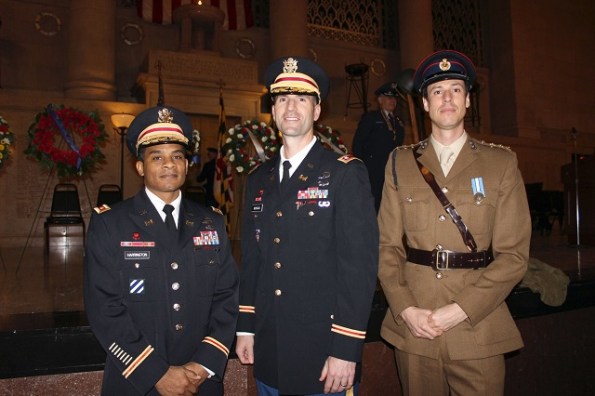
Maj Harrington, Lt Col Morgan (Deputy Comd) and myself at the WWI commemoration
Attending this event reminded me of the other military events I’ve been fortunate enough to be part of during my time here. This includes a battlefield study and trip to Westpoint, a leadership staff-ride at Gettysburg, and a trip to attend a USACE conference in Alabama of all places (where I stayed on a university campus with no bar!). The US exchange first and foremost offers engineering experience (obviously). However, there’s another side to it which shouldn’t be underrated. I’ve found it absolutely fascinating to be part of USACE, to operate with them, and to see how they go about their business. From a military organisational point of view things are certainly different over here, and a year ago when I arrived I found it almost impossible to compare USACE with the Royal Engineers; they’re simply poles apart in terms of structure, capability and function. There are of course some things they do badly. For example (in my opinion) separation of combat and trade engineer skills, which reduces flexibility and increases reliance on non-organic support and sub-contracted work. There are however a number of lessons we might consider paying attention to, for example they are very good at fully integrating their reserves and have an extensive reach-back capability. Overall from a developmental point of view I’ve found the social and cultural emersion to be just as interesting and useful as my day to day work.
Finally, one last photo from the Baltimore District military ball! If there’s one thing we’re undeniably better at it’s uniforms!

Military personnel at the Baltimore District Ball
Thesis: Information Overload!!
I’m sure all but the most organised of you have experienced something similar, even if you’ve subsequently solved the riddles and moved on!? I was hoping to get some advice that might help me make better use of my time over the coming two months.
Having extended my TMR4 deadline, then had the audacity to take a weeks leave at the end of February, I’m now beginning to feel the thesis crocodile circling closer and closer to the canoe. I’m extremely conscious of upcoming deadlines, but having gone out and collected as much data as I can, I now think that I’ve got too much and I’m struggling to refine it into useful material of the right academic level.
My thesis is on the structure of the Royal Engineers, and how we might consider re-structuring ourselves in order to better deliver effect on Operations. My basic premise is that the current historic structure (Platoons, Companies, Battalions, Regiments etc.) was/is fine for fighting wars, but pretty useless for undertaking construction tasks, not only does it seem to be an ineffective way of managing skilled tradesmen, but it also appears to leave managerial skill gaps within the command structure.
My main issue is that having obtained no less than 20 PXR/POR/PERs from the TICRE (luckily there was plenty of stuff they didn’t have or I’d have ended up with even more), together with the latest Project ANEMOI Lessons Learned document, I’m currently sitting on hundreds, probably thousands of pages of text (of varying quality and command level) that I’m attempting to evaluate in order to find reoccurring themes and patterns. I was keen to avoid any kind of selection bias by simply choosing the reports I liked the best, but in doing so I’m finding it almost impossible to pick out the most useful (and relevant) lessons learned. I could write a whole literature review on just three or four of the reports on their own, so having complied a spreadsheet of lessons learned from all 20, I’m struggling to condense them into useful (academically sound) results. So far, all I seem to have done is hand select obvious anecdotes with little further analysis. It’s like finding passages in the Bible or Koran; search long or hard enough and you’ll find something that backs up your opinion. The rest can just be discarded, even if there are a similar number of anecdotes contradicting the first. It feels like I’ve almost gone the other way and that having too much information is creating its own bias by allowing me to pick and choose what I want rather than what is actually relevant or meaningful.
Did anyone else have similar issues with regards to information overload, and if so what strategies did you employ in order to focus your efforts and obtain useful, valuable data from the sea of literature available?
PS: Please no “I’ve almost finished my thesis you should have started earlier” comments!
Permissible Stress or Limit State Design?
Hopefully this blog won’t be as boring as the title suggests?….
Even though it was a very long time ago….. I remember being at university and learning about permissible stress design (it obviously wasn’t a Thursday morning). At the end of the lecture a wise old professor informed us all that we’d never actually design anything this way, that it was pretty much obsolete because everything was moving well and truly towards the future…. and the limit state approach. Indeed, when I worked in industry prior to joining the military I found this prediction to be true, and the idea was reinforced during Phase 1!
Imagine my surprise when I arrived in the US and found that, rather than being a bastion of enterprise and advancement, the US actually embraces and encourages the two design philosophies to be used in parallel! Over here they are known as ‘Allowable Stress Design’ (permissible stress), and ‘Load Resistance Factor Design’ (limit state). When I say ‘encourages’, this isn’t quite fair. What I mean is that the American Institute for Steel Construction (AISC) publishes both methods side by side in its design manuals, allowing designers to pick which method they prefer. Interestingly, concrete did make the jump years ago, and no longer practices ASD.
So I’m currently designing a glorified giant dog kennel and training facility for some fierce secret service working dogs. I’m working to ASD for the steel and masonry, which is nice because it makes things simpler and I don’t have to worry about any complicated plastic analysis or behavior etc…. it’s also handy because all of the joists come from the manufacturer designed and specified using ASD. Nice and simple. Until it comes to designing the footings, which of course being concrete mean that I had to alter my loads using a crude conversion factor of 1.4 to ‘upgrade’ them from ASD service loads to LRFD design loads! But even then the fun isn’t over; the soil bearing capacity (4000psf John, very stiff!) isn’t factored, so I need to multiply this by an additional ‘resistance factor’ so I can work in LRFD, making sure I don’t accidentally divide by the ASD global ‘safety factor’ instead, because that would be a disaster! Who needs a sinking building and (expensive) squashed mutts!?

My Design: Permissible Stress or Limit State? Why choose, have both!
Apparently things are improving! Until recently live load and dead load factor of safeties for steel and concrete construction using LRFD where different! 1.6 & 1.2 for steel and 1.7 & 1.4 for concrete; imagine having to swap between the two sets whilst working with the same philosophy on the same design! You all thought Euro-codes were frustrating, you’ve got it easy! Also, (and back to the point) the AISC are apparently considering removing ASD from their manuals which will be a step in the right direction! However I’m not holding my breath; it takes a long time to buy a stamp over here, imagine how long it might take to alter something as ingrained and controversial as this.
This all seems like madness and an accident waiting to happen… and it nearly it! During my time on the JOC project over at East Campus it was discovered that a series of giant steel trusses had been sub-contracted out to a ‘specialist’ by the designer. When they were finally delivered to site it was discovered that they, together with all the connections had been designed using ASD rather than LRFD loads. On checking the truss turned out to be fine (phew, almost a very expensive error for someone), but all the connections were under-designed by approximately 40%! These trusses were very nearly installed, and it was only scrutiny of the drawings at the beginning of the week of installation that prevented fundamentally unsafe construction! Whilst it is considered bad practice to mix design philosophies, in my experience it seems to happen an awful lot. Particularly on simpler, small projects that need to be turned out quickly, and by older-generation engineers who grew up with ASD and see no reason to change.
I was wondering if anyone else had had any experience of permissible stress design during their attachments? Surely if there’s a slow backwards nation that can stand with America on this one it’s Australia?! Or is it really only America that lacks the will to embrace change?
USACE Funding Model
Introduction
Well, it’s been a little while but I though now was as good a time as any to jump back into the blog-o-sphere. Like everyone else I’m in a design office, the work isn’t too bad despite having to do all my calculations in strange units of measurement such as inch-kips and force-lbs; which means that I don’t really have any idea what answers I’m expecting to get. No change there then!
I’m still working for USACE, but the commercial environment is like something halfway between a commercial company and a non-profit government organization [sic]. I’ll do my best to outline some of the budgeting and funding principles below:
The Military Design Branch (where I’m now based) is an arm of USACE that essentially carries out design work on behalf of the Baltimore District. Despite being a Corps of the US Army, USACE are not entirely publicly funded, and are required to cover their own overheads (including wages) by charging a fee for their services on any projects undertaken. Legislation prevents the military from making a profit; however this arrangement means that the organisation is run somewhat like a business, with Districts required to break-even within a 1% margin. Performance (profit) is reported up the chain, with Divisional Commanders having the authority to support under-performing areas. Commanders are therefore required to effectively manage income and expenditure whilst aiming to hit the 1% profit target, after which any profit achieved (over 1%) are returned to the US Treasury.
MILCON Program.
The MILCON program is funded directly by the Senate, with budgets set on an annual basis according to performance, budget, program progress and projected work. All USACE costs associated with the planning, management and design of projects is taken directly from this source. There is therefore only a finite amount of work that districts can pursue, and it is usually delegated to divisional chiefs to determine which work/projects they wish to undertake according to the resources available to them. However, the final decision remains with the District Commander. Any remaining MILCON program work will then be sub-contracted out to commercial Consulting Engineers (I did an outline design for a one-storey VCP before being told it had been put out to tender!). The direct result of this arrangement is that clients operating within the MILCON framework have no direct say in who conducts the planning, design and management of their own projects, which is often determined by the capacity of the local USACE district office.
Construction Funding
The Senate annually funds the MILCON program, however these finances exclude the costs associated with new construction projects or renovations, instead clients apply directly to the Senate for these projects. A formal bid process is initiated approximately two years prior to the anticipated project start date, whereby project scope and justifications are submitted and the bid is accessed against pre-determined government metrics. If approved, funds are released directly to the client, and used to cover construction costs (e.g. the JOC project). As previously, this means that the client generally has a choice as to which organisation will ultimately administer their own construction contract, however USACE are generally ‘chosen’ because of their reputation and specialist knowledge. In order for USACE to then meet the overhead and wage liabilities of the project delivery team a ‘supervision and administration’ fee is then charged back to the client. These fees are generally charged at a standard rate of 5.7%. As a hedge against poor performance by the contractor or unforeseen events/variations USACE will also typically also apply a 5% contingency value to the overall construction cost, as per the diagram below.

Contract Relationships
A fixed price contract model is employed on all Government projects, and the client is legally obliged to compensate USACE for all work conducted. However, at the outset of any project a one-off contract is negotiated which includes rates and fees for all design costs, management, profit and overheads. Contract ‘variations’ however are always subject to inter-party negotiation, which due to their uniqueness and un-foreseeability are not agreed prior to the commencement of work. Disputes or claims that arise from variations can and are still subject to legal proceedings and/or arbitration. However, the Government’s policy of ‘fair and reasonable’ treatment generally ensures that most of the Principal Contractor’s disputes are settled prior to reaching court. This policy can benefit both parties, however first-hand experience has demonstrated a willingness for the Government to concede positions to the Principal Contractor that they could reasonably have argued and won. My observations were that the Contractor usually came off better because they threw the toys the furthest!
SITE FATALITY: INVESTIGATION PROCESS
Moving on to the investigation side of things. As in the UK, the situation is slightly complicated by the fact that the incident took place on military/federal/government property. There will be no less than 4 separate investigations, and potentially 2 separate court cases. I will do my best to explain them, and what has happened so far:
CID (Criminal Investigation Division): The equivalent of our SIB, this is a military body that immediately took control of the site, closing it down and undertaking the initial ‘crime scene’ investigation, including taking photographs and evidence etc. The investigation is military and aimed at documenting the incident, as well as trying to determine if there is any criminal negligence. This report is not necessarily made available to the public, but can feed a potential criminal investigation.
OSHA (Occupational Safety & health Administration): The closest thing to our HSE. Under Federal law OSHA were contacted within 8 hours and took over the site once it was handed over to them by CID. OSHA represent the Federal Department of Labor [sic], this investigation is open to the public and transparent. This investigation will focus on what caused the accident, and who was at fault. It focuses on any violations that may have taken place, and particularly on any ‘willful violations’. It can apportion fines to those responsible, all of which are paid to the Department of Labor.
Contractor Investigation: The sub-contractor have five days to produce their own incident report, which is then passed on to USACE and feeds the USACE investigation.
USACE: An internal investigation aimed at understanding what went wrong, as well as making recommendations and generating ‘lessons learned’. The investigation establishes an ‘Executive Incident Board’ comprising 6 personnel from across the Corps (military and civilian), who are experts in their fields and are given considerable powers to investigate the incident from a military (non-criminal) perspective.
Once these investigation have been concluded, which could be as soon as six months, but likely to be much longer, there are then court proceedings to consider:
Civil Court Case: Likely to be sought by the family of the deceased in order to claim compensation from those deemed to be responsible. Any awards here would be made to the relatives of the deceased, as opposed to fines paid to the Department of Labor under the OSHA investigation.
Criminal Court Case: Potentially sought by some branch of the government against anyone likely to be criminally liable. As in the UK a higher burden of proof is required to obtain a conviction in a criminal case over a civil one. Depending on the investigation(s) the truck driver could potentially face a charge of ‘vehicular homicide’, which in Maryland can carry a custodial sentence of ten years.
Both civil and criminal trials have the ability to subpoena information from any of the plethora of investigations conducted.
SITE FATALITY: INCIDENT UPDATE
So following on from my SITE FATALITY blog on Friday. After speaking to the project Safety Manager and others the situation has become a little clearer. Without wanting to overrun the blog, I’m going to write a piece confirming the circumstances of the accident, and a second outlining the investigation process so far, and moving forwards.
Firstly, the incident: As expected, the information I received on Friday was generally correct, but wrong in a few key areas. Here is an update:
A third-party (AI) delivery of aggregate was received on site. This delivery was ordered by the concrete sub-contractor (DCB), who were therefore responsible for the delivery for the whole duration of his time on site. The truck drove around to the specified delivery site, then reversed off the road and down an incline in order to discharge the aggregate. The surface of the incline was dusty, so once the mass of the aggregate had been removed from the flatbed, the truck lost traction with the surface, which is why it got stuck and needed to be recovered. So potentially some culpability for the General Contractor (MG) who failed to provide safe site access (no matting or aggregate etc. etc.). There was no tow-bar on the front of the truck (potential culpability for AI), so a tow-strap was attached to the front axle and the vehicle recovered to the track. At which point the truck driver exited the vehicle (left-hand side), and walked around to the rear of the truck in order to secure the tailgate. Whilst this was happening two sub-contractors (DCB) moved forwards (from the right of the vehicle) to undo the tow-strap. One wedged himself under the front right tire to give himself enough leverage to work the straps, whilst the second handed him tools. There was no spotter or banksman (so potential culpability on behalf of both DCB and MG for not following site best-practice). The truck driver, unaware of this activity climbed back into the cab and without doing a vehicle walk-around or checking that he was clear drove off crushing the first man, and knocking the second over (potential culpability for both the delivery driver (AI) and also MG for not properly briefing, training or supervising him). It appears that all of this happened so quickly that the MG foreman was not aware of it until after the incident. There could quite easily have been two fatalities that day.
The investigations have started, but it is likely to take some time for conclusions to be reached. It is the opinion of the Project Safety Manager (and myself) that all three parties will be found liable to some extent; it is just a question of the proportionality of blame. Ultimately, according to the contract and site-practice over here, the delivery was the full responsibility of the sub-contractor DCB (not the General Contractor (MG)), who may be found more liable than the others. Though this is just conjecture on my part at this stage.
SITE FATALITY
Unfortunately a concrete sub-contractor was killed on the East Campus site earlier today.
I wasn’t on site at the time, and the accident didn’t occur on the JOC project. However there are four construction projects taking place concurrently across the East Campus site, all of which utilise the same access routes and co-ordinate closely. The incident took place only a few meters from the JOC building, and JOC personnel where amongst the first on the scene, and to attempt first aid. All USACE personnel are based in the same site-office, and a number of them (including Safety Managers) are double-hatted across two or more projects. The accident appears to have been entirely preventable.
In my first blog I made the following off-handed remark with regards to site traffic: “someone had a cunning plan which involves not enforcing any sort of traffic management plan and only vaguely checking who moves to and from site, which has alleviated some of the congestion”. Perhaps traffic management was a contributing factor, and maybe I should have pushed this further at the time rather than brushing it aside. The fact is someone who turned up to work today isn’t going home. Here are the salient facts as I understand them at the moment:
A dumper truck arrived on site and was directed to the appropriate area. When he arrived at the designated spot he pulled off the site access road in a forwards direction in order to discharge his aggregate. At which point he became stuck. A recovery vehicle was called for, which, after attaching a sling to the rear axle of the dumper truck pulled the truck back onto the access road. The sub-contractor in question moved forwards and crawled under the truck in order to detach the haul-sling from the rear-axle. The driver of the dumper truck, unaware of this, put the vehicle in reverse and accelerated off in order to maneuver his vehicle around so that he was facing the right direction to exit the site. Workers quickly stopped the driver, but by this time it was too late. The sub-contractor was crushed under the wheels of the truck, and despite attempts could not be revived. I haven’t been able to ascertain what if any hand signals or communications there were between the truck driver and any banksmen/site workers, or if there had been any specific (beyond the obvious) breaches of site safety protocol.
Obviously work was stopped across the site for the day and an investigation has been opened, which may provide some answers.
It seems slightly macabre to turn this into a discussion topic so soon after the event, shocking as it is. I’m sure lots will come out of the investigation, but from what I understand so far it looks like a combination of poor communication, corner-cutting and an uncertain/ever-evolving traffic management plan. This accident should not have happened!
I’ll update as the situation develops, but if anyone has any initial thoughts please let me know.
Contractor Corner Cutting Question
As most of you are probably aware, the US placement is a little different to what most of you are probably up to on site. I’m not working for a contractor per se, our role as USACE is really one of contract management, i.e. being the client’s representative on site, and making sure the contractor delivers what he’s meant to as per the (unbelievably strict) contract. This (apparently) was relatively easy during the heavy civils stage; what could possibly go wrong with concrete columns and slabs etc.? Anyway, now that the project has progressed to the close-in and fit-out stages the contractor is struggling, and has started cutting as many corners as possible whilst taking as many liberties as he can. Seemingly in an attempt to try and get the job done to the lowest possible acceptable standard (though this is doubtful at the moment).
The suspicion is that the contractor (more used to building hotels and apartments for developers rather than “weapons systems” for the government) has massively underbid on the project, and is now facing a catastrophic loss. They appear to have completely abandoned their QC plan in order to try and pull the plug and get out as quickly and painlessly (for themselves) as possible. Unfortunately the Federal government has rather large pockets (and me working for them) so it’s unlikely they’ll get far. It appears that the contractor simply wasn’t expecting the level of QA and scrutiny into every aspect of the build that USACE are now applying. Also, as a design, bid, build, project the contractor is struggling to some extent with the idea that every single change needs to be approved, rather than having the freedoms afforded by the more ‘traditional’ design and build type contracts.
I’ll break here, unfortunately, due to the sneaky-beaky nature of the site I’m working on I’m not actually allowed to take any pictures of the work I’m doing, which could be interesting with upcoming presentations and reports etc… So to keep you all interested (vaguely) and to prevent this from being just a big block of writing here are some nice architects impressions of how the fancy building I’m working on will look once it’s finish.
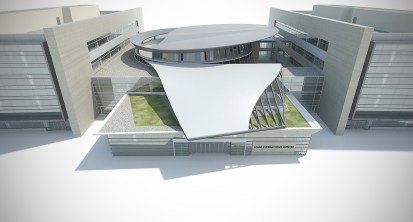
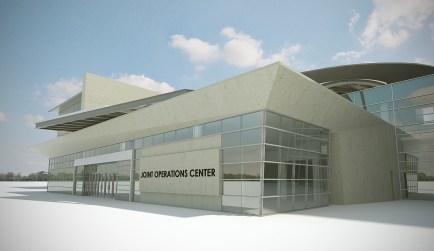
The US Government’s new toy
Back to the blog, here are some examples of the kind of corner cutting being taken by the contractor:
- Building block walls to the wrong specifications (including using weak mortar, and failing to install lintels above penetrations), then deliberately painting over and installing services on top of deficiencies to try and cover up the issues in the hope that they won’t be noticed. Or, they might be gambling that our QA checks will take so long to uncover the issues that we wouldn’t then order defective work to be corrected because it will have too much of an adverse impact on the rest of the project?
- Using inadequate stud walling systems, being notified of the errors, then completing the wall anyway and installing doors and services etc.. Basically a continuation of the first point!
- Running out of concrete during the pour of a footing, then instead of creating a construction joint with appropriate dowel-bar and correctly positioned re-bar, just covering it up and hoping to finish the pour the following day without us noticing!
- On a slightly different note: I walked the site with one of the contractor’s representatives in order to agree on the ‘cost of work done to date’ so that payment could be made for the months work. The whole process took about three to four hours; we came to schedule/percentage agreements on site. But when the claim was subsequently submitted the figures in a number of key areas had been adjusted in their favour; which I found quite insulting. I know this isn’t quite the same as producing sub-standard work and trying to cover it up, but it does none-the less seem to be symptomatic and consistent with poor practices at the management level?
Some of the issues are quite innocuous, but others are more serious. If the contractor was allowed to get away with everything he’s tried then a truly sub-standard building would be delivered at the end.
My question (in many parts) to all of you working for contractors is this:
I wouldn’t expect anyone to be working for a company that is quite as blatant as this, and I know the situation is slightly different. But has anyone encountered similar issues on site from the perspective of the contractor? And if so what did you/the company do about it? Also, in this particular instance the (contractor’s) QC manager is in the process of losing his job, and whilst there has undoubtedly been a complete failure of their QC process, I believe he is something of a fall-guy for managerial failures elsewhere in the company. Has anyone encountered any other particular drivers of bad performance on site?
Raystown Dam & Reservoir
Raystown
I was toying with a semi-technical blog, but then realised I hadn’t actually finished my “interesting things that USACE do that the Royal Engineers don’t do” mini-series. So here goes, today I’ll be looking at the Raystown dam and reservoir.
I visited the site a couple of weeks ago. This gave me the opportunity to tour the facilities, but seeing as it’s located 175 miles from Baltimore in the middle of deepest darkest Pennsylvania it also afforded a good excuse to do some walking and go camping for a night. It was also the piece of critical national infrastructure that the cadets had to go and ‘recon’ so it made sense to do backbriefs etc on-location.
Anyway, a bit of background: Construction began in 1968, and it was by most accounts quite unpopular at the time; the perceived wisdom being that all available funds should be used to support troops in Vietnam! Construction was completed in 1972, and the accompanying recreation area was inaugurated a couple of years later in 1974. The principal purpose of the dam was flood defence, with the creation of a recreation area a close second. Power generation wasn’t even considered at this stage, however a 21MW hydroelectric plant has subsequently been added. Interestingly this is the only part of the site (including wildlife management schemes) that isn’t directly administered by USACE. Immediately following construction, the area was hit by tropical storm Agnes, which all but filled the reservoir only months after completion. Had the dam not been built the Juniata (and subsequent valleys) would have experienced the worst flooding on record.
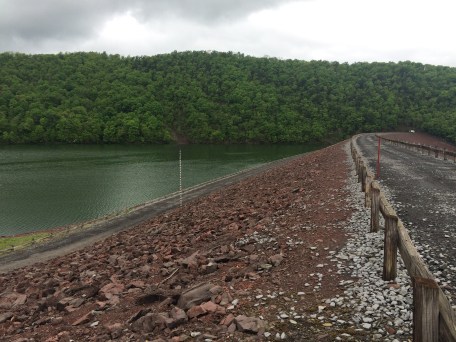
Raystown Earth Dam
Some facts and figures then: The principal dam is 69m high, with a planned ‘constant’ water depth of 58m at the deepest point by the dam. The dam itself is a classic earth (or embankment) dam with a clay core. Material for the dam was harvested nearby, in an area which now serves as the emergency spillway should the reservoir overfill and other mitigation measures fail. There is a secondary (much smaller) concrete dam which houses the main spillways and regulation gates. The hydroelectric plant has its own water feed and under normal operation all water leaving the reservoir passes through the plant. The spillway is only utilised when the volume of water in the reservoir becomes too great for the plant to handle on its own. The lake is approximately 45km long, has a 180km long shoreline, covers an area of 34km2, and has a flood capacity of around 306,000,000m3. Interestingly there is no ‘Raystown’ nearby. I asked about this, and the only answer I could get is that the project was named after a local trapper (presumably called Ray) of some fame from “the old days”!

Concrete Dam and Spillway
Some interesting engineering points came out of the facilities tour. During construction 5 massive movable steel bulkheads were created and ingeniously stored within the dam. The idea being that when required they could be hoisted out and dropped into position across the spillways allowing the main gates to be serviced. However, once lowered into position the designers failed to take into account the ergonomics of the finished dam. When it came to using them for the first time it became apparent that no crane could get close enough to lift them out because they are unable to deploy their spreaders sufficiently on the service road on the top of the dam. The bulkheads have thus sat undisturbed, entombed in the dam since 1971! Down at the bottom of the dam (below the lowest water level) there are a series of walls drains to reduce the pore-water pressures acting against the foot of the dam. There are also a series of “bubblers” which are simple air pipes used to pump air out from the bottom of the spillway entrance in order to circulate water and to try and prevent or reduce damage caused by water freezing in and around the spillway gates. There are three separate water inlets from three different depths within the reservoir. This allows the operator to take different proportions of water from different depths in order to mix them and achieve the desired temperature before releasing water downstream; an important environmental consideration.


Emergency Spillway Tower & Bubblers and Wall-drains (within the concrete dam)
The reservoir also has a ‘plughole’, or in this case a 9m x 6m tunnel which runs from the bottom of the original valley out into the river beyond the dam. It has never had to be utilised, but it is controlled from a giant tower which stands in the middle of the emergency spillway. During the tour we were able to go down and look at the giant pistons which operate the ‘plug’. Also of engineering interest is the emergency spillway. This appear to be just a giant field, however it has been engineered to have specific properties. The upper lip is bedrock which has been chiselled out of the hill in order to form a specific level below which the water will remain contained in the lake. Onto this however an earth bund has been installed which is approximately 1m high. This is made is made of ‘erodeable’ material which has been designed so that it will contain water up to a certain height, but that once breached it will be washed away emptying the lake down to the level of the bedrock lip. Simple but clever engineering.
During my visit, I had to keep reminding myself that the site was completely designed, built and managed by USACE, and that this represents one of many similar projects across the country. The reach and scope of the organisation is quite staggering, it really is a very different beast to our own military.
Other News
It looks like some of the QC contractors will be losing their jobs soon. Apparently it’s not okay to just turn up at meetings, make promises then not do anything. They have two weeks to turn it all around but it’s not looking good! More to follow. Finally, bacon covered doughnut anyone?………….

Poplar Island
Poplar Island
So, I’m actually on site now doing some engineery type things! However, for obvious reasons taking photos is proving to be a bit problematic. In order maintain some sort of presence on the blog, welcome to my new two part mini-series, which I’ve catchily decided to call “interesting things that USACE do that the Royal Engineers don’t do”! Location one: Poplar Island.
Poplar Island was/is an island in the middle of the Chesapeake Bay, approximately 18 miles south-east of Annapolis. Historically it was settled in the 1630s, and had a permanent population all the way up until around 1920. However, due to a number of reasons, mainly human mismanagement, but also natural erosion, the island shank from approximately 1000 acres in the 1840s to less than 5 acres by 1990, and was set to disappear altogether had someone clever not decided to do something about it. A vast amount of material is dredged out of the Chesapeake Bay each year in order to keep the shipping route to Baltimore open, and some other clever person decided it might be a good idea to use this material to try and stabilise and rebuild the island.
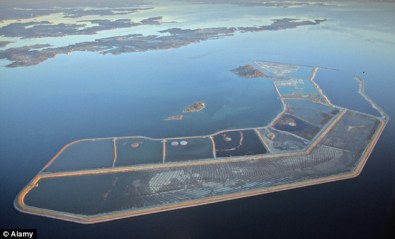
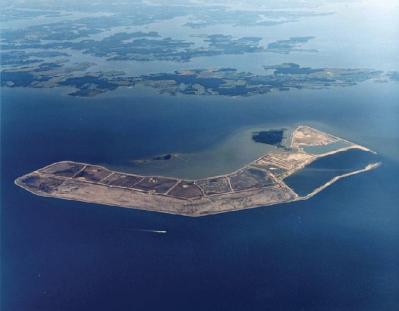
Poplar Island During Construction (bottom photo is probably 2 or 3 years old)
What has been achieved since then is one of the best examples of ‘environmental’ engineering that I’ve ever come across. Since 1998 USACE have created 1140 acres of ‘new’ wildlife reserve in the middle the Chesapeake Bay. The technique they use is to create a series of waterproof bunds that divide the ‘island’ up into manageable ‘cells’. They then pump millions of litres of sediment rich slurry into the cell they are working on, allow the slurry to dry out, then repeat the process for as many times as is necessary to build up the amount of material required for the habitat they are trying to create. The two habitats being created on Poplar Island are ‘tidal wetlands’ and ‘upland woodland’ in about a 50:50 ratio. When we visited last month a number of the tidal wetland cells had been completed, but all of the uplands cells were still ‘work in progress’ because they require the ‘finished floor level’ to be significantly higher!
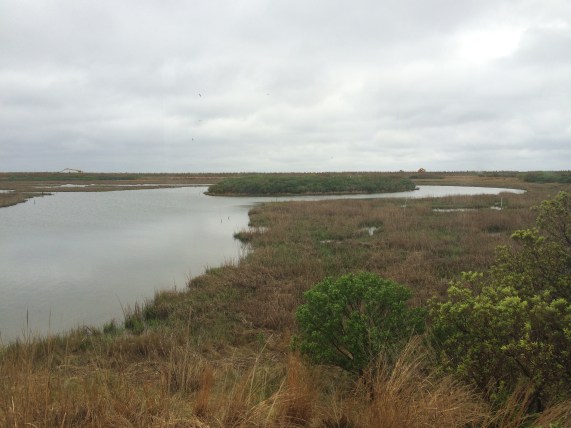
Completed ‘Tidal Wetland’ Cell
Whilst generally successful the tidal wetland cells that have been completed so far provided some challenges, mainly for the biologists creating the habitats. Initially the channels linking the ‘inland’ water and marshes to the bay were too small and discouraged the large predator fish species from entering which led to an unbalanced ecology. Subsequent cells have been designed with larger openings and have been more successful.
So far the island is frequented by around 175 different species of birds, including ospreys, and terns. The terns are interesting; despite having over 1000 acres to choose from, they are habitual, and so return every year to the same tiny section of the island that they have always used! The biologists are hoping they’ll eventually get the idea, but so far they seem happy on their little patch of mud. The ospreys are currently living on ready-made posts, but the plan is for them to move into the trees once the woodland sections of the island are far enough advanced. A significant colony of terrapins has also established itself on the island which the staff are particularly happy about!
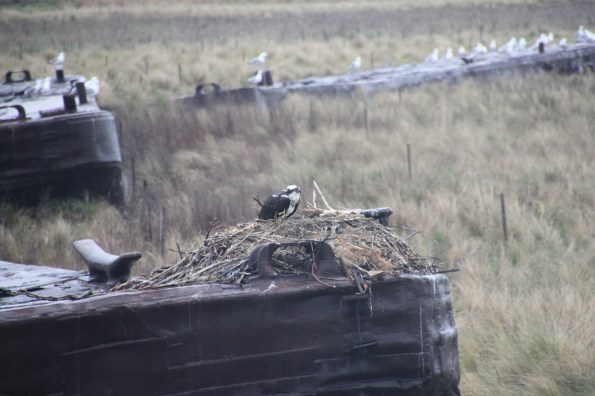
Local Inhabitants (Osprey)!
From an engineering point of view project is interesting, but really relies on the sheer volume of material for success. Now that the techniques have been tried and tested there is little in the way of complicated problems to be solved, and the process is very repetitive. The one issue the project did have was when one of the bunds was breached/overtopped during a particularly bad storm early in construction. This led to a significant amount of material being washed away and the bund having to be reconstructed before work could re-commence.
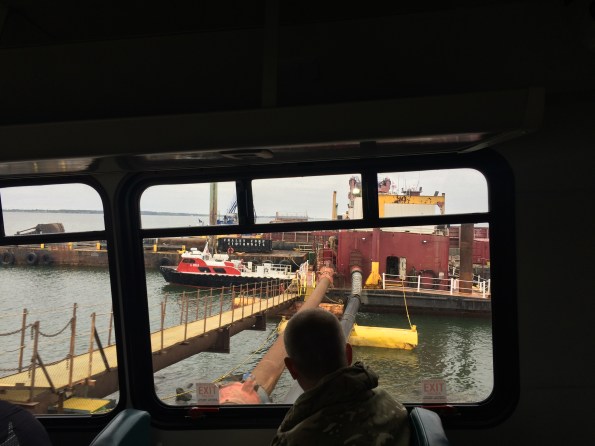
Henry’s Head (and the pumping station from where dredged material is pumped to the cells)
The total cost of the project is set to be around $800m, of which 75% comes from the Federal Government and 25% from Maryland State. The scheme has proved to be so successful that plans are well advanced to add a 575 acre expansion to the north of the island which would take the total area to approximately 1700 acres. The ‘construction’ phase is currently due to be completed in 2029, however significant management would be required beyond this date. If only the Royal Engineers were trusted to deliver something like this!
Other News
I’ve inherited three Officer Cadets! They were recently sent out on a two day ‘recon’ to gather ‘intel’ on some local critical national infrastructure! I very much enjoyed listening to their backbriefs and grilling them ‘Warfare Wing style. The next “interesting things that USACE do that the Royal Engineers don’t do” blog will be on the Raystown Dam and reservoir, an equally colossal project!
 Holdfast Training Services Trial Blog