Archive
Designing for Tendor.
I have been on site now for nearly a month and am quickly picking up tasks from all over the place. One of the main items I have been put in charge of is a 6km pipeline running from the Spencer Gulf to site, designed to carry seawater in and a separate pipe to return the brine water. The pipeline was designed by KBR, procured by John Holland (JH) and is in the process of being installed by York Civil. Up to now no one from JH has taken any ownership of the pipeline so it seems a good chance to actually contribute something worthwhile to the project. I have been looking after it for two weeks now and these are some of the issues I have come across:
Design and Procurement
The pipe itself and all of the fittings are to be procured by JH and free issued to York Civil. The JH team responsible for this procurement is based in Brisbane and has worked directly off the KBR drawings to procure all of the items. This has led to a number of issues, firstly individual responsible for procurement is not subject matter experts or an engineer; this has contributed to key items being missed in the procurement process including all of the gaskets and bolts. Secondly the initial design used for the tender process appears to have been done using geographical data and aerial photography this has resulted with a design that is not suitable for the ground and as a result considerable redesign is being conducted on site, which will result in some serious variation orders from York Civil. In addition these changes have resulted in many of the items procured already being inadequate or insufficient for the new design, some of which have long lead times, such as the pipe itself which has come from Turkey. This leads into the third point which is that the procurement teams method seems to be to request quotes from various suppliers; they then choose the cheapest supplier. It appears that no consideration is given to the suppliers’ location and delivery times. For example six automatic air valves are being shipped from Israel taking 8 weeks to arrive despite there being manufactures in South Australia.
Stakeholders
The pipeline runs across some private land, through existing easements, however the landowners were up aware of the easement. Currently they have ourselves putting a pipeline through it and the local power supplier constructing an overhead power line, to get power to our site. This has resulted in a re-route of the pipeline and narrowing of the working corridor. One of my tasks has been to construct a dilapidation report along the route in order to ensure compliance with guidelines laid down by the local environment agency.
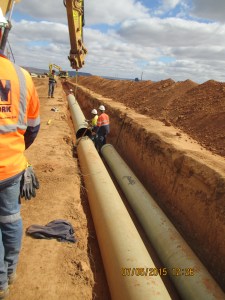
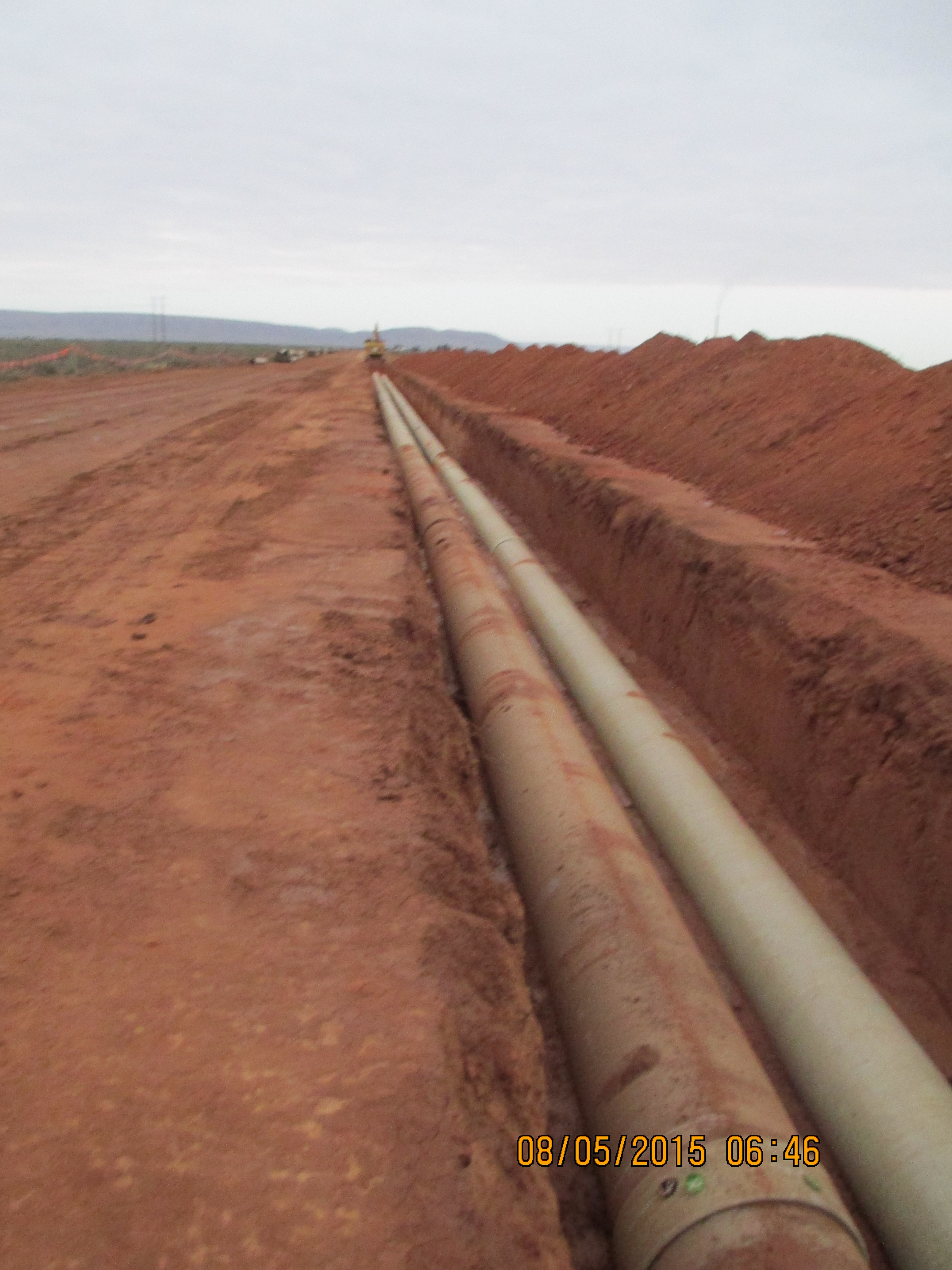
The pipeline beginning to be lifted into place.
Construction
The drawings issued for construction along with the specifications have resulted in a design that is almost impossible to build. For example, the design requires a compaction to be provided by mechanical means around the pipes in layers of 150 mm. Once the pipes are in the trench there is insufficient space to fit equipment to compact or to test the levels of compaction. The designers are up willing to renegotiate the levels of compaction because the specification of the pipe has already been reduced by JH in order to reduce the cost. At the moment we are working with the sub-contractor to develop some trial areas to establish if the desired levels of compaction can be met by any other means.
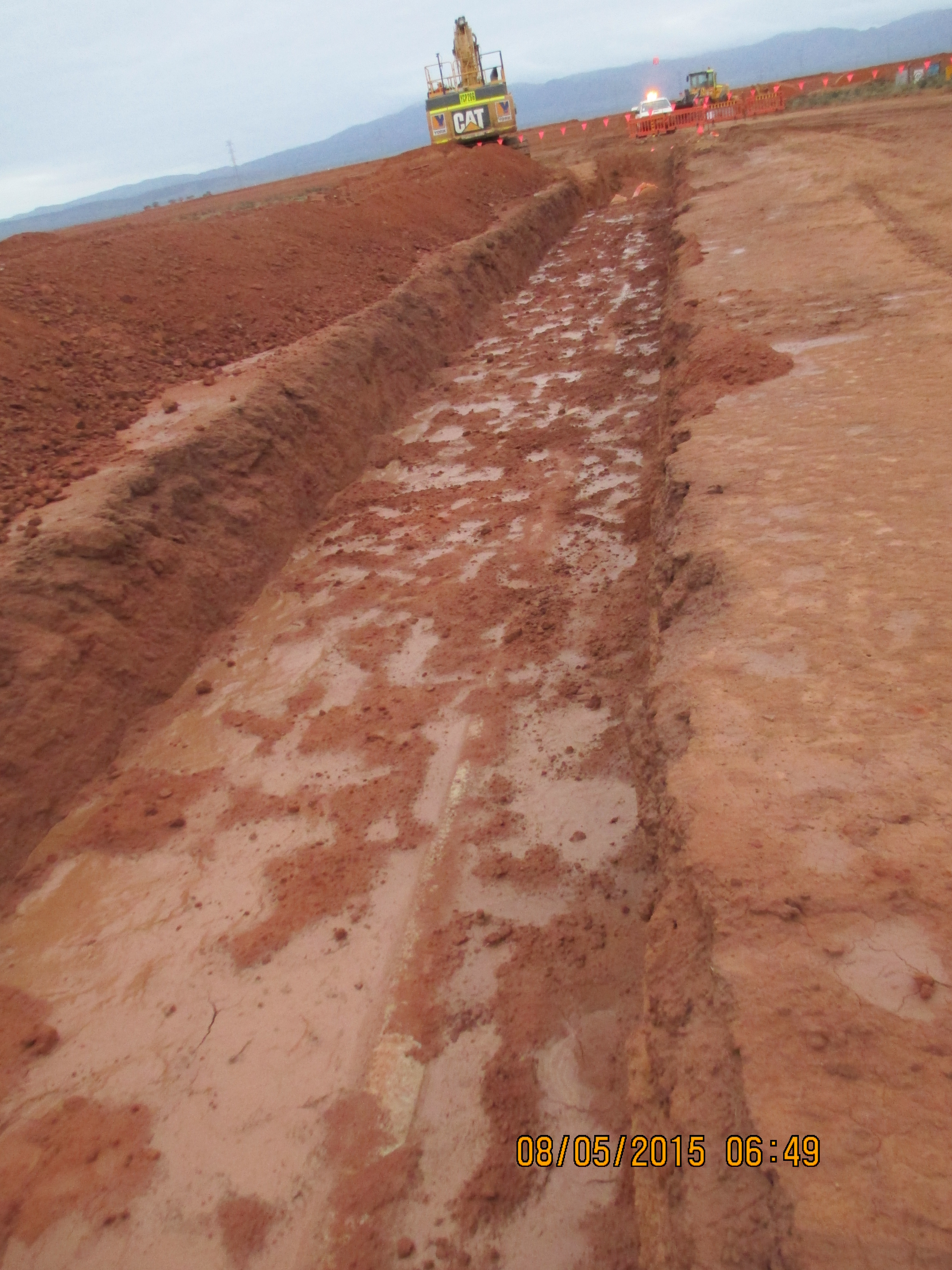
A shot of the trial compaction area- walking in and damping down with water.
Linked in to the compaction of the pipes is the requirement in the specification for the subcontractor to check the internal diameter of the pipe following compaction. At the moment the subcontractor have not found a method of how to do this; the pipe has a number of bends so a laser cannot be used. Again because of the reduction in the specification of the pipe the designers are not willing to remove this requirement.
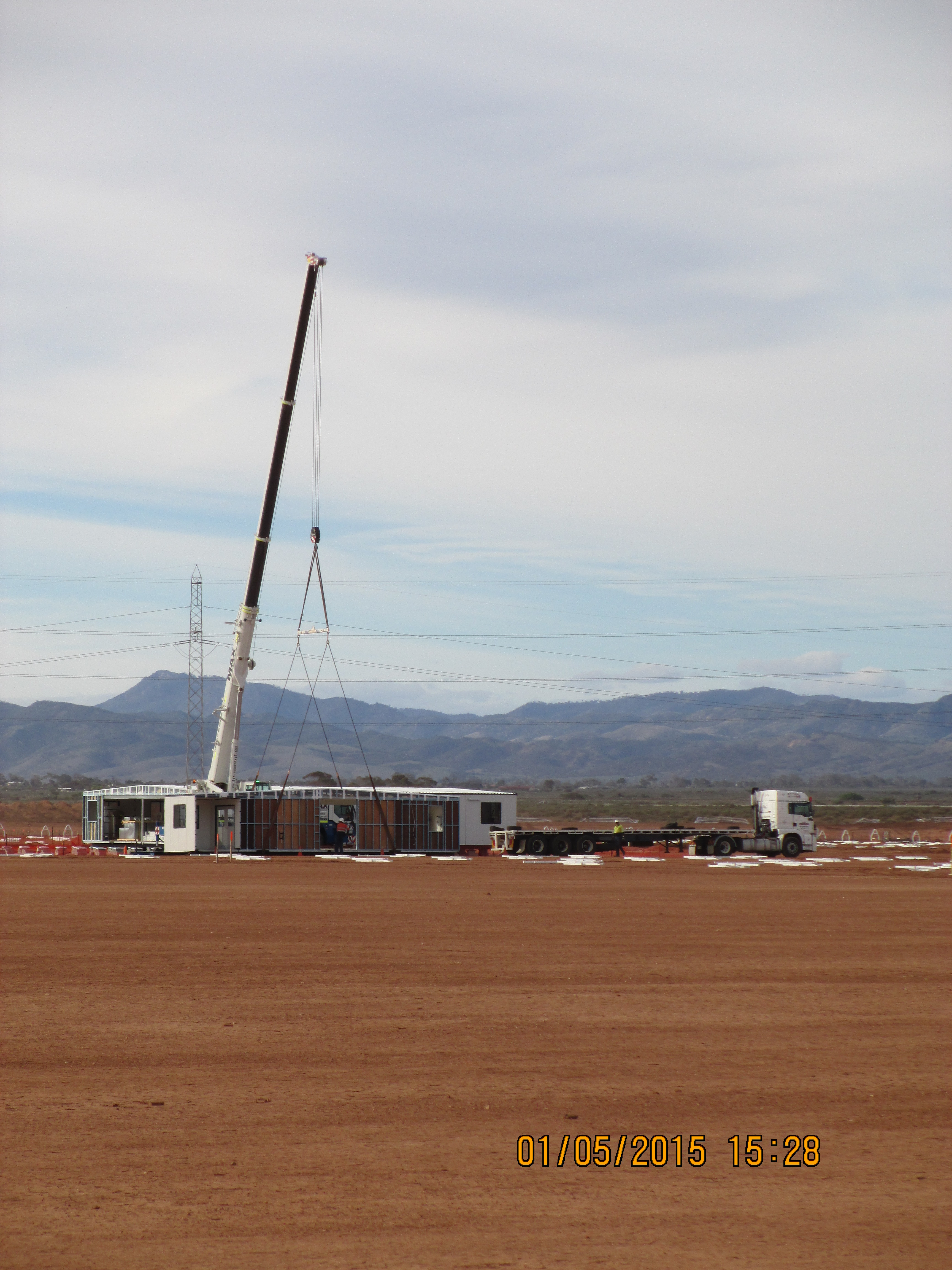
One of the other items I was running with was installing of 16 modular buildings that will form the permanent offices and amenities on site.
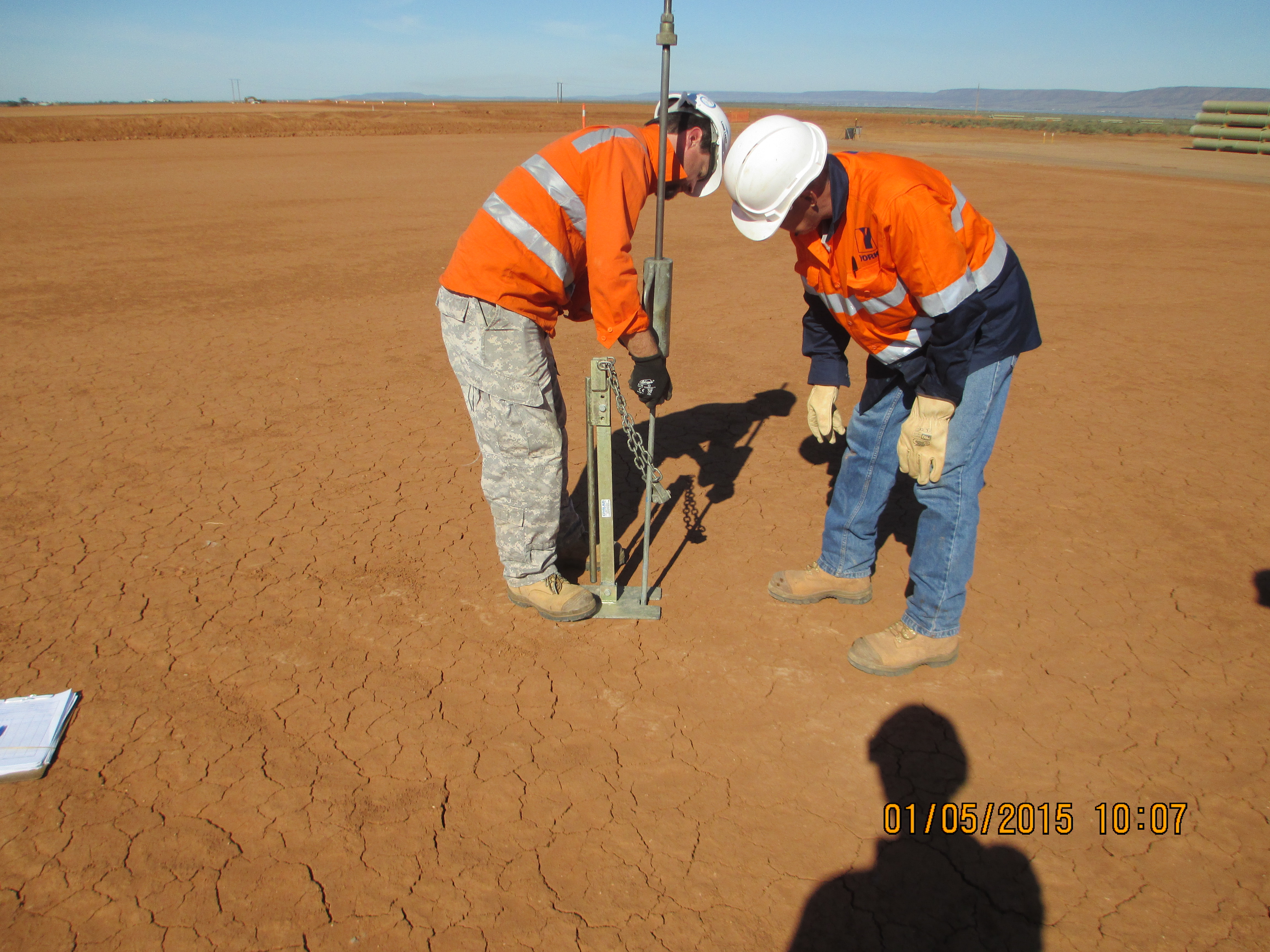
I thought I would add this for all you civils out there, seems to be some advanced version of the cone penetrometer, I did ask the guys how it worked, but they were just working it out for themselves!
Growing Tomatoes in the Desert
This blog aims to give a brief overview of the project I am working on here in Port Augusta, along with progress to date and key risks/issues identified by John Holland Group (JHG).
The Project
The overall aim of the project is to produce a year –round sustainable horticultural products for the Australia’s national grocery market and to do so with minimal fossil fuel usage and no extraction of fresh water from the environment. To achieve this the project will incorporate a solar energy collection system that is designed to heat water for thermal energy storage and use. The hot water is then used to distil freshwater from sea water and heat the greenhouse in cold conditions. The excess steam produced is used to drive a steam turbine and generator. The greenhouses alone will cover 20ha and the tower will be 115m. This system is simplified below:

The Site
The site is in the bush, approximately 12km South of Port Augusta. For those of you unaware of Port Augusta, it is classified as a major city in South Australia, but with a population of around 13000, think more like small town. It is situated about 300km north of Adelaide at the head of the Spencer Gulf and it is a bit of a crossroads town, with the main communication lines (rail and road) linking North/South and East/West crossing here. The site was selected as the area has a warm desert climate, with low humidity and sun almost every day of the year. (Although this week work on site was suspended as 33mm of rain fell in 12 hours).

Contract
The contract is an Engineering, Procurement and Construct (EPC) which is the same as a Design and Build Contract. It was awarded to JHG on 1 Dec 14, with ground works beginning just two weeks later currently the project is due for completion in Oct 16.
As this an EPC contract the final cost ($168 million) of the project has already been agreed with the client and finances secured from an investor. In order to secure this finance the client was forced to appoint a main contractor to manage the whole project, additionally the amount of finance is the upper limit, therefore there is no scope for change on the client’s behalf, without having to find savings elsewhere within the project, and this again is identified as a key risk by John Holland Group (JHG).
The majority of subcontractors have already been selected for the construction and have been used in the detailed design stage, and are listed below:
Civil works – York Civil
Greenhouses – Van Der Hoven
Power Generation – AALBERG
Balance of Plant – KBR
Electrical – TBC
Risks
One of the key risks identified by JHG is the interface between each of the subcontractor elements, in particular the E&M elements. In addition because several of the subcontractors are new to working with a main contractor there are concerns over the difference in perceptions and procedures, especially in regards to risk management and planning. As an example, last week two loads of concrete had to be turned around from site; Van Der Hoven had ordered it for the foundations for the first greenhouse, however they had not submitted Inspection and Testing Plans, thus no one from JHG had inspected the foundations. In addition the delivery had not been briefed during the pre-start, therefore none of the plant operating on site knew about it, raising issues about safety. By the time inspections had been made, the concrete had been sitting there too long and was rejected. Clearly there are also various environmental risks when working on a site in the middle of the bush:


Progress to Date
So far the ground works have been the focus, laying out of the first greenhouse is now taking place and the foundations dug. So far JHG representation on site has been limited to around 5 personnel, this is changing at the moment with someone new turning up almost every day, and a new project manager (Former Royal Engineer Mark Burnett OBE) is due in the next couple of weeks. With this influx of personnel the organisational structure and roles and responsibilities on site is changing daily, with the new project manager hopefully this will stabilise. My role within the project is still up for debate, with various people offering up opinions, but confirmation TBC. So far similar to Rich I have been reading various contracts, attending meetings with stakeholders and getting to know the JHG procedures.
 Holdfast Training Services Trial Blog