Archive
Level of Learning: Conscience Incompetent
Following a good week in the office last week, I am starting to understand BP, Projects & Modifications and my role within it; here’s a flavour.
Ground
BP North sea operations currently own 6 assets in the North Sea. Bruce, Claire, Magnus, Andrew, Foinaven and Eastern Trough Area Project (ETAP), which are a mixture of single and double, steel jacket design platforms, with or without multiple subsea wells connected to the processing platform, with Foinaven being a Floating, production, Storing and Offloading (FPSO) vessel. It is the hub which covers ETAP that I have been assigned to.
Eastern Trough Area Project (ETAP) is an integrated project consisting of 9 independent reservoirs (each containing one or more well heads), 6 owned by BP and 3 by Shell, all linked to a central Processing platform. Considerably different from what a layman might consider a ‘standard’ single well, steel legged rig; the truth is there doesn’t seem to be a standard, with each of the 6 BP North Sea assets different from the next.
The diagram below shows the layout of ETAP. The main structure consists of a Processing, drilling and Raising (PdR) platform connected to a Quarters & Utilities (QU) platform, separated for safety. The Marnock well is directly below the PdR platform, with Monas, Mirren, Machar and Madoes (and Shell Egret, Skva & Heron) all being subsea wells, tied back to the Central Processing platform (CPP). The 6th BP well, Mungo, requires a Normally Unmanned Installation (NUI) in order to carry out additional processes on top of what is required for the other subsea reservoirs.
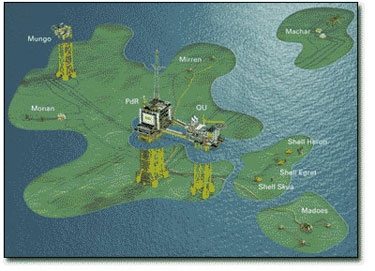
ETAP Schematic
The picture below shows the QU platform on the left, consisting of a heli deck above the accommodation and welfare facilities, power generation units (gas turbines) and other services, connected to the PdR in the centre. The structure on the right is a Flotel, which provides additional Person on Board (POB) capacity when required (i.e. during construction or Turn-A-Round (TAR)).
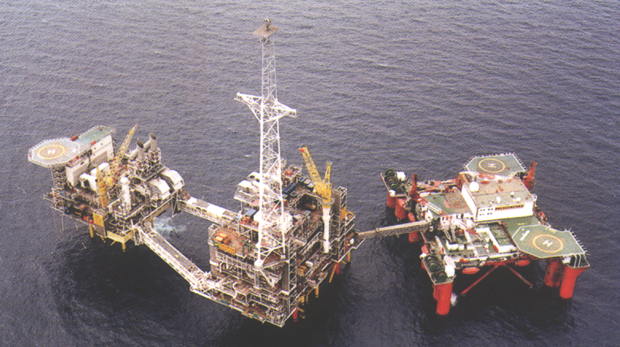
ETAP QU & PDR platform with Flotel
Organisation
As mentioned earlier, I am assigned to a hub which currently only deals with ETAP (and Mungo), although asset responsibilities often move between hubs depending on workload, personnel and suitability. The 3 or 4 hubs (again remaining flexible) all work within the Projects and Modifications branch of Engineering Services, which itself lies within BP Global Operations Organisation, comparable, I guess, to a TLB in the MOD.
The main role of the Project and Modifications team is in the title. It doesn’t deal with well drilling or new platform construction (these are dealt with by Global Wells Organisation and Global Projects Organisation (other TLBs)) but instead deal with any routine or emergency upgrades, additions or repairs, primarily to enhance safety or production, up to a value of $15m.
Contract
A contract was renewed this year with Wood Group PSN (WGPSN) called BP Focus, which is a 5 year contract (with a 2 year extension option), which covers Upstream (offshore assets) and midstream (onshore processing) on a cost reimbursement + basis. WGPSN primarily only deal with the latter stages of the project lifecycle, (Define & Execute), with the earlier stages, (Appraise & Select), being delivered by Costain. Again, remain flexible.
The Cost reimbursement + contract means that WGPSN invoice BP for all direct costs incurred, due to general overheads and any work carried out on the specific projects. Added to this is a fixed mark-up percentage, the value of which depends on the cost element but as an example is 6% for ‘Real estate services, desk space, phones etc and up to 8% for personnel. In addition, there is an incentive scheme which offers a bonus of up to 4% against some of the cost elements, primarily personnel if a project meets certain Key Performance Indicators (KPIs) which are agreed annually.
My Role
As a Project Engineer, I am the Single Point of Accountability (SPA) for a number of projects on ETAP. My role is to liaise with the appropriate team within WGPSN and monitor the development throughout each of the project lifecycle phases, engaging with BP staff, WGPSN staff and external agencies as required in order to move the project forward. Budgets and scheduling are key, and it will be my responsibility to ensure that timings are adhered to, budgets are realistic and monitored, whilst constantly feeding this back to the BP side to ensure there is one version of the truth. The BP Method of Change (MoC) process which is there to help identify, assess, manage and communicate risk throughout the project lifecycle also needs to be managed, to ensure the correct processes are being followed and that all relevant documents are up to date and easily accessible. This along with other key documents will form the basis of a go/no go decision at key points along the project life cycle either between phases or at the 12, 6 or 2 week review before the project is executed offshore.
Clearly this is an attempt to summarise in a paragraph what I am meant to be doing, having had very little experience to date; talking to Brendan and Nick, it is clear it is not as simple as it sounds and only be doing it will I get a thorough understanding. My next blog will explain a project I have just taken over, which should hopefully provide some clarity on all the above.
Key points to take away: The military are just amateurs when it comes to TLAs and flexibility is key!
Other news
Pregnancy – Still
New house – aim for contract exchange this Friday, completion next week.
Just been along to a meeting at my local BSAC dive club, looking forward to some off shore diving soon.
Lang time nae see, Far hiv ye been, min?
It’s now the start of my third week at BP and although I’ve not really got into the detail of what I will be doing and be responsible for, I thought I would summarise what I have done to date and offer an anecdote or two. A separate post will follow on BP, the contract and my role, in due course.
Safety, Safety, Safety
It’s a bit of an eye opener, exactly how safety conscious BP, and indeed the wider oil & gas industry are. I have had to do two inductions as you might expect, one for each of the buildings I will be working in. The Wood Group PSN induction was a fairly straight forward video, which lasted 15 mins or so, the BP induction lasted a little under an hour, at the end of which I received the guides shown below. The main document (top right) has 23 pages, each of which either presents critical information, directs you to read one of the other documents or asks you to carry our further reading / action, which all require a signature; this is then followed up by the second part of the induction process.
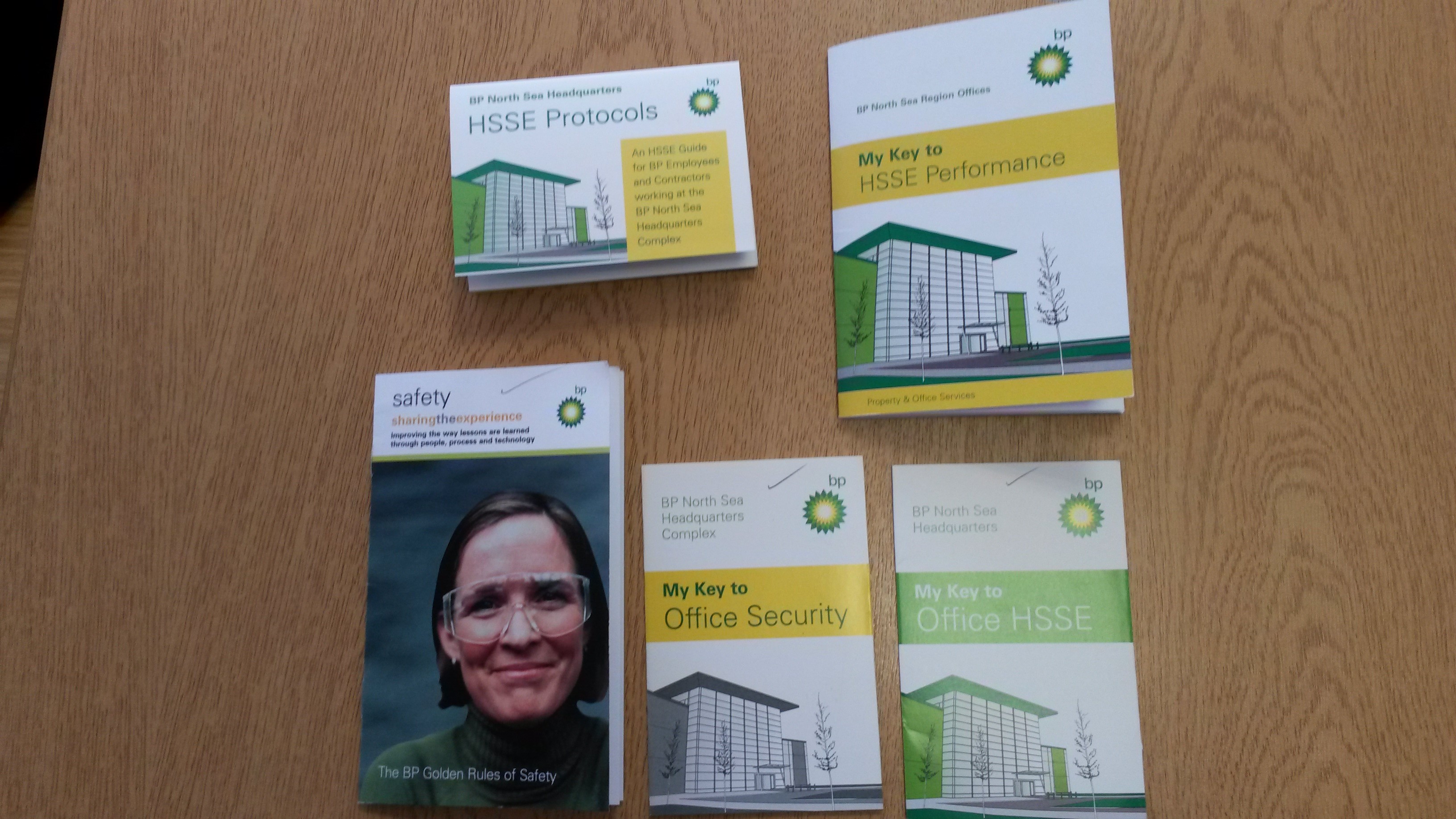
A bit over the top for an office environment? My opinion is not. (you may be surprised by that). What it does, is make you understand just how seriously they take your health & safety and drum this into you from the start, reinforcing the company values of ‘No accidents, No harm to people, No damage to the environment’. (try sitting at Costa in the Union Square shopping centre in Aberdeen; you’ll easily be able to identify those in the industry – they are the ones who walk up the stairs on the left and hold the hand rail)
The place where H&S is absolutely vital is of course off shore on one of the installations. To that end, last week, I completed the Basic Offshore Safety Induction & Emergency Training (BOSIET), Compressed Air Emergency Breathing Apparatus Course (CA-EBA) and the Minimum Industry Safety Training (MIST). The BOSIET Cse was probably the most interesting as it goes through the different types of offshore installation, how to survive in water and in a life raft, firefighting, basic first aid and of course the heli dunking; good value. MIST had some value and added to training already completed at the RSME and previously. (Offshore regulations, Fire, Risk matrix, permit to work etc)
Process, Process, Process
BP appears to have a very defined and slick process for everything they do; the most obvious is their Management of Change (MoC) process. This is supported by an online application which groups together information and documentation for any individual project from the screening phase all the way through to hand over, with great usable features including automatic email updates, assignment of responsibilities and go/no go gates.
They also appear to be very swept up in dealing with Information Management (IM) using their Intranet sites to good effect; I certainly spent a lot of time in my first week reading the various areas and has been useful whilst writing AER1.
Notice that I used the word ‘appear’ in both those paragraphs; I’m sure time will tell if it is as good as it looks or if it will be comparable to JPA, SPOC, MOSS et al.
Money, Money, Money
It’s eye watering looking at the costs of what seem to be simple projects. I will make this a separate post in the future, once it is fully understood as it’s deserving of its own blog.
In other news
Aberdeen is a great city – Would certainly consider living here
Charlotte is still pregnant (27 weeks) and don’t I know it!
Still waiting to move into new house (in London) and preparing for our DIY(ish) ‘Grand Design’
For future BP attach-mentees: I am preparing a 3-4 pager ‘Get you in’ Admin Instr to summarise the last few months of admin points, similar to the AUS document, but clearly a lot simpler. This will be stored on the RMSE servers. Additional documents (initial actions and HO/TO notes) will then be available on arrival which have been passed on from previous courses.
 Holdfast Training Services Trial Blog