Archive
There is no ‘I’ in team
This week has be punctuated by the ANZAC day public holiday on Thursday which essentially converted the week into a 3 dayer as it seems everybody managed to get their leave passes in for Friday to make it a good 4 day weekend. I am not entirely sure how and why they were all sanctioned by the powers that be but it left me with a site without a Site Manager or Supervisor for both Friday and Saturday meaning that team set deadlines were missed.
As previously expected, the slip-lane has assisted in the turmoil this week, and only exacerbated by crane breakdowns has meant that the delivery of the beam and bottom mat steel for Zone 5 was not delivered on Monday as directed but finally made its way to site on Wed evening, just in time to see the fixers waving goodbye for their long weekend. The steel supplier was unable to deliver on the Monday as the order was still incomplete due to an error on their part. The carnage (deliberate typo for Craneage), booked to move it from the slip-lane to zone in the evening of the Wed, broke down meaning that as the skeleton fixer crew returned to site on the Friday, the steel was only just making its way over. This obviously caused issues for the fixer contractor who blames JHG for all the delays and the cost of his manpower that was under used for the week.
The State (Clients Representative) issued notice on JHG on Wed afternoon in relation to quality issues they had found around site. As there were limited Non-Conformance Reports (NCR) filed in the system, the PM had a pretty hard time explaining why the situation was as it was. All South engineers were then called into a meeting with the PM and given a formal letter detailing how things must get better and questioned on why and how these issues happened. It smelled strongly of a blame issuing exercise but actually highlighted processes that I don’t think had been briefed to everyone, as a wise man once told me, “You don’t know what you don’t know”. The following day off for ANZAC day was welcomed.
ANZAC day started with a 0430 Dawn service in Kings Park overlooking the Swan River for sunrise, followed by a good breakfast in town with Nicky, Remi (Australian RE) and a few other Engrs prior to watching possibly one of the longest parades in history – the bands were running back to the start of the route as there were not enough to go around (not that it made much difference as nobody was in time). I think Remi and I were the only people to Perth who were wearing suits but not marching. I was impressed at the 50,000 people that turned up for the dawn service and the support in town throughout the day. I would like to think that a similar day in the UK would be so well supported. Nicky and I then went for an afternoon sail on the Tall Ship Leeuwin 2 – billed as a chance to pull up sails and crew the boat, but actually more a money spinner for the trust where you were crammed onto a deck and watch a rather inept volunteer crew do it for you. Nice to get out on the water though, and spurred us on to start planning a trip to the Whitsundays for a sail later in the attachment.
The H&S issues on site are well known, and management are leading the charge to transform the statistics from the top down. JHG head office has now sent 2 H&S Ninjas to site with the top cover of the Operations Manager for infrastructure. The stimulus for this I believe was on a knife-edge decision whether or not to close the site down for a period to rectify the H&S situation. The Ops manager gave a presentation on the JHG mission and visions to all those JHG employees who were actually on site during the moral boosting period of 1600-1730 on Friday afternoon. The emphasis was on teamwork, integrity and accountability, but I have to say that I left feeling a little patronised and, after Wednesday’s session, a little unsupported. My reaction to this was to have a think about ways to turn the South team around. My initial ideas are:
- Social activities to break down barriers,
- A daily RAG’d milestone status update (within the South, Centre and Basement blocks) back-briefed to the PM mid-weekly as a method to focusing effort,
- A change in team focus on solution finding not fault finding.
Any further ideas would be welcomed. My feeling is that people currently don’t want to raise issues for fear or persecution.
Much like Rich has found, this week has really brought home to me the pettiness in the construction industry that takes effort away from producing a quality product. The 2 cases in particular this week have been:
- The ongoing saga of kit on the ground. The formworkers were asked to remove their kit from an area that needs to be road-based prior to falsework construction. They claim that all the kit isn’t theirs (true, but the vast majority is) and this has resulted in photos being sent between JHG and WCF, which has developed to annotated photos and lists, which has increased to annotated, annotated photos, and coloured lists. In my view, in the time taken to log all the kit down there it would have been quicker and cheaper to programme a late shift for the crane and just move it but this would require an additional cost to someone.
- The crane allocation. Daily crane allocation meetings have intensified to the extent that PM’s and Construction Directors now attend. At 2 hours for some of these meeting it is such a waste of senior and site management time it is incredible. What is more amusing is the bloke who is employed by one of the contractors (or maybe all of them) to sit on his arse and log what the cranes are lifting to ensure compliance with the timetable and give them ammunition to respond to JHG.
I have said it before, but this job would be so much simpler if there was only 1 or 2 contractors! Engineers and managers could then focus on their primary role and help bring the project back on track.
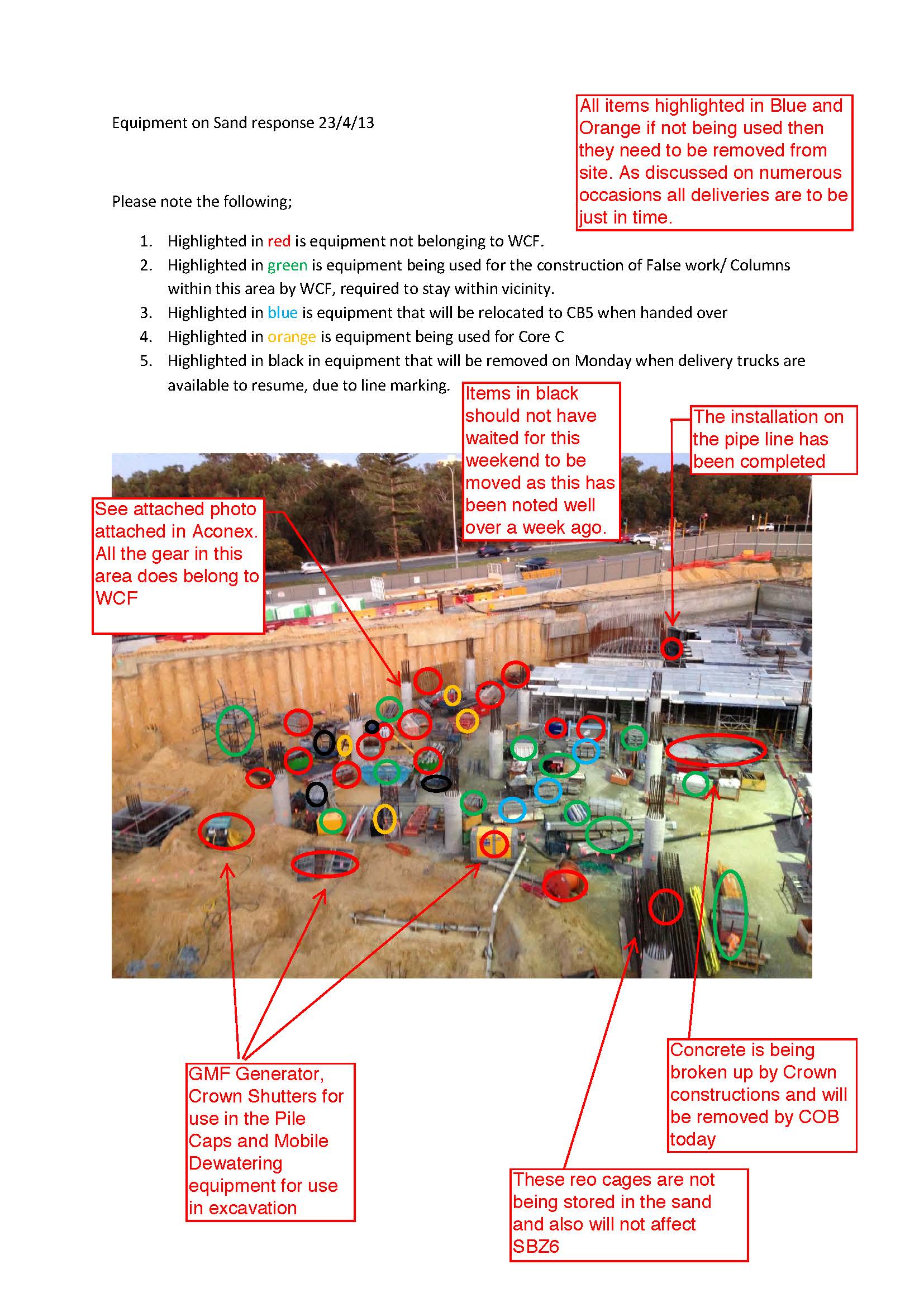
Excessive time wasted on documentation
Bull$h*t Baffles?
The latter part of last week and the former part of this week have been spent preparing for the pour of Upper Basement Zone 4, oh and dealing with the aftermath of the Zone 3 pour. We called in a professional slab scanner to assess the perceived cold joint and had the lads from Cut’n’Break take a couple of core samples along the join. This involved a nifty little radar car (not dissimilar to Imran’s efforts on his attachment) that was rolled around the surface taking scans of the slab. This was initially done to locate the core samples in the dodgy areas and do so missing the reinforcement – not entirely successful but it seems nothing ever is. The radar car then spent the following day taking cuts across the centre line at 1m intervals in order to build a picture of the state of joint. Both sets of results came back in whilst I was on course but I have yet to have a good look at them. What I do know is that of the 6 core samples at 7 days their strengths (for a 32MPA mix) range from 25 to 10 – so I would hazard that it doesn’t look good for zone 3. The next stage is working out exactly what to do. The initial suggestion is to chip out the joint and either side of it and re-pour but the ultimate decision rests with the structural consultant.
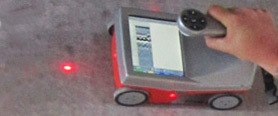
The GPR scanner car
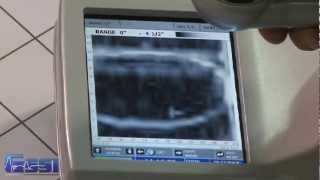
Example of GPR output (low point of curve = reo location)
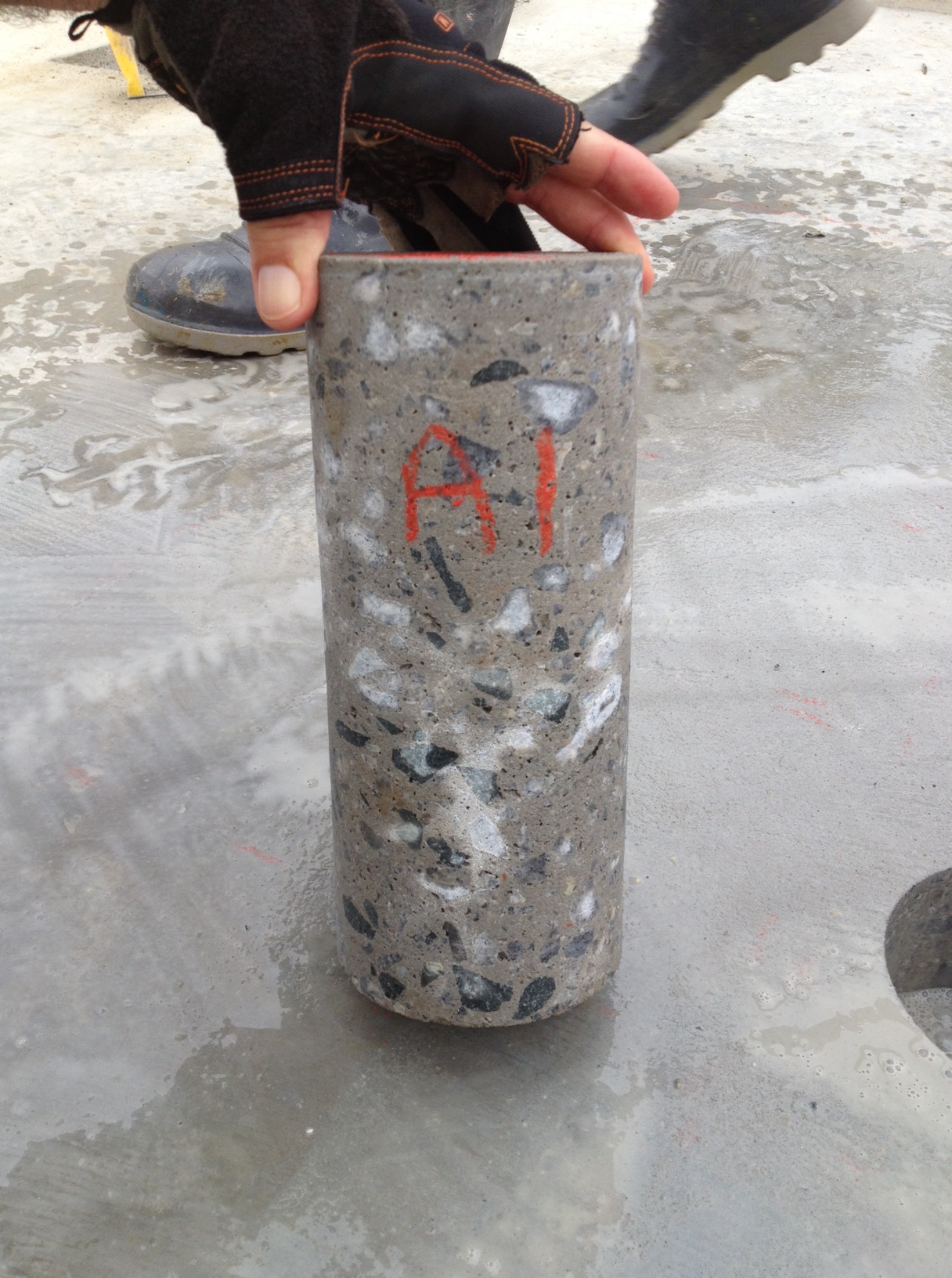
Cored concrete sample
The fallout from this situation is that the client’s representative (CR) is not convinced that JHG are taking quality seriously and placed a suspension notice on the pouring of suspended slabs until it was proved that the processes are in place. This notice will remain indefinitely for all suspended slab pours which will be cleared for construction by the CR on a individual basis. What this means for me is not much really, I keep doing what I was doing before but just pay a little more attention to the presentation of my pour card, and ensure that site looks the part.
On Thurs and Fri I attended the Operational Safety, Quality and Environmental (SQE) Risk Management course. I was expecting a typical half-arsed training course that nobody wanted to be at but was pleasantly surprised. Aside from a couple of days respite ‘off the log’ from site it was actually a very full and well structured course. The attendees were a mix of JHG supervisors and site managers from across the spectrum of business units as well as a couple of additional blokes who were working as contractors with JH (one of whom was a 30 year soldier in the Arty/RAPTC). The programme was loose for the 2 days but this allowed a lot of talking around the topics which for me was good to gain an understanding of how the different units and workers approached the systems that JHG uses. The syllabus basically ran through the SQE process from Tender to Site and explained all the process’s and roles throughout. I found that it built upon the subjects that were merely touched on in the inductions, and I left with a better understanding and the confidence to implement and question the processes on site.
Whilst I was away Zone 4 was poured through an intricate system of pipes, pumps and towers. The original plan was for a 0700 pour from a mobile pump in the slip-lane which was feeding a tower pump that rises out of the slab through a penetration. This all worked fine in principle, (calculations were put together to ensure the load of the mobile pump was not too great to compromise the integrity of the piled wall) but in reality, feeding 260m3 of 120mm slump concrete through a 150mm diameter pipe for 130m and expecting it to be of a consistence (they still use workable here) that can be poured is not an act of war. I had to request a new mix from the concrete supplier which then had to be cleared through the concrete pouring contractor and the structural engineer before we could send it to commercial for pricing and order the material for the next day. A surprisingly long winded process but it covered all the bases and was completed in a couple of hours. I am told that there were issues with the pump, but nothing that wouldn’t have happened anyway (My ‘Actions On’ section of the pre-pour meeting come into their own and the delay was assessed and concrete paused at the batching plant), and also that the main hold up which delayed the pour till 1400 was because of the Unions holding their members back from site due to a H&S issue the day before. The H&S issue was one that their own union members had caused through blind stupidity – instead of waiting for a bloke to finish surfacing a poured concrete edge or going a different route, they decided to carry the concrete pump tube over him, inevitably dropping it on his head. This initial delay meant that the slab was not finished until 1900!
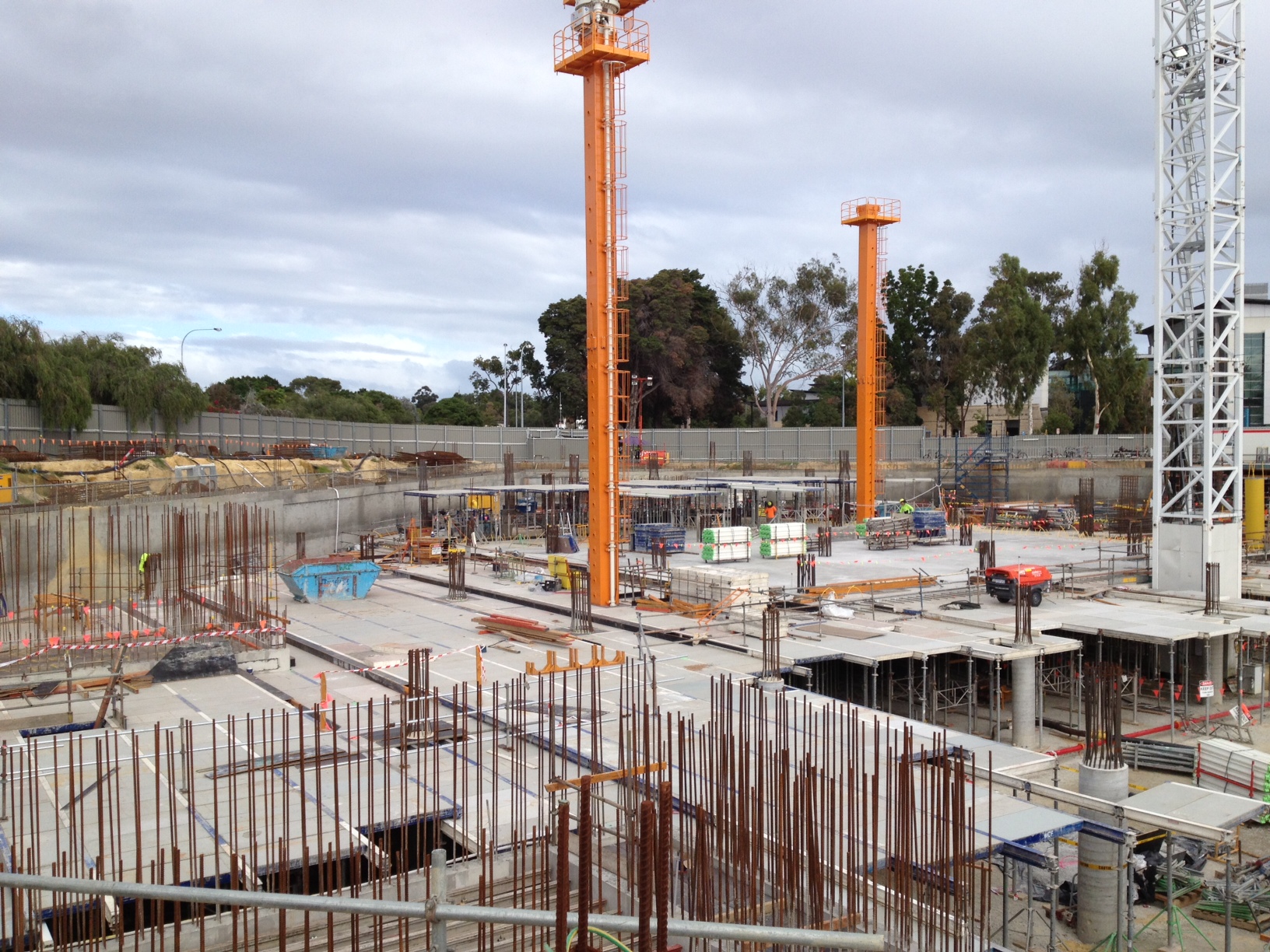
Zone 4 (poured) between 2 Tower Boom pumps
The CR later said that the zone 4 pour was one of the best prepared zones they had seen yet which leads me to think that they don’t really know what they are looking for. In my opinion, as the bloke coordinating both slab preparation, they were identical in preparation and only separated by trivial but obvious issues such as concrete splatter on reo. Maybe it is true that “Bull$h*t Baffles?”
Loose lips costs time and effort
Following the successful pour of South Block’s Upper Basement Zone 2 slab last week I continued the motion to start on Zone 3 this week with a programmed pour date of Wed 10th. This involved the coordination of concrete cylinder testing and post tensioning to ensure that the pour could be completed on time after Zone 2 had been tensioned. The stated criteria for tensioning on a 32MPA concrete suspended slab beam is 9MPa or 24hrs for the initial stress to 25% of the maximum, and 5days and 22MPa for full tensioning. In this case the structural consultant allowed the period to be reduced to 3days and 22MPa for speed of construction. The RFI to use a stronger early age mix to assist in this process has now been approved by the structural consultant but has been held up at commercial the commercial level. In my view, with a liquidated damages rate of A$180,000 per day, the increased cost of a 40MPa early strength mix will be negligible if the project runs over.
The reinforcement tying went in without major issue except a couple more clashed with PT ducts and a lack of reinforcement design for a stair core that was partially encased by the slab. The design was for finally released on the Thursday evening before the Wednesday pour placing an increased pressure on the steel scheduler and the steel provider to get the couplers to site in time to be fixed. This didn’t happen, they arrived at 1745 the day before the 0530 pour and still sit idly next to the stairs. (I can potentially use them for a penetration that has been missed from the initial steel schedule but will require structural sign off first.) The solution to this issue is to drill and epoxy starter bars into the core wall prior to construction of the internal landing. This was already the solution for the other half of the stair wall that missed the inclusion of couplers when initially cast prior to my arrival so is not seen as a major issue. In my eyes it is galling that the parts were on site prior to the pour but there was nobody there to fix them. If I could have done it myself I would have.
The clients representative made a visit to the site the evening prior to the pour and made several observations to the structural consultant about finishes on column tops (not rough enough) and splashed concrete on reinforcement. Both easily fixed, one by me with a spare piece of reo smashing into the top of the column to scabble, the other after a fair degree of effort coercing the contractor to do it and in the end having to do it the morning of the pour.
The pour itself began well. The initial concrete mix was a 32MPa with Xypex and Eclipse as the surface was to be subject to external weathering and hence would require these additives to increase its durability. This mix flowed into a normal 32MPa mix. I placed myself at the concrete pump to check the mix prior to pouring and ensure quality of the batch. About halfway through the pour the formwork contractors spotters below the deck who move with the pour monitoring any deflections alerted the site manager that one prop had settled 30mm and that the pour should move to another area while they fixed the issue. This was done but the concreters deemed the deck to move so were immediately removed to a safer area whilst an inspection of the underside was conducted. The area was re-propped and initial props placed ahead of the pour to ensure stability. The pour continued with the concrete just on the limit of its use-by time (90mins post batching). The slump had decreased but was still in range.
The concreters then claimed the formwork moved again and were once again removed from the slab. The H&S coordinator barricaded the slab and called in the Construction Director and Project manager to manage the initial investigation. It was found that a prop was not sat on the roadbase surface and had been undermined by water flowing from the deck above and had consequently settled 30mm. The subsequent additional propping had been a little over zealous and had lifted one of the deck units 15mm give the concreters the impression that the whole deck had dropped. The slab was deemed safe and after a brief H&S representative meeting the concreters returned to work, working a nearly cold joint. This continued whilst I turned away 5 trucks that were out of range and waited for new concrete to arrive whilst the concrete pump cleaned its pipes. The remainder of the pour was relatively uneventful.
My pour card was removed for evidence in the H&S investigation. Comcare (equivalent of the H&S executive was informed but as it was not a complete of partial collapse, and the incident caused no injuries, it was not notifiable. The unions were also informed and were reluctantly granted access to site – they found nothing and were satisfied with procedures. That said the rumour mill amongst tradies is similar to soldiers and pretty soon news that the deck had collapsed and dropped 180mm were rife. I hear it also made local news and Glenn Palin, MD of JHG was also informed. I am informed that there is often a small degree of settlement that occurs in falsework but to call it a collapse is an exaggeration. The clients representative has now issued a suspension notice to prevent any further suspended slab pours until it is satisfied by a JHG report that the correct processes were and are in place to manage such issues and ensure quality of the product. My pour card formed a substantial part of this report and included density tests of the roadbase, falsework plans and sign off from a 3rd party certified engineer of its compliance and structural stability, and sign off from all contractors that their work was to the required standard. I’m glad I had all the ducks in a line and the only issue that my PM had to answer for was that of quality management.
I was subsequently involved in the H&S investigation to establish the root causes of the problem, not to issue blame, though it was blatantly evident that everybody in the room was posturing to remove themselves from the circle of blame.
I think the incident, although it had the potential to be catastrophic, was managed well. The systems were in place to monitor the pour and have been proved to be effective. One of the bigger issues I think is one of information release. Even the contractor referring to the incident as a partial collapse sends out the wrong message from the start and required stamping out early. In the event it wasn’t and spread across the site and indeed country rapidly which only served to increase pressure to perform on an already pressurised build. The additional work to compile reports took a day from all the South engineers and PM which was time that was not spent making an impact on site.
A Long 4 day Week
After a relaxing, if short 4 day Easter break on Rottnest Island off the coast of Perth I returned to a 4 day week that has felt like a month. Prior to leave a milestone had been missed and it was now best effort to get the South Block Upper Basement Zone 2 suspended slab (320m3) poured by Wednesday and the following Zone 3 (120m3) poured by Friday. Even to my inexperienced eye I could see this was pushing it especially because the Senior Engineer was off for the week and it was down to me to manage.
I was handed control of the pour with about 50% of the Reo on Zone 2 complete but for a first slab it was a bit of a nightmare to comprehend. It was not regularly shaped, it had 3 step ups, 6 integral beams (4 with PT), 2 Temporary Movement Joints (TMJ) (for seismic design), 3 ramped sections, 1 stairwell, and 2 penetrations (one of which was to accommodate the up ramp from Lower Basement). To deal with the more interesting details in a little more details:
The reo schedules and mark-up drawings were fairly epic in themselves and took me a good couple of days to get my head around which was unhelpful as I was being asked questions from the point of arrival on Tuesday morning. This mainly involved multiple trips to the slab deck to identify the issue, to steel fixers (NRG) office to discuss a solution, then to the site office to call the scheduler to check measurements, delivery dates and bar marks to ensure all the required steel was there to complete the task. Having been on the task for 3 weeks at this point with minimal top cover, it was inevitable that there were going to be issues. There were plenty, culminating on the night before the pour, after the structural designer had completed his structural check, that we found we were missing wall starters and were unsure of the wall dimension. After a few frantic emails and an early morning dash around site, the size of the pour became an advantage as after the 0600 pour start we had approximately 3 hours to get it rectified if we poured in the correct configuration. We didn’t pour in the correct configuration but luckily the fixers were quick and it was done in the hour.
Slab joints are a fairly new one for me, and it seems that the TMJ technique used on the NCH is for a lot of people in Perth. The TMJ’s are designed to give the structure a degree of flexibility between slab edges during construction to accommodate shrinkage due to curing and PT. The project is using a range of Ancon shear connectors that are either locked off after a specified period or allowed to accommodate movement throughout it’s life. The benefit of using the shear connectors is that it speeds up the rate of construction as it reduces the requirement for complicated or additional formwork, and only leaves a small joint and connector that required grouting to finish the connection.
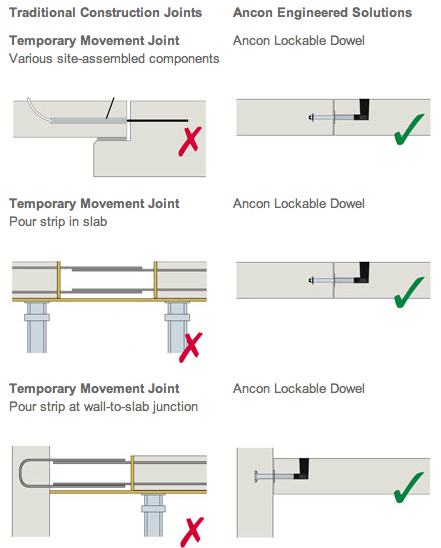
Post Tensioning in the beams is quite an issue, it appears that the structural drawings when sent to the contractor to produce shop drawings get changed ever so slightly that they always clash with the top reo. There has been several issues with the lateral placement of the ducts as many are detailed to pass through columns, but as the PT shop drawings were not complete at the time of column pour the bars were cast in the standard positions, therefore requiring bars to be removed and replaced by drilling and epoxying new starters in place. The issue that I have now found to be the biggest issue is the lack of any consideration in programming for the lag that occurs in construction due to tensioning. The initial stressing can occur at 24hrs post pour (concrete approx. 9MPa), however as per the structural specification the final stress can not occur until the slab reaches 22MPa and 5 days post pour. This builds in an additional 2 days per slab to each pour date. I have looked at the sequencing of the slabs and think there may be a more efficient way of doing it, but I need to speak to the programmer to ascertain the assumptions behind the decisions.
From a RE background of pouring a maximum of 5m square flat slabs, the idea of moulding the concrete into ramped sections concerned me a little – it turns out to be pretty much by eye. Pouring 320m3 of concrete in one hit was pretty hectic considering steel was still being fixed at the other end of the slab. This was the last ‘easy’ pour as the truck mounted pumps will no longer have access to the bottom of the hole. From now on concrete will be pumped from the access slip lane into a standing boom pump, which will pour to the final destination. The complication comes in the fact that the agitator trucks will not have the space to wait in the slip lane, where all the other deliveries arrive, so coordination is vital. This will be yet another task for the site engineers but in my view is so crucial it should have a single responsible person as there is so much scope for errors and with the prospect of turning concrete/reo away due to lack of space it could get pretty costly.
One of the overarching issues for me is the complication that so many contractors on one job creates. Not just the usual issues of construction but also the issues between themselves (Rivalry, Unions). I realise the intent of employing workers and sourcing materiel separately is to cut the costs of the project, but it appears that the time taken to liaise between the various consultants (architects, structural, services), the individuals who are doing the work, and those sourcing the materiel takes the vast proportion of the engineers day leaving only a small element for actual forethought and fault finding prior to construction. I don’t think that many sub-contractors makes light work and cost effective construction, quite the opposite actually.
On the Rise(r)
At the end of the 2nd week I am gradually settling in on site. The pace is furious but that is probably because the project is nearing a milestone that is worth about $20m and without a big push it may be missed. To couple with that the next 2 weeks are short due to Easter so I don’t expect the pace to slacken much.
There has been a restructure of the project team since last post which has seen a split into North and South project teams. This has meant a move of offices but probably only for a while before we move again when the growing hospital superstructure expands into the space we are currently sitting.
It turns out that I have picked up responsibility for a stricken riser in the Central block that appears to have been passed from pillar to post by both management and contractors alike. I have inherited the task after its initial lift from pile caps to RL 6.2m but quality control seems to have been an issue. On first inspection it was clearly evident that not only was the reinforcement completely different to the schedule, but its placement within the walls was pretty poor. The cover ranges from 10-60mm and the surface finish (Australian Standard (AS) Class 3) is debatable, but due to continuation prior to resolution it would appear that a precedent has been set and parties agree to disagree.
I was due to monitor the 2nd pour by shadowing one of the lead project engineers but ended up managing it myself. I was quite reliant upon the contractors for information but very wary that they were only telling me what they wanted. The reinforcement continued to be an issue for the 2nd pour as it turned out it had been incorrectly scheduled by the reinforcement provider and due to time pressures the design was amended to use what was available. This actually increased the overall strength of the wall, but threw up issues with header beams above and below wall penetrations. Because the header beams were designed to fail in bending it meant that the shear reinforcement was greater. However by increasing the bending reinforcement meant increasing the shear reinforcement further which led to crowding of steel around the beams and a lot of awkward fixing to ensure room for the vibe which increased time delays. Due to the rush to complete this task I was left feeling like a young Troop Commander with a clearance certificate again cutting about site to get the required contractor signatures to certify their work before the concrete could be called forward.
The pour appeared to go well from my amateur perspective, but after the shuttering was removed it looks pretty poor. There are a couple of small areas where the concrete hasn’t quite reached on the underside of voids and a couple of corners that appear to have honeycombed somewhat (potentially a leak in the formwork).
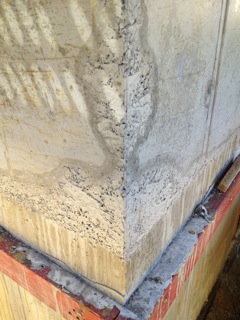
honeycombing at base of pour
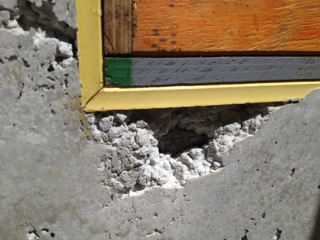
poor access for concrete flow
One thing I should definitely picked up on was the starter bars to the next level. Although this lift will be capped by a slab and the subsequent lift will then tie in after it has been cast, there are sections of the next lift where door voids are designed. By dealing with the lower lift in isolation I didn’t check the reinforcement plan for the upper lift and should have noticed that the reinforcement should have been closed off. As it stands now there is only a very short length of reinforcement at the top that will be enclosed by the slab. This is not a huge issue as the slab reinforcement can be amended to accommodate this oversight, however it does highlight to me how looking at the bigger picture will save time in the future. I should have ownership of the next lift from the start and will be able to manage it to completion with the correct Reo, and correct starts for the next lift.
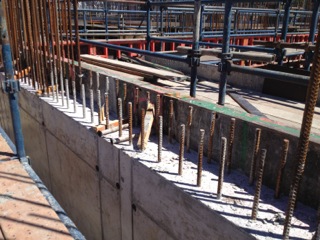
stubby starters
I am now looking at column and wall pours in the South Block from the upper car park level to ground level. In an attempt to make up some time it was suggested that the columns and ramp walls should be poured as one unit. I agree that this would save time in pouring, but after the issues with reinforcement fixing that I experienced with Riser 1, think that the additional effort of getting the whole thing formed and fixed could take longer than expected. The other option is to use couplers embedded into the columns and pour a more simple, un-structural flat wall at a later date. I will be looking into this next week.
My objective for this week is to get my head fully into the contracts. I have booked a meeting with the project commercial director to do this
Better late than never
Finally I have reached site. It has taken a fair degree of admin to move countries and a brief period of R&R in the wine region to pacify Nicky; apparently 36 bottles will last until next visit (24 Mar).
I attended a corporate induction at head office Western Australia which was a good welcome to the company but lacked any of the detail that I really wanted for AER 1 and mainly consisted of powerpoint presentations given by people who would rather be doing other things. A fairly standard induction I think. The following day was spent in an isolated cell on the top floor of the building frantically clicking my way through online learning packages that I was assured were essential for site. I was told on arrival at site that 2 of the 3 were not necessary immediately so although I will not have time to do them when required at least I will have done them in order to forget them later.
The site induction was interesting. It actually gave a pretty good background to the project and was pitched at all levels. The team building activity of completing a 21 piece puzzle was my favourite part, though some struggled more than others. I had the corner piece so nailed it early and decided to project manage from the back.
The project is huge and has advanced rapidly since Steve left, as such has been split into North, Centre and South Blocks, with the superstructures well and truly out of the ground. The North is more advanced than the South with the main cores well into jump forming with the decks chasing the cores up rapidly. In the Centre and South the majority of the piles are now capped and columns cast with work well underway on the first slab for the upper car park level. The ground slab has been leapfrogged as the E&M plan was not completed on time and would have held up construction (Proof that E&M’s worldwide are slow and unwieldy). This will be completed once the backprops have been removed allowing work to commence beneath the first slab. (I may delve into this further for a TMR as I am sure it was not a lightly taken decision). I can’t really provide much more detail as yet, as after day 2 my head is pretty much still swimming.
The local schools entered a competition to name the cranes. The winners were:
- Koolangkas
- Kranasaurus
- Magnus
- Sir Lift a lot
- Tall Bert (My favourite)
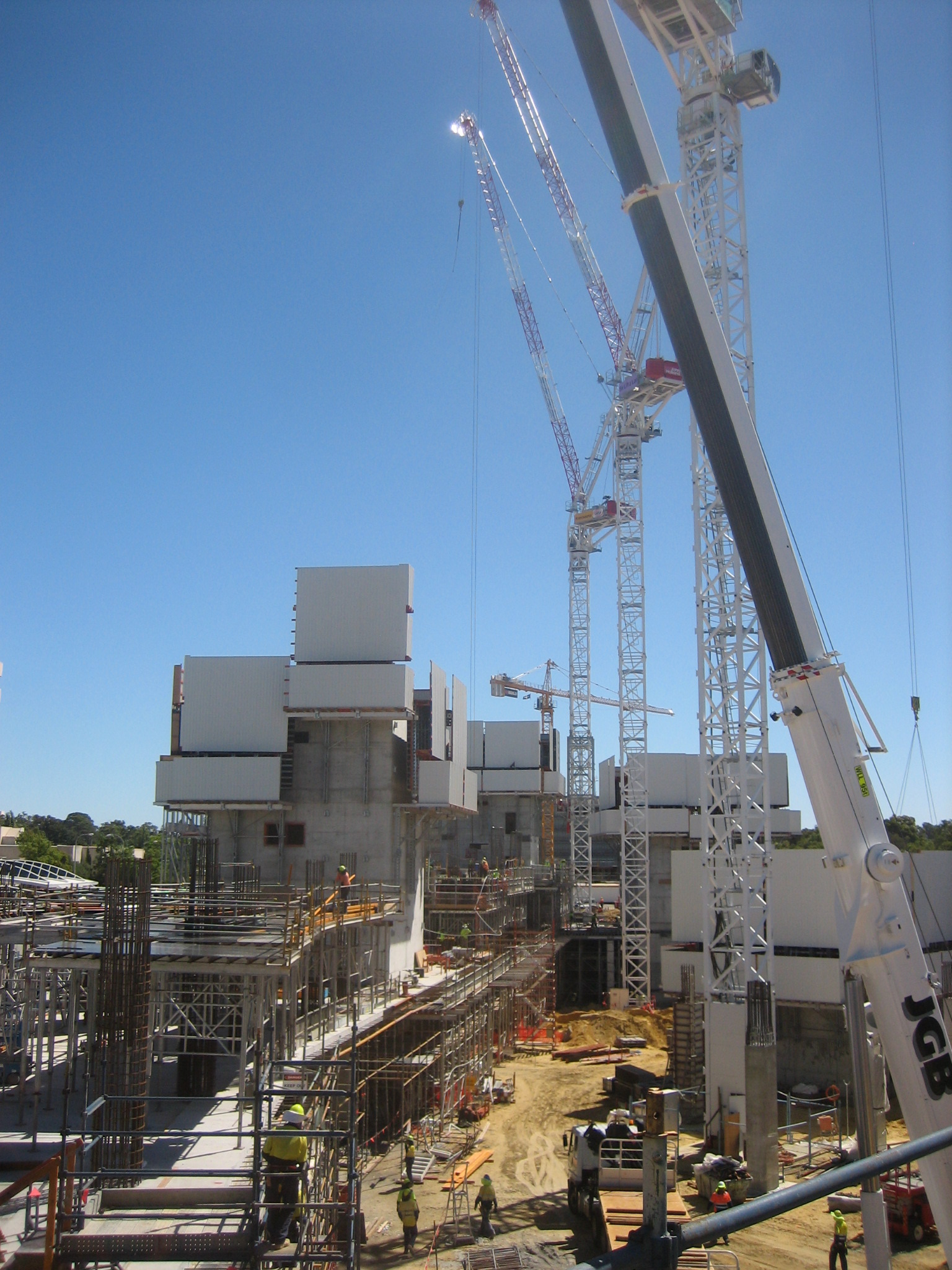
View from Core C – North (Tall Bert in foreground)
I have been appointed as a Project Engineers though I am currently shadowing the Centre and South Engineer until I can take of the training wheels and fly free. Could be a while. Initial chat was that I may take over the as Project Engineer for the Centre block but I am meeting with my PM next week to discuss my objectives and set a plan to achieve them.
My time currently has been spent preparing works packs for column pours and I will soon be looking at preparation of a slab pour. I have been out and about on site whenever possible mainly to bring some of the masses of drawings to life, but also to ask the other Engineers how we have got to where we are and why things have been done as they have to understand the history of the project.
I have been impressed by the quality of engineer on the project. Even the youngest of site engineers is incredibly knowledgeable and luckily, all are quite willing to lend a hand to understanding the processes.
I have only met a few Australians on site so far. In similarity to Rich, everybody else appears to be Irish. It is no wonder the Irish economy is in turmoil, they are all working overseas! Looking forward to Paddy’s day this weekend.
 Holdfast Training Services Trial Blog