Archive
Model in your hands
One of the projects being delivered by Arup has made use of QR codes on their design drawings to bring them to life.
You can scan the code on the drawing set with your phone camera and get automatically re-directed to a snapshot of the BIM 3D model. You can then ‘look around’ using the motion sensors in the smartphone. An example is here.
Anyone with the design drawing and a smart phone has access. Great for coordinating with a sub-contractor on site without having to be in an office with access to the software and model files.
Has anyone else spotted any novel uses of BIM/3D models?
Powerhouse
Thought I’d share an interesting and beefy mechanical services problem I’ve been landed with over the last few weeks.
Following a successful competition bid, I have been placed on the ‘Powerhouse Museum’ mechanical services team.
The Powerhouse is a new event/museum/art space project (think a mix between Science Museum and the NEC) that forms the ‘largest investment in culture and the arts in Sydney since the Opera House’ and has a budget of around AU$400m.
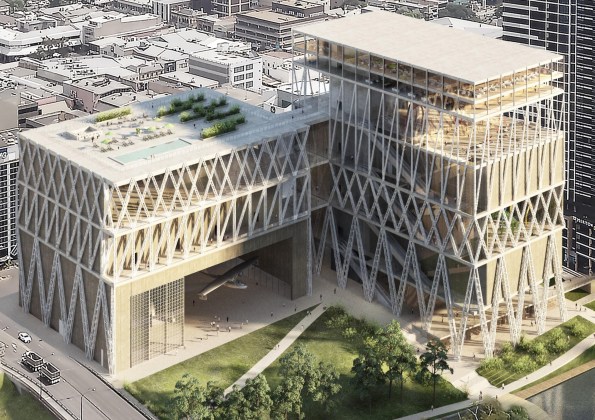
We’re at the very early stages of design and I’ve just finished knocking out the initial space conditions appreciation for the internal space in an attempt to provide some plant massing figures for the air handling plant.
All I’ve had to work with is a rough layout from the architect, depicted on ‘Rhino’ (coloured blobs depicting rooms/areas) and a very ‘strategic level’ project brief.
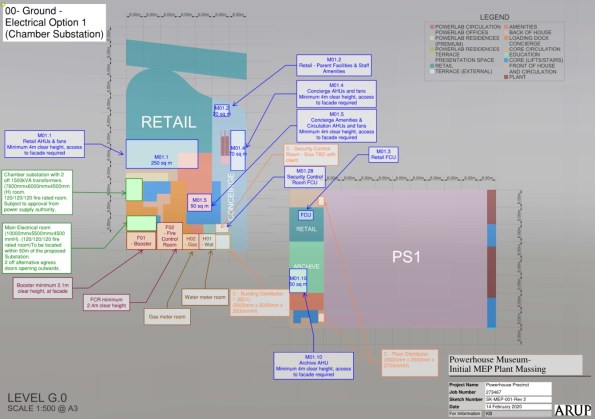
It quickly became apparent that there are some significant issues with what the winning architect wants, what is physically possible and what the Client (Govt. of NSW) can pay for. Not only has the building envelope shrunk by 30% whilst the expected space populations remain unchanged, the control level for the spaces is to the ASHRAE ‘AA’ standard (rigid temperature and moisture control to protect sensitive artwork).
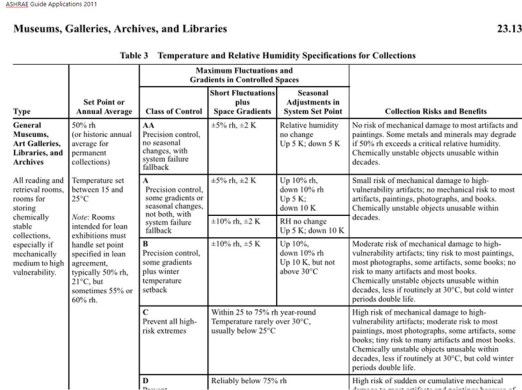
Helpfully the architects have allocated less than 1% of the floor area to plant space and are appalled that we may request more. Considering the location (summer 40+ degrees and high humidity) and the fact that the façade is all glass…my numbers are coming out silly sized!
Taking the largest presentation space as an example – the space is approximately 3000m2, with a floor-to-ceiling height of 30m. Current plans have this space with a peak population of 5000 people (0.5m2 per person).
I’ve had to make some pretty savage assumptions to ensure the entire structure isn’t just filled with plant:
- Firstly, the assumption that the population will reduce, so I’ve been modelling at 50% occupancy relative to the original value
- Secondly, we will only be treating the lowest 4m of the room
Even with this, to ensure minimum indoor air quality I need to deliver over 40m3/s of cool air to the space. This OA requirement, coupled with the estimated heat gains, sees a cooling load in the order of 1.4MW; and this is one of seven presentation spaces.
Another big issue is how we deliver the cooled air to the space. With a 30m high space, the means of controlling the mixing with the layer above 4m, which will have its own humidity, temperature and stratification presents a problem for control. ‘Top down’ delivery sees the air thrown 26m before it reaches the 4m layer to be cooled. I conducted a benchmarking exercise against other museums, which seem to favour floor level grills. These require thicker walls for the ductwork – however the spaces they are used are kept relatively small and are located at the core of the building to assist the plant.
What is inflating the numbers is the rigid control class and the population – these are our first targets to ‘manage’ with the architect. I get the impression that this is a once in a lifetime/legacy project for them and the museum curators; as such they’ve asked for all the bells and whistles.
Thankfully, the Client has appointed Arup directly – so there’s some leverage to play with when interacting with the JV of French, Japanese and Australian architects!
Does anyone have experience of controlling temperature in very large spaces? I’m thinking that airports will have similar volumes, albeit with more flexible control regimes. Can you throw air that far, still maintain control and not ruin the comfort conditions with the effects of draft?
Construction Declares…
In the vein of sustainability that seems to (thankfully) be gaining traction, I was reading the Arup newsletter and came across the ‘Construction Declares’ petition (https://www.constructiondeclares.com/).
The intent is ‘to unite all strands of construction and the built environment in a public declaration of the issues facing our planet and a commitment to take positive action to prevent climate breakdown and biodiversity collapse.’
Since June 2019 over 800 UK practices have made the declaration, with firms in 17 other countries (including Australia) beginning to sign up. With the construction industry contributing to 40% of global carbon emissions, this seems like a positive step. However, it has yet to set any SMART targets, remaining at present the start of a ‘wide-ranging declaration of intent’. Let’s hope it goes somewhere.
Arup have signed up and released a detailed internal sustainability plan. They have also incorporated performance indicators for the 17 UN ‘Sustainable Development Goals’ (SDGs) into their design process and have project management tools to match.
I’d be interested to hear how other consultancies are treating the problem? Has your Phase 3 organisation signed up? Can you be your firm’s ‘Greta Thunberg’ and start the change from the inside (…and tick that UK-SPEC box)?
Buildings as ‘urban mines’
On the same vein started by Ali wrt sustainability – a short read from the ‘lefties’ at the Guardian that I found interesting:
The construction industry accounts for 60% of new materials used, a third of waste and 40% of the carbon emissions. A few countries are starting to turn construction into a circular process, with ideas such as ‘building passports’ detailing every component for future re-use; ‘building elements as a service’, with ownership retained by the manufacturer and buildings never truly ‘owned’; and old buildings being ‘mined’ for useful materials.
In my (short) experience so far in a city based Phase 3 – the lack of space means that many of the projects are ‘re-imaginings’ of a current, in-situ structure. That being said, the place is gutted and, with a Client focus on ‘going green’, replaced with facades and services to achieve 6-stars (GreenStar). In this way Sydney is slowly upgrading its ‘old’ stock (bear in mind many of the buildings are less than 50 years old, modern Oz is young!) and improving its green profile.
Has anyone found this to be a trend in other major cities, or indeed wider? I get the impression that Europe is leading the way.
For those with experience with the RSME refurb – did they consider sustainability, or was it a ‘lick of paint’ for those old, drafty buildings?
A blog on blogging…
The PET Blog so far for me has been a scary place, full of complex Civil treatises about mud and concrete. So I questioned – what do PEW want from a blog?
Now that I have moved to Phase 3, I’ve discovered a similar concept at Arup. Called ‘Yammer’, it seems to be an avenue for the sharing of short dits that could be useful across multiple project disciplines, or to succinctly frame a problem and ask for advice from across the company. Being a much larger organisation (c.14,000 personnel), the blog is split by discipline/area and includes Project Management, Building Services, Bicycle Users Group etc etc.


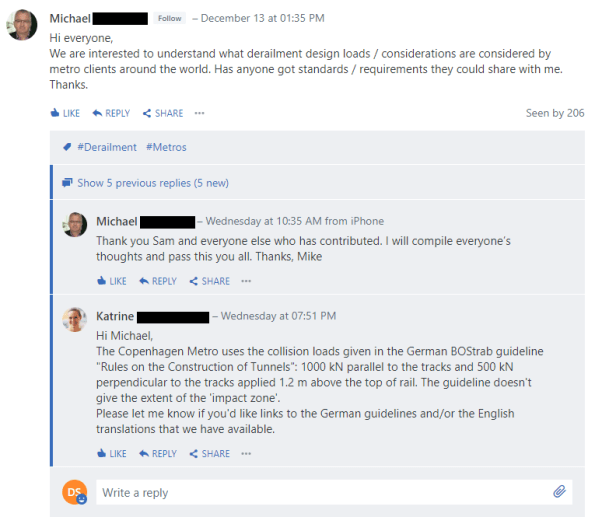
Arup blog examples from ‘Yammer’
It has made for some interesting reading and has demonstrated, at least for me, how useful a blog could be as a knowledge sharing device. The short, quick nature of their posts takes little from their day, but the benefit is obvious. I also think that keeping it short promotes involvement from a wider audience. But this is just their way of doing things.
I’d be interested to hear what you guys think about what the PET blog should be – What do we want from it? Is it being used in the best way? How should we be using the blog? Should we set Cheese and Groom a word limit?
Have a good Christmas and NY! Back to the beach…
 Holdfast Training Services Trial Blog