Archive
Load Testing with a Difference– 25 NOV 16
So Bridge 1 is complete. This is the temporary structure that cuts across our site and provides access to adjacent phases. Its construction will facilitate our basement excavation in due course. Broadly speaking it is a motorway over bridge. It spans 80m over 9 spans (the largest of which is 18m) has a 7.3m carriageway with a maintenance footpath on either side. It has been delivered on time, on schedule and possibly to budget… Probably not to budget as the client’s scope was so vague that the trade contractor has taken him to town with additional items. I have spent the last month or so compiling Site Instructions to complete the bridge in line with the client’s intent.

Bridge 1 Aerial View – An adjacent phase 40T artic can be seen on the bridge ready to be offloaded
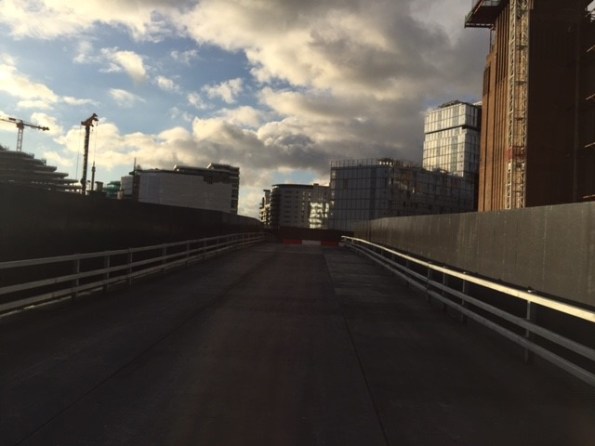
Bridge 1 – Deck View
Most recently, I have hosted a series of visits from various client representatives that have not just moved the goal posts but completely changed the sport… The design brief was cast in stone well over a year ago. The structure of the temporary bridge was to be designed as a private access road and therefore Highway regulations did not apply in their entirety. Clearly, the client and designer cherry picked areas (crash barrier rating and bridge loading for example).
From my perspective, the past month or so has been challenging, the client’s expectations are wholly unrealistic. My “favourite” client check was the load testing dry run conducted last week. Photos below:


Porsche Load Testing
The test to confirm the ground clearance for sports cars was successful as the Porsche did not ground out at any point. However, from my perspective, given that the gradient was dictated by the existing road profile at the entrance to the site and the final road level at the permanent HALO Bridge. How could the bridge deck profile have been altered had the sports car test failed? Answers on a self-addressed postcard please.
Sustainable development on site
Fellow PETs, rather then clog up the Watsapp I thought I would bring a query here…
Whilst writing AER 3 I have noticed that I have still some way to go to get ‘Ability’ within ICE attribute 7 – Sustainable Development and I was wondering what methods other sites have. On site at Southbank Place there are a few schemes that they have used to try and tick the sustainability box; they have employed operatives from the surrounding area, use sustainably sourced aggregate for the concrete (according to London Concrete anyway!), used precast elements in the design and not worked past 1800 so that there is limited noise pollution. To me, there does not appear to be a massive emphasis on being sustainable; it is just a box to be ticked. I went to Laing O’Rourke’s in house lecture (delivered by the project leader on site) on how they are improving sustainability across the business. The project leader managed to cram the hour long presentation into 10 minutes and left me with the feeling that sustainability was viewed more as a hindrance than anything else.
Has anyone had similar experiences? What sustainable development initiatives have you had on your site?
Having a cracking time – wish you were here!
There have been a lot of posts about concrete recently so I thought I would throw my hat into the ring with some issues I have been having with reinforced and post-tensioned concrete. The client was walking around site and went mad about some surface cracking that we are experiencing in the car park. This sent the PM into a flap and I was sent out to investigate. I took these photos of the area she was concerned with.
![IMG_5557[1].JPG](https://pewpetblog.com/wp-content/uploads/2016/11/img_55571.jpg?w=595)
Surface Cracking caused by rapid water loss.
![IMG_5554[1].JPG](https://pewpetblog.com/wp-content/uploads/2016/11/img_55541.jpg?w=8064)
A crack along the top of a ramp – not really a concern though.
However, while on my crack patrol I came across this crack- that hadn’t been spotted by the client or the PM. Now it is big enough to fit a credit card into so I was concerned. I immediately checked the propping and found it to be in good order.


These cracks are in a post-tensioned slab that has not been tensioned yet and are a very different beast. Normally PT slabs are initially stressed 24 hrs after pour and then stressed again after 72 hrs. The advice I had from a consulting engineer from another company was that you should expect big cracks to form because PT slabs are not as heavily reinforced. The small cracks turn into one big crack, so don’t worry about cracks until the slab is fully stressed. I called the engineers working on this slab and other than a visit yesterday they have slipped into radio silence. We are leaving these tendons until last but, we are stressing the rest of the slab now. If we have still heard nopthing back form the engineers our intention is to isolate the area and then stress the tendons. I will let you know how it goes.
How to construct a geo-thermal borehole
I am now three weeks into the construction of what will be the UK’s largest geothermal borehole field with 170x 200m deep Boreholes.
So here is the rough method of construction:
Install a 6m casing to protect the top of the borehole.

Using a specialist drilling rig, bore down 204m. Throughout the drilling, clean water is pumped into the borehole to reduce the temperature and help remove the spoil.
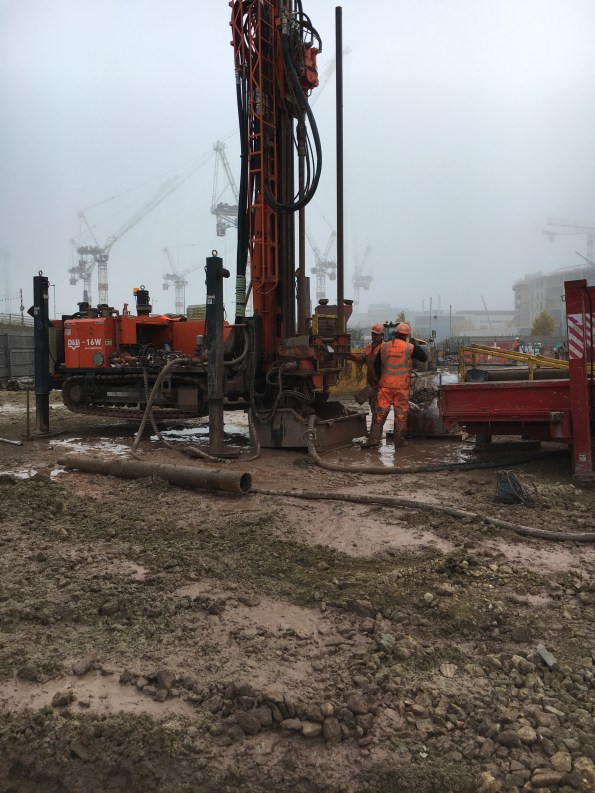
Once at depth, recover the drill rods. During this phase, the rejected water is collected and pumped to a mud-cleaner so it can be used to drill the next borehole or can be used to flush the borehole. The mud-cleaner adds a coagulant to help remove the fine solids and the slurry is then passed through two screens to remove the larger muds (On the let hand side of the mud-cleaner). Then the slurry is put through a centrifuge to remove the fines down to a size of 4microns. The clean water is then stored in the tanks along the bottom of the mud-cleaner or the reserve tank. The mud removed from the water is deposited in skips for off-site disposal.
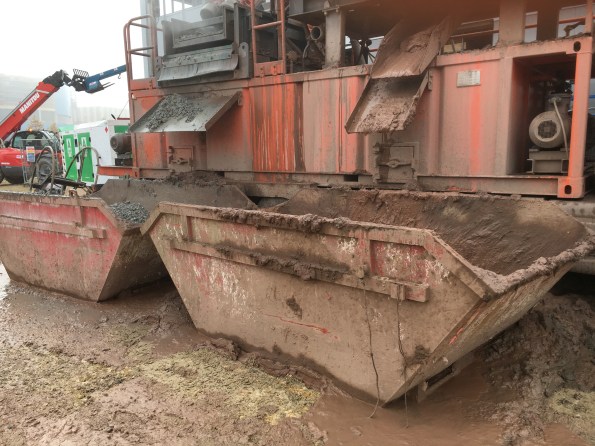
Remove the muddy water and replace with clean water to reduce the buoyancy of the pipework. This is known as flushing.
Drop 2xpipe loops and a sacrificial pipe (green tremmy pipe) down the bore. To reduce the buoyancy of the pipework, the pipes are filled with water and a 230kg sacrificial weight is connected to the end. The pipe are installed using a specialist spool and a telehandler.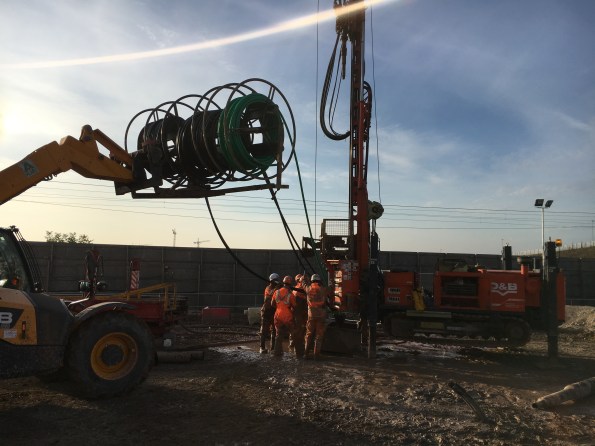
Pressure test the two pipe loops. Both u-shaped black pipes are tested at 8 bar for 30mins and then at 4 bar for 1 hour. Initially the pressure will dropped as the pipe expands and so the pressure is topped up. Towards the end of the test, a reduction in pressure points towards a leak.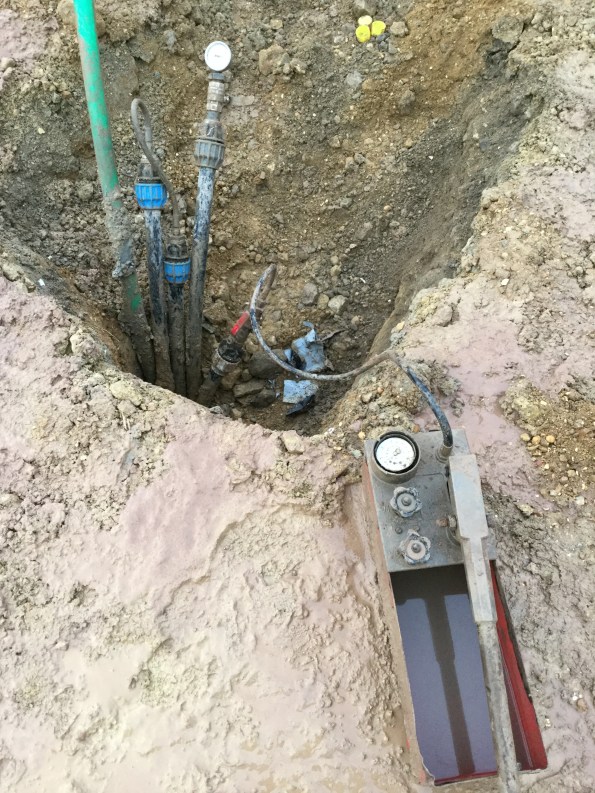
Flow test the pipe loops to check for blockages.
Backfill the borehole with thermal grout. This grout consists of bentonite and Chelmsford 52 silica sand with a silicon dioxide content of 97%+. Just enough water is added to the grout to make it ‘pumpable’. on my site we are using a 5.5 to 1 sand-to-bentonite ratio as this gives a thermal conductivity of 1.8W/Km2. The grout is mixed in a hopper and a sample is taken at random. The grout is pumped to the bottom of the borehole through the tremmy pipe which means that during filling, the water in the borehole is pushed up and rejected. This water is collected and pumped to the mud-cleaner to be cleaned and stored for future use.
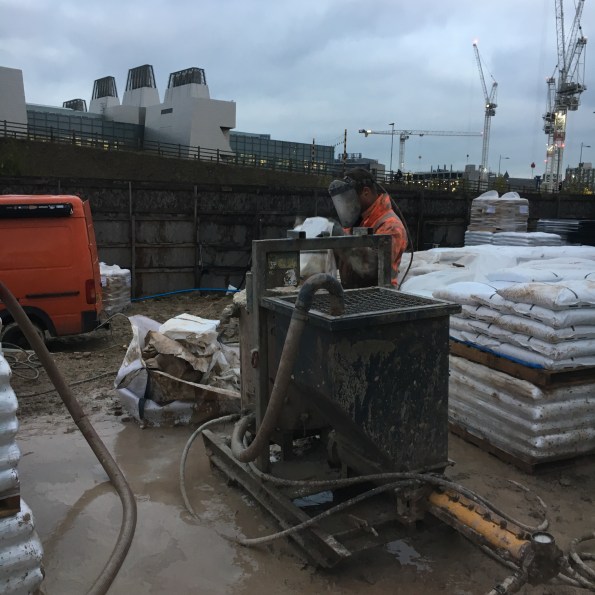
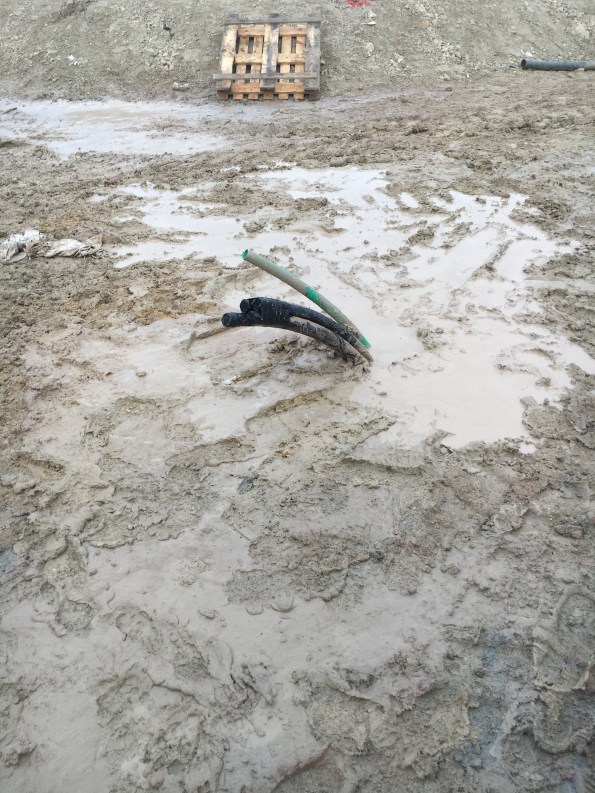
So that is how to construct a vertical heat exchanger for a Ground Source Heat Pump System. This is the end result ready for the horizontal pipework to be installed.
Dealing with Delays
The pace of work is speeding up as I reach the last month of my phase 2 attachment. Excellent news *insert sarcasm*.
The finished Bond Street East shaft structure should now be complete to accept tunnel ventilation equipment; cut-away graphic shown below.
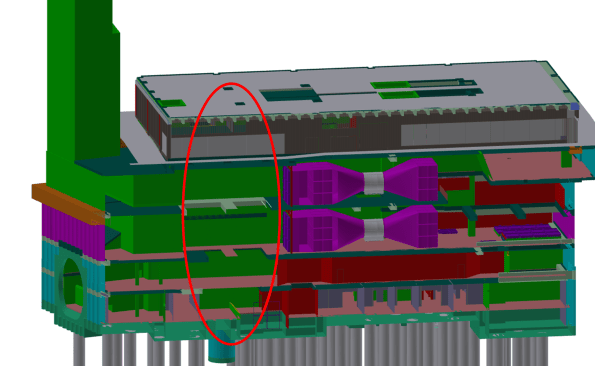
Graphic of the station structure; the ventilation equipment is shown in purple. The red oval denotes a gaping hole currently being filled by the civil contractor (see next photo).
The station structure was due to be complete by Aug 16; however the current site still has no roof, no lights, unsealed walls, etc; as shown in the figure below.
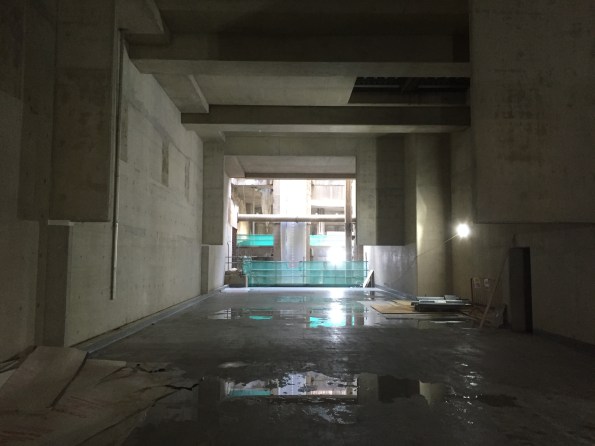
Tunnel vent fan room, missing the end wall (see previous image) and some weatherproofing, paint, permanent lights, etc….
As a result of this delay the mechanical install (by ATCjv, my placement company) has to happen concurrently with the remainder of the civil works to make sure the trains can start running on time. The past few weeks have therefore been dominated by ‘collaborative planning’ to mitigate the civil contractor’s delays. I have eaten through a couple of packs of post-it notes and a lot of coffee to achieve an integrated 8-week plan that both sides agree on, see below:
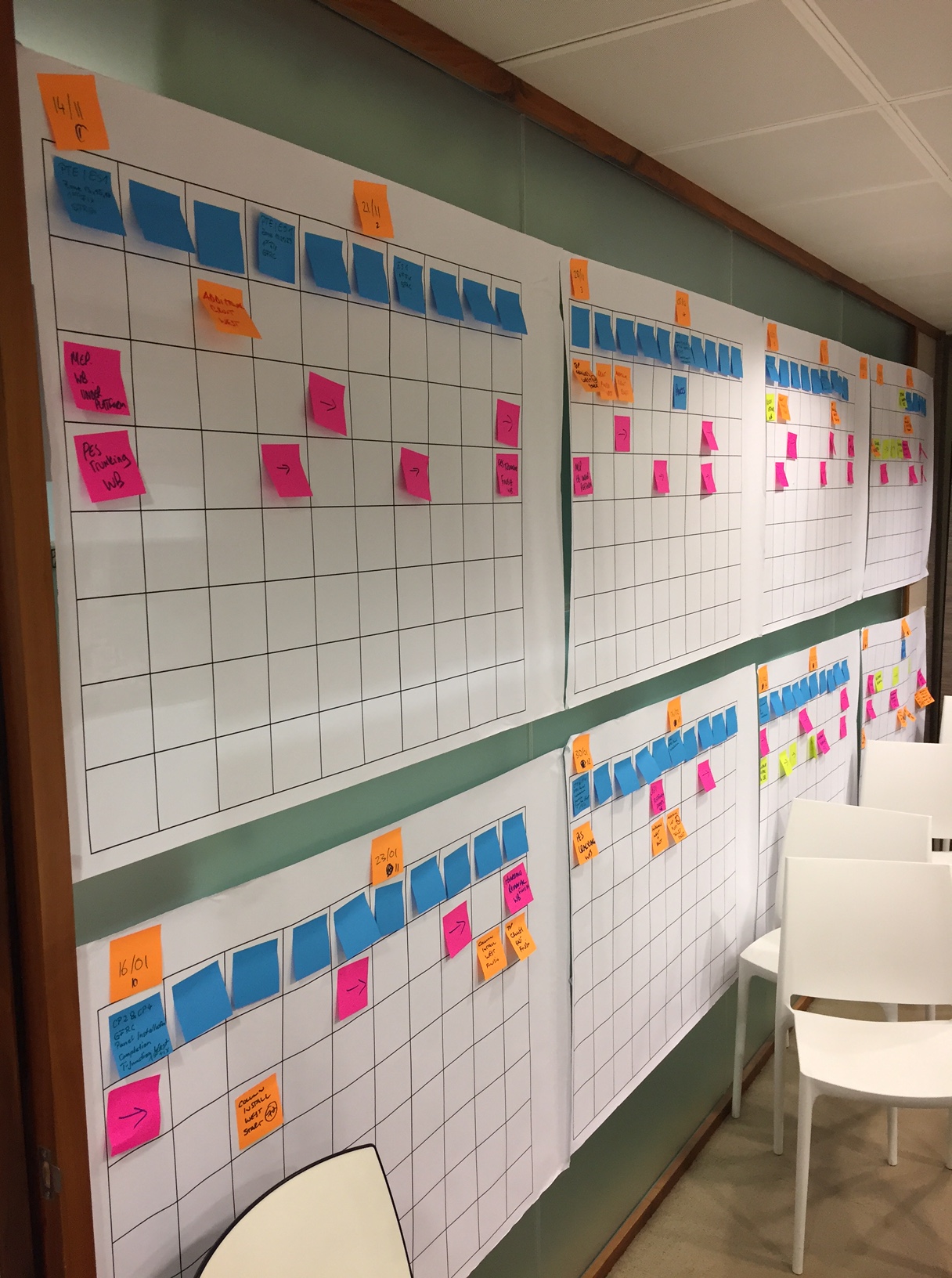
This is all to achieve an interface control document (ICD); a kind of access and working contract where ATCjv mechanical works are installed in another contractors site Prime Contractor (PC) area. The process has also been a contractual minefield as the ATCjv works information assumed we had uninterrupted access to the entire structure.
The handover process should follow these steps:
- Civil contractor finishes structure.
- ATCjv accept structure and conduct a condition survey.
- Both sign an ICD and ATCjv start installing mechanical ventilation kit.
The actual process has been:
- Civil works delayed by >5 months.
- ATCjv have to start install to achieve Crossrail opening date, 2 weeks of collaborative planning commences.
- ATCjv rinse Crossrail (the taxpayer) for compensation events. ATCjv hide all their delays behind the civil contractors problems.
- ICD signed and mechanical install starts
It has not felt comfortable knowing that I have been part of the dodgy contractor game of blaming all our problems on a third party and getting a wedge of extra money out of the client/taxpayer…. welcome to construction.
On a brighter note we have achieved actual mechanical installation at our Tottenham Court Road site; one gantry crane installed and commissioned on programme. However, I can’t help but feel out-done by the size of Jo’s man-size crane.

How to erect a 390D tower crane
I thought i’d put up a photo montage of the erection of our second tower crane in case anyone had ever wondered how it was done – the crane is a 390D self climbing core crane with a 25t lifting capacity. I know it will especially interest all you E&M engineers out there 🙂
- 4 double towers and the slew ring erected first


2. Cab and machine deck crane on top of slew ring


3. A frame is craned into place


4. 45m boom erected in the loading bay completed with the compulsory Multiplex signage, electrical fittings and the monkey. Note the red and white markings in accordance with pan ops regulations (as we will be protruding into the ‘flight zone’ for a period of three months).


5. Cables fitted to secure the boom and prepare for lifting load
Spot the fearless bloke running around the boom!!
6. The final product awaiting commissioning…
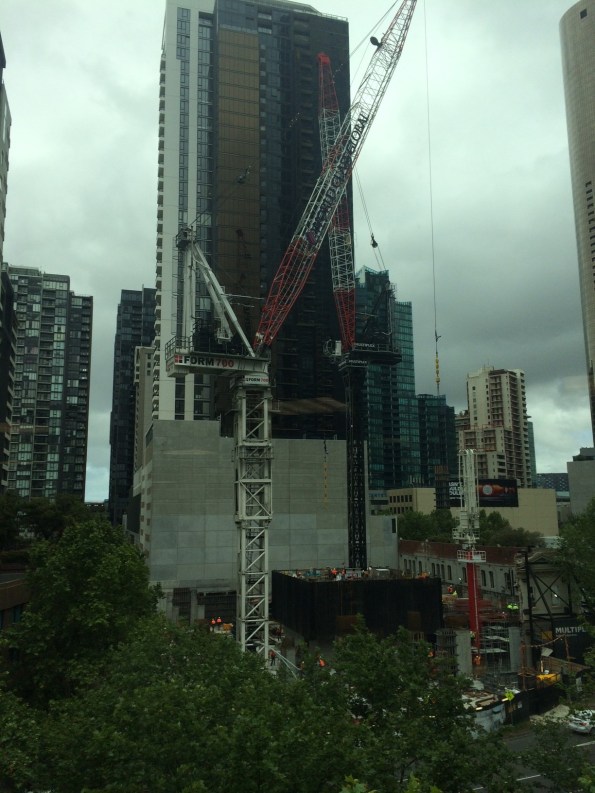
All in all this effort took two 2 days to complete over a rather gloomy weekend.
P.S Tom’s addition to my blog following his comment:
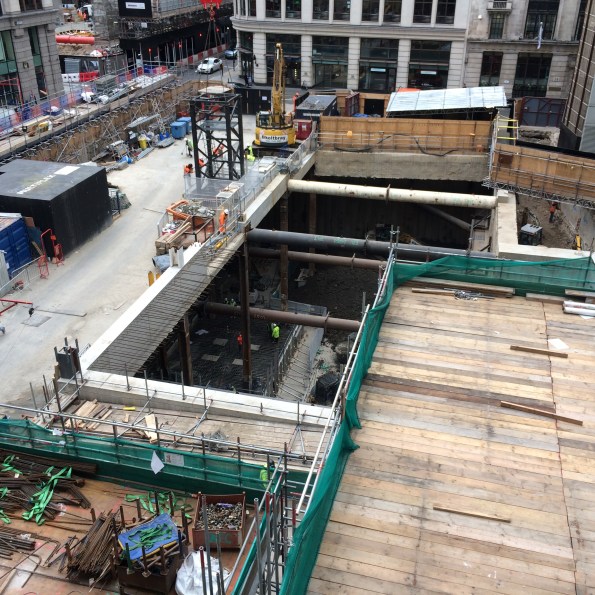
Temporary Works Inspections
The Temporary Works Design Manager thinks that I was appointed as the Temporary Works Supervisor (TWS) a couple of months ago, but in fact I refused to sign the appointment letter because I’m not wet behind the ears and I recognise a hospital pass when I see one. Apparently all of his underlings have refused to tell him this though. Regardless of the formalities I have in fact been fulfilling the role of TWC and TWS (the temporary works department are woefully under resourced) since we started on site.
The temporary works implementation process has now been issued so I have defined roles and responsibilities to discharge and am happy to take up my appointment (for the few weeks I have left on site). My first task was to formalise the temporary works inspection register, in accordance with the process that I helped draft, and to produce a template for other sites within the project to use.
Most of our work is managed by one main subcontractor (Volker Stevin or VSL) therefore we have stipulated that they submit their own inspection records to me and I will review their records and conduct spot checks on their paperwork and their temporary works elements on site.
As luck would have it I’ve poked a bit of a hornets nest with the first item that I chose to review, namely the access gangways that they use between shore and the jack up barges. The proprietary system used is shown on the pdf. They have improvised a fixing detail to the ancient timber on top of the jetty wall and have made no allowance within the design for any horizontal actions despite the gangways being used at an angle.
When I queried this with VSL they initially tried the “proprietary system” defence from personnel of increasing seniority (Senior Engineer, TWC, then Site Agent), followed by the “but we’ve only got it on site for a few more weeks” defence, followed by the submission of random bits of information that don’t actually answer the question I’ve asked them.
As “prove to me that this is safe” wasn’t working I have asked them for confirmation of what specification has been given for the fixing detail, what it should be fixed to, maximum angle of the gangway, restraint against sliding, detail of connections between gangways, and whether accidental actions been considered. Unsurprisingly the site team could answer none of these questions and have farmed them out to their designers. Which leaves me with the interesting question of what to do in the meantime, as no-one apart from me really seems to want to push the issue for fear it may delay the works.
Note: The image below is actually an earlier image where the gangway spanned from shore to barge and there were no issues with the use of the gangway. Currently the JUB is further out and one gangway spans from the jetty to the inner pile line (sloping down as the piles are lower than the jetty) and another gangway from the piles up to the JUB. I will upload a more recent picture when I can get back up in the cage, and also a close up of the improvised fixing detail on the jetty. [Picture updated 11/11/16]


One for the civils – concrete
We are having some issues with the supply of concrete meeting the specification (its under strength) and I am curious as to why and how this could have been managed better. I don’t think the contracts are robust enough to manage the risk of getting it wrong as we appear to be dealing with the aftermath of it all rather than our subcontractor. Tail wagging the dog scenario. The questions goes out there as to whether anyone else has had any major dramas with their concrete not meeting the required standard and have you had any issues with your supply chain? If so, what has been done about it?
Repeat answers from the whatsapp group greatly appreciated 🙂
What I wish I knew before starting phase 2!
This kind of links in to AER3 and a discussion that the civils were having on WhatsApp. I will leave the concrete supplier conundrum to Jo. But I hope my fellow Phase 2 PETs will all add comments.
I wish I had agreed from the outset that I would do 6 months on the site team then 6-8 weeks with the commercial team.
I also wish I had more of a data base of TMRs and AERs to baseline against.
Implementation of Compensation Events (CEs)
I start my Phase 3 attachment on 5/12/16 at Expedition Engineering (http://expedition.uk.com/). This is conveniently close to my current site, which will allow me to come back and investigate anything interesting, hopefully mitigating the few months I was waiting around for works to start on site. Whilst Expedition are content that they can easily provide the right experience in most of my attribute fields, they have asked me to focus on achieving experience in commercial and quality areas before I leave site, as this will be harder for them to deliver for me in Phase 3.
To achieve this before Phase 3, on the commercial side I will be working with one of the QSs to review subcontractor notified compensation events (SNCEs). On the quality side I will be managing the Inspection and Test Plan (ITP) for the tie rod installation within the cofferdam, and I have set up the temporary works inspection register for the PC and sub-contractors across all Tideway East sites. This blog will provide an update on the commercial side.
Volker Stevin (VSL), the marine subcontractor, have been sitting on a backlog of around 60 CEs (values between 1,500 and 190,000), and having boosted their QS numbers recently they are now looking to progress as many of these as possible. VSL have reportedly confessed to under quoting their works (although not deliberately), but had I not known this already it would be obvious from their CE quotations, where they have attempted to double (even triple or quadruple) bill their own labour, and S/C labour and plant across multiple CEs and their original tender.
The majority of the CEs have arisen from an Instruction to Subcontractor (ITS) or Instruction to Submit Quotation (ISQ) issued by the CVB to VSL. To speed up the process of reviewing and implementing the CEs we agreed the following process with VSL:
- CE Quotation submitted by VSL to CVB. Quotation to include:
- Excel copy of the quotation so I can add the CVB assessment
- Any relevant sub-sub-contractor quotations
- Any time/ sheets or record sheets- signed.
- Any relevant delivery tickets/ transfer notes
You may have noted that some of these are records – as VSL have allowed a backlog to accumulate then CVB are in the fortunate position of having these records available as some of the work has already happened. However, this is not usually the case with a CE quotation which is normally made in advance as a forecast. This could arguably be an unfair advantage to CVB, but CVB have allowed additional time for the quotations to be submitted, and not submitted their own assessment after the 21 day period allowed.
- One round of questioning. My comments are fed to the S/C through the QS.
- Following response to the questions hold a CE meeting to agree the terms for implementation of the CE. The quotation for the CE is then added to the project target cost, with a 50/50 pain gain.
The CE assessments are slightly complicated by the need to constantly cross reference against a CE for delayed access to site. This stems from the delayed handover due to the overrun of the enabling works PC.
The key points so far are:
- Designers can get carried away with creating the best “X” the world has ever seen, without thinking about who is paying for it. I have had to go back to designers to clarify where requests for changes came from to establish if it is additional instructed works that we are then eligible to submit a quotation for. So what – a PMI from the Client we can go back to back on the CE quotations, if it’s something that we missed in brief to the S/C then CVB foot the bill.
- VSL are more than happy to waste my time by double/treble/quadruple billing in the hope that one will make it through to implementation. So what – I have asked the QS to keep a log of the staff allocation to the CEs we are implementing so we can reduce double billing, and to compare all CEs to the back to back CE for delayed access to site.
- There is an agreed schedule of rates for staff billing, but not agreed productivity rates – so what – I can ignore the hourly rates and focus on the seniority of staff and the tasks they say they will be conducting (such as Site Agent supposedly setting out formwork and supervising the works, and the forecast of 20 hours of welding for welding tie rods to two metal plates). [Update 11/11/16 – Following my enquiry about productivity rates for staff and tasks the Senior QS has now instructed that we capture the precedents in the CEs that we are implementing to ensure that we apply them consistently. This will also help with policing the SNCEs we review and improve the consistency of VSLs QSs, as one is currently much more realistic than the other.]
- VSL want to implement the highest CE quotation possible so they have a chance at a large gain share. You might think that CVB would welcome this as we get a share too, but there is the risk that the Client will implement a lower sum and CVB could have to foot the difference.
- We need to come up with a policy for accounting for overheads for items not required on site, but for which the sub sub contractor will still be paying for as a result of the CE. For example – the fencing gang is on site longer as a result of a CE, they have a van which is not allowed on site due to the Works Information, but they are still paying hire charges on the van and would be using it if they were not still on site as a result of the CE. We’re still working on this one and are keen to get it right as it will set a precedent for some significant amounts in some of the CEs. Any suggestions?
The next blog will cover the quality and temporary works elements.
(Update
 Holdfast Training Services Trial Blog