Onwards and upwards
This week has seen reasonable progress although in my humble and inexperienced opinion the subcontractor carrying out the FRP works holds too much control over proceedings and the rate of progress. We have a programme which most of the engineers/management look at it and utilise but I am more convinced following this week that the subcontractor couldn’t care less what the programme says as they tend to look no more than 3-4 days in advance depending on their mood that week and a more honest appraisal would probably bring that down to a ‘one day at a time’ philosophy. At present we have no regular meetings/O groups regarding Dickson Rd as with all the other structures there seems no ‘stomach’ for them or belief that anything good will come from one. There is a weekly Structures Team meeting which lasts around 90 mins and does a great job of providing situational awareness to the rest of the team regarding all the work throughout the project. My goal over the next few weeks is to try and implement a weekly progress/forecast meeting by where we review the work done the previous week against the programme and highlight any issues and more importantly forecast what we want to achieve next week and get the subcontractor to ‘buy in’ and agree what we can achieve which may be different. We engineer’s seem to chat a lot and decide when things will be done without consulting any of those actually carrying out the work. The subcontractor seems to be a sensitive beast to me (apparently not the best but certainly the cheapest) which I am sure has nothing to with the fact they are all Irish but certain management individuals are somewhat prickly by nature.
Dickson Rd is progressing with both Pile Caps now complete and backfilling of material complete on one and about 80% complete on the other. This now means we can focus on the abutment walls which I was hoping the subcontractor would start with erecting the scaffolding late last week. Clearly this wasn’t organised earlier enough to get it delivered on site for Fri morning or it was decided they had worked hard enough for the first 4 days and fancied a slack Fri before the weekend. Both abutment walls are 14m wide and 9.4m at the heightest point (due to cross fall) and we intend to pour both continuously which will be about 140m^3 each. Concurrently throughout the week we have constructed the shutters for abutment A and we have completed the steel fixing and forming up of the outer base slabs of the Embankment Retaining Walls (deflection walls) which we will pour on Mon morning. I am very close in being able to close down my first worklots which were the piling works but I am still waiting on the 28 days concrete test results and the Pile Integrity Test results. It seems the PIT’ing didn’t go well and the results were inconclusive. This seems to be down to the individual who carried out the readings who was actually the supervisor when we were piling. The Engineer who interprets the results has said he will now come out and re-test (free of charge) but clearly we now have a 1.2m deep pile cap between the surface of where he can test and where he should be testing – I wait in anticipation of the findings!
Kemps Creek bridge is really becoming very tight for time as we approach the handover deadline to the rail team. I was on Sat duty and predominantly carried out labouring duties as we worked towards having the bridge deck ready for the waterproofing subcontractor to start on Tue and a joint sealing subcontractor to fill in the gaps between the parapet wall sections on Mon. A slight annoyance has been that the remaining pre-cast parapet wall sections were delivered without halfen channels cast into them so that we can bolt them on to the brackets. Out of around 2500 parapet sections on this job these four are the only ones without fixing points and they were actually detailed on the drawings as so which none of us picked up on. The designers response was “we didn’t think you would need them” which was puzzling. So Sat was spent drilling new fixing points and grouting in threaded bars ready for Mon so we can install the remaining sections and then pour the final CSR walkway sections to tie them in. Other work includes crack repair and closing out certain Non Conformance Reports so that that Rail can take over the site.
Sorry for the lack of photos but I have had a media issue today – misplaced camera.
The Storm after the Storm
Monday – Rainy/Stormy
Tuesday – Rain/Stormy
Wednesday – Rain/Stormy
Thursday – Patchy Rain/Windy
Friday – Sunny with spells of rain.
So, even though, over half the workforce is Irish, Tradies in Australia don’t work in the rain! I think they must melt.
The Zone 5 suspended slab sits quietly rusting in the South, and now the clients are unhappy that there are rust patches on the formwork. This was also an issue with the Zone 4 slab but after negotiations at PM level, JHG eventually issued a site instruction to the formwork contractor (who is responsible for a daily blow out of debris (including tie-wire) from the slab) to powerwash the deck. It visually made bugger-all difference but there are minimal rust marks on the soffit now the formwork has been stripped. On the stripping of formwork, I did think it was rather open beneath the slab and pretty soon realised they had stripped all the backprops. I asked the question of the formworker whether he thought it wise to strip all of the propping from a suspended slab on which they were forming the next level on, but he seemed fairly unfussed that he was stood under a loaded, unsupported 3week floor. I pointed out the requirement for backprops in the design and sent the email to ensure it was rectified.
The big news for the week is that the structural engineers report into the Zone 3 concrete has come back and indicates that although the concrete is not to the expected strength and exhibits de-bonded steelwork and delaminated aggregate in some places, these places are in areas of contra-flexure and therefore any remedial work to the slab may in fact make the situation worse. This is a massive bonus as I was expecting to see Sappers down there chipping out concrete with chisels. We can now forge ahead and form up the columns and decks and push onto ground level.
The rain did very little to affect the programme, it only affected the amount of work completed during the week. Therefore milestones that were set to be complete in May remain where they were before the inclement weather and Strike action. This increased pressure on Engineers to hit targets doesn’t really transmit to the tradies though who continue to amble along at their normal pace. Frustrating.
The phrase that has been thrown around most of the week is attributed to one of JHG’s senior managers who stated during the planning for the NCH that “It doesn’t rain in Perth so don’t factor in that many days for wet weather.” Sensible. This decision was also made at a similar time as the one not to build in days for strike action – we currently sit at about 25days in just over a year lost to industrial action.
I organised a meeting with my PM this week to discuss a few issues that had arisen over the last few weeks. I put my suggestions to him as positively as possible in an effort to make them heard and maybe effect a change in the team structure. They were:
- A weekly mid week meeting to RAG status the Short Range Programme in order to proactively manage and focus the effort of the team for the following days to meet the level 3 milestones. Currently the SRP is slipped weekly and I don’t think there is any buy in by the engineers as there is no real incentive the aim for milestones if they are all verging on impossible from the time of publishing.
- Following on from point 1, a team review of the SRP to set realistic targets that will be bought into as everybody would have had a role in the planning. I quoted the Project Director who said “I realise the SRP’s are near impossible.” By having a programme that is not achievable, targets are continually missed and this damages team morale.
- Following on from point 2, we need a team social. Time is obviously short so a day out of the office is not feasible, and nobody would go for a weekend, so I suggested volunteering for a charity for the afternoon (assisting in local image and sustainability targets set by JHG) or at the very least a team lunch for 2 hrs once a month. I had also noticed that in the pub down the road from my house there is the 141 challenge (141 beers to be imbibed by a person or team in the shortest time possible – 28mins seems to be the record, so must have been a huge team or big drinker, but days seems quite common). Probably not in keeping with the 0% tolerance on alcohol on site though so maybe this is just one for after my TMR submissions.
The overall thought on my suggestions was that they are not new, there are changes in the pipeline, and a monthly lunch would be good. 1 out of 3 isn’t bad. I am still planning on a daily “RAGing” of the South area as a method to highlight the risk to the Snr Engr and PM.
So the Stormy weather has ended in time for the weekend, now the next couple of weeks look set to become a thrashing to meet the milestones that are in danger of being missed.
On a brighter note, I have just fired up the BBQ.
A bit too quiet…..
With everything on hold until the submittals are answered it has been a quiet week. The big news however is that one submittal is a potential problem. In the roof are a series of pipes that will take the rain water away from the middle and out to the edges. These pipe runs are 500 ft long, 12 inches in diameter and are made of PVC . In last week’s site meeting the contractor asked about expansion joints in the pipes. In these conditions PVC expands over 6 inches for every 100ft and the design has no mention of expansion joints. After some research the contractor has come up with a price of $750,000 to incorporate the design change (each joint is $1000). One school of thought is that the contractor should have thought about this even though it is not mentioned in the drawings or specifications as it is common sense the pipe work will expand and not our problem. However to further complicate matters the current design doesn’t actually have any expansion joints in it and has never leaked in the the past 25 years! Mike, my mentor thinks this is more of a bluff on the behalf of the Contractor who has under priced the scaffolding he needs to work above the high bay storage area. This has therefore gone back to the designer to make a decision. I think they will risk it for $750,000 and not bother. I would like to see where the liability lies with that. And apart from a 5 hour Safe Driving computer package, interviewing my department and learning everything I can about the project I did go on a site visit to Mechanicsburg. This is an Army Reserve project for a new Drill Hall and Servicing bay that is a year behind. When the design was done the designer missed a large rock pinnacle just below the surface that just so happened to have every underground service running through it. This meant a huge variation to the contract was required to dig out this hard limestone. From the geological data I saw it seemed obvious there was rock there but the site was going well now the warm weather is here.
Hopefully more to do next week.
And in other news:
A quiet week in the US. A turf war has broken out between rival Ice Cream Vans in New York. Snow Cone Joe has been chasing Mr Dingle Dangle around the streets offering free ice creams to under cut his rival and put him out of business. Joe has now been arrested for threatening behaviour.
Road Kill Round Up:
5x Deer
6x Ground Hogs
2x Possums
2x Racoons (actually from last week still)
1xFire Chief (a DUI ran him over whilst he was marshalling a HLS)
Country Hit Parade:
I am looking for my next Heart Break
How are you doing Country Pumpkin (like the frost on the pumpkin)
She was acting single, I was drinking doubles
And finally a warning for all parents (particularly those who shop in Walmart!)

Getting out of the ground
As last week included ANZAC day (thu) and yet another Rostered Day Off for all onsite trades on the fri, actual production has been very slow. So this post covers a week and half as we continue to try and get out of the ground at Dickson Rd. We have now excavated and blinded the four Embankment Retaining Walls (deflection walls) which are utilising as laydown areas for the pile cap steel. We have had a few problems in de-watering the pile cap excavations over the past couple of weeks as the shale material has been acting like a conduit to trickle water further down the alignment into what is the lowest point in the vicinity into our holes. The CSR is also not helping in that respect as they currently stop just before the excavations so water literally floods down the services conduits. After acquiring the a de-watering permit to discharge our ‘clean’ water (floculant added overnight) into Scalabrini Creek we got an enviro slap on the wrist when the pump head slipped out of the bucket and started sucking up the snot at the bottom which meant we were pumpng ‘dirty’ water for a while without our knowledge. We then pumped the other pile cap using a ‘sucker truck’ and eptied it into a holding pond a few hundred metres away having seen the civil team do this yesterday. The pond is geofabric lined and is treated regularly before emptied. The pond holds about 500 ‘sucker truck’ loads and we added 1 which again seemed to cause an enviro stir and our second slap on the wrist. Apparently the civil team ‘dobbed’ us in even though we didn’t think we were doing anything wrong. Theye claim that they had ‘flocced’ the pond the previous day ready to be pumped and that we had now dirtied the water. In our defence we asked for permission to pump from the General Superintendent who also seems to be the civil superintenednt as well. We were also told we require a permit to de-water everytime we want to pump and on the permit it has to state exactly where you are pumping to. Overall it has been a slow and frustrating few days but lots learned about enviro and especially the particulars of Erosion and Sediment Control Management.
We finally started to fix the reinforcement for both pile caps last week and after hoping to pour both by fri we just about managed to pour pile cap A on fri evening before the sun went down.
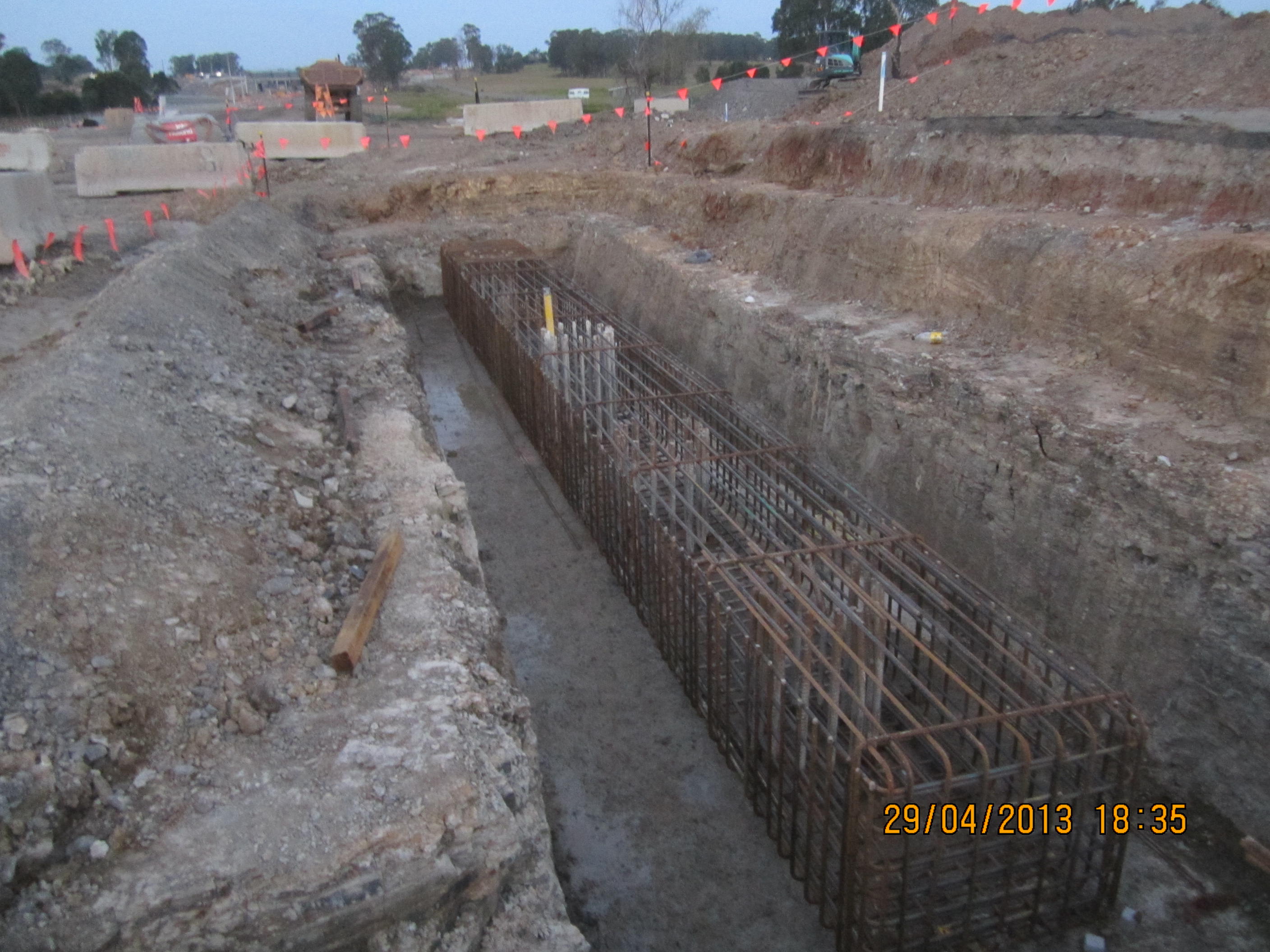
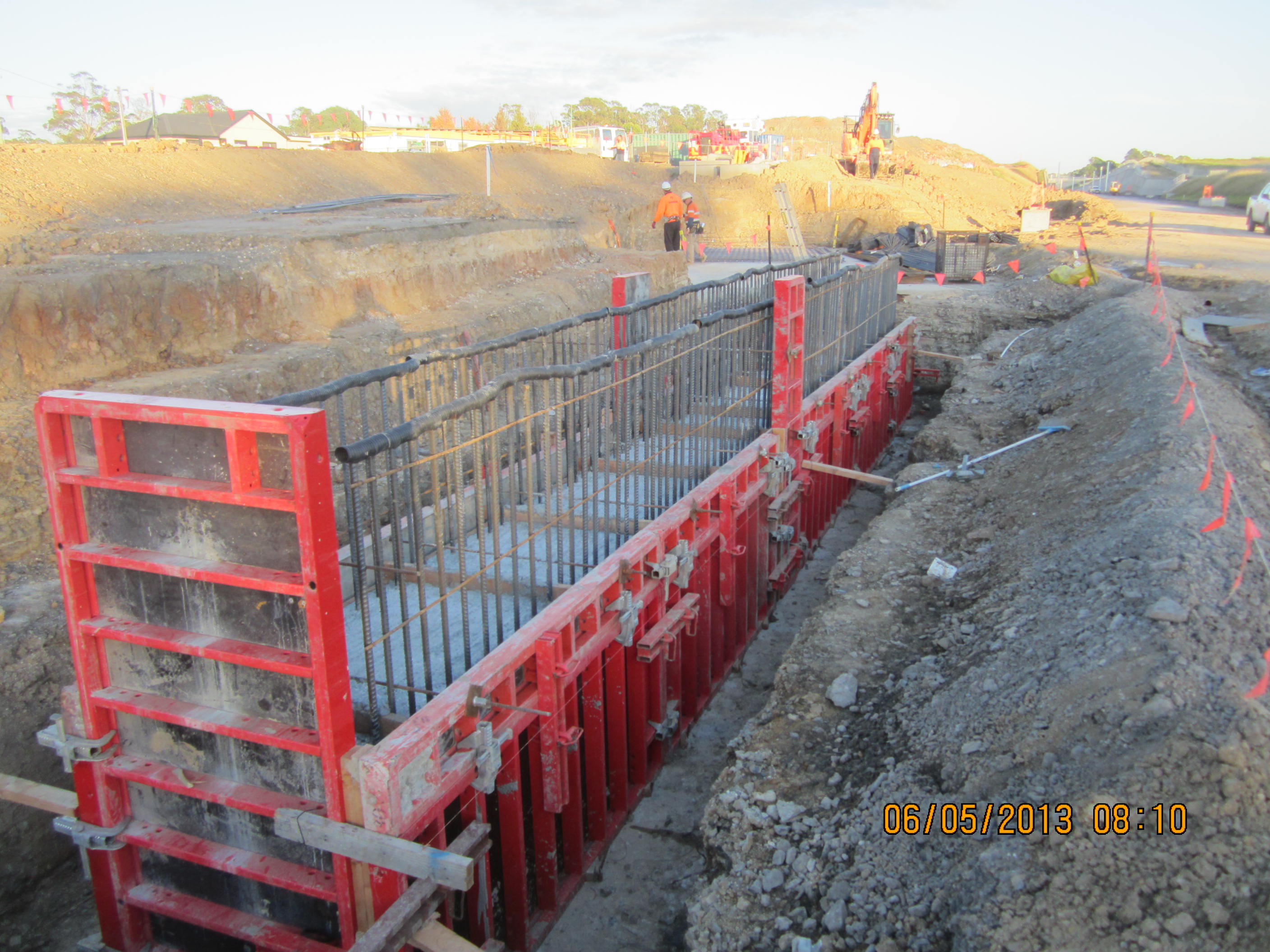
The shutters are about 80% complete on pile cap B and we should be able to pour this on mon afternoon. Before we can backfill we need to reach 32Mpa (75% of the design strength) which from testing has given us 4 days so by wed this week we should be able to start backfilling pile cap A and fri afternoon or most likely mon morning for pile cap B. We have been instructed by TPD to also carry out Pile Continuity Tests for which one pile from each abutment has been selected and after finally getting rid of the water and sludge at the bottom I was able to get them in to carry out the tests. This seems to involve grinding a bit of the surface away and banging a hammer on the top of the pile and recording the sounds. This will check that the pile is of consistent diameter throughout its length with no voids – I await in atticipation for the results!
Kemp Creek bridge is slowly edging towards completion although we will be cutting it fine. We were originally told that by 15 May the bridge needs to be complete as track will be laid, this has now moved to thr right by 7 days giving us some breathing space. I conducted an 86m^3 pour on tue of the CSR walkways which house the services but also tie in the pre-cast parapit sections. I seem to be getting a reputation with the concreters for being able to order the exact amount everytime we pour which I find rather to close for comfort if I’m honest. On this pour I had 13 ‘agi’ trucks and with 3 to go got my calculator out to work out what I needed to add for the message. Having ordered 80+ I activated an extra 6m^3 and all we had left was about 0.5m^3 which was left in the boom pump. I repeated this with Pile Cap A at Dickson Rd but it was a little more stressful but after we blew out the pump and emptied the hopper it was exact – I may just order a little more on the next pours to give me some wiggle room!
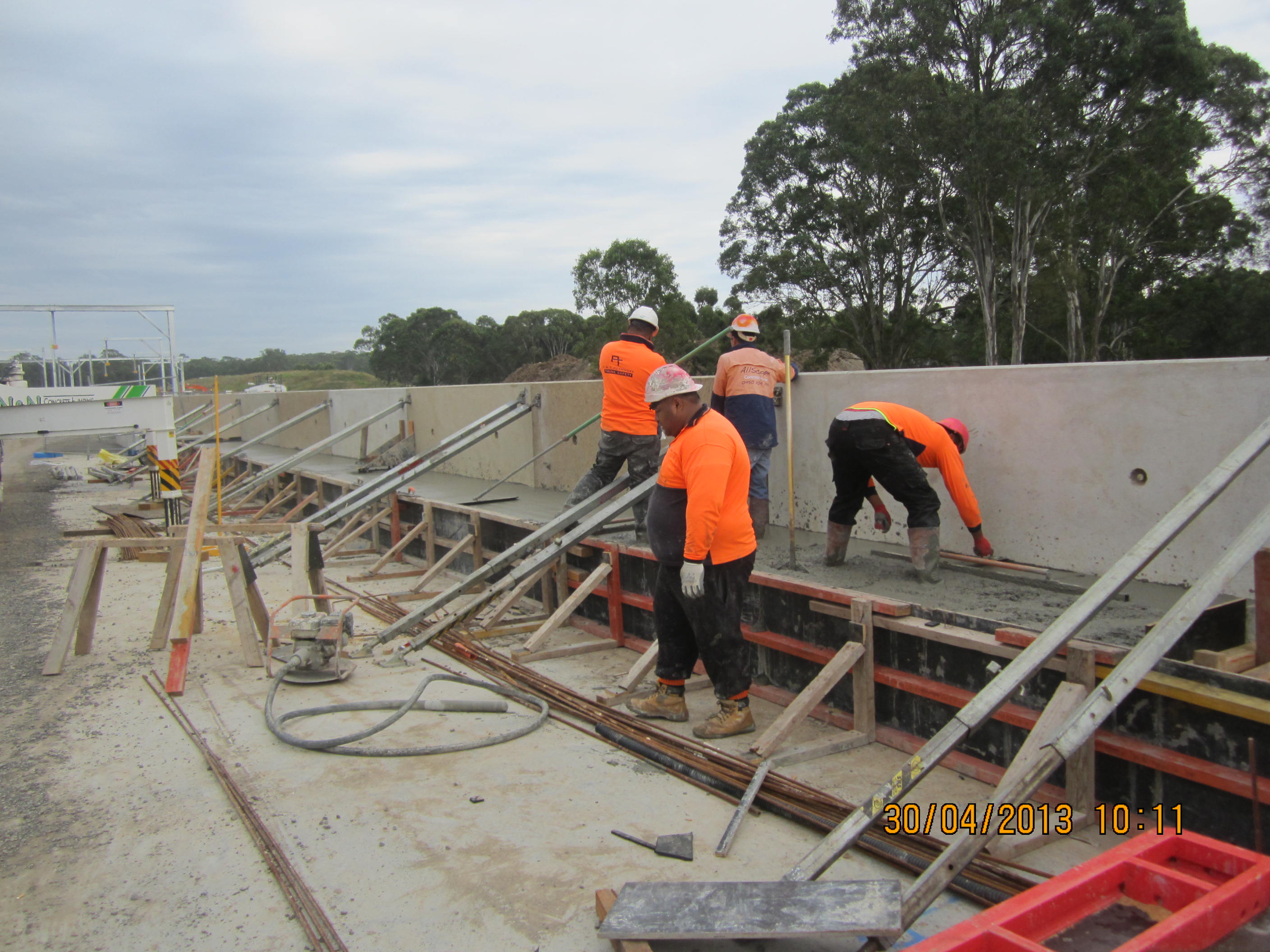
All the walkways are now complete for Kemps Creek apart from a few bays at abutment A. We have poured half of these to the construction joint level. The remainig parapit sections will now be fixed onto these ‘plinths’ and the top half’s poured to tie the parapits in.
The CI’s visit went well and after dropping both off at the Pyrmont office I manged to get back to pour Pile Cap A and see the concrete pump on Kemps Creek bridge die and dump 50 litres of hydraulic fluid on to the deck before it dissapeared rather sharpish
Keep on Chooglin’
It has been a busy two weeks, but I have seen some real progress at BP. I have two jobs regarding the Bruce platform, both of which have potential to go off-shore next year which means I would see them through to close out, possibly.

The Bruce platform lies about 175 miles North East of Aberdeen and is composed of three platforms as shown above. Processing, Utilities and Quarters (PUQ), Drilling (D) and Compression Reception (CR). It is, as most in the North Sea are, an old platform having been built in the 90s for a ~30 year life of field. The general currency of projects on these installations is Persons on Board (PoB) and as a result, long lead planning with the client (the Asset i.e. platform) and early buy in is critical to the progression of any project as can be seen in my two concerns. Bruce has flexibility to surge around 20 personnel on board over and above the basic off shore staff at any one time and as I am finding out, these precious spaces are always filled months in advance as per the Assets priorities.
P60 Bridge Access Platform – Between PUQ and D.
The P60 bridge is a 47m long bridge with a loading of around 183 tonnes in storm conditions. It has had a long history of bearing issues as they have consistently failed to achieve their design life. This can be put down to lack of design data on how the platforms move during annual weather patterns and it is a common failing on platforms built post Piper Alpha where bridges are used to link platforms and effectively isolate the more volatile on-board processes from the living quarters and bridge.
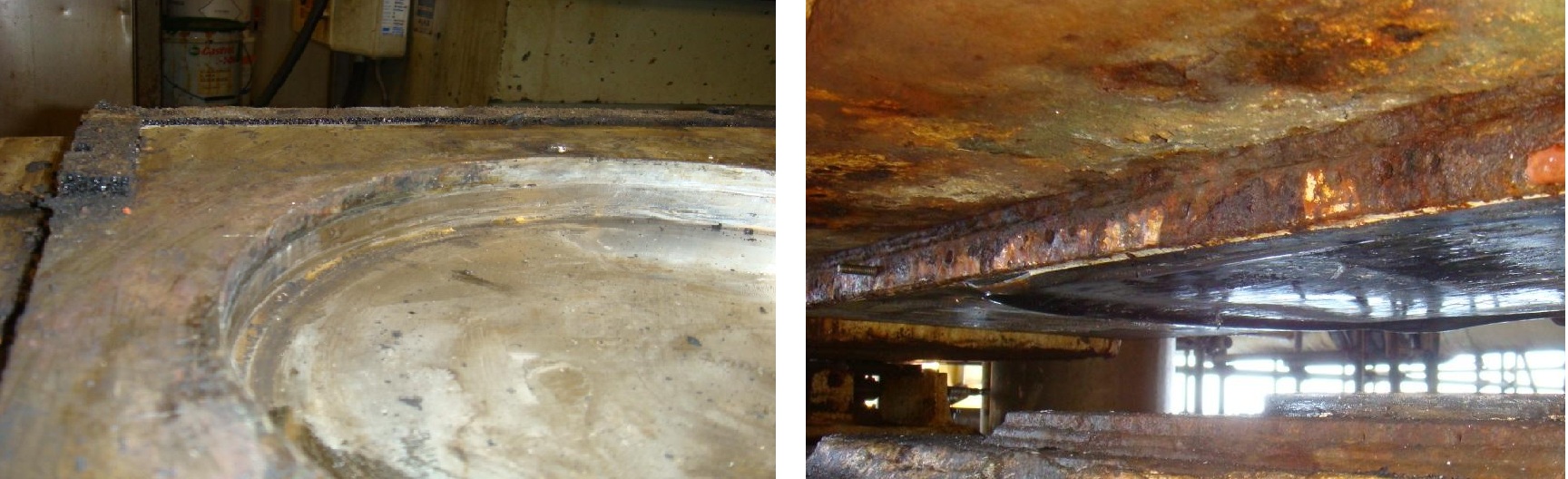
The photo on the left shows slight elongation to the piston plates at the PUQ bridge bearing, while the photo on the right shows damage to the stainless steel runner plate. The manufacturers estimated field life for the bearing pad is 20km aggregated travel and this was not expected to be exceeded with the life of field of the installation. Recent estimates have put the actual aggregate travel of one bearing at 3km in a single month of bad weather! As a result of the manufacturers generous estimates, no method for jacking the bridge up to perform regular maintenance was built into the design and so every quarter an over the side scaffold must be built to allow inspection and maintenance to take place. This is costly, but most importantly ties up bed spaces on board on a regular basis. There is a lot of work going on on this old platform and so simply reducing the PoB burden is quite a significant win for the asset.
I have ~£80k to take this project through the Define stage to gate 3, the beginning of the on-shore Execute. This would see the basis of design complete and much of the risk identified prior to the detailed design. This is the BP practice of Front End Loading to ensure that as little time is spent in the On and Off Shore Execute. From what I can see, this is driven by the desire to achieve effective long lead planning rather that simply moving milestones to avoid missing them (which seems to be relatively common at the moment). A project that is effectively Front Loaded is on the 8Q plan (8 quarter) early, PoB are allocated to the project well in advance and once Execute is reached all of the risks are controlled/mitigated in such a way as to allow the project to progress through to closure efficiently. This is the goal.
The original Kick Off for Define took place in February, but seeing as neither I nor my Job Responsible Engineer (JRE) were actually at that meeting, it seemed sensible to run a Kick Off Review to ensure that all parties in the Define were clear on the time-line, scope and deliverable of this phase. So I will be off to Runcorn on Wednesday for this very reason. My plan has the Define finished in about 3 months, although I am not fully clear myself on the deliverables required and so I will be clarifying this with the Programme Lead, Kerry Scott, before I head south.
Seawater Lift Caissons
I have been asked to review the business case for the ongoing programme to replace the Seawater lift caissons on the Bruce Platform and write a recommendation on its continuing validity by 15 May for presentation to the programme stakeholders. The programme is ~£2 million through a £26 million spend and, while being quite complex in execution, presents no serious issues for BP on-shore. The problem comes back to the Assets priorities and for 2014 this is focussed on the Turn Around (TAR) which will see a major development in the existing delivery infrastructure and an increase in production. No firm decision has been made, but it is likely that the TAR is going to steal the best (forecast) weather window for the first phase of the Caissons programme. This review will look to inform the client of the risk they will be taking on running phase 1 during potential bad weather (think delays and increased PoB thus delays to other work) and the assosciated risk with pushing the programme back a year to de-conflict with the TAR.
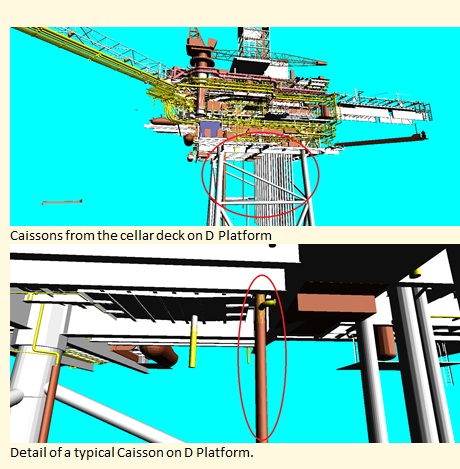
Caissons on oil rigs are not much more than fancy service conduits and are used to protect equipment from the effect of the North Sea. They are commonly used to bring risers off the sea bed onto the installation and in this case they are used to protect large seawater lift pumps that bring fluid on board to cool various elements of the production process. They are called upon to withstand the corrosive effect of seawater and air, attack from marine life such as barnacles and algae and of course the constant buffeting by the waves. These Caissons are critical to the installations’ Safety Case as they also provide back up to the fire water lift caissons. They are around 1-1.5 m in diameter, 75m long and made from carbon steel. They are typically under designed to reduce the dead weight when lifted into place during the original construction. Caisson failures have occurred on a regular basis in recent years and the HSE is particularly interested in this programme. One of the first things I intend to do is examine how many caisson interventions have been required since the initiation of this programme as it may be a good indication of how many PoB have been squandered by not pushing this project forward fast enough. As it is the programme is a year behind where it is supposed to and I have yet to ascertain exactly why. I am keen on the programme not sliding to the right as at present I could be around to see the off-shore execute next year.

The diagram above shows just how close the caissons lie to the jackets (the legs the platform stands on) and many of the supporting struts, the small red circles being the SWL Caissons. Each caisson weighs in the region of 40 tonnes and presents a very real risk to the integrity of the platform, not in the least regarding potential damage to sub-sea piping if they were to come loose and fall to the sea bed.
All in all I am hoping that this is a lead-in to taking on some aspect of the caisson replacement programme as the lead engineer appears to be quite snowed under. The Asset Lead is also under resourced so I think there is a good chance that I will be able to get more work on this and other related platforms in the future.
On Another Note
Hugo has fully recovered from his Bronchiolitis, but unfortunately Corine is now getting over her bout of Sinusitis. Luckily the Scottish summer has finally arrived and so I intend to make the best use of it, who knows how long it will be around for!
This week I have been mostly….procrastinating
This has been a glorious week to be on site here in Southampton, only I haven’t found myself on site much this week. I can’t really put my finger on exactly why that’s the case but it seems to be mainly because I’ve been doing paperwork.
After inheriting the Site Waste Management Plan from the other assistant site manager who left the company a little while ago I was told it was all fine, after who knows how many HOTOs you would have thought if anyone said that it should ring alarm bells in my head, clearly I haven’t learned my lesson. So digging into the SWMP allowed me to discover that all was not well and being that it’s a legal requirement it probably shouldn’t be the work of fiction that it was. That took up Monday.
I had yet more students on site this week as the ones that I spoke to last week had obviously said there was some old bloke who still thinks he’s down with the kids that is willing to give out answers freely.
The most interesting day this week was Thursday. The problem of artesian water continues to be an issue, a meeting was called with the client, the geotechnical consultant and the site team to discuss what has happened in the past and where we might go next. With the best estimate of the borehole location (the log only recorded it to 100mm accuracy) plotted on the ground 4 very well paid men and me stood around looking into a hole next to a pile cap with some dirty water in it. We spent 3 hours discussing what could be done on site and in the meeting room and all the while the geotechnical expert was remarkably quiet on what could be done. Not much of plan came out of the session other than to find out what would be the opinion of the EA in a round about way if we did nothing. The tip that the Great Orator mentioned on one update about the water problems about the UK spec lead me to do a bit of a search on IHS and allowed me to reveal a few choice lines that would indicate to me that the Geo Consultancy haven’t done what they should have done and didn’t inform Osborne of the potential problems. I didn’t wheel this out during the meeting but mentioned it one of the client’s representatives (who is also part of the Osborne Group) afterward who seemed very excited about what I was telling him. This morning (Friday) during a conversation with the same guy I mentioned where I will be doing my consultancy placement and he asked me to initiate contact with them explaining the problems and exploring the possibility of them coming to advise on the situation, they have accepted. In 2 days I’ve managed to make both my current and future employers happy. This is all TMR gold dust so I’m also happy.
A very unproductive week.
This week started in the normal manner of Mad Monday where everything that was meant to be done over the weekend was started on top of the planned works. The focus this week was on the continued preparation of the Zone 5 suspended slab and column, wall and ramp fixing in Zone 2. The slab finally started on Mon, after the calamity of reo deliveries last week, but was held up by cranage moving the bottom mat across from the slip-lane. Zone 2 is more of an issue. Drawings issued on the same day by both the architect and structural engineers differ in their portrayal of the detail around the ramp and were missing detail on slab set-down levels which dictated soffit levels for slabs and beams. After several RFI’s to the Architects I received a satisfactory answer for set-down levels which allowed work to continue but a vague and pretty non-committal response on whether a wall was ramped or horizontal. This matter is still open.
I received an email from the concrete testers stating that the 3 and 7day tests on the 65/20/140 mix used for a column poured last week were significantly understrength. My initial response was to investigate with the tester what the expected final strength would be and whether the mix was as designed and noted on the docket. This was confirmed and it was suggested that it may be a mix that was on the lower percentile of the range. It may reach the approximate strength after 56 days but the question now is whether the risk can be taken to accept this or whether remedial work is required. I forwarded all info to the structural engineer to investigate the situation and recommend a course of action. In my view, as the column forms a corner of a vertical stairwell that is tied into the slabs it may be possible to increase the reinforcement around the connection in order to minimise the loading on the column. This may be the best COA as it will allow construction to continue with minimal rework, and if the column does not reach the required strength it will have an element of redundancy built in to assist in carrying the load.
Tuesday was largely spent in preparation for the work I would not be able to complete during CI’s visit on Wednesday. I think the visit went well and I imagine the change in the site since the CI’s last visit was considerable. From my perspective it was good to talk through the project and highlighted just how much I do actually know about it.
Black Thursday
During the later stages of the CI’s visit we became aware of an altercation between one of the contractors and the JHG H&S representative. This must have escalated after our departure from site as on arrival at site on Thursday there was a significant union presence at the main gate. I had no dramas getting into site though. The lads had more of an issue and the pre-start was lacking numbers. As it happened the rain had effectively stopped play on site (Aussies don’t work in the rain!) which pretty much negated the strike outside. The issue can about 1100 when it was noticed that there was a small fire outside the cab of Tower Crane 2. The operator raised the alarm and evacuated effectively, which resulted in a full evacuation of site. This would not usually be an issue but the fact the union was camped out on the assembly area 1 and after H&S closed the slip-lane (assembly area 2) to access from outside site it meant that the Union propaganda machine whirred into action to get as many photos of their ‘massive’ turn out until we managed to gain access to assembly area 2. The incident was handled well from an operational perspective with the Fire-service on the scene within minutes, but in my view the JHG information flow to the workforce was lacking and the fact a contractor took charge of information passing was a little embarrassing. Work was later put on hold, and eventually stopped for the day (for the lads). A team meeting was called by the PD who briefed that an anonymous text had warned him of a Picket Line for Fri morning.
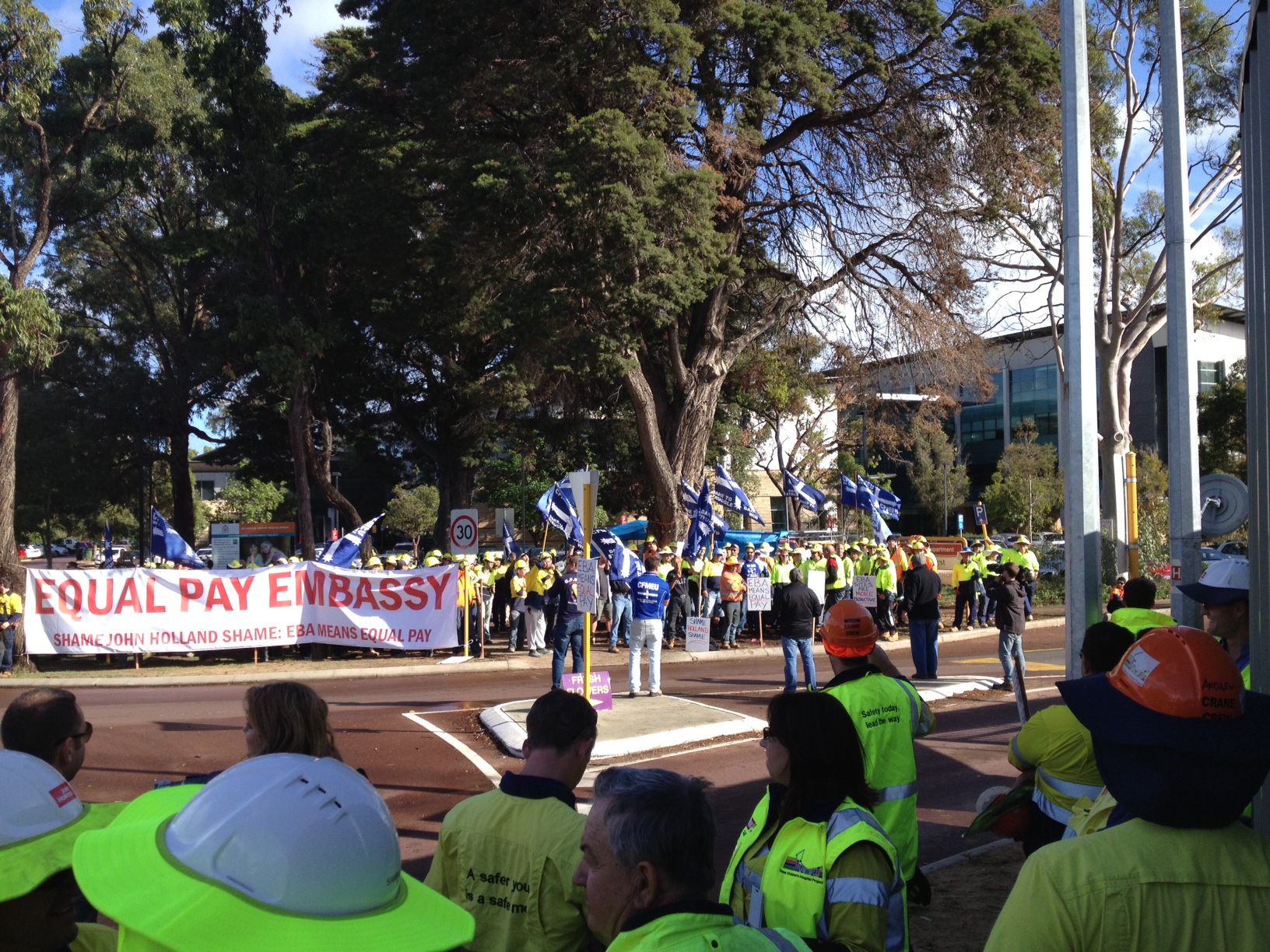
Evacuation to the Union Assembly Area
Quiet Friday
I planned on arriving early to avoid the masses so parked up my bike at Steve’s and walked down to site. It was relatively quiet along the main road, but as I approached the main gate there were about 12 union blokes blocking the path. I weaved my way through to find the gate locked and padlock injected with glue. A couple of choice words and a push in the back and memories of Ex Broadsword flooded back. I walked back along the fence-line and was let in through a manned gap in the chain-link. I have spent the morning walking around with a H&S as the site has been locked down and everybody told not to bother coming in. So I am sat here with my fellow 10 JHG inmates listening to the Union songs and chants whilst the remainder of the staff have a day off. This had better be remembered come report time. I just hope I can get out in time for my flight to Melbourne this afternoon.
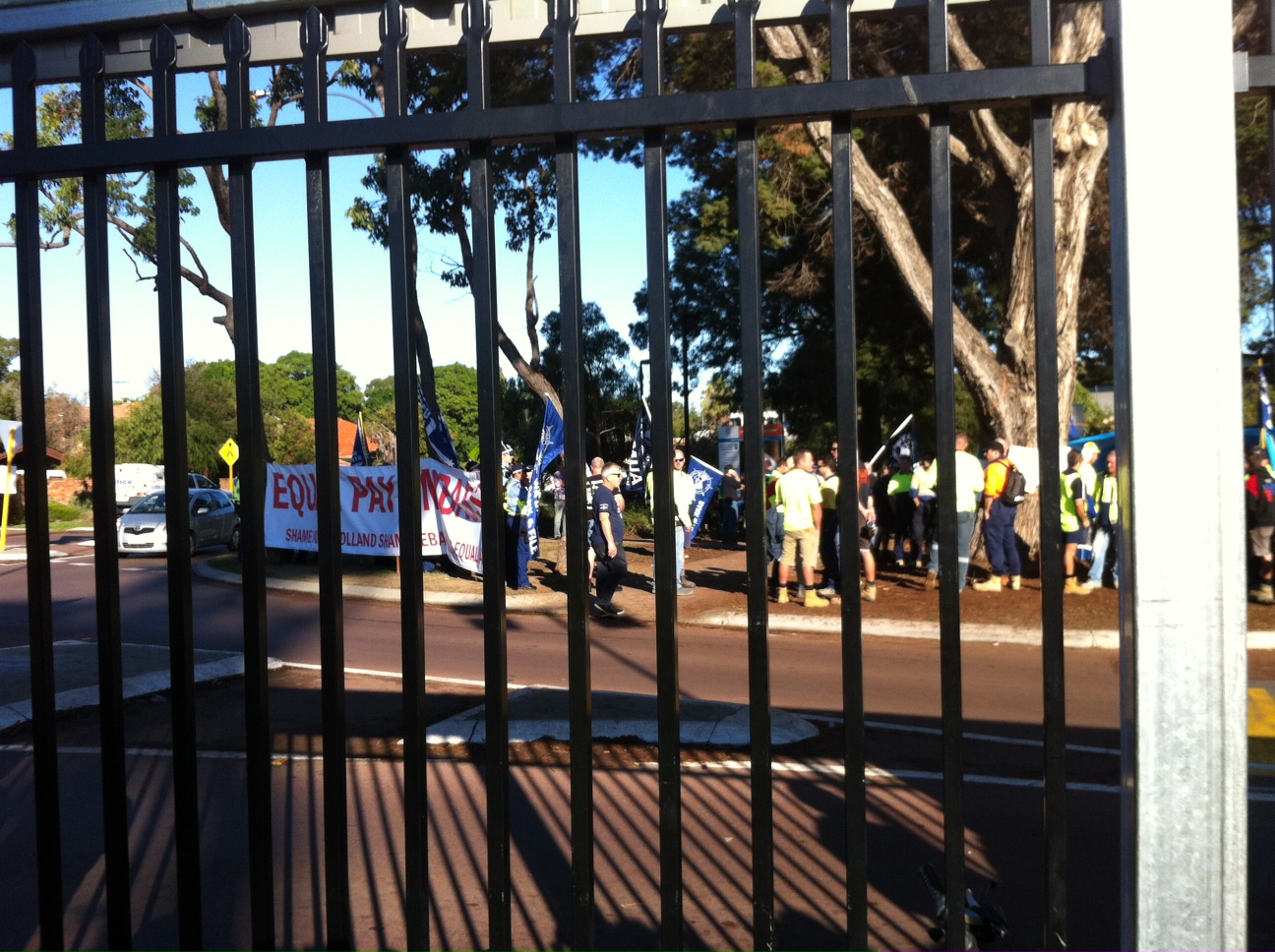
The Union Camp across the road

Memories of Longmoor and Ex BROADSWORD. This was my initial entry point – Foiled by a glued padlock
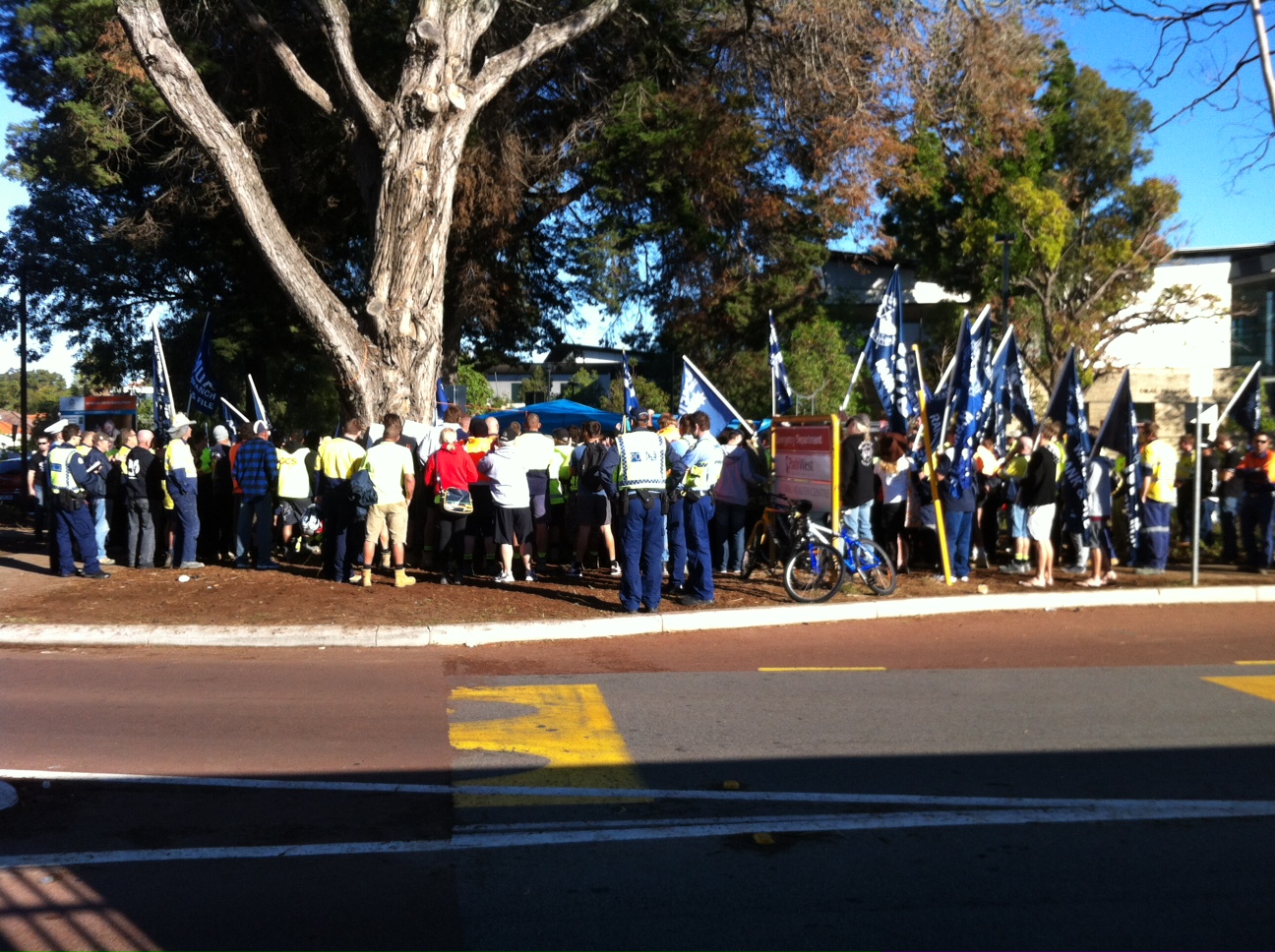
A reassuring police presence has kept the unions at bay so far
So in effect, I have worked 1.5days this week. It is lucky the CI visited when he did – what a difference a day makes.
There is no ‘I’ in team
This week has be punctuated by the ANZAC day public holiday on Thursday which essentially converted the week into a 3 dayer as it seems everybody managed to get their leave passes in for Friday to make it a good 4 day weekend. I am not entirely sure how and why they were all sanctioned by the powers that be but it left me with a site without a Site Manager or Supervisor for both Friday and Saturday meaning that team set deadlines were missed.
As previously expected, the slip-lane has assisted in the turmoil this week, and only exacerbated by crane breakdowns has meant that the delivery of the beam and bottom mat steel for Zone 5 was not delivered on Monday as directed but finally made its way to site on Wed evening, just in time to see the fixers waving goodbye for their long weekend. The steel supplier was unable to deliver on the Monday as the order was still incomplete due to an error on their part. The carnage (deliberate typo for Craneage), booked to move it from the slip-lane to zone in the evening of the Wed, broke down meaning that as the skeleton fixer crew returned to site on the Friday, the steel was only just making its way over. This obviously caused issues for the fixer contractor who blames JHG for all the delays and the cost of his manpower that was under used for the week.
The State (Clients Representative) issued notice on JHG on Wed afternoon in relation to quality issues they had found around site. As there were limited Non-Conformance Reports (NCR) filed in the system, the PM had a pretty hard time explaining why the situation was as it was. All South engineers were then called into a meeting with the PM and given a formal letter detailing how things must get better and questioned on why and how these issues happened. It smelled strongly of a blame issuing exercise but actually highlighted processes that I don’t think had been briefed to everyone, as a wise man once told me, “You don’t know what you don’t know”. The following day off for ANZAC day was welcomed.
ANZAC day started with a 0430 Dawn service in Kings Park overlooking the Swan River for sunrise, followed by a good breakfast in town with Nicky, Remi (Australian RE) and a few other Engrs prior to watching possibly one of the longest parades in history – the bands were running back to the start of the route as there were not enough to go around (not that it made much difference as nobody was in time). I think Remi and I were the only people to Perth who were wearing suits but not marching. I was impressed at the 50,000 people that turned up for the dawn service and the support in town throughout the day. I would like to think that a similar day in the UK would be so well supported. Nicky and I then went for an afternoon sail on the Tall Ship Leeuwin 2 – billed as a chance to pull up sails and crew the boat, but actually more a money spinner for the trust where you were crammed onto a deck and watch a rather inept volunteer crew do it for you. Nice to get out on the water though, and spurred us on to start planning a trip to the Whitsundays for a sail later in the attachment.
The H&S issues on site are well known, and management are leading the charge to transform the statistics from the top down. JHG head office has now sent 2 H&S Ninjas to site with the top cover of the Operations Manager for infrastructure. The stimulus for this I believe was on a knife-edge decision whether or not to close the site down for a period to rectify the H&S situation. The Ops manager gave a presentation on the JHG mission and visions to all those JHG employees who were actually on site during the moral boosting period of 1600-1730 on Friday afternoon. The emphasis was on teamwork, integrity and accountability, but I have to say that I left feeling a little patronised and, after Wednesday’s session, a little unsupported. My reaction to this was to have a think about ways to turn the South team around. My initial ideas are:
- Social activities to break down barriers,
- A daily RAG’d milestone status update (within the South, Centre and Basement blocks) back-briefed to the PM mid-weekly as a method to focusing effort,
- A change in team focus on solution finding not fault finding.
Any further ideas would be welcomed. My feeling is that people currently don’t want to raise issues for fear or persecution.
Much like Rich has found, this week has really brought home to me the pettiness in the construction industry that takes effort away from producing a quality product. The 2 cases in particular this week have been:
- The ongoing saga of kit on the ground. The formworkers were asked to remove their kit from an area that needs to be road-based prior to falsework construction. They claim that all the kit isn’t theirs (true, but the vast majority is) and this has resulted in photos being sent between JHG and WCF, which has developed to annotated photos and lists, which has increased to annotated, annotated photos, and coloured lists. In my view, in the time taken to log all the kit down there it would have been quicker and cheaper to programme a late shift for the crane and just move it but this would require an additional cost to someone.
- The crane allocation. Daily crane allocation meetings have intensified to the extent that PM’s and Construction Directors now attend. At 2 hours for some of these meeting it is such a waste of senior and site management time it is incredible. What is more amusing is the bloke who is employed by one of the contractors (or maybe all of them) to sit on his arse and log what the cranes are lifting to ensure compliance with the timetable and give them ammunition to respond to JHG.
I have said it before, but this job would be so much simpler if there was only 1 or 2 contractors! Engineers and managers could then focus on their primary role and help bring the project back on track.
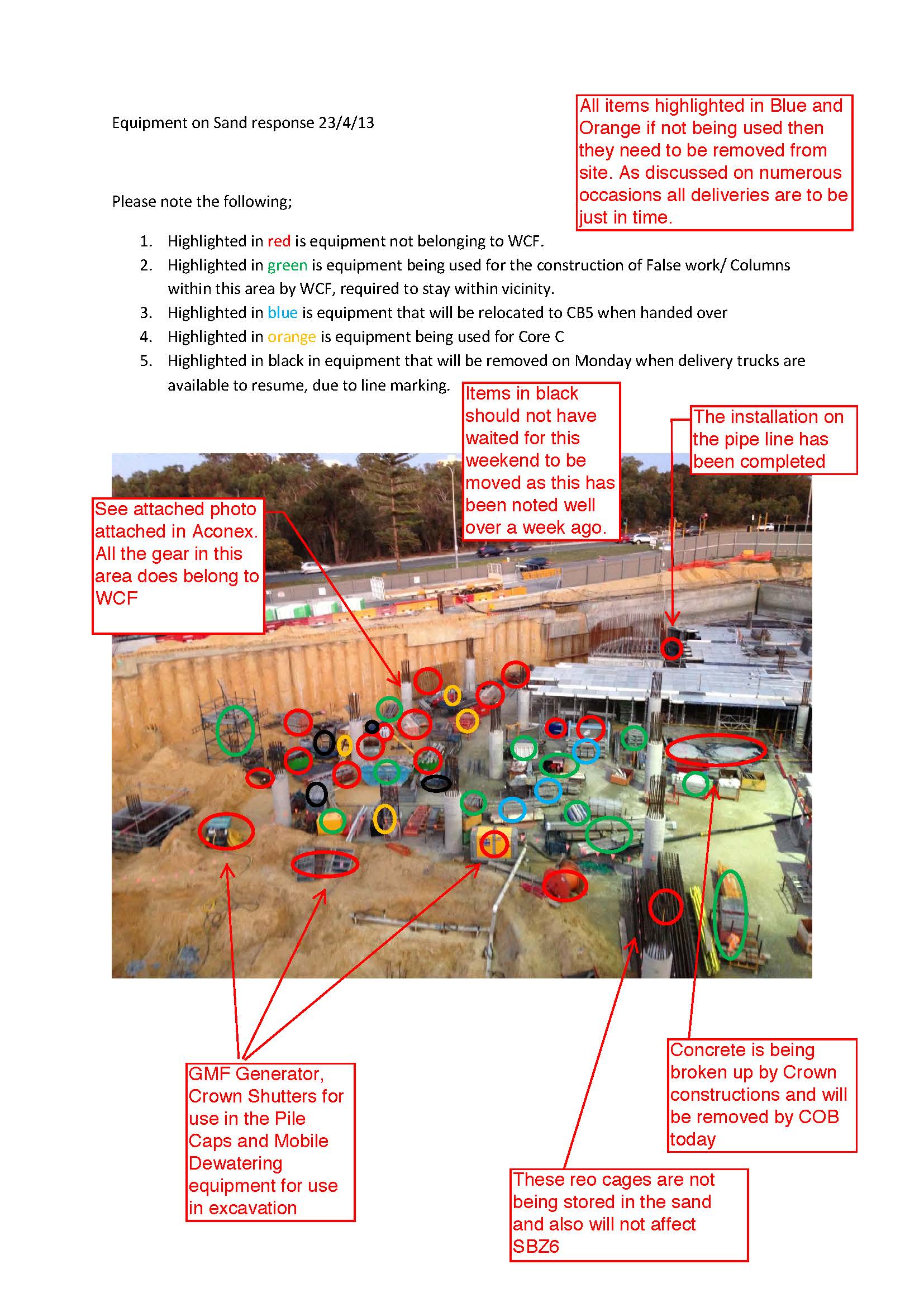
Excessive time wasted on documentation
Whilst the cat is away, the mice fight and knock off early
The senior project manager has been away this week so the atmosphere has been much more relaxed, fewer signs have been printed and more decisions made.
A significant portion of the car park slab in my block was poured last Friday. We take it in turns to stay late and lock up the site and the more experienced members of the team saw me off, the slab was brush finished which apparently requires the concrete to be just right and means that the new boy gets to stay on site until 1930!
Politics have been interesting this week, relations with the sub-contractor are somewhat strained and the delays in the build are growing and it has all become a bit odd. I’m trying to avoid getting involved if I’m perfectly honest, I’m quite interested in seeing how civilians resolve conflict. The activity that has brought this to a head has been the standard of the gas membrane that is being placed under each of the blocks. An extensive ground investigation and gas monitoring survey found that they is no gas on site, the building inspectors decided that the inclusion of a gas membrane is the minimum they expect and rather than spend the time and money in trying to convince them that there is no need Osborne decided that it was easier to just get on with it rather than fight public sector bureaucracy (I’m sure we all agree it was probably the right decision). Now this means that we have to fit the membrane correctly as it is inspected before each slab pour, unfortunately the sub-contractor is trying to pay it the least amount of attention possible. The slab pour that went ahead last week had membrane workmanship that was pretty poor, the inspector came to look at it and only just passed it; because of this we have been rigid on standards this time around and this has caused arguments between the one of the site managers (who does need lessons in diplomacy from time to time) and the sub-contractor’s foreman.
This week I’ve been acting as student liaison, on Tue I had a graphic design student to take around site to take photos (including yours truly) for a project on construction, the process of getting all of these photos approved by the companies who have an interest has been slightly painful as the on site computers can’t deal with the size of the photos and I’ve had to bring them all home to resize and send on. On Wed I had about 12 students from the University to come and ask questions for their Construction Management assignment, their question set was identical to the one that I completed 11 years ago for the same lecturer and slightly more recently for you Mike. A lot of the questions looked similar to AER 1 and so I provided them with a copy of that (but didn’t tell them that I’d also sent it to the lecturer to stop them copying) and a few other bits and pieces. All of this is so we can grab a few more points for considerate constructors.
by
“Living in America” (cue James Brown…)
Finally after 5 and a half weeks we are nearly settled in the US and actually have working internet!! From turning up at Dulles Airport (of Die Hard 2 fame) on a sunny Friday afternoon in mid March with only a couple of suitcases and 2 hyperactive children, we now have a fancy town house (terraced house in English) with a SUV and convertible parked outside (to blend in), we own smartphones and a smart widescreen LED TV, broadband internet at 20Mbps and today our stuff arrives from the UK. I will not go into the heartache and pain (not to mention the $23,000 we have spent) to get here (most of it actually reimbursable) but needless to say it all takes quite a bit of time. Yes the Colvins have finally joined the 21st Century! We have received a tremendous amount of help from Matt, Ulli and Ben who having been through this already and helped make the process as painless as possible. Barbecue at ours, once I have bought one!
Work started well meeting up with Matt and Ben as well as all the other Army Officers in the district for the OPD week as Matt has described. The Dinner Night should get particular mention (great effort from Matt and Ben) because it is the first one I have had in a floating restaurant on a reservoir at sunset and also it was our introduction to the USACE Dinner Night traditions, in particular the brewing of the of grog. In a nutshell, the junior officer makes a dirty punch for everyone to share but with some poetic significance attached to each of the ingredients to produce a potent but enjoyable brew that is then used to liven up the festivities. A USACE dinner night should be tried at least once in a life time.
Initially I spent 2 weeks in the USACE Baltimore District Office. This was to get my USACE email access applied for (still not got it after 3 weeks!) as well as meeting the various departments who I will be responsible to or might need to contact when out in the field, from the design teams and contract managers to the environmental and legal teams. I was able to go on a field recon of a potential project (a boiler house refit in a barracks block) before going to my field office in Harrisburg, Pennsylvania. The project I will be working on as the only resident E&M engineer is a $53 million roof replacement of a main distribution depot on site. This place is enormous, with a site footprint of 43 acres (1.9 million square feet) which uses an internal Scalextric track of trolleys to move orders around the site. It runs 24 hours a day and cannot be interrupted in its operations during the refit because it supplies operations overseas (photos to follow once I get clearance…). The roof has been redesigned and all mechanical and electrical services are being upgraded to improve efficiency. Currently Matt’s Solar Wall is not linked in with any other environmental condition monitors and each work station (an open area every 2om in every direction) on the shop floor has its own heating/cooling controls for that area making for a very inefficient heating and cooling system. The new system upgrades all heating and cooling machinery and attempts to centrally control the environmental conditions. At present the work has not started as there are RFIs and pre construction issues being ironed out. This a Design Bid Build Contract where an Architectural Engineering company has produced the design for USACE (who only design 15% of their projects) and a contractor has been selected for the construction. Thus there are complications arising from drawing interpretations at all levels!
And in Other News
Aside from terrorist bombings, fertilizer factory explosions, shootings, gun control debate (why should people need checking before buying a gun and ammunition at a gun convention?), live terrorist hunting and a hurricane warning, it has been relatively quiet. However a leading Yoga clothing outfitters company has suffered huge losses on the stock market after it was ‘revealed’ that its leading style of yoga trousers had a faulty batch where the material was see through once worn. Apparently during the “salute to the sun” warm up exercise people at the back of the classes were being treated to a view of the moon and more – (underwear ruins the line………). Customers are being offered a full refund.
Roadkill Count (back by popular demand)
6x Racoons
3x Deer
2x squirrels
8x anonymous piles of dried out fur
1x Owl
1x St Bernard
Country Song Titles
“Come and take a ride on my big green tractor (if you scream we can go faster)”
“I wish I had been a cowboy”
“God is great, beer is good, people are crazy”
“I am old school (and won’t cheat on my wife)”
See y’all!
 Holdfast Training Services Trial Blog